In the rapidly evolving renewable energy landscape of 2026, Rajasthan has emerged as the solar hub of India. With the vast Thar Desert and record-breaking solar irradiance levels, homeowners and industrial leaders are no longer satisfied with basic technology. Today, everyone is asking about the bifacial solar panel price in Rajasthan because they want a system that doesn’t just work—but dominates the harsh desert environment.
Rajasthan’s unique geography—characterized by high ambient temperatures, intense ultraviolet radiation, and highly reflective sandy terrain—provides the perfect laboratory for bifacial technology. While traditional monofacial panels have served us well for a decade, the shift toward double-sided generation is now a financial and technical necessity for anyone looking to maximize their Return on Investment (ROI).
What Exactly is Bifacial Technology and Why Does it Matter Here?
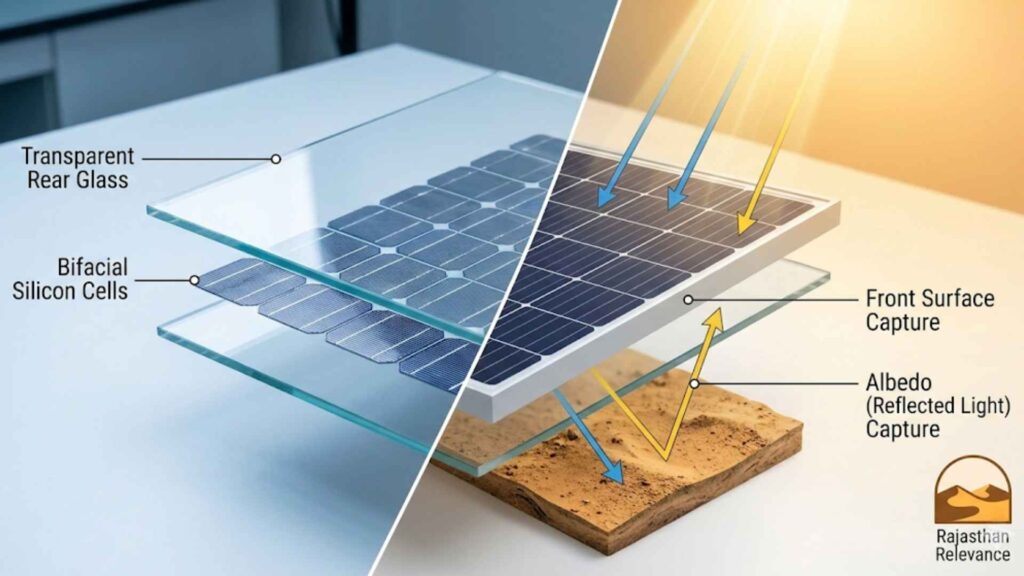
To understand why the bifacial solar panel price in Rajasthan is worth every rupee, we must first look at the engineering. Unlike a standard panel that has an opaque backsheet, a bifacial module is constructed with solar cells on both the front and the rear.
The Magic of the Albedo Effect in the Thar Desert
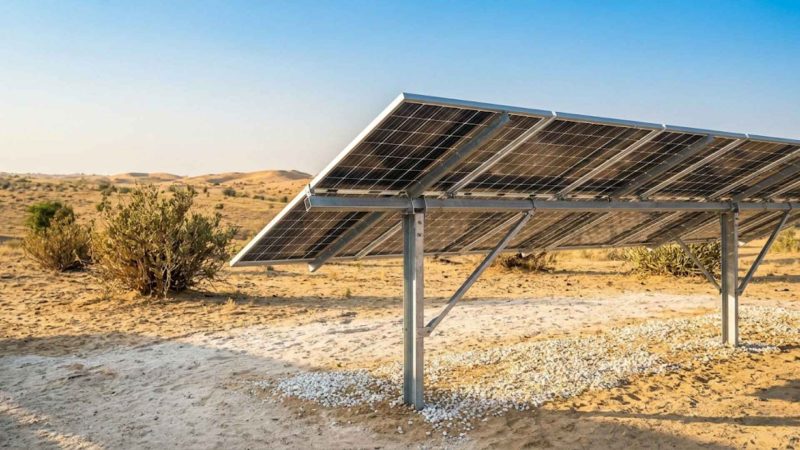
The term “Albedo” refers to the reflectivity of a surface. Rajasthan is blessed with light-colored soil and vast stretches of sand. When sunlight hits this sandy ground, it doesn’t just disappear; it bounces back up.
- Standard Panels: Waste this reflected light.
- Bifacial Panels: Capture this “albedo light” through the rear glass, adding an extra 15% to 30% to your total energy harvest.
In cities like Jodhpur, Bikaner, and Jaisalmer, the ground reflection is exceptionally high. This means that even if your roof space is limited, you can generate more electricity simply by choosing the right panel technology.
A Deep Dive into Bifacial Solar Panel Price in Rajasthan (2026 Market Analysis)
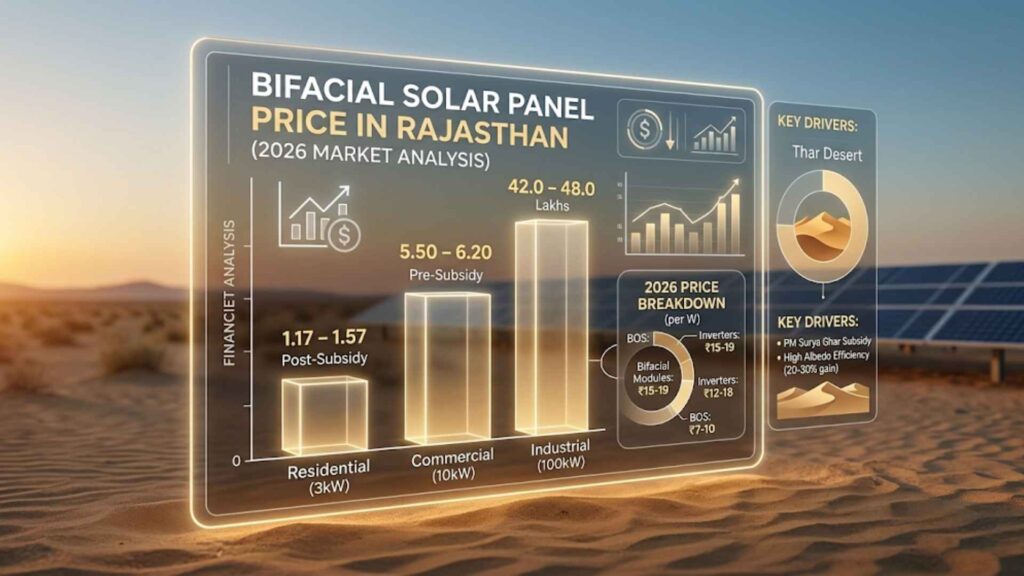
The most common question we encounter is: “Is it too expensive?” As of March 2026, the bifacial solar panel price in Rajasthan has stabilized due to massive local production by brands like Adani, Waaree, and Tata Power.
Price Per Watt Breakdown
Currently, the market rate for high-efficiency bifacial modules (550Wp to 700Wp range) sits between ₹15 and ₹19 per watt for the hardware alone. When you factor in the full system—including high-rise structures, inverters, and BOS (Balance of System)—the costs are as follows:
| System Capacity | Average Cost (Lakhs) | Post-Subsidy Cost (Approx) | Expected Annual Units |
| 3 kW Residential | ₹1.95 – ₹2.35 | ₹1.17 – ₹1.57 | 4,800 – 5,400 |
| 5 kW Residential | ₹3.10 – ₹3.60 | ₹2.32 – ₹2.82 | 8,000 – 9,000 |
| 10 kW Commercial | ₹5.50 – ₹6.20 | Varies (Tax Benefits) | 16,500 – 18,500 |
| 100 kW Industrial | ₹42.0 – ₹48.0 | High ROI via Depreciations | 1,70,000+ |
Why the Price Varies Across Rajasthan
The market rate for these advanced panels across Rajasthan is not uniform. In Jaipur, logistics costs are lower. However, in remote areas of Barmer or Jalore, transportation and specialized mounting structures (to handle wind loads) might add a small premium to the total project cost.
Why the Desert Climate Justifies the Bifacial Solar Panel Price in Rajasthan
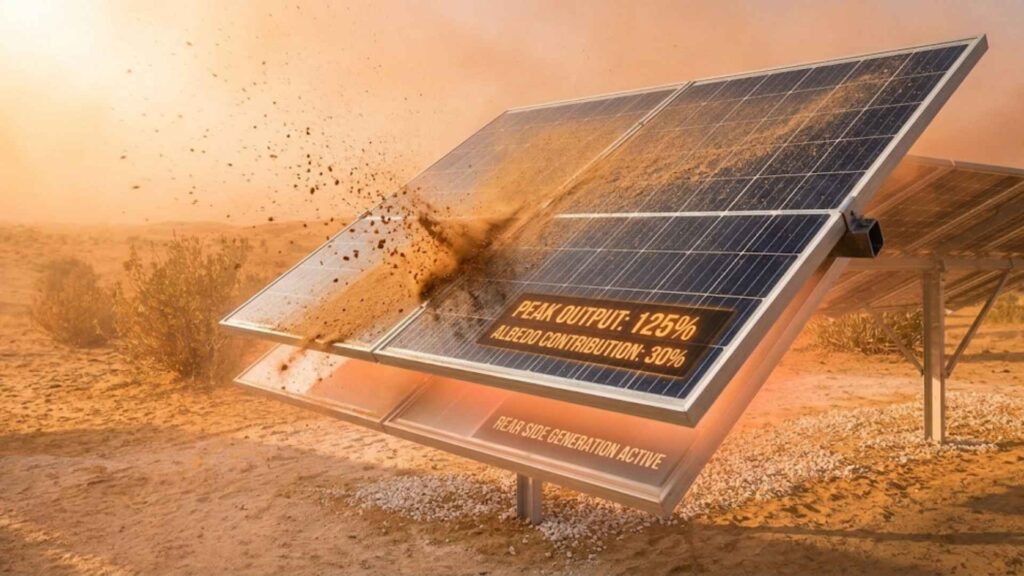
Investing in solar in a desert is different from investing in a coastal or hilly region. You face three main enemies: Heat, Dust, and Wind.
Superior Thermal Stability to Justify the Bifacial Solar Panel Price in Rajasthan
In Rajasthan, summer temperatures frequently cross 48°C. Standard panels suffer from “Thermal Degradation,” where their efficiency drops as they get hotter.
However, most bifacial panels today use N-Type TOPCon or HJT cells. These cells have a much lower temperature coefficient. While a cheap panel might lose 15% of its power on a hot Jodhpur afternoon, a high-quality bifacial panel will only lose about 8-10%, ensuring your ACs keep running without drawing from the grid.
Durability Against Sandstorms: A Key Factor in Bifacial Solar Panel Price in Rajasthan
The “Glass-to-Glass” design inherent in bifacial modules provides a level of physical protection that “Glass-to-Backsheet” panels lack. Sandstorms in Western Rajasthan can act like sandpaper, wearing down the plastic backsheets of older panels over 10-15 years. With bifacial panels, the rear is protected by toughened glass, making the bifacial solar panel price in Rajasthan a “lifetime” investment of 30 years or more.
Maximizing the Output After Paying the Bifacial Solar Panel Price in Rajasthan
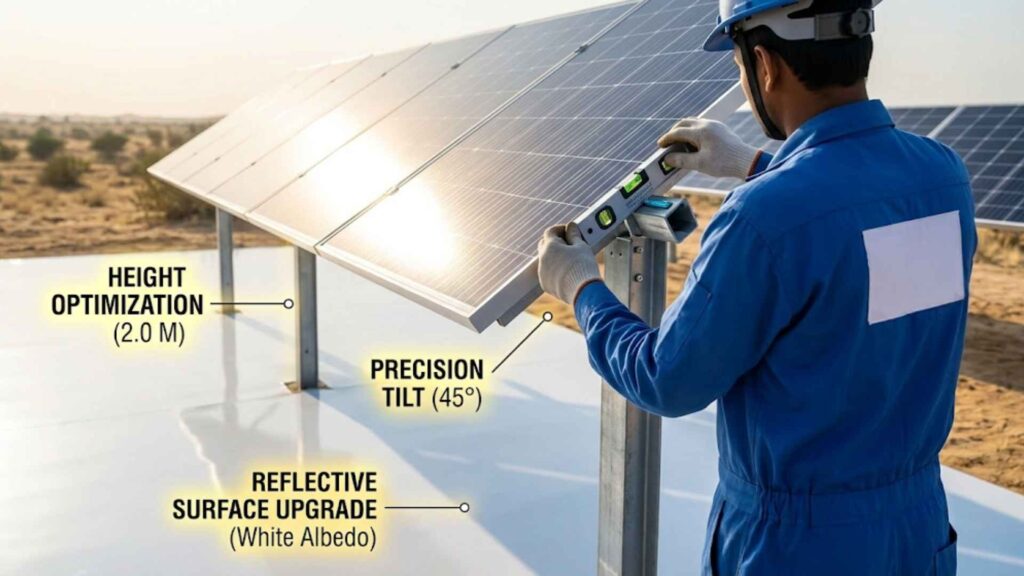
If you have paid the bifacial solar panel price in Rajasthan, you must ensure the installation is done correctly to reap the benefits. A poor installation will make a bifacial panel perform exactly like a cheaper monofacial one.
The Importance of Mounting Height
To allow light to reflect onto the back of the panel, the modules must be installed at a certain height from the ground or roof.
- Minimum Height: 1 meter.
- Recommended Height: 1.5 to 2 meters.
The higher the panel, the more “diffuse” light can reach the back side.
Surface Reflectivity: A Hack to Lower the Effective Bifacial Solar Panel Price in Rajasthan
To truly justify the bifacial solar panel price in Rajasthan, we recommend preparing the surface beneath the panels:
- White Roof Paint: Increases reflection by up to 80%.
- Light-colored Tiles: Durable and highly reflective.
- White Gravel/Stone: Excellent for ground-mounted systems in farmhouses or factories.
Subsidies and Government Support in Rajasthan (2026 Update)
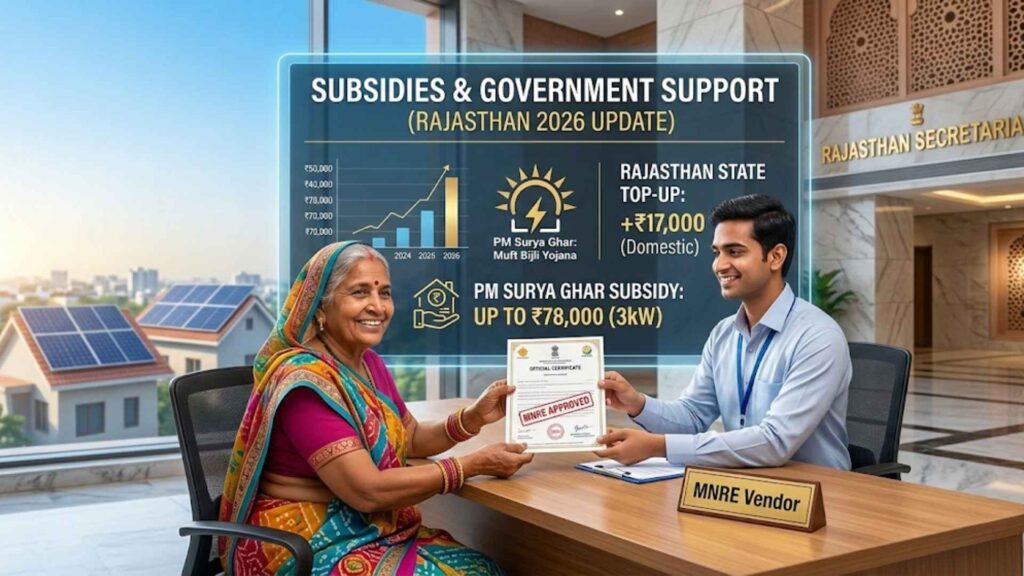
The Rajasthan government, under its Solar Energy Policy, has made it incredibly easy to transition to green energy. The bifacial solar panel price in Rajasthan is heavily offset by the PM Surya Ghar: Muft Bijli Yojana.
How Much Subsidy Can You Get?
- Up to 2 kW: ₹30,000 per kW.
- For 3 kW: A fixed total of ₹78,000.
- State Top-up: Depending on the current budget, the Rajasthan state government occasionally provides an additional ₹15,000 to ₹20,000 for domestic consumers.
By leveraging these subsidies, the effective bifacial solar panel price in Rajasthan for a 3kW home system can drop to as low as ₹1.2 Lakhs, which pays for itself in just 3 to 4 years.
Technical Comparison: Why Bifacial Wins in 2026
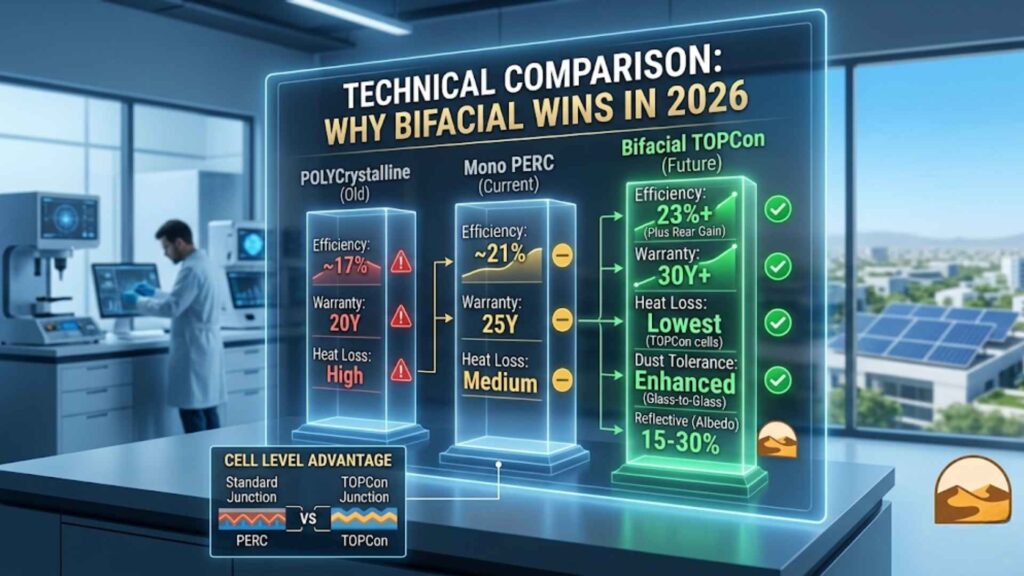
To understand the value proposition, let’s compare the three main technologies available in the Rajasthan market today.
| Feature | Polycrystalline (Old) | Mono PERC (Current) | Bifacial TOPCon (Future) |
| Efficiency | 15-17% | 19-21% | 22-24% (Plus Rear Gain) |
| Performance in Dust | Poor | Average | High (Dual Side Generation) |
| Warranty | 20-25 Years | 25 Years | 30 Years |
| Suitability for Rajasthan | Not Recommended | Good for Budget | Best for Performance |
Maintenance and Cleaning: The Rajasthan Challenge
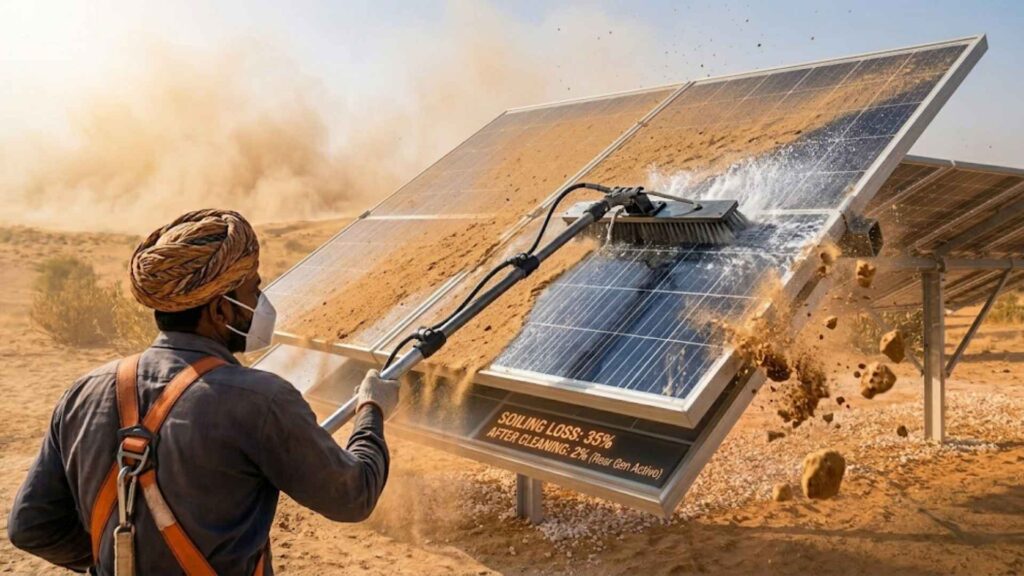
Dust is the biggest enemy of solar in our state. Even if you pay a premium bifacial solar panel price in Rajasthan, a layer of dust can cut production by 40%.
Automated Cleaning Systems
For large-scale installations (above 10kW) in dusty areas like Nagaur or Churu, we recommend Robotic Cleaning or Sprinkler Systems. Since bifacial panels produce more energy, the “loss” due to dust is financially higher, making an automated cleaning system a very smart add-on.
Conclusion: The Verdict for Rajasthan Consumers
In conclusion, if you are looking to install solar in 2026, choosing monofacial technology is like buying a 10-year-old car. While the bifacial solar panel price in Rajasthan is slightly higher upfront, the technical advantages—higher heat tolerance, better durability, and the ability to capture reflected light from the desert sand—make it the undisputed winner.
By choosing bifacial, you are future-proofing your home. You are ensuring that even during the hottest May afternoons or the dustiest March winds, your home remains powered by the sun. With the current subsidy schemes slashing nearly half the cost, there has never been a better time to invest in double-sided solar power.
Frequently Asked Questions (FAQ)
Q1: Is the bifacial solar panel price in Rajasthan much higher than normal panels?
No. In 2026, the price difference has narrowed to about 10-12%. Since you get 20% more electricity, you usually recover the “extra cost” within the first two years.
Q2: Do I need a special inverter for bifacial panels?
You don’t need a “special” type, but you do need a higher capacity inverter. Because a 540W bifacial panel can actually produce 600W+ during peak reflection hours, your inverter must be able to handle that extra “over-generation.”
Q3: Can I install bifacial panels on my existing old structure?
Only if the structure is high enough. If your current structure is low, you won’t get any extra benefit from your investment in high-efficiency solar tech.
Q4: Which is the best brand for bifacial panels in Jaipur?
Adani Solar and Waaree are the market leaders in Rajasthan due to their local manufacturing units and strong dealer networks. Tata Power is also an excellent choice for those looking for premium after-sales service.