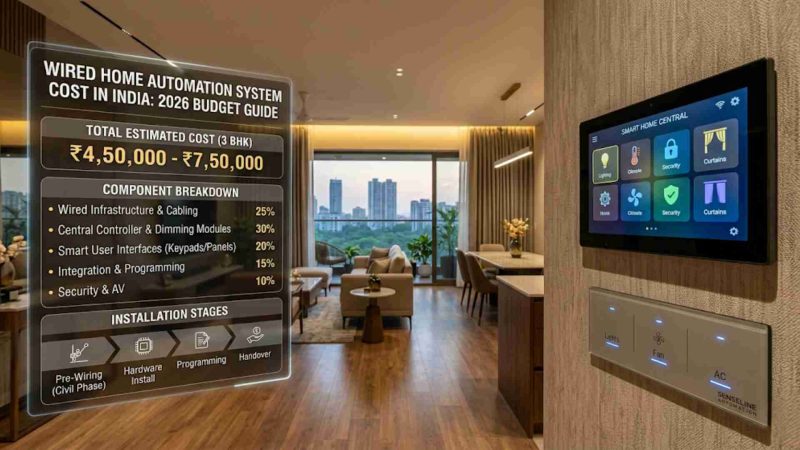
If you are planning a premium smart home project, calculating the overall wired home automation system cost in india is likely your top priority before civil work begins. Unlike basic wireless plug-and-play modules, a centralized wired framework offers unmatched stability, but it requires strategic budgeting during the early construction phase. Knowing the exact market rates helps you plan your electrical layout efficiently without running into unexpected overheads down the line.
Why Choose a Wired Home Automation System?
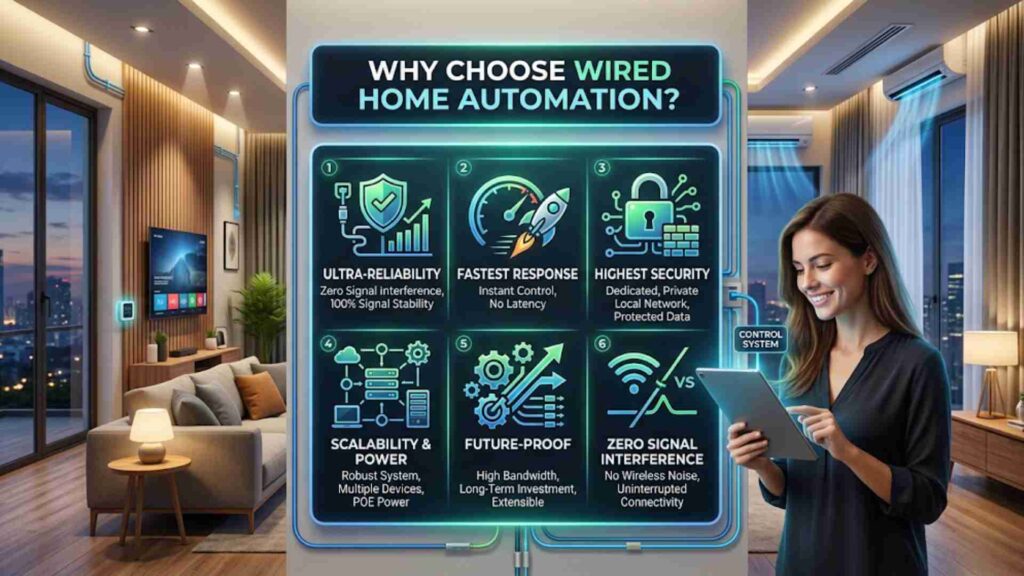
Unlike wireless systems that rely on Wi-Fi or Zigbee protocols, a wired automation system utilizes dedicated low-voltage bus cables (such as KNX or Cat6) pulled through your walls straight to a central distribution panel.
The Construction Window: Wired automation systems require extensive internal conduits. This means they are best planned during the civil construction or deep renovation stage, right before wall plastering begins. Retrofitting a wired system into a finished house requires extensive civil work and repainting.
While wireless setups are quick to install, premium wired automation offers:
- Absolute Reliability: Commands travel instantly through physical wires, completely immune to Wi-Fi drops, thick concrete walls, or router reboots.
- Commercial-Grade Lifespan: High-end wired systems like KNX are built to last 20 to 30 years without hardware degradation.
- High Property Resale Value: A centralized wired system transforms your real estate asset into an ultra-luxury smart property.
Complete Breakdown: Wired Home Automation System Cost in India
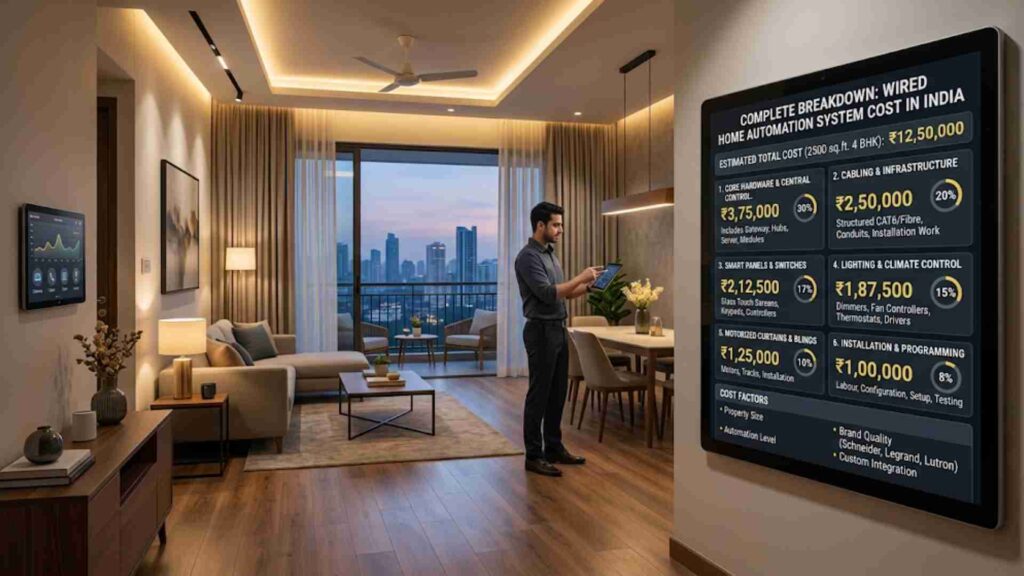
The cost of automating a home in India depends heavily on the total square footage, the number of electrical control points (lights, fans, curtains, ACs), and the premium tier of hardware you select.
Wired automation requires a significantly higher upfront investment than wireless alternatives because it involves central controller hardware, heavy-duty relay modules, dedicated bus cables, and specialized programming.
The table below provides a realistic cost estimation across different residential configurations in the Indian market for 2026.
Table 1: Estimated Budget Guide by Property Configuration
| Property Type | Average Built-up Area | Estimated Price Range (INR) | Primary System Inclusions |
| 2 BHK Apartment | 1,000 – 1,400 sq. ft. | ₹1,50,000 – ₹3,00,000 | Central automation gateway, wired lighting controllers for key areas (Living, Master Bed), premium smart touch panels, and basic smartphone integration. |
| 3 BHK Apartment | 1,500 – 2,200 sq. ft. | ₹2,50,000 – ₹5,50,000 | Full centralized lighting control, smart dimming, climate control (AC integration), motorized curtain motors, and video door phone (VDP) synchronization. |
| 4 BHK / Luxury Flat | 2,500 – 3,500 sq. ft. | ₹5,00,000 – ₹8,50,000 | Comprehensive lighting scenes, multi-room HVAC optimization, motorized curtains, premium metallic/glass touch keypads, and smart door locks. |
| Luxury Villa / Bungalow | 4,000+ sq. ft. | ₹8,00,000 – ₹20,000,000+ | Enterprise-grade decentralized BUS system (KNX), multi-zone audio streaming, complete HVAC integration, automated security gates, sensor-driven outdoor lighting, and server rack installations. |
Component-Wise and Brand Factors Affecting the Wired Home Automation System Cost in India
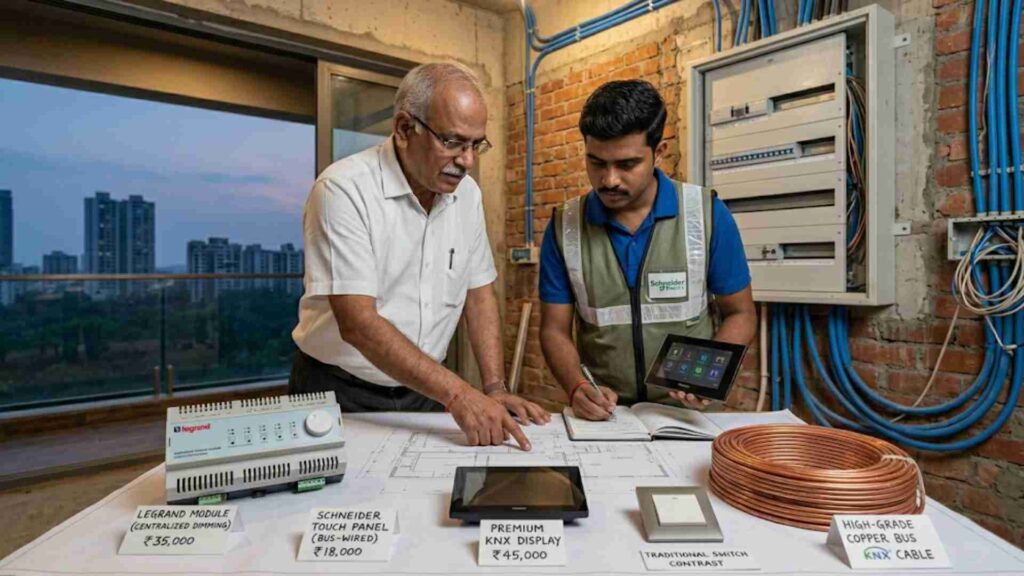
To help you audit your quotation from a system integrator, it is vital to know where your money goes. Hardware cost is generally split between central distribution modules (the “brains” hidden inside your DB cabinet) and the physical user interfaces (the luxury switches on your walls).
Brand Ecosystem Tiers
- Premium European/Global Standards (Schneider, Legrand, ABB, Crestron, Lutron): These brands generally use the decentralized KNX protocol or high-end proprietary wiring. They are exceptionally reliable, highly secure, and fetch the highest premium.
- Affordable & Mid-Range Hardwired Brands: Emerging systems and specialized Indian integrators utilize hybrid architectures or direct-wired relay panels to offer solid wired stability at roughly 40% less cost than European legacy brands.
Table 2: Estimated Component-Wise Cost Breakdown
| System Component | Purpose / Function | Estimated Cost Range (INR) |
| Central Automation Gateway | The core controller linking your system to local processing and app control. | ₹40,000 – ₹1,50,000 per unit |
| Wired Relay Modules (8/12/24 Channel) | Installed inside the main electrical panel to switch lights, fans, and heavy appliances. | ₹30,000 – ₹90,000 per module |
| Premium Smart Touch Panels / Keypads | Elegant glass, wood, or brushed-metal switches replaced on the wall. | ₹6,000 – ₹22,000 per board |
| Motorized Curtain Track Setup | Heavy-duty, silent motorized tracks for automated drapes. | ₹15,000 – ₹35,000 per window |
| Dedicated BUS / Cat6 / KNX Cabling | Low-voltage communication cables linking switches to the central panel. | ₹25,000 – ₹80,000 (Bulk wiring package) |
| System Programming & Commissioning | Fees for specialized engineers to map custom scenes, logic, and apps. | 10% – 15% of total hardware value |
Hidden Expenses That Increase Your Wired Home Automation System Cost in India

When budgeting for a wired home automation system cost in India, don’t look solely at the hardware quote. Keep these three additional expenses in mind:
- Civil & Electrical Labor: Pulling hundreds of meters of extra low-voltage cabling through conduits requires dedicated electrical labor. Your civil contractor may charge extra for the localized wall-chasing (cutting grooves into brick walls for extra pipes).
- Upgraded Electrical Distribution Boards (DBs): Because all wires run back to a central hub rather than traditional individual switchboards, your main electrical distribution box will be significantly larger—frequently requiring a standalone floor-mounted server-style cabinet.
- Annual Maintenance Contracts (AMC): While wireless systems can be troubleshot easily by changing a module behind a switch, complex wired architectures require software configurations. Many premium integrators offer complimentary support for the first year, followed by an optional yearly AMC of 5% to 8% of the total system cost.
Conclusion
Investing in a wired home automation system is a definitive upgrade that transforms your property into a highly efficient, premium living space. While a wireless smart home setup can be executed for under ₹1 Lakh, the wired home automation system cost in india typically starts at ₹1.5 Lakhs for basic setups and averages around ₹5 Lakhs to ₹10 Lakhs for premium, full-scale villa automation.
If you are looking for structural permanence, flawless performance, zero dependence on unstable Wi-Fi networks, and compatibility with world-class brands, planning a centralized wired framework during your current construction or renovation phase is an investment that pays dividends in comfort, luxury, and property value.
Frequently Asked Questions (FAQs)
1. Can I install a wired automation system in an existing house?
No, it is not recommended for finished homes. Wired systems require extensive cabling inside the walls before plastering. For existing homes, a wireless smart system is a much more practical and budget-friendly choice.
2. Will my wired smart home work if the internet goes down?
Yes. Wired networks process commands locally through physical bus cables (like KNX or Cat6). Your switches, sensors, and lighting scenes will work perfectly without internet; you only lose remote app control when you are away from home.
3. Wired vs. Wireless: Which is better for a luxury villa?
Wired is highly preferred for large luxury homes and multi-storey villas. Wireless signals struggle to pass through thick concrete structures and marble flooring, whereas wired systems guarantee instant response times with zero signal interference.
4. How long does the installation and programming take?
The physical wiring runs alongside your home’s standard electrical piping during the civil construction phase. Once the walls are ready, the final hardware mounting, connection setup, and technical software programming take about 5 to 10 days.