Are you tired of soaring electricity bills from Jaipur Vidyut Vitran Nigam Limited (JVVNL), especially during the scorching summer months when air conditioners run non-stop? With Rajasthan boasting India’s highest solar irradiance—averaging over 5.5 to 6.2 peak sun hours daily—switching to rooftop solar is no longer just an eco-friendly choice; it is a highly lucrative financial strategy. However, maximizing your long-term savings requires partnering with the Best Solar Installation Company in Jaipur to ensure high-performance engineering, domestic ALMM-compliant hardware, and seamless JVVNL net metering integration. This definitive guide breaks down the real-world costs of solar panel installation in Jaipur for 2026, analyzes essential hardware components, and provides exact Return on Investment (ROI) calculations to help you break free from rising power tariffs.
1. Solar System Cost Breakdown by Capacity in Jaipur (2026)
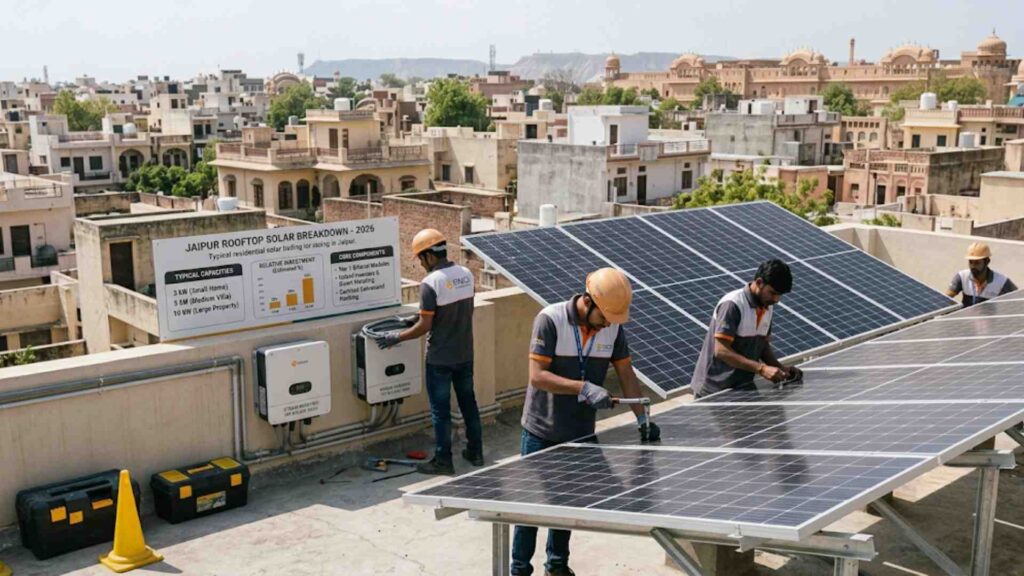
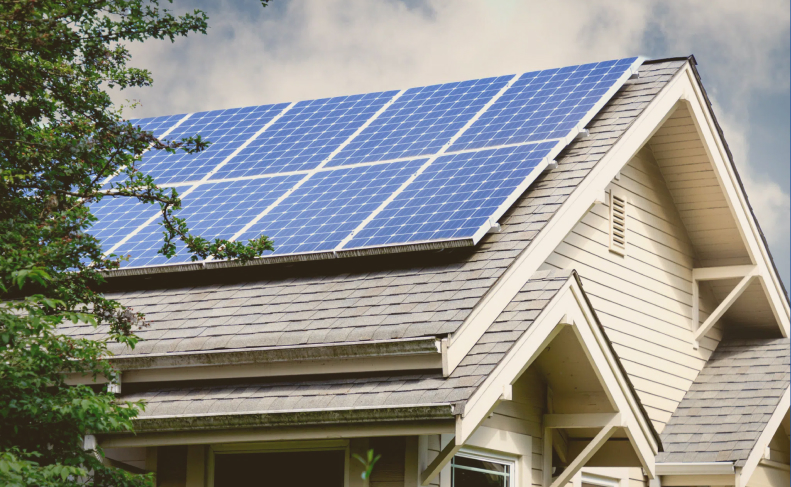
The initial capital required for rooftop solar depends heavily on your system size, roof structure, and whether you select a standard build or a premium tier utilizing high-efficiency N-Type TOPCon or Bifacial modules. Under the ongoing PM Surya Ghar Muft Bijli Yojana, the Central Government provides substantial financial assistance to residential consumers.
The central subsidy is structured at ₹30,000 per kW for the first 2 kW, and an additional ₹18,000 for the 3rd kW, capping out at a maximum of ₹78,000 for all residential systems of 3 kW or larger. To give you full clarity on out-of-pocket expenses, the table below outlines the current price benchmarks in Jaipur, factoring in gross costs, subsidies, and net consumer pricing.
Table 1: Comprehensive Cost Breakdown by System Size (Residential & Commercial)
| System Size (kW) | Average Gross Cost (Before Subsidy) | PM Surya Ghar Subsidy Amount | Average Net Cost (Post-Subsidy) | Recommended For (Property Profile) |
| 1 kW | ₹60,000 – ₹75,000 | ₹30,000 | ₹30,000 – ₹45,000 | Small 1 BHK flats, rural homes, monthly bills < ₹1,200 |
| 2 kW | ₹1,20,000 – ₹1,45,000 | ₹60,000 | ₹60,000 – ₹85,000 | 2 BHK homes, basic appliances, monthly bills ₹1,200 – ₹2,500 |
| 3 kW | ₹1,80,000 – ₹2,20,000 | ₹78,000 | ₹1,02,000 – ₹1,42,000 | 3 BHK homes, 1 inverter AC, monthly bills ₹2,500 – ₹4,500 |
| 5 kW | ₹2,60,000 – ₹3,10,000 | ₹78,000 (Capped) | ₹1,82,000 – ₹2,32,000 | Large 3-4 BHK villas, 2 ACs, monthly bills ₹5,000 – ₹8,000 |
| 10 kW | ₹4,80,000 – ₹5,80,000 | Nil (Commercial Cap) | ₹4,80,000 – ₹5,80,000 | Commercial complexes, schools, large estates, bills > ₹12,000 |
Pro Tip from the Best Solar Installation Company in Jaipur: Notice that the subsidy caps at ₹78,000 for a 3 kW system. If you install a 5 kW or 10 kW system on a residential connection, you will still receive a flat ₹78,000 subsidy. The additional capacity must be funded independently or through zero-collateral solar bank loans available at low interest rates via the national portal.
2. Technical Component Breakdown: Where Does Your Money Go?
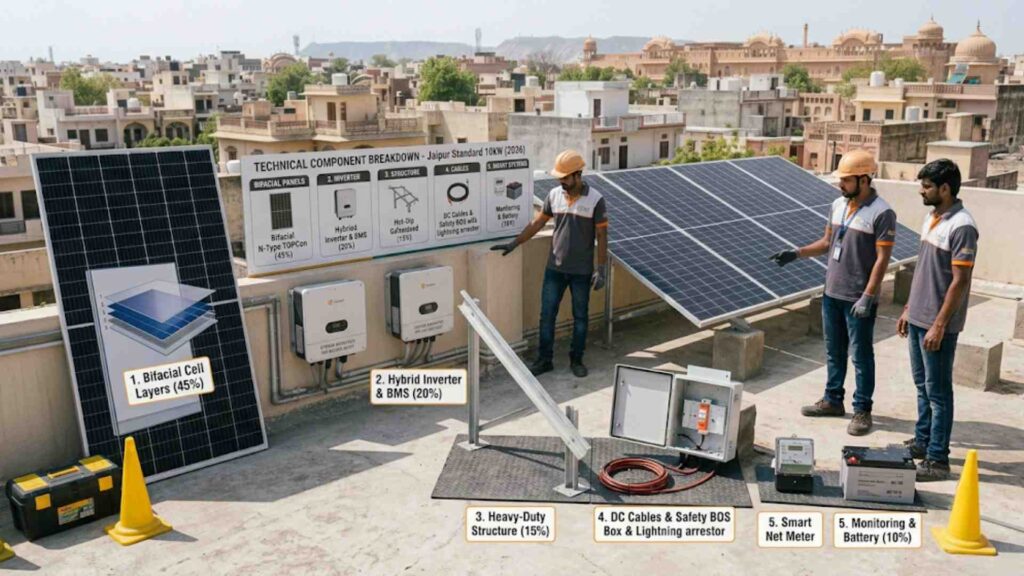
When evaluating quotes, look beyond the bottom-line figure. A solar power plant is a 25-year long-term asset. Any certified Solar Installation Company in Jaipur will always provide a granular, transparent bill of materials detailing premium, industry-certified components. Cutting corners on safety or build quality to save a few thousand rupees can severely limit your generation or void your government subsidy.
Solar Modules (Panels): The Core Generation Engine
Solar panels constitute roughly 55% to 60% of the total project cost. In 2026, technology has progressed far beyond traditional polycrystalline models. Homeowners now have two main options:
- Mono-PERC Panels (18% – 21% Efficiency): The dependable, cost-effective benchmark that handles intense heat efficiently.
- N-Type TOPCon & Bifacial Modules (22%+ Efficiency): The new premium standard. Bifacial panels capture light from both sides by absorbing reflected light from your roof terrace, expanding your total yield by up to 15%. This is especially effective across the bright, open concrete terraces typical of Jaipur architecture.
Solar Inverters: The System’s Brain
Inverters represent 15% to 20% of your total layout cost. They convert raw, erratic Direct Current (DC) from your roof into stable Alternating Current (AC) for home electronics.
- On-Grid String Inverters: The standard option for urban households with minimal power cuts. It utilizes JVVNL net metering to trade power dynamically.
- Hybrid Inverters: A premium choice that interfaces directly with lithium-ion or lead-acid batteries. While adding battery banks can increase your initial investment by ₹60,000 to ₹1,200,000, it provides clean, uninterrupted backup power during local grid maintenance.
Mounting Structures & Balance of System (BOS)
Jaipur regularly experiences fierce desert winds and extreme dust accumulation during pre-monsoon summer storms.
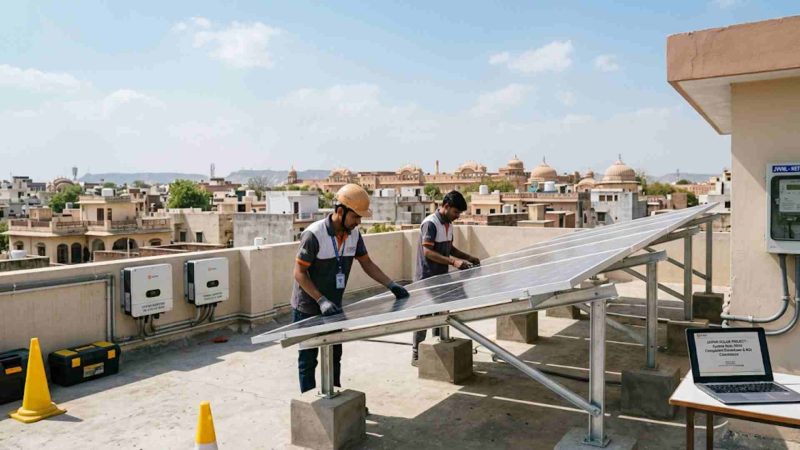
- Mounting Structures: Lower-tier vendors often use cheap, poorly coated iron that rusts quickly. The Best Solar Installation Company in Jaipur uses Hot-Dip Galvanized (HDG) steel or aluminum structures designed to withstand wind speeds up to 150 km/h. Elevated structures are also popular if you want to keep your roof accessible for outdoor seating or rooftop gardening.
- Cables & Safety Gear: High-quality UV-protected DC cables (minimum 4 sqmm), IP65-rated distribution boxes, lightning arrestors, and robust chemical earthing pits protect your home from sudden surges or electrical hazards.
3. Selecting a Residential vs. Industrial Solar Installation in Jaipur
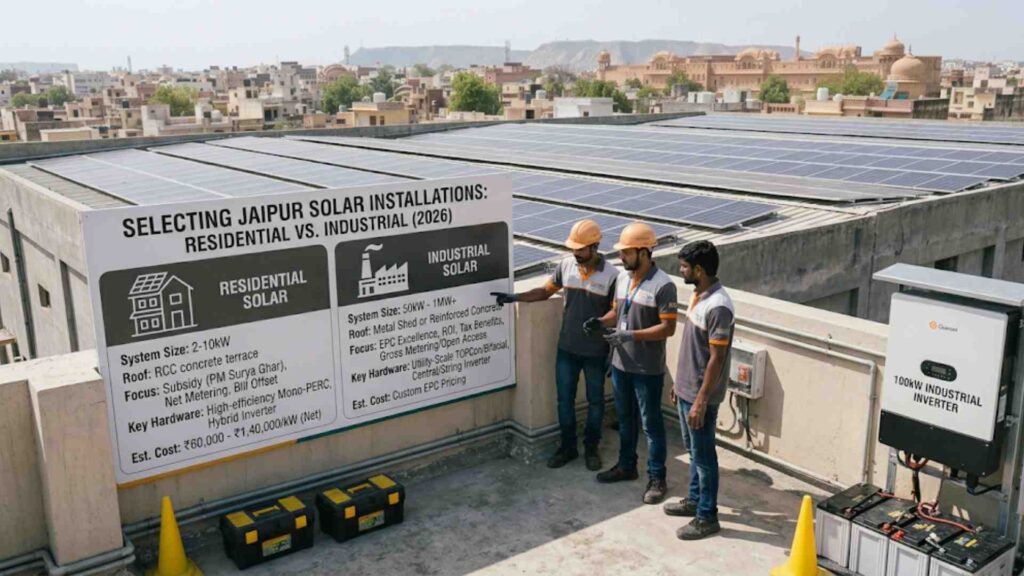
The scale of your property dictates the engineering approach, structural design, and financing models needed for deployment. Achieving a high-performing system requires choosing a partner with the correct expertise for your target profile:
Residential Grid Integration
For homes, the focus remains on aesthetic optimization, maximizing limited roof spaces, and successfully procuring national subsidies. A professional team specializing in Solar Installation in Jaipur will ensure your domestic system complies perfectly with JVVNL single-phase or three-phase residential net metering rules.
Commercial & Industrial (C&I) Scale Engineering
For factories, manufacturing units, shopping complexes, and schools, the energy demands are fundamentally different. If you operate a business in Vishwakarma Industrial Area (VKI), Sitapura, or Mansarovar Industrial Area, you must hire an experienced Commercial Solar Installation Company in Jaipur. Industrial systems (ranging from 50kW to over 1MW) require:
- Detailed power quality analysis to avoid harmonics.
- Heavy-duty structural load calculations for metal sheds or RCC roofs.
- Advanced high-voltage multi-string or central inverters.
- Navigating Open Access regulations or industrial gross metering systems.
To execute projects of this magnitude flawlessly, businesses partner with an end-to-end Solar EPC Company in Jaipur that manages everything from pre-feasibility 3D shading studies to procurement, civil foundation works, and statutory DISCOM approvals.
4. Financial Analysis & ROI Calculations for Jaipur Homeowners
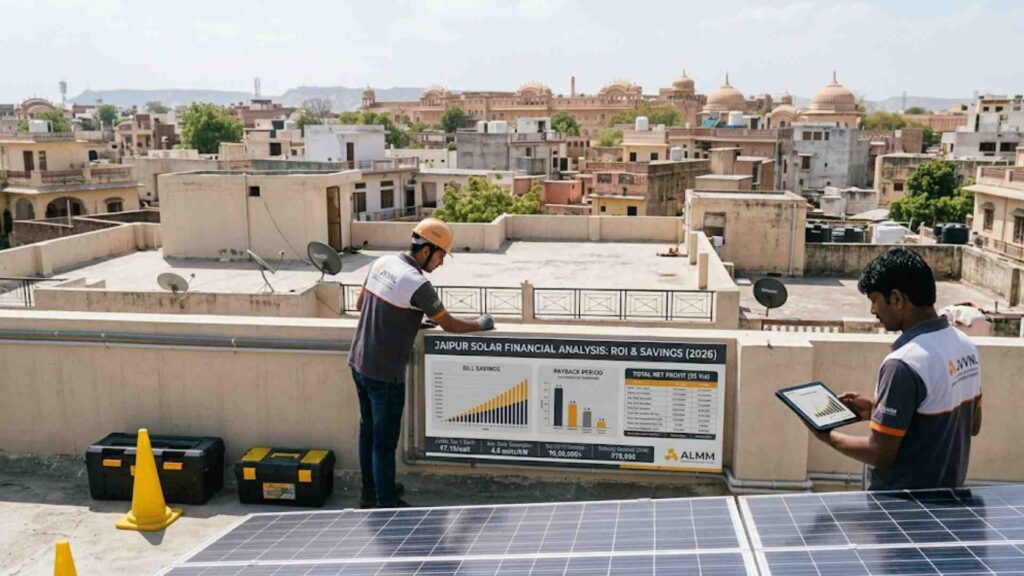
Because solar panels are exposed to phenomenal solar irradiation in Rajasthan, the financial payback period here is among the fastest across all metropolitan areas in India. JVVNL follows a tiered tariff structure, meaning heavy residential consumers are billed up to ₹7.15 per unit (plus fixed taxes and duties) for consumption exceeding 300 units a month. Rooftop solar offsets these expensive upper-tier slabs first, drastically reducing your monthly bill.
To help you understand the long-term compounding financial returns, the table below provides a detailed ROI matrix based on actual performance metrics in the Jaipur region.
Table 2: Financial ROI and Payback Period Analysis for Jaipur (JVVNL Connections)
| System Capacity | Avg. Daily Generation (Units) | Est. Annual Generation (kWh) | Annual Bill Savings (at ~₹7.00/unit) | Estimated Post-Subsidy Net Cost | Real Payback Period (Years) |
| 2 kW | 8 – 10 Units | 3,200 kWh | ₹22,400 | ₹70,000 | 3.1 Years |
| 3 kW | 12 – 15 Units | 4,800 kWh | ₹33,600 | ₹1,15,000 | 3.4 Years |
| 5 kW | 20 – 25 Units | 8,000 kWh | ₹56,000 | ₹2,05,000 | 3.6 Years |
| 10 kW | 40 – 45 Units | 15,000 kWh | ₹1,05,000 | ₹5,30,000 | 5.0 Years |
Explaining the Math: A 3 kW System Example
Let’s analyze a typical 3 kW installation case study:
- Net Investment: You pay an empanelled vendor a net cost of roughly ₹1,15,000 after your central PM Surya Ghar scheme subsidy is credited via Direct Benefit Transfer (DBT).
- Annual Power Output: The system consistently generates around 4,800 units over 12 months.
- Monetary Value: At an average displacement cost of ₹7.00 per unit, you save around ₹33,600 each year.
- Breakeven Point: By dividing your upfront net cost (₹1,15,000) by your annual savings (₹33,600), you recover your entire capital investment in 3.4 years.
Since Tier-1 solar modules are backed by a comprehensive 25-year performance warranty, your system will operate for over 21 additional years entirely free of cost. This represents an annual tax-free return on capital exceeding 25%, significantly outperforming traditional fixed deposits or mutual funds. For enterprises executing large-scale Industrial Solar Installation in Jaipur, accelerated depreciation benefits and section 32 tax exemptions can shrink this payback window even further.
5. Crucial Pitfalls to Avoid When Installing Solar in Jaipur
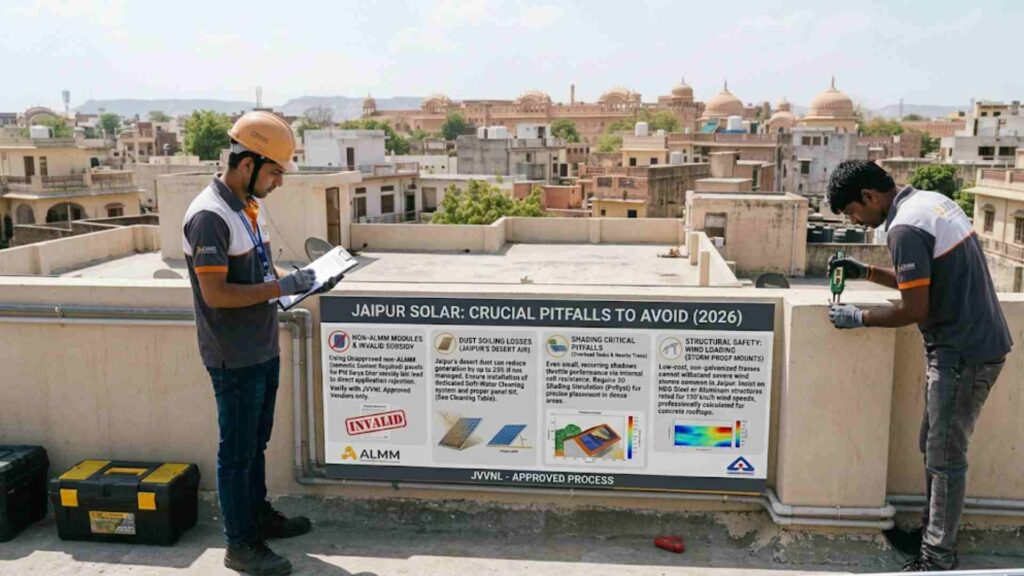
While the financial metrics are compelling, your long-term success relies heavily on avoiding corner-cutting and sub-standard engineering. Ensuring a reliable, high-yield installation means watching out for several critical factors:
Avoiding Non-ALMM Equipment and Invalid Subsidies
This issue is the most common reason for subsidy rejection during local DISCOM inspections. The Ministry of New and Renewable Energy (MNRE) mandates strict compliance rules. To qualify for the PM Surya Ghar subsidy, your system must use certified hardware.
The solar modules must be explicitly listed under the Approved List of Models and Manufacturers (ALMM). Furthermore, the panels must feature domestic solar cells.
Some unverified vendors install unapproved, cheap imported panels. They do this simply to lower their initial quote. As a result, your subsidy application will fail entirely. This avoidable mistake can cost you up to ₹78,000.
Managing Dust and Desert Soiling Losses
Jaipur’s proximity to the Thar Desert means airborne dust settles rapidly on glass surfaces. Thick layers of dust can block sunlight and trigger soiling losses, dropping your generation by 15% to 25% within a single fortnight.
- The Fix: Ensure your vendor designs a dedicated on-roof water cleaning line or leaves safe walking pathways between panel rows. For peak performance, wash down your solar array with soft water once every two weeks early in the morning before the panels heat up.
Shading Factors and Structural Safety
Old-city homes and modern villas across Jaipur often feature overhead water tanks. Many properties in Vaishali Nagar, Mansarovar, or Malviya Nagar also have parapet walls or nearby trees. These structures create shadows.
Even a tiny shadow on a single cell can throttle system performance. This happens due to high internal resistance across the entire string.
An experienced engineer from the Best Solar Installation Company in Jaipur can solve this issue. They run a professional 3D shade simulation using specialized tools. This process optimizes panel positioning and pitch angle. As a result, you get maximum generation all year round.
Conclusion
Rooftop solar is one of the safest and most efficient home improvement investments available to property owners in Rajasthan. By matching your home’s energy profile with a correctly sized system, choosing certified components, and leveraging the PM Surya Ghar subsidy framework, you can comfortably eliminate up to 90% of your recurring household electricity bills.
To secure these long-term returns, avoid ultra-cheap, unverified quotes from fly-by-night operators. Always choose a trusted, MNRE-empanelled expert recognized as the Best Solar Installation Company in Jaipur to manage your layout design, secure net metering approvals from JVVNL, and ensure reliable support for the next 25 years.
Frequently Asked Questions (FAQs)
Q1: How can I identify the Best Solar Installation Company in Jaipur?
Look for an MNRE-empanelled vendor on the official PM Surya Ghar National Portal who possesses an active electrical contractor license. The Best Solar Installation Company in Jaipur should handle everything from system design and JVVNL net metering to ensuring your subsidy is credited seamlessly via DBT.
Q2: What sets a standard contractor apart from a dedicated Solar EPC Company in Jaipur?
A standard contractor typically installs basic residential setups using off-the-shelf components. In contrast, a full-service Solar EPC Company in Jaipur handles end-to-end Engineering, Procurement, and Construction, specializing in large commercial projects and high-capacity Industrial Solar Installation in Jaipur.
Q3: How long does the JVVNL net metering and subsidy process take in Jaipur?
The physical rooftop setup takes only 2 to 3 days. Following this, the JVVNL net meter installation and safety approval process takes about 20 to 30 days. Once the system is commissioned, your central government subsidy is deposited directly into your bank account within 30 to 45 days.
Q4: Do solar panels work efficiently during Jaipur’s extreme summer heat?
Extreme heat above 45°C can cause a minor drop in generation due to thermal resistance. Partnering with a leading Commercial Solar Installation Company in Jaipur ensures the use of premium modules (like N-Type TOPCon) mounted with a proper 10–15 cm air gap to allow natural cooling and maintain peak output.
Q5: Is net metering available for both residential and commercial properties in Rajasthan?
Yes, JVVNL fully supports net metering for all sectors. Any excess power generated by your system during the day is automatically exported to the grid. JVVNL deducts these exported units from your monthly consumption, meaning you only pay for the net units used.