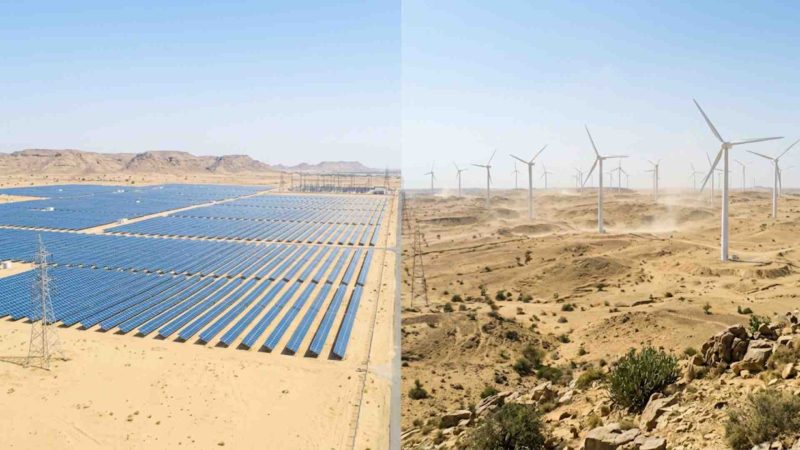
Rajasthan is currently playing center stage in India’s green energy revolution. Blessed with vast stretches of arid land, intense solar irradiance, and high-velocity wind corridors, the state has rapidly transitioned into a nationwide renewable energy powerhouse. For businesses, investors, and policymakers, evaluating solar energy vs wind energy for Rajasthan is no longer just an environmental debate—it is a critical economic and operational calculation.
As of 2026, Rajasthan leads the country with a massive installed renewable capacity exceeding 43,000 MW, heavily anchored by its desert districts like Jaisalmer, Jodhpur, Bikaner, and Barmer. However, when choosing between deploying or investing in solar or wind power, understanding the distinct advantages, geographical constraints, and capacity profiles of each is essential.
Let’s dive deep into the ultimate renewable energy face-off to see which resource holds the upper hand in the land of kings.
The Power of the Sun: Rajasthan’s Solar Dominance
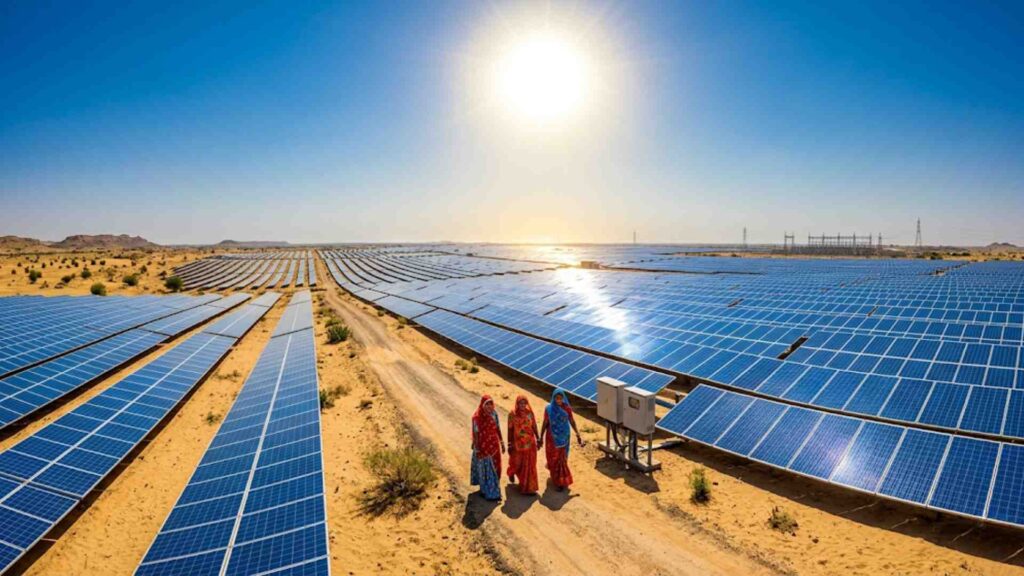
When it comes to solar energy, Rajasthan possesses an unparalleled geographical advantage. The state receives more than 325 sunny days a year and boasts some of the highest solar irradiance levels in the world, averaging between 5.5 to 6.5 kWh/m2/day.
This natural abundance has allowed Rajasthan to build India’s largest solar portfolio, breaching 41,000 MW of installed solar capacity. Groundbreaking installations like the Bhadla Solar Park in Jodhpur—stretching across thousands of acres—demonstrate the massive scale at which solar can be deployed.
Advantages of Solar Power in Rajasthan:
- High Predictability: Solar generation follows a highly reliable diurnal pattern, peaking during peak daytime hours when industrial demand is soaring.
- Versatile Scalability: Unlike wind turbines, solar setups can be scaled dynamically. They range from small-scale residential setups under schemes like the PM Surya Ghar Muft Bijli Yojana to multi-megawatt commercial and industrial (C&I) ground-mounted plants.
- Abundant Land Availability: The vast, non-agricultural terrains of the Thar Desert provide an ideal foundation for sprawling photovoltaic (PV) arrays without triggering intense land-use conflicts.
The Power of the Air: Rajasthan’s Wind Energy Potential
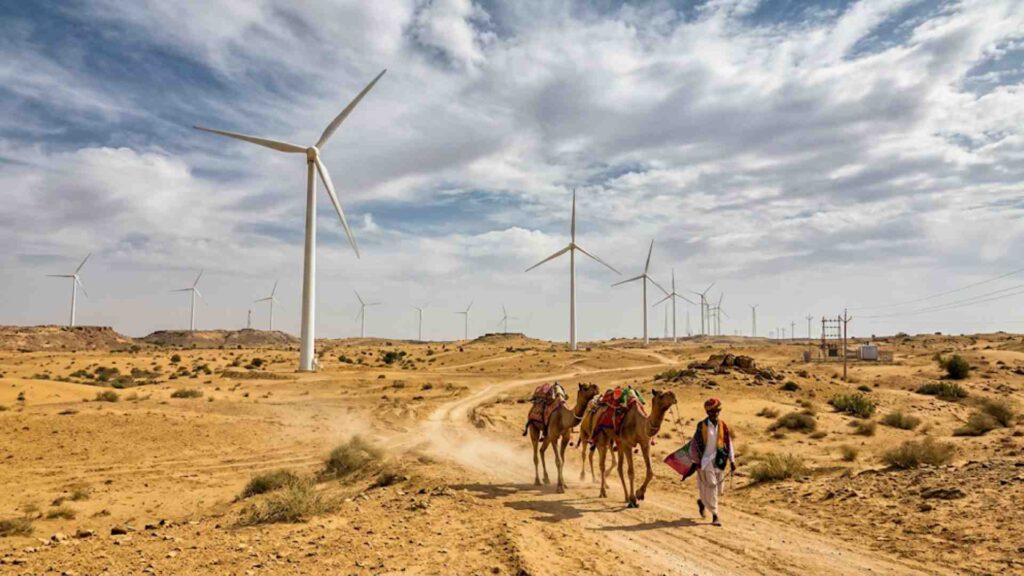
While solar energy commands the headlines, wind power remains a vital, highly potent pillar of Rajasthan’s energy mix. The state ranks third in India for installed wind power capacity, driven largely by the heavy wind corridors running through Western Rajasthan.
Wind generation in Rajasthan relies on high-velocity wind streams that are highly active during specific seasons, particularly during the pre-monsoon and monsoon months (May to September). Jaisalmer, famously dubbed the “Golden City,” is also the wind capital of the state, hosting one of the largest operational onshore wind farms in the world.
Advantages of Wind Power in Rajasthan:
- High Capacity Utilization Factor (CUF): Modern wind turbines operate at higher efficiency levels during their peak periods, frequently outperforming solar installations in total units generated per megawatt of installed capacity.
- Complementary Generation Cycles: Wind velocity in the desert often peaks during the late evening and nighttime hours. This provides a natural counterbalance to the daytime drop-off of solar power.
- Minimal Footprint per Turbine: While wind farms span massive geographic regions, the physical footprint of individual turbine towers is small. This allows landowners to utilize the surrounding ground for secondary purposes.
Head-to-Head Comparison: Solar Energy vs Wind Energy for Rajasthan
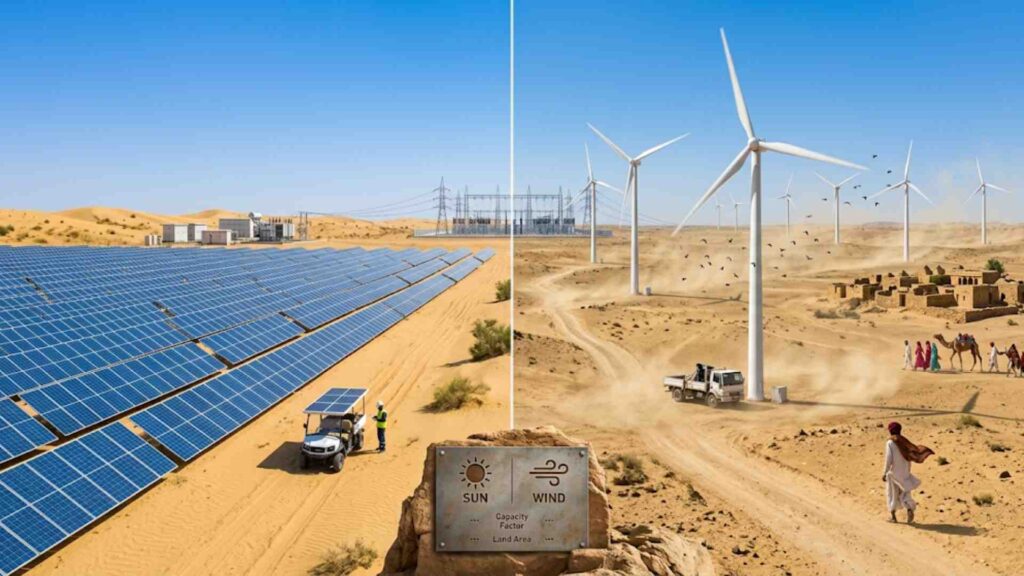
To evaluate how these two massive resources stack up against each other across critical business metrics, we can look at their core operating parameters:
| Metric | Solar Energy in Rajasthan | Wind Energy in Rajasthan |
| Installed Capacity Status | Dominant leader (Over 41,000 MW installed) | Steady growth (Third highest state capacity in India) |
| Primary Hubs | Jodhpur, Bikaner, Barmer, Jaipur | Jaisalmer, Jodhpur, Pratapgarh |
| Peak Generation Hours | Daytime (9:00 AM to 5:00 PM) | Evening, night, and Monsoon months |
| Average Capacity Factor | 20% to 24% | 25% to 30% (During peak season) |
| Land Footprint | High spatial footprint (Requires contiguous land blocks) | High aerial span, low ground footprint |
| Initial Capital Cost (Capex) | Highly cost-competitive and affordable | Higher initial capital expenditure per MW |
| Maintenance & Operations | Low complexity; requires regular panel cleaning | High complexity; requires specialized mechanical upkeep |
The Synergy of Solar Energy vs Wind Energy for Rajasthan’s Future Grid
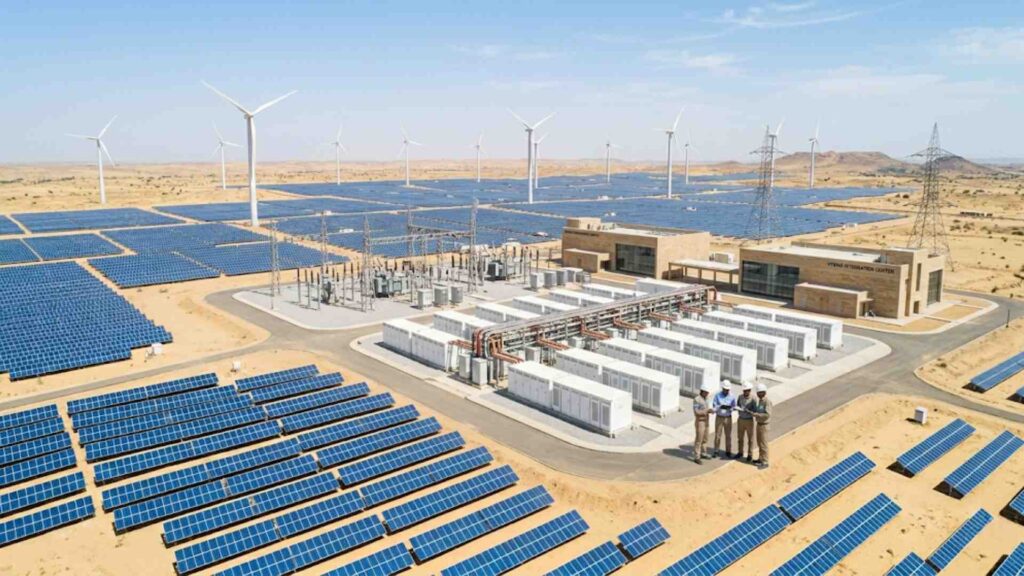
As Rajasthan pushes toward its ambitious target of 125 GW of renewable energy, relying on just one source creates operational challenges. Pure solar grids face steep generation drops after sunset, while wind generation can be highly seasonal and intermittent. In early 2026, grid curtailment—where the state grid forces plants to scale back production due to transmission congestion—highlighted the limits of single-source generation.
The solution rewriting the energy playbook across Jaisalmer and Jodhpur is the Solar-Wind Hybrid Plant.
By co-locating solar panels and wind turbines on the same piece of land, developers maximize shared transmission infrastructure. When the sun sets, the desert winds pick up, creating a steady, balanced power output that stabilizes the grid. Large-scale corporate entities are shifting completely toward these hybrid models to secure reliable, round-the-clock green energy.
Conclusion: Driving Rajasthan’s Green Energy Capital
In the battle of solar energy vs wind energy for Rajasthan, there is no singular winner—only a powerful synergy. Solar power is undeniably the dominant force in terms of sheer capacity, ease of deployment, and low capital cost, making it the preferred choice for mass commercial adoption and decentralized generation. However, wind energy provides critical structural balance, offering high-output generation during evening hours and monsoonal drops when solar is offline.
For Rajasthan to maintain its crown as India’s green energy capital, the future lies in balanced integration. Hybrid power setups backed by Battery Energy Storage Systems (BESS) will be the true driver of the state’s industrial and economic future.
Frequently Asked Questions (FAQs)
1. Which resource is more reliable for consistent power generation in Rajasthan?
Solar energy is highly predictable on a day-to-day basis because Rajasthan receives consistent sunlight throughout the year. Wind energy provides higher power outputs but is more seasonal, peaking sharply during the monsoon months and late evening hours.
2. Why is Western Rajasthan preferred for both solar and wind plants?
Western Rajasthan, comprising districts like Jaisalmer, Jodhpur, and Bikaner, features vast expanses of low-cost, flat arid land. It simultaneously experiences some of the highest solar radiation in India and acts as a natural wind corridor, making it perfect for both technologies.
3. What are Solar-Wind Hybrid systems, and why are they growing in Rajasthan?
Solar-Wind Hybrid systems combine both solar panels and wind turbines into a single power plant using shared grid connection lines. They are surging in popularity across Rajasthan because they solve intermittency issues; solar generates power during the day, while wind often picks up at night, providing stable grid transmission.
4. Is solar energy cheaper to install than wind energy in Rajasthan?
Yes. On a per-megawatt basis, solar installations feature a significantly lower initial capital expenditure (Capex) and simpler operational logistics compared to wind turbines, which require specialized heavy machinery, structural towers, and complex mechanical maintenance.