When planning a rooftop transition to clean energy, understanding the exact difference between Poly, Mono, and N-type solar panels is the single most critical step to maximizing your long-term investment. The global renewable energy landscape is shifting rapidly, and making an informed decision requires looking past marketing buzzwords to see how these cell architectures actually perform in real-world conditions. Choosing the right module technology directly impacts your system’s daily power generation, space utilization, and financial return.
Understanding the Solar Cell Core: What Defines Poly, Mono, and N-Type?
To understand how these panels perform on your roof, we must look at how they are made. At the heart of every solar panel is a silicon wafer. The purity of this silicon, along with the chemical elements mixed into it during manufacturing, determines how smoothly electrons flow when sunlight hits the panel.
Polycrystalline Cells: Understanding the Core Difference Between Poly, Mono, and N-Type Solar Panelsa
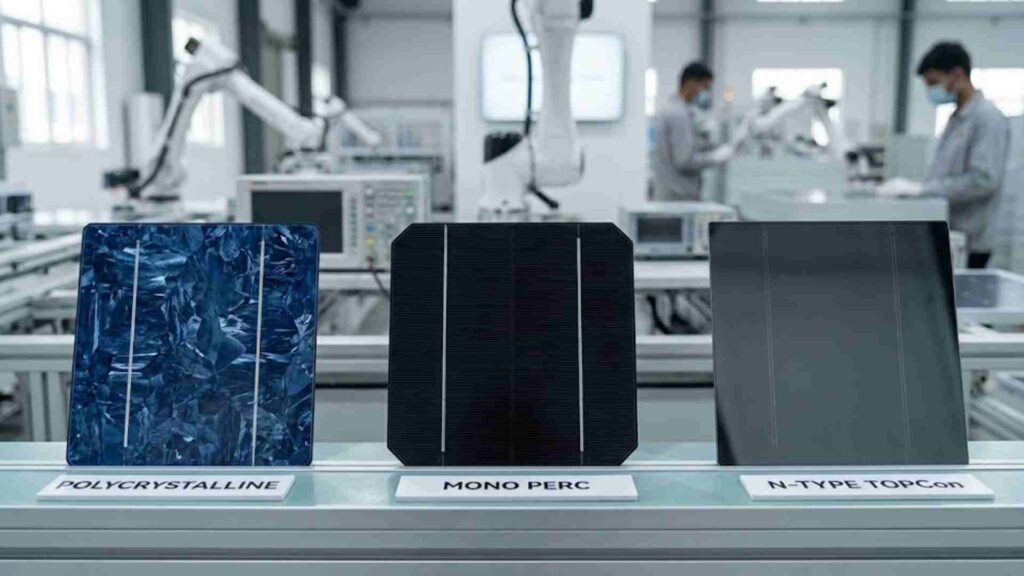
Polycrystalline cells are made by melting raw, unrefined silicon fragments together in a square mold. Because the silicon cools and solidifies rapidly, thousands of individual crystals form within a single cell.
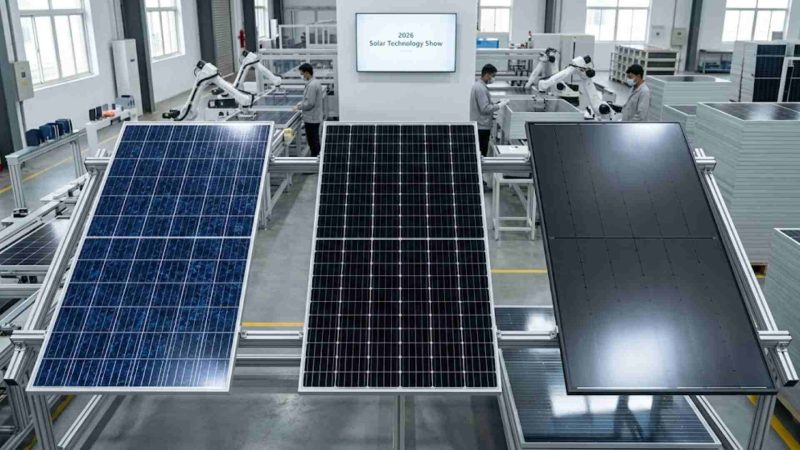
This multi-crystalline structure creates visible crystal boundaries, giving the panel its characteristic fragmented, shimmering blue appearance. While this manufacturing process is highly cost-effective and wastes minimal raw material, the internal crystal boundaries act as minor structural barriers. They scatter traveling electrons and reduce the panel’s overall ability to convert sunlight into usable electricity.
Monocrystalline PERC: Efficiency Difference Between Poly, Mono, and N-Type Solar Panels
Manufacturers engineer Monocrystalline panels by utilizing the advanced Czochralski process. Specifically, technicians grow a single, ultra-pure silicon crystal into a continuous cylindrical ingot. Consequently, factories slice this pure ingot into thin, uniform wafers. Because a single crystal lattice forms the entire cell, electrons encounter virtually zero internal resistance. Therefore, electricity can flow freely through the module, which significantly increases power efficiency.
In addition, modern manufacturing utilizes PERC (Passivated Emitter and Rear Cell) technology to boost performance further. This process adds a reflective passivation layer directly to the back of the cell. Consequently, the layer bounces any unabsorbed sunlight back into the silicon wafer. This step provides a second chance for efficient power generation. Furthermore, this specific design gives Mono panels their uniform, premium matte-black look.
N-Type Technology: Next-Gen Difference Between Poly, Mono, and N-Type Solar Panels
N-Type technology represents the modern frontier of advanced solar engineering. Traditional Polycrystalline and Mono-PERC panels are “P-Type” modules, meaning their silicon wafers are treated (doped) with Boron. Boron-doped silicon is highly effective, but it has a built-in vulnerability: when exposed to oxygen during manufacturing and initial sunlight on your roof, it suffers from Light-Induced Degradation (LID). This causes a permanent drop in performance during the very first year of operation.
N-Type panels completely eliminate this problem by replacing Boron with Phosphorus as the primary doping agent. Phosphorus-doped silicon is entirely immune to Boron-Oxygen defects, ensuring near-zero initial degradation.
The most dominant commercial variation of this technology is TOPCon (Tunnel Oxide Passivated Contact). It adds an ultra-thin tunnel oxide layer and a heavily doped polysilicon film to the back of the cell. This allows electrons to “tunnel” through the electrical contacts smoothly while minimizing electron loss (recombination).
Another premium option is HJT (Heterojunction Technology), which sandwiches a crystalline silicon wafer between layers of amorphous “thin-film” silicon to squeeze every possible drop of energy out of available sunlight.
Technical Analysis: What is the Difference Between Poly, Mono, and N-type Solar Panels?
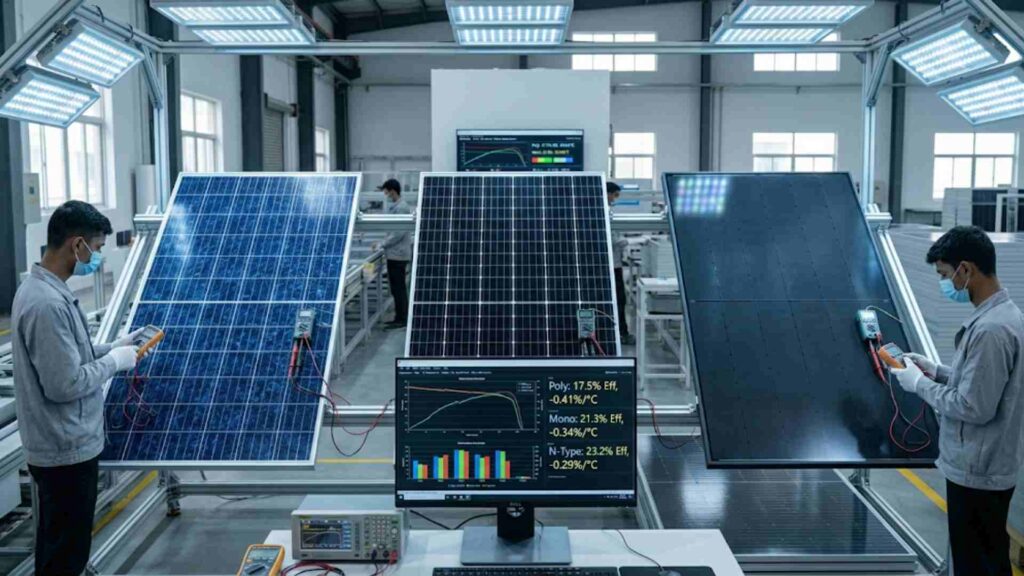
When deep-diving into the operational difference between Poly, Mono, and N-type solar panels, the ultimate selection comes down to four fundamental parameters: electrical conversion efficiency, temperature resilience, long-term degradation rates, and initial upfront costs.
1. Efficiency Metrics: The Performance Difference Between Poly, Mono, and N-Type Solar Panels
Efficiency represents the percentage of available solar energy hitting the panel surface that is successfully converted into usable direct current (DC) electricity.
- Polycrystalline panels feature an efficiency range of 16% to 18%. Because their multi-crystal structures scatter electrons, you need a significantly larger roof footprint to generate the same amount of power as higher-tier options.
- Monocrystalline PERC panels have long been the commercial benchmark, delivering efficiencies between 20.5% and 22%. However, P-type architecture has hit its physical limits; it cannot exceed a theoretical ceiling of roughly 24.5%.
- N-Type TOPCon and HJT modules shatter these limits, delivering active production efficiencies of 22% to 24.5%, with a theoretical ceiling stretching past 28%. This means you get maximum power generation from every square foot of your rooftop.
2. Thermal Resistance: Real-World Heat Difference Between Poly, Mono, and N-Type Solar Panels
Solar panels are tested in laboratory environments at a standard temperature of 25°C. However, in real-world conditions—especially during severe summer months—solar cells on concrete roofs can easily reach operating temperatures of 65°C or higher. As panels heat up, their internal electrical resistance increases, causing their power output to drop. This loss is measured by the temperature coefficient.
Polycrystalline panels feature a high temperature coefficient of roughly -0.40%/°C. This means that for every single degree your panel surface heats up above 25°C, you lose 0.40% of its total power capacity. Mono-PERC improves upon this slightly at -0.35%/°C.
N-Type modules offer exceptional thermal resilience, featuring an ultra-low temperature coefficient of -0.28%/°C to -0.34%/°C. During intense summer spikes, an N-Type system loses significantly less power than P-type alternatives. This ensures consistent, high-volume electricity production when your household cooling or commercial air conditioning demands are at their absolute peak.
3. Lifespan & Wear: Degradation Difference Between Poly, Mono, and N-Type Solar Panels
Every solar panel loses a small percentage of its power generation capacity over time. This long-term wear is split into two phases: Year 1 Light-Induced Degradation (LID) and annual linear degradation over the remaining 25 to 30 years of the panel’s lifespan.
Traditional Mono-PERC modules experience an initial Year 1 drop of 1.5% to 2.0% due to Boron-Oxygen defects, followed by a steady annual loss of roughly 0.55% to 0.70%. Over a standard 25-year warranty cycle, a Mono-PERC panel is guaranteed to retain around 84.8% of its original power.
Because N-Type modules use Phosphorus-doped silicon, they experience zero Boron-Oxygen LID. Their Year 1 power output is guaranteed at a remarkable 99%. Over the subsequent decades, their annual linear degradation rate drops to just 0.40%.
This superior durability allows N-Type manufacturers to offer extended 30-year performance warranties, guaranteeing that the system will still deliver over 87.4% of its original capacity at year thirty.
Technical Specifications Comparison Table
To help you visualize the structural and electrical variance, this table outlines the exact metrics defining the difference between Poly, Mono, and N-type solar panels:
| Technical Performance Metric | Polycrystalline Panels | Monocrystalline PERC | N-Type TOPCon / HJT |
| Wafer Silicon Substrate | P-Type (Multi-Crystal) | P-Type (Single Crystal) | N-Type (Phosphorus Doped) |
| Visual Appearance | Fragmented Navy Blue | Uniform Matte Black | Uniform Sleek Black |
| Average Module Efficiency | 16.0% – 18.0% | 20.5% – 22.0% | 22.0% – 24.5% (Highest) |
| Temperature Coefficient | -0.40% / °C | -0.35% / °C | -0.28% to -0.34% / °C |
| Year 1 Degradation (LID) | 2.0% to 2.5% | 1.5% to 2.0% | 0.5% to 1.0% (Near Zero) |
| Annual Linear Degradation | 0.70% – 0.80% / year | 0.55% – 0.70% / year | 0.35% – 0.40% / year |
| Standard Product Warranty | 10 to 12 Years | 12 to 15 Years | 15 to 25 Years |
| Performance Warranty | 25 Years (80% output) | 25 Years (84.8% output) | 30 Years (87.4%+ output) |
| Bifaciality Factor | Not Applicable | 65% – 75% | 75% – 85% (Superior Rear Gain) |
| Relative Upfront Cost | Economy (Base Price) | Moderate (+15% vs Poly) | Premium (+10% to +15% vs Mono) |
Financial Analysis: Upfront Costs vs. 25-Year ROI
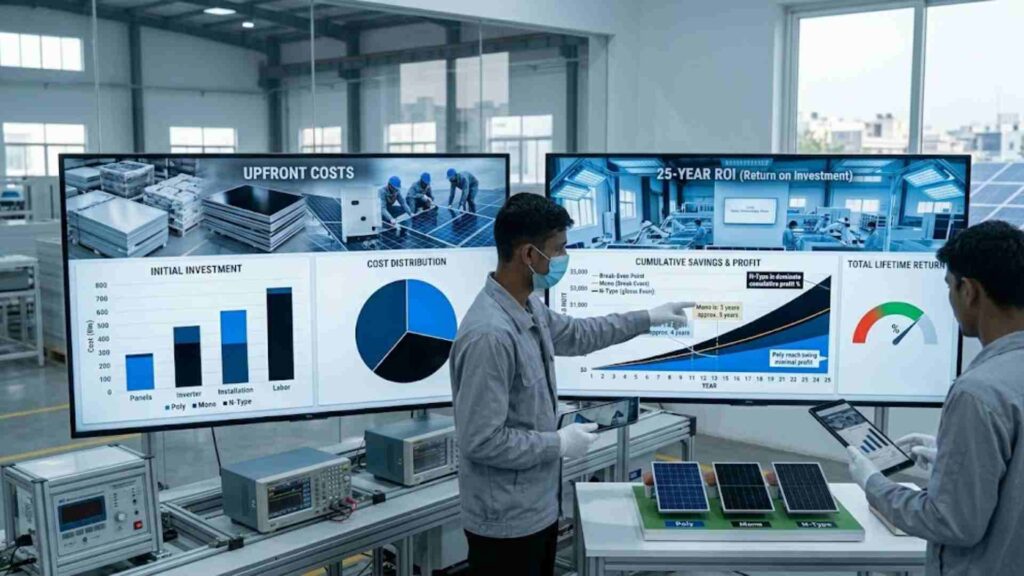
When evaluating the commercial difference between Poly, Mono, and N-type solar panels, you must look past the initial purchase price and evaluate the Levelized Cost of Energy (LCOE). This measures the total cost of the system relative to the total number of electricity units (kWh) it will generate over its operating life.
Initial Investment: Upfront Cost Difference Between Poly, Mono, and N-Type Solar Panels
Polycrystalline remains the cheapest upfront option per panel. However, because of its low efficiency, it requires more panels, more mounting structures, more cabling, and significantly more labor to match the capacity of higher-efficiency systems. This extra hardware often cancels out much of the raw panel savings.
Monocrystalline PERC currently represents the sweet spot for budget-conscious consumers, balancing a mature supply chain with affordable upfront costs.
N-Type TOPCon modules command a 10% to 15% price premium over Mono-PERC modules. However, this initial premium pays for itself rapidly in real-world operating conditions.
Long-Term ROI: 25-Year Return Difference Between Poly, Mono, and N-Type Solar Panels
Let us analyze a standard residential 5 kW rooftop installation.
- While a Mono-PERC system costs less upfront, an N-Type TOPCon system delivers roughly 5% to 10% higher electricity generation annually due to its superior efficiency and better low-light performance.
- When you factor in the lower annual degradation rate (0.4% vs 0.7%), the N-Type system generates thousands of additional units of electricity over a 25-to-30-year operational lifespan.
- If you calculate the financial value of those extra units against grid electricity tariffs, the N-Type architecture pays back its initial price premium within the first 3 to 4 years. Past that point, the extra electricity generated is pure financial profit.
Government Subsidies and Compliance: PM Surya Ghar Muft Bijli Yojana
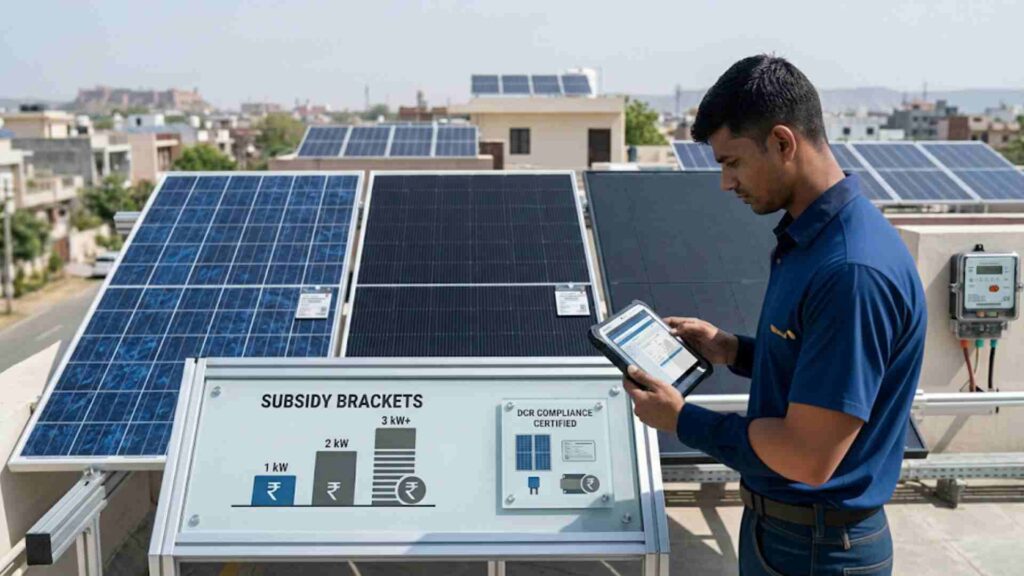
For residential solar installations in India, policy alignment is just as important as technical performance. The Indian Government’s flagship PM Surya Ghar Muft Bijli Yojana provides substantial financial assistance directly to homeowners to make renewable energy accessible.
Important Subsidy Guidelines: To qualify for central government financial assistance under the PM Surya Ghar scheme, your system must utilize Domestic Content Requirement (DCR) compliant modules. This means the solar cells and modules must be manufactured entirely within India, and the models must be listed on the Ministry of New and Renewable Energy’s (MNRE) Approved List of Models and Manufacturers (ALMM).
Subsidy Slabs Under the Central Scheme
The national subsidy framework provides direct financial support based on your total installed system capacity:
- 1 kW System: Fixed subsidy support of ₹30,000
- 2 kW System: Fixed subsidy support of ₹60,000
- 3 kW and Above Systems: Fixed subsidy support capped at an absolute maximum of ₹78,000
Choosing the Right Technology for Your Subsidy Campaign
When designing a system under this scheme, space optimization is key. Most residential rooftops have limited usable, shadow-free space.
- If you choose Polycrystalline panels, a 3 kW system requires a vast physical footprint, which can be challenging on smaller roofs.
- By upgrading to Monocrystalline PERC or N-Type TOPCon panels, you can reach that 3 kW threshold using fewer individual modules. This allows you to claim the full ₹78,000 government subsidy while leaving plenty of open space on your roof for other uses.
Conclusion: Which Solar Panel Technology is Right for Your Property?
Ultimately, understanding the core difference between Poly, Mono, and N-type solar panels allows you to choose a technology that matches your physical space, upfront budget, and long-term energy goals.
- Choose Polycrystalline if: You have vast, unrestricted space, low energy requirements, and are focused on minimizing your initial upfront costs. It remains a functional option for basic agricultural water pumping applications where peak efficiency is not a priority.
- Choose Monocrystalline (Mono-PERC) if: You want a reliable, field-tested balance of high efficiency, sleek aesthetics, and moderate upfront pricing. It is a proven, highly practical choice for residential roofs with standard energy needs.
- Choose N-Type (TOPCon/HJT) if: You want the absolute highest possible return on investment. If you have limited roof space, experience intense summer heat, or want a premium asset that will generate maximum power for 30 years, N-Type technology is the clear choice.
Frequently Asked Questions (FAQs)
1. What is the main difference between Poly, Mono, and N-type solar panels?
The primary difference between Poly, Mono, and N-type solar panels lies in efficiency and silicon purity. Poly panels use multiple silicon crystals (16–18% efficient), Mono panels use a single pure crystal (20.5–22% efficient), and N-Type panels use advanced phosphorus doping to deliver maximum performance (22–24.5% efficient).
2. Can I mix Monocrystalline and N-Type panels in a single system?
No. Mixing different panel technologies causes an electrical mismatch in current and voltage. This forces your entire system to drop down to the efficiency level of the weakest panel.
3. Why do N-Type panels perform better in extreme heat?
N-Type modules have an ultra-low temperature coefficient (-0.28%/°C). They lose significantly less power output than traditional Poly and Mono modules during hot summer days.
4. Are N-Type panels eligible for the PM Surya Ghar subsidy?
Yes. Both Mono and N-Type panels qualify for the PM Surya Ghar subsidy, provided they are Domestic Content Requirement (DCR) compliant and listed on the official MNRE ALMM roster.
5. Is it worth paying the upfront premium for N-Type solar panels?
Yes. With near-zero initial degradation and a lower annual wear rate (0.40%), N-Type panels generate much more lifetime electricity. The extra savings recover the initial cost premium within 3 to 4 years.