Switching to solar energy is one of the smartest financial decisions an Indian homeowner can make. With rising electricity tariffs and the unpredictability of power cuts in many states, having a backup system is essential. However, when homeowners start researching, they often look at the solar battery price for home online and assume that is the final cost.
The reality is quite different. The sticker price of the battery is just one component of a functioning solar power system. Whether you are installing a 3kW system for a 2BHK or a 10kW system for a large villa, understanding the “hidden” costs is crucial to avoid budget shocks.
This guide details the complete financial picture, moving beyond the basic solar battery price for home to cover installation, inverters, wiring, and structural costs in the Indian market.
Understanding the Base Solar Battery Price for Home in India
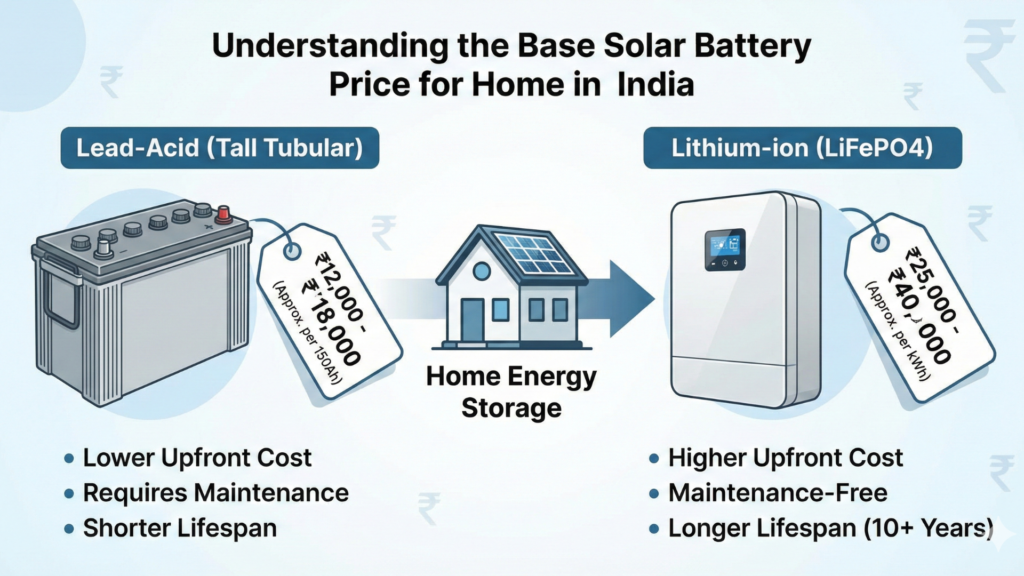
Before we dive into the hidden costs, it is important to understand what the battery itself costs. In India, the market is currently split between two main technologies: Lead-Acid (Tall Tubular) and Lithium-ion (LiFePO4).
When searching for the solar battery price for home, you will find a massive price difference between these two technologies.
1. Lead-Acid Batteries (Tall Tubular)
These are the traditional batteries used in most Indian households. They are bulky, require maintenance (topping up distilled water), and have a shorter lifespan (3-5 years).
- Average Cost: ₹12,000 to ₹18,000 per 150Ah battery (approx. 1.8 kWh).
- Pros: Low upfront cost, easily available.
- Cons: Heavy, requires ventilation, regular maintenance, lower efficiency.
2. Lithium-ion Batteries (LiFePO4)
This is the modern standard. They are compact, zero-maintenance, and last 10+ years.
- Average Cost: ₹25,000 to ₹40,000 per kWh.
- Pros: 10-year warranty, fast charging, compact, higher Depth of Discharge (DOD).
- Cons: Higher initial investment.
Hidden Components That Increase the Solar Battery Price for Home
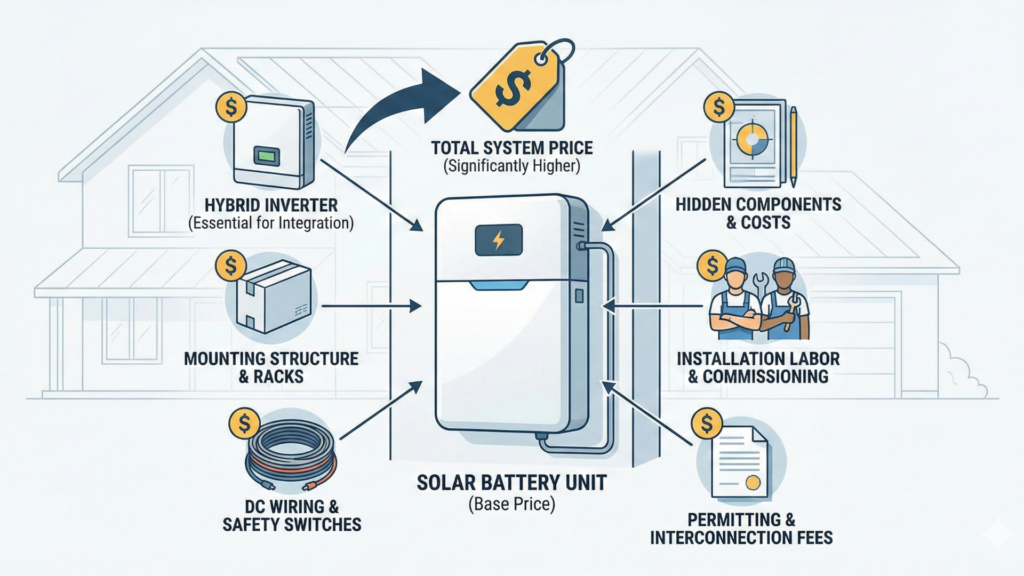
A battery sitting in a box cannot run your fans or lights. To integrate it safely into your home’s grid, you need “Balance of System” (BOS) components. These often account for 30% to 40% of the total project cost.
1. The Solar Inverter (PCU)
If you are adding a battery, you cannot use a standard grid-tie inverter. You need a Hybrid Inverter or a Power Conditioning Unit (PCU) that can manage both solar input and battery charging.
- Cost Impact: A high-quality hybrid inverter in India costs between ₹35,000 and ₹85,000 depending on the kVA rating. This is a significant addition to the standalone solar battery price for home.
2. Structure and Mounting (GI Structure)
Batteries, especially lead-acid banks, are heavy. If you are installing a 4-battery system (48V), it weighs over 200 kg. You may need a heavy-duty rack or a customized cabinet.
Furthermore, if you are installing solar panels along with the battery, the Galvanized Iron (GI) mounting structure is a major cost. It must be elevated to withstand high wind speeds.
- Cost Impact: ₹5,000 to ₹15,000 for battery racks/cabinets; ₹4,000 per kW for panel structures.
3. DC Wires and Earthing Kit
Safety is non-negotiable. DC electricity carries a high risk of fire if not wired correctly. You need specialized DC cables (4 sq mm or 6 sq mm), Lightning Arresters (LA), and a proper Earthing Kit (chemical earthing).
- Cost Impact: The wiring and safety kit typically adds ₹10,000 to ₹20,000 to the final bill.
Table 1: Estimated “All-In” Cost Breakdown (2025)
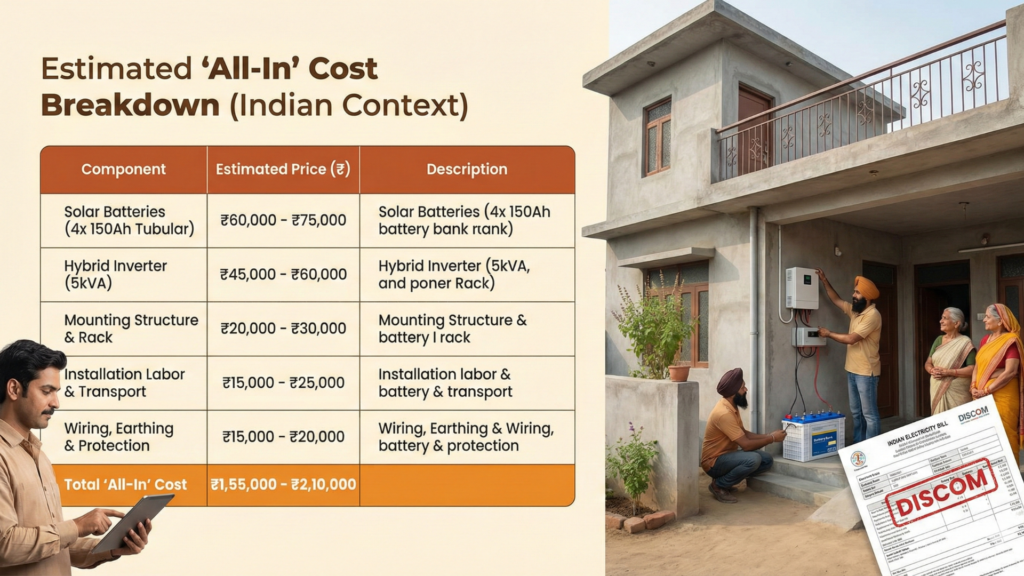
This table breaks down the total expense for a typical 5kW Hybrid Solar System with battery backup, suitable for a standard 3-4 BHK Indian home.
| Cost Component | Estimated Price (₹) | Description |
| Solar Batteries (4x 150Ah Tubular) | ₹60,000 – ₹75,000 | The core energy storage component. |
| Hybrid Inverter (5kVA) | ₹45,000 – ₹60,000 | Manages solar, grid, and battery power. |
| Solar Panels (Optional Add-on) | ₹1,20,000 – ₹1,50,000 | Mono-PERC panels (bifacial are slightly higher). |
| Mounting Structure & Rack | ₹20,000 – ₹30,000 | GI high-rise structure for panels + battery rack. |
| Installation Labor & Transport | ₹15,000 – ₹25,000 | Professional installation by certified technician. |
| Wiring, Earthing & Protection | ₹15,000 – ₹20,000 | DCDB, ACDB boxes, Lightning Arrester, cables. |
| Total “All-In” Cost | ₹2,75,000 – ₹3,60,000 | Total cost before government subsidy. |
Note: The solar battery price for home setups mentioned above uses Lead-Acid batteries. If you opt for a Lithium-ion wall mount (5kWh), replace the battery cost with approx. ₹1.2 Lakh to ₹1.5 Lakh.
Installation Labor and Soft Costs Impacting the Solar Battery Price for Home
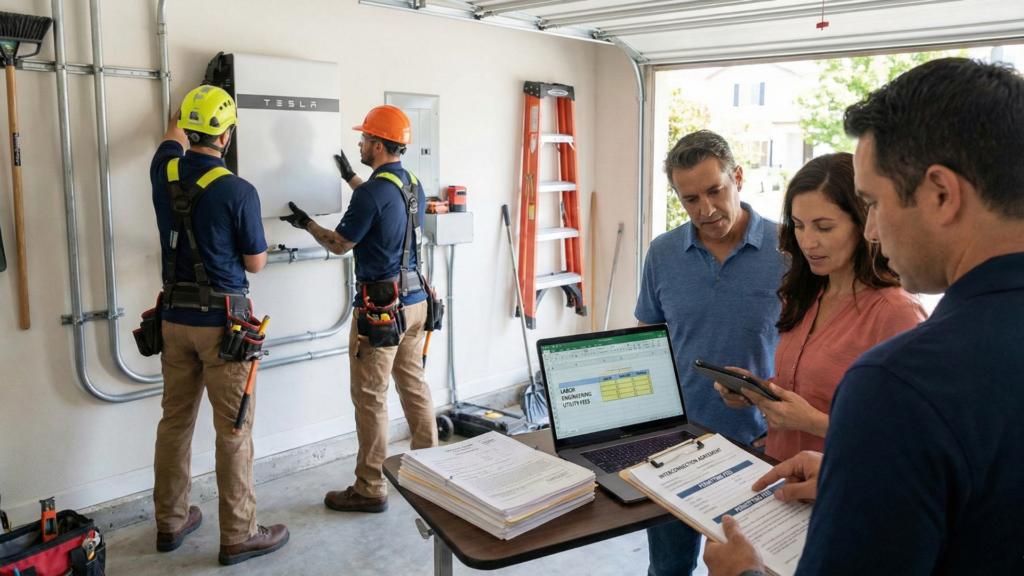
In India, labor costs are relatively affordable compared to the West, but skilled labor for hybrid systems is premium. You should not hire a local electrician for this job.
Professional Installation Charges
A certified solar installer will charge for:
- Site Survey: Checking shadow-free areas and load calculation.
- Civil Work: Creating concrete blocks for the structure legs to prevent roof damage.
- Electrical Commissioning: Configuring the inverter settings (configuring battery cut-off voltages, grid feed-in settings).
Labor usually adds about 10-15% to the hardware cost. While you might try to negotiate the solar battery price for home, do not negotiate on labor quality. Poor crimping of DC wires is the #1 cause of solar fires.
Net Metering Fees
If you are installing a hybrid system that also exports excess power to the grid (Net Metering), you have to pay the DISCOM (like Tata Power, BESCOM, TNEB, etc.) for:
- Net Meter Application fees.
- Bi-directional meter hardware (₹3,000 – ₹5,000).
- Liaisoning charges (administrative work handled by the vendor).
Comparison of Technologies Influencing the Solar Battery Price for Home
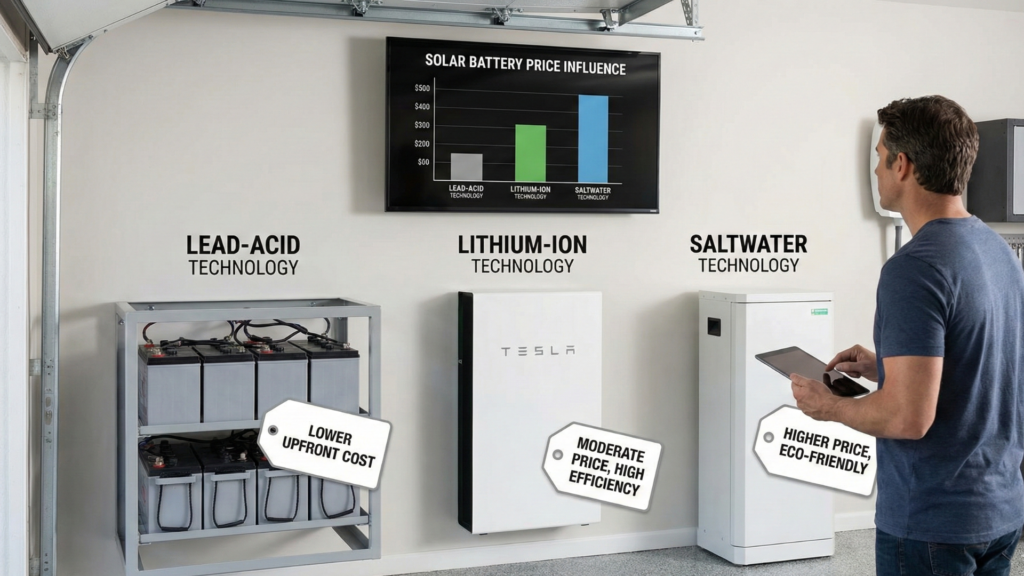
Choosing the right brand and technology is critical. Below is a comparison of popular options available in the Indian market.
Table 2: Brand and Tech Comparison (Indian Market)
| Brand / Series | Technology | Voltage / Capacity | Est. Price (Battery Only) | Best For |
| Luminous Red Charge | Lead-Acid (Tubular) | 12V / 150Ah | ₹14,500 | Budget users; areas with long cuts. |
| Exide InvaTubular | Lead-Acid (Tubular) | 12V / 200Ah | ₹19,000 | High-load homes needing longer backup. |
| Tata Power EzHome | Lithium-ion | 5 kWh Unit | ₹1,35,000 (approx) | Premium apartments; aesthetic look. |
| Livguard | Lead-Acid (Tall) | 12V / 150Ah | ₹13,800 | Value for money; robust warranty. |
| Loom Solar Atom | Lithium Battery | 100Ah / 48V (approx 5kWh) | ₹1,25,000 | Modern homes; maintenance-free usage. |
As seen above, the solar battery price for home doubles if you switch from Exide/Luminous tubular batteries to a Lithium solution, but you save on replacement costs in the long run (Lithium lasts 10 years vs. 4 years for Tubular).
How Government Subsidy Affects the Solar Battery Price for Home
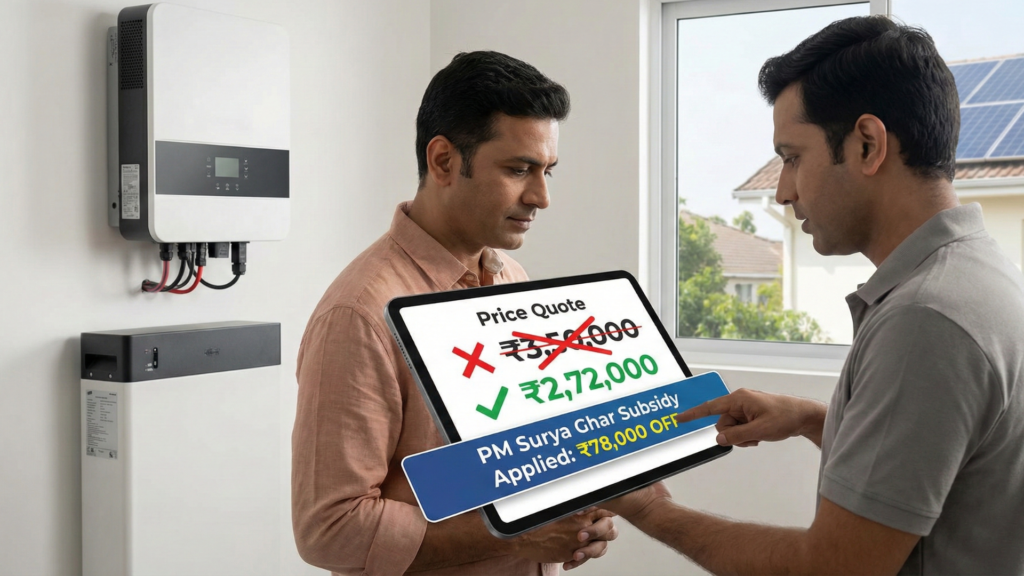
A major factor to consider in 2025 is the PM Surya Ghar: Muft Bijli Yojana.
While the government subsidy (up to ₹78,000 for a 3kW system) is primarily calculated on the solar module capacity, many homeowners use this subsidy to offset the cost of the hybrid inverter and batteries.
- Direct Subsidy: Generally applies to On-Grid systems.
- Hybrid Systems: Under the new schemes, hybrid systems (which include batteries) are becoming eligible for interconnection, but the subsidy amount usually remains capped based on the solar panel capacity.
By utilizing the subsidy on the panel and structure side, the effective solar battery price for home setup reduces significantly, improving your Return on Investment (ROI) from 5 years to roughly 3.5 years.
Calculating the ROI: Is the High Solar Battery Price for Home Justified?
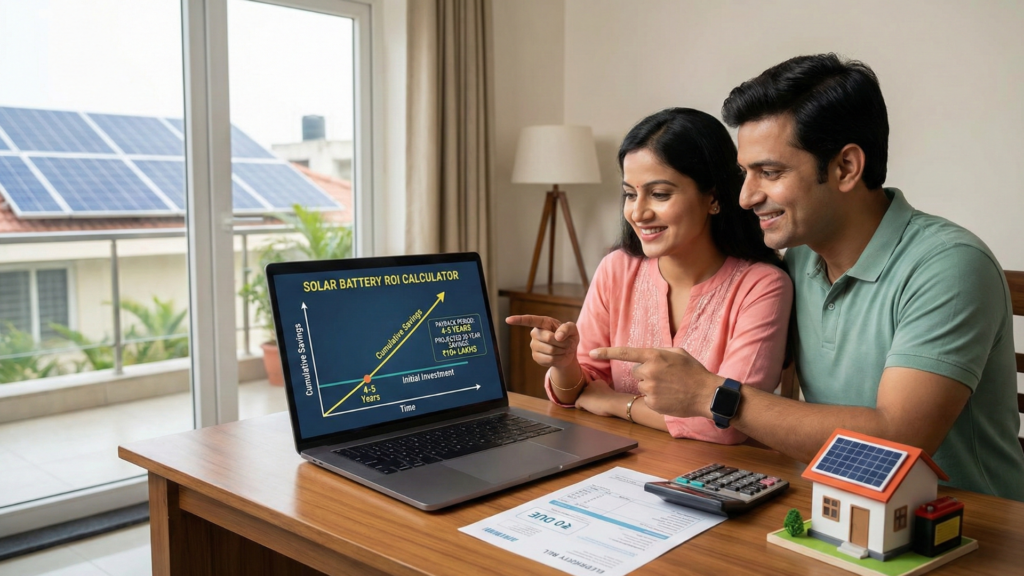
Many Indians hesitate due to the upfront cost. However, let’s look at the math for a typical household in a Tier-2 city with a ₹4,000 monthly electricity bill.
- Bill Savings: A 3kW hybrid system generates roughly 360 units a month. This can eliminate an electricity bill of ₹3,000-₹4,000.
- Diesel Savings: If you use a diesel generator during power cuts, the cost is ₹18-₹25 per unit of electricity. Solar batteries provide this power for “free” (after initial cost).
- Appliance Safety: Hybrid inverters provide pure sine wave output, protecting sensitive electronics (TVs, Fridges, Laptops) from grid fluctuations, saving repair costs.
When you factor in these savings, the high solar battery price for home pays for itself within 4 to 5 years, after which you enjoy virtually free electricity for the next 20 years.
Maintenance Costs to Consider
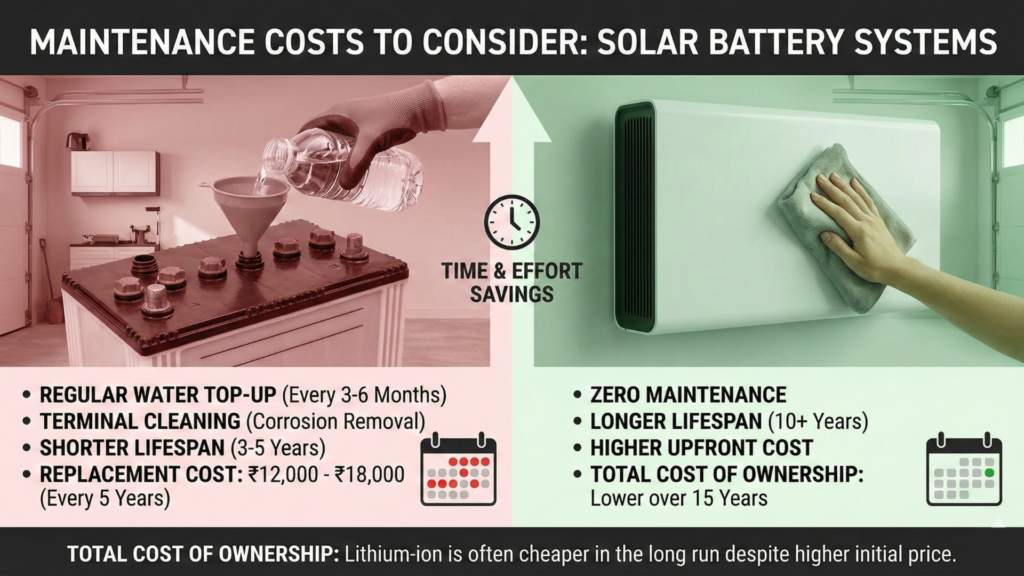
When budgeting, remember that the solar battery price for home isn’t a “one-time” expense if you choose Lead-Acid batteries.
- Distilled Water: You must top up the water every 3-6 months. Neglecting this ruins the battery.
- Terminal Cleaning: Carbon buildup on terminals needs cleaning to prevent voltage drops.
- Replacement Cycle: Lead-acid batteries degrade. You will likely need to pay the solar battery price for home again in 5 years when they die.
This is why Lithium-ion is gaining popularity. Despite the higher upfront price, the “Total Cost of Ownership” over 15 years is lower because you buy it once, whereas you would buy lead-acid batteries three times in the same period.
Conclusion
The solar battery price for home is more than just the cost of the box you buy from Amazon or a local dealer. It is an ecosystem of safety devices, heavy-duty structures, intelligent inverters, and skilled labor.
For a standard Indian household, while you might see a battery listed for ₹15,000, the reality is that a complete, safe, and reliable power backup system will cost between ₹1.5 Lakh and ₹3.5 Lakh (depending on if you include solar panels).
However, with the rising cost of grid electricity and the generous subsidies available under the PM Surya Ghar scheme, the investment has never been more attractive. When soliciting quotes, always ask for an “All-Inclusive” price that covers wiring, structure, and commissioning to ensure there are no surprises later.
Frequently Asked Questions (FAQ)
1. What is the average solar battery price for home in India for a 150Ah unit?
For a standard Lead-Acid Tall Tubular battery (150Ah), the price ranges from ₹12,000 to ₹16,000 depending on brands like Exide, Luminous, or Livguard.
2. Is the solar battery price for home covered under the government subsidy?
Directly, no. The subsidy (Central Financial Assistance) is calculated on the solar module capacity (kW). However, you can use the subsidy amount received for the panels to offset the total cost of your hybrid system, effectively reducing the battery investment.
3. Which is better value for money: Lead-Acid or Lithium?
If you have the budget, Lithium-ion is better value long-term. Although the solar battery price for home for Lithium is double that of Lead-Acid, Lithium lasts 10+ years, whereas Lead-Acid lasts 3-4 years.
4. Can I run an AC on a solar battery?
Yes, but it requires a larger bank. To run a 1.5 Ton Inverter AC, you typically need at least a 5kVA Inverter and a 48V battery bank (4 batteries). This setup increases the solar battery price for home significantly compared to a basic lights-and-fans backup.
5. Do I need to pay monthly charges after installing solar batteries?
No. Off-grid and hybrid systems have no monthly charges. However, if you are on a Net Metering connection, you may still pay a small “fixed charge” to the electricity department for the grid connection, even if your energy consumption bill is zero.