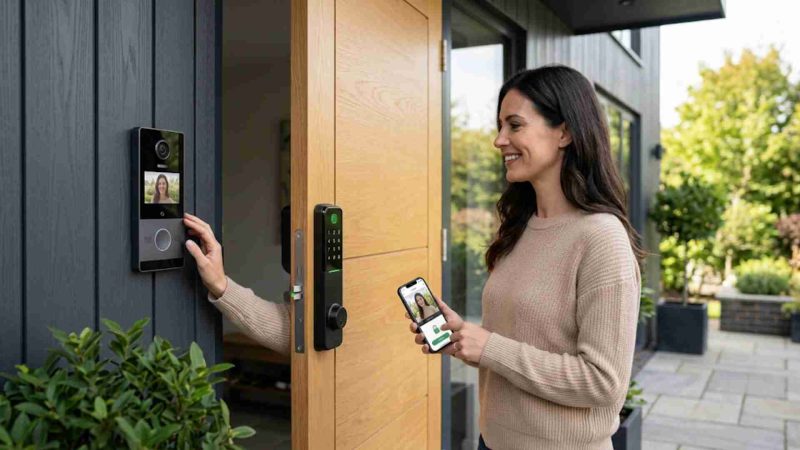
In the era of modern residential security, upgrading your front entryway is no longer just about buying a sturdy deadbolt. Homeowners today demand a system that blends maximum security with effortless convenience. This is exactly where a unified smart lock and video door phone integration comes into play, transforming how we manage home access. By bridging visual communication with electronic locking mechanisms, you can see, speak to, and grant access to visitors from anywhere in the world through a single, cohesive ecosystem.
Separately, smart locks and video door phones provide excellent standalone utility. However, when you combine these two pieces of hardware into a singular, interconnected network, you eliminate daily operational friction. Let’s explore how this technology functions, the tangible security benefits it brings to your household, and how you can successfully implement it.
What is Smart Lock and Video Door Phone Integration?
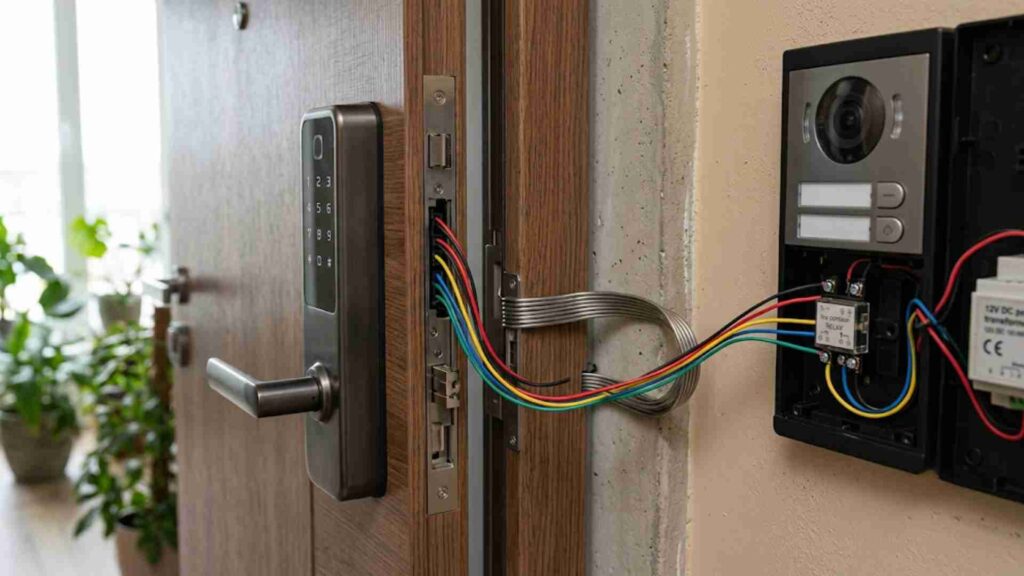
To truly appreciate the value of a unified front door, it helps to understand what happens beneath the surface. When you combine a digital access lock with an intercom video station, you are merging real-time visual verification with physical execution.
Technical Workflow: How Smart Lock and Video Door Phone Integration Connects
Traditionally, a standard video doorbell simply acts as a camera and a buzzer. If you want to let someone in, you still have to physically walk to the entrance or switch over to a separate smartphone application to toggle the deadbolt. A proper smart lock and video door phone integration bridges this communication gap using one of two primary structural methods:
- Hardware Relay Connections (Hardwired): In many modern apartment complexes and commercial setups, the outdoor panel of the video door phone contains a physical dry relay connection. This relay is directly wired into an electronic mortise lock or motorized drop-bolt power supply. When you press the unlock button on your indoor monitor panel, it triggers the circuit, causing the lock to mechanically release.
- Software-Level Smart Ecosystems (Wireless): With universal IoT protocols like Matter gaining mass adoption, modern systems are shifting rapidly toward wireless software cohesion. When your smart lock and video intercom station share a universal protocol or live within the same manufacturer ecosystem, they communicate over local Wi-Fi or Thread networks. This allows the application to overlay a native “Unlock Door” button directly over the live video stream.
Core Benefits of Smart Lock and Video Door Phone Integration for Home Security
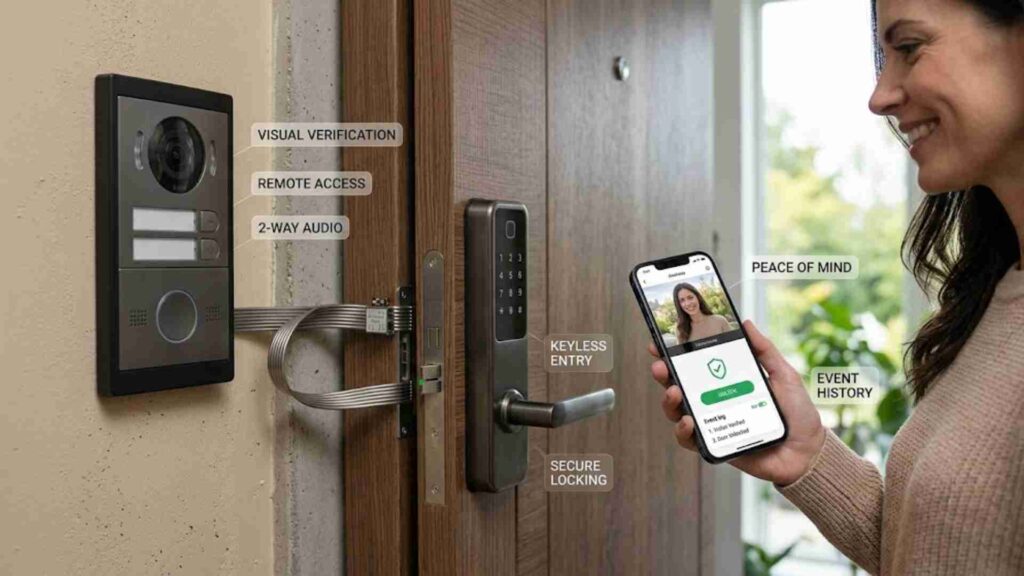
Why take the extra step to link these two security devices? The advantages of a dedicated smart lock and video door phone integration extend far beyond the pure novelty of remote unlocking.
Eliminating Visual Blind Spots
A standalone smart lock lets you give out PIN codes or register fingerprints, but it can never verify if the person using that code is alone or under duress. Conversely, a basic video door phone lets you see the visitor but leaves you helpless to grant entry remotely. Integrating them ensures that every single lock activation can be contextually tied to a live visual confirmation.
Simplified Management for Busy Households
Managing a modern home with a rotating roster of family members, domestic help, delivery drivers, and guests can be a logistical headache. An integrated front door turns complex scheduling into a simple, automated routine.
Real-World Impact: Instead of distributing physical mechanical keys—which are highly susceptible to loss or unauthorized duplication—homeowners can monitor arrival logs via the integrated app and let trusted workers inside on a strict schedule without ever giving out a master password.
Advanced Threat Mitigation
With local AI processing embedded within contemporary security chips, an integrated porch system behaves less like a passive latch and more like an active digital sentry. If an unidentified individual lingers in front of your doorway for an extended period without ringing the bell, the video phone can trigger ambient porch lighting to illuminate, flash an instant alert to your smartphone, and place the smart lock into a heightened temporary lockdown mode.
Deployment Protocols: Smart Lock and Video Door Phone Integration Matrix
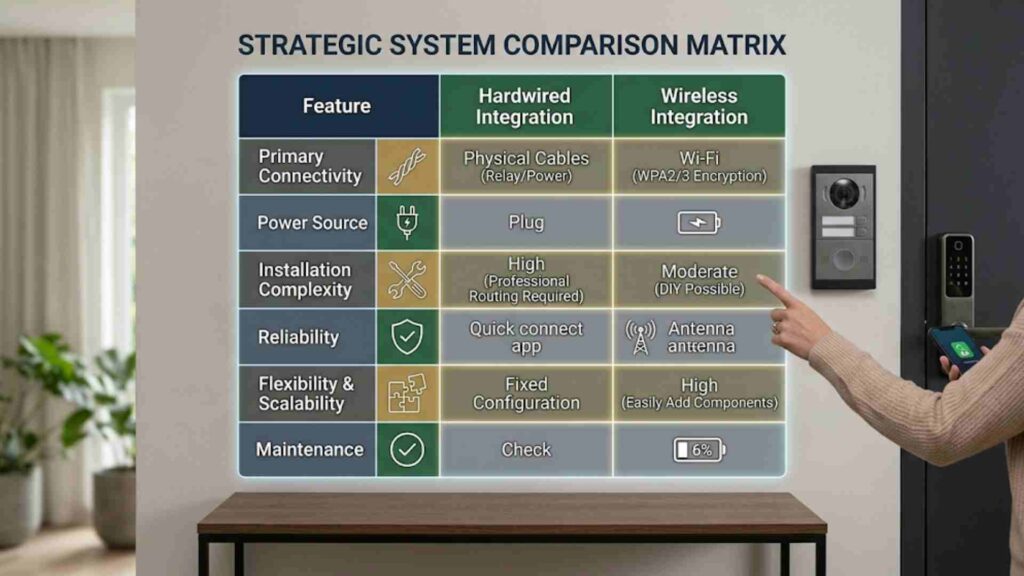
Before purchasing your hardware, it is critical to determine which structural approach fits your physical framework. Use the table below to weigh your options based on installation complexity, structural constraints, and lifestyle needs.
| Integration Type | Primary Connectivity | Best Suited For | Key Advantages | Potential Limitations |
| Hardwired Relay System | 12V/24V Physical Wiring, Dry Contact Relays | New Constructions, High-Traffic Offices, Fixed Apartments | Absolute reliability; immune to Wi-Fi outages; zero battery maintenance. | Disruptive installation; requires professional routing of cables through the door frame. |
| Ecosystem-Native Wireless | Matter, Thread, Local Wi-Fi Networks | DIY Renovations, Existing Smart Homes, Rental Properties | Extremely easy setup; deep integration with voice assistants; scalable over time. | Dependent on network stability; requires regular battery monitoring or rechargeable modules. |
| All-in-One Camera-Lock Unit | Built-in Wi-Fi & Integrated Video Lens | Individual Apartment Main Doors, Minimalist Entrances | Single device to install; cohesive native app experience straight out of the box. | Lens angle is fixed strictly at door level; cannot view the porch if the door is fully swung open. |
Step-by-Step Implementation Guide
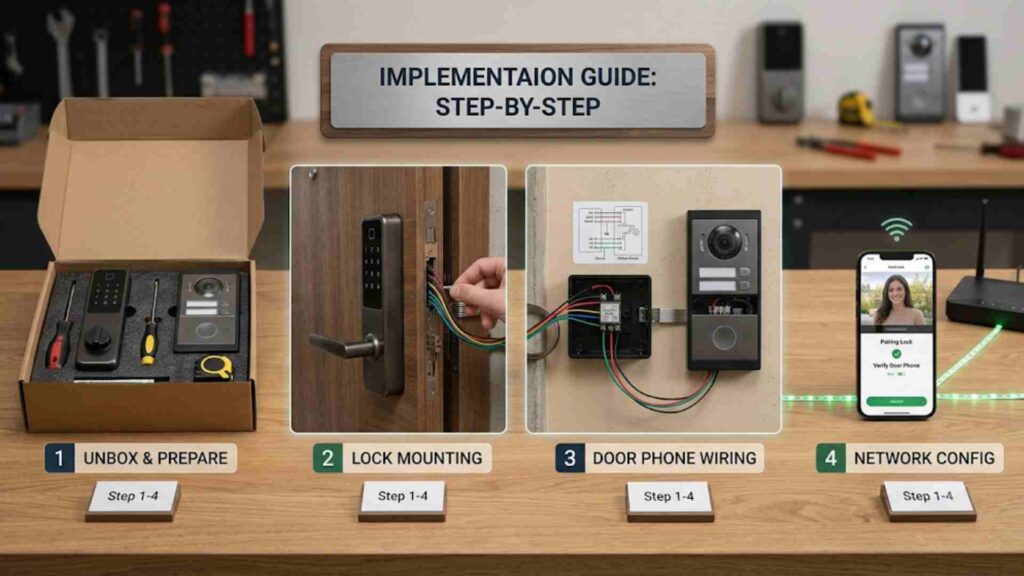
If you are planning to deploy a seamless access architecture, following a strict structural sequence prevents common compatibility pitfalls.
Step 1: Physical Door Evaluation
Measure your door thickness, backset, and frame clearance. Determine if you are working with a standard wooden deadbolt layout or a multi-point metallic locking mechanism, as this dictates the exact smart mortise lock size required.
Step 2: Protocol Compatibility Verification
Ensure both devices can communicate. If opting for a wireless configuration, select a lock and door phone that support a shared standard like Matter or live on the same application platform (e.g., Smart Life or Tuya). If hardwired, confirm the video station’s relay voltage matches your lock’s power demands.
Step 3: Hardware Installation
Mount the smart lock chassis onto the door panel. If using an electric strike or a hardwired drop-bolt, precisely carve out the recess within the door frame and safely route the low-voltage power lines through a concealed loop hinge.
Step 4: Video Door Phone Alignment
Install the outdoor camera unit at an optimized height (ideally 4.5 to 5 feet off the ground) to prevent backlighting glare from the sun. Position the indoor master monitor panel in a central, easily accessible location like a main hallway or kitchen hub.
Step 5: Ecosystem Syncing & Testing
Boot up your central smart home app. Pair both units to your local network, assign static IP addresses if using an IP intercom system, and test the digital override button to verify that pressing “unlock” successfully triggers the physical latch.
Conclusion
The implementation of a comprehensive smart lock and video door phone integration marks a significant evolutionary leap. Indeed, by intertwining visual verification with digital execution, you create an entry point that is profoundly secure. It remains incredibly welcoming for verified visitors.
Moreover, eliminating the physical key barrier significantly reduces daily friction. This applies whether you opt for a hardwired system or a wireless ecosystem. At the same time, this setup ensures that you maintain total sovereignty over your threshold. Therefore, a unified front door is undoubtedly standard infrastructure for modern, intelligent living.
Frequently Asked Questions (FAQ)
Q1. Can I unlock my smart lock directly from the video door phone screen?
Ans: Yes. When you set up a complete smart lock and video door phone integration, a dedicated unlock button appears right on your indoor monitor or smartphone screen during a live video call, allowing you to grant access with a single tap.
Q2. What happens to the door lock if the internet goes down?
Ans: Fortunately, the core locking features continue to function perfectly. Since smart locks rely on local battery power, your main door remains completely secure. You can still access it via fingerprints or PIN codes during a Wi-Fi outage.
Q3. Can I integrate an existing video doorbell with a separate brand of smart lock?
Ans: Yes, you can bridge different brands by connecting them to a unified smart home platform like Google Home, Apple Home, or Alexa, or by using universal smart home protocols such as Matter.
Q4. Is this integrated security system vulnerable to digital hacking?
Ans: Modern premium systems use bank-grade AES 128-bit or 256-bit encryption to protect data transmission. Additionally, sensitive biometric data is stored locally on secure hardware chips inside the device, not on open cloud networks.
Q5. Does a hardwired integration require constant battery replacements?
Ans: No. Hardwired systems run on a continuous 12V or 24V power supply routed directly through your home’s electrical lines. Only wireless, battery-operated smart locks require periodic battery swaps or recharging every few months.