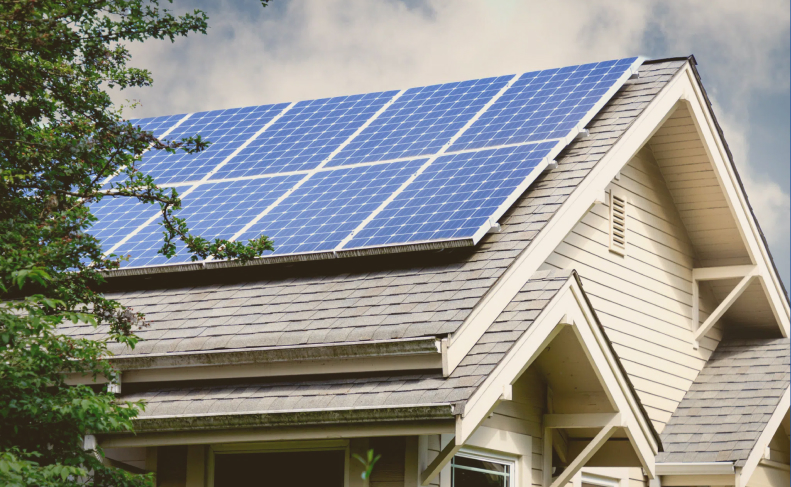

The Pink City is turning green. As electricity prices rise and the push for sustainable energy grows, rooftop solar installation in Jaipur has shifted from being a “future concept” to a “present-day necessity.” For homeowners in areas like Vaishali Nagar, Mansarovar, or Malviya Nagar, the question is no longer if they should go solar, but when.
With Rajasthan leading India’s solar revolution, Jaipur sits at the heart of this transformation. In this massive guide, we will break down costs, subsidies, technical requirements, and the step-by-step journey of transitioning to solar power in 2026.
Why Now is the Perfect Time for Rooftop Solar Installation in Jaipur?

If you look at the skyline of Jaipur today, you’ll notice a shimmering blue-and-black pattern across residential rooftops. This isn’t just a trend; it’s a financial masterstroke.
The Solar Potential of Jaipur
Jaipur receives nearly 300 days of clear sunshine annually. The solar irradiance level here is significantly higher than in coastal or hilly regions. When you opt for rooftop solar installation in Jaipur, you are essentially tapping into a free, infinite battery that sits right above your house.
Beating the JVVNL Tariff Hikes
The Jaipur Vidyut Vitran Nigam Limited (JVVNL) tariffs have seen a steady climb. By installing a solar plant, you lock in your electricity costs for the next 25 years. Imagine not having to worry about the “Fuel Surcharge” or “Electricity Duty” on your bill ever again.
Financial Benefits of Rooftop Solar Installation in Jaipur

Most people view solar as an expense, but it is actually one of the highest-yielding investments available in India today.
Return on Investment (ROI)
A typical residential solar system in Jaipur pays for itself within 3.5 to 4.5 years. After this period, the electricity generated is essentially free for the remaining life of the system (which is usually 25+ years).
Property Value Appreciation
Homes with a pre-installed rooftop solar installation in Jaipur are seeing a 3-5% increase in resale value. Buyers today prefer “smart homes” that come with zero-electricity-bill guarantees.
Understanding the PM Surya Ghar: Muft Bijli Yojana in Jaipur

The year 2026 has seen a massive push through the PM Surya Ghar Yojana. This central government scheme has simplified the subsidy process for rooftop solar installation in Jaipur.
Subsidy Breakdown for 2026
The subsidy is credited directly to the consumer’s bank account within 30 days of installation. Here is how the numbers look:
| System Capacity | Estimated Cost (INR) | Central Subsidy (PM Surya Ghar) | Effective Cost to Customer |
| 1 kW System | ₹70,000 – ₹85,000 | ₹30,000 | ₹40,000 – ₹55,000 |
| 2 kW System | ₹1,45,000 – ₹1,65,000 | ₹60,000 | ₹85,000 – ₹1,05,000 |
| 3 kW System | ₹1,95,000 – ₹2,15,000 | ₹78,000 | ₹1,17,000 – ₹1,37,000 |
| 5 kW System | ₹3,10,000 – ₹3,40,000 | ₹78,000 | ₹2,32,000 – ₹2,62,000 |
| 10 kW System | ₹5,60,000 – ₹6,20,000 | ₹78,000 | ₹4,82,000 – ₹5,42,000 |
Technical Components of a Rooftop Solar Installation in Jaipur

To ensure your system lasts 25 years, you need to know what goes on your roof. Quality varies, and in the heat of Jaipur, quality is everything.
High-Efficiency Solar Panels (Modules)
In 2026, TOPCon and Bifacial panels are the gold standard. Since Jaipur can get extremely hot (45°C+), you need panels with a low temperature coefficient so they don’t lose efficiency when the sun is at its peak.
Solar Inverters: The Brain of the System
For a successful solar setup, your inverter must be robust enough to handle Rajasthan’s climate. Leading brands like Growatt, Sungrow, and Havells are highly popular due to their durability. Many homeowners now prefer Hybrid inverters to ensure an uninterrupted power supply even during occasional grid failures.
The Mounting Structure
Jaipur is prone to dust storms (Andhi) in May and June. Your rooftop solar installation in Jaipur must use Hot-Dip Galvanized (HDG) structures. These are rust-proof and heavy enough to withstand wind speeds of up to 150 km/h.
Step-by-Step Process for Rooftop Solar Installation in Jaipur
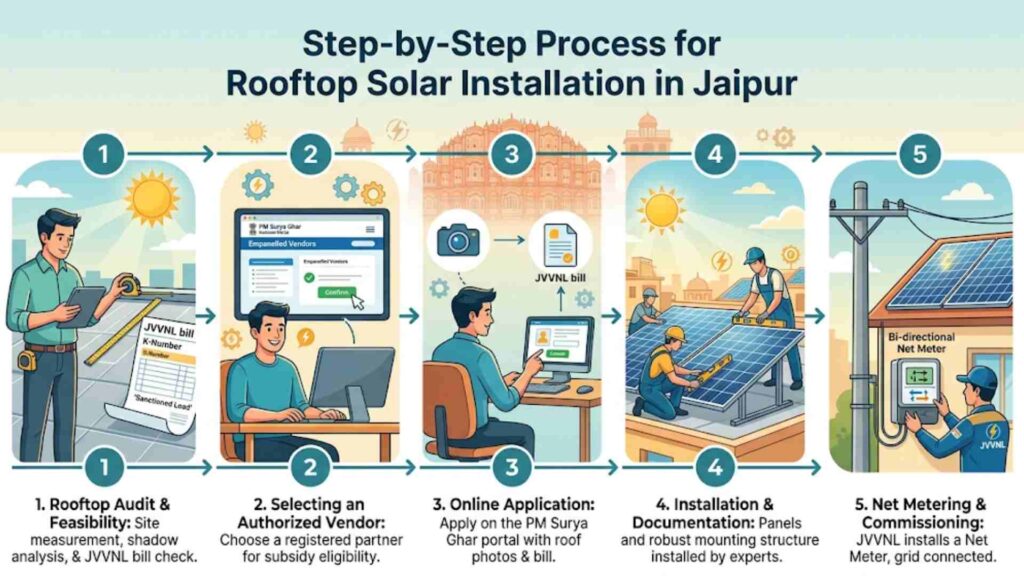
Navigating the JVVNL and National Portal can be tricky. Here is the simplified roadmap:
Step 1: Rooftop Audit and Feasibility
A technician will measure your roof. You need roughly 100 sq. ft. of shadow-free space per 1kW. They will also check your “Sanctioned Load” from your JVVNL bill.
Step 2: Selecting an Authorized Vendor
Only vendors registered on the National Portal (PM Surya Ghar) are eligible to provide subsidies. Ensure your partner for rooftop solar installation in Jaipur is an empanelled vendor.
Step 3: Online Application
Apply on the PM Surya Ghar portal. You will need your K-Number, a photo of your roof, and a copy of your latest electricity bill.
Step 4: Installation and Documentation
Once “Feasibility Approval” is granted by JVVNL, the physical installation begins. This usually takes 2-4 days.
Step 5: Net Metering and Commissioning
JVVNL will replace your old meter with a Bi-directional Net Meter. This meter records both the energy you consume and the energy your rooftop solar installation in Jaipur exports to the grid.
Challenges and Maintenance of Rooftop Solar Installation in Jaipur

While solar is “low maintenance,” it is not “no maintenance”—especially in Rajasthan.
Dealing with Dust (The Biggest Enemy)
The dust in Jaipur settles on panels and creates a “shading effect,” which can drop generation by 30%.
- Solution: Weekly cleaning with pressurized water. Automated sprinkler systems are now a popular add-on for rooftop solar installation in Jaipur.
Heat Degradation
Electronics hate extreme heat.
- Solution: Ensure your inverter is installed in a shaded, well-ventilated area, and not directly under the sun.
Monkey Menace
In areas like Galta Gate or near the Aravalis, monkeys can be a problem.Solution: Use reinforced structures and protective fencing around the panels.
Comparing Solar Types: Which is Right for Your Jaipur Home?

When planning your transition to clean energy, you must choose between three main system types based on your needs:
- On-Grid System: Best for those who want to reduce bills. It uses the grid as a “battery.”
- Off-Grid System: Best for farmhouses on the outskirts of Jaipur (like Kalwar Road or Ajmer Road) where grid stability is low.
- Hybrid System: The most premium choice for rooftop solar installation in Jaipur, providing both savings and 24/7 backup.
Environmental Impact: How Jaipur Residents are Saving the Planet

By choosing rooftop solar installation in Jaipur, you aren’t just saving money; you are preventing carbon emissions.
- A 5kW system saves approximately 125 tonnes of CO₂ over its lifetime.
- This is equivalent to planting over 200 trees.
As Jaipur strives to become a “Smart City,” solar energy is the backbone of its environmental goals.
Conclusion: Lighting Up the Pink City
Rooftop solar installation in Jaipur is a win-win scenario. The combination of high solar radiation, generous government subsidies, and rising electricity costs makes it the most logical home improvement you can make in 2026.
From the initial site visit to the first “Zero Bill” you receive from JVVNL, the journey to solar is an empowering experience. You stop being a mere consumer of energy and become a “prosumer”—one who produces and consumes their own clean power.
Frequently Asked Questions (FAQs)
1. Is there a specific policy for rooftop solar installation in Jaipur for 2026?
Yes, the Rajasthan Solar Policy 2023 (updated in 2025/26) and the PM Surya Ghar Yojana govern all installations. They provide the framework for net metering and the direct-to-bank subsidy.
2. Can I install solar on a rented house in Jaipur?
While you can, it is technically difficult because the JVVNL connection must be in the owner’s name. However, many landlords in Jaipur are now opting for rooftop solar installation in Jaipur as an amenity for tenants.
3. How do I clean my solar panels if I live in a dusty area like Mansarovar?
Use a soft brush or a sponge with water. Avoid using hard water (borewell water) as it can leave calcium deposits on the glass. Many companies providing rooftop solar installation in Jaipur also offer AMC (Annual Maintenance Contracts).
4. What happens to the excess power my system generates?
The excess power is sent to the JVVNL grid. At the end of the billing cycle, JVVNL adjusts this against your consumption. If you have a surplus at the end of the year, they pay you at a pre-determined feed-in tariff.
5. What is the average payback period for rooftop solar installation in Jaipur?
With the current 2026 subsidy rates, the payback period is roughly 3.5 to 4 years for a standard 3kW residential system.