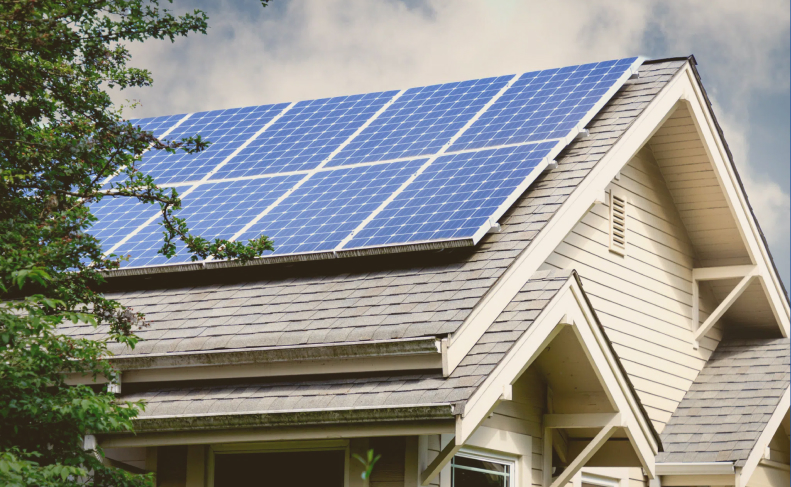
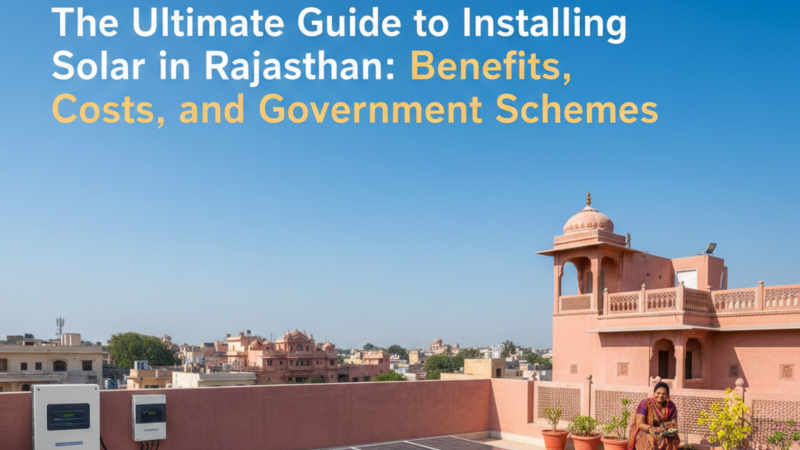
Rajasthan is not just the land of kings and heritage; it is rapidly becoming the solar capital of India. With over 325 sunny days a year and the highest solar irradiance in the country, the state offers a goldmine for renewable energy. Whether you are a homeowner in Jaipur or a business owner in Jodhpur, understanding the benefits of solar energy in Rajasthan’s climate is essential, as switching to solar is no longer just an environmental choice—it is a smart financial strategy.
In this comprehensive guide, we explore everything you need to know about solar installation in 2026, including costs, subsidies, and how to maximize your savings.
Why Rajasthan is the Best State for Solar Energy
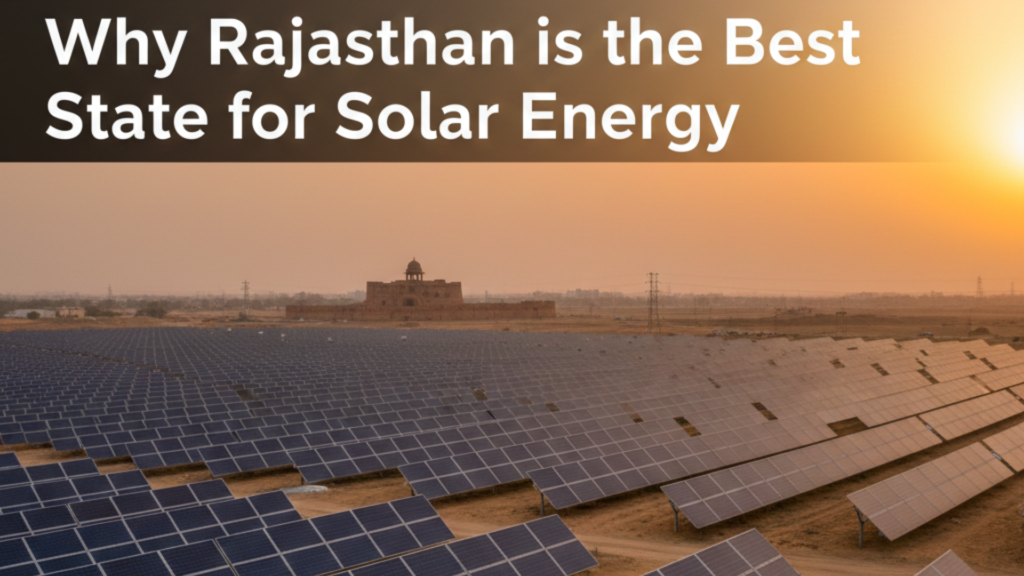
Rajasthan currently leads India in solar capacity, surpassing 18 GW. The state’s geographical advantage—vast stretches of the Thar Desert and minimal cloud cover—makes it a powerhouse for solar generation.
Under the Rajasthan Solar Energy Policy 2025, the government has set ambitious targets to reach 90 GW of solar capacity by 2030. This push is supported by massive infrastructure projects, such as the extension of the Bhadla Solar Park and new solar parks planned for Bikaner and Jaisalmer in the 2026-27 State Budget.
Exploring the Core Benefits of Solar Energy in Rajasthan’s Climate
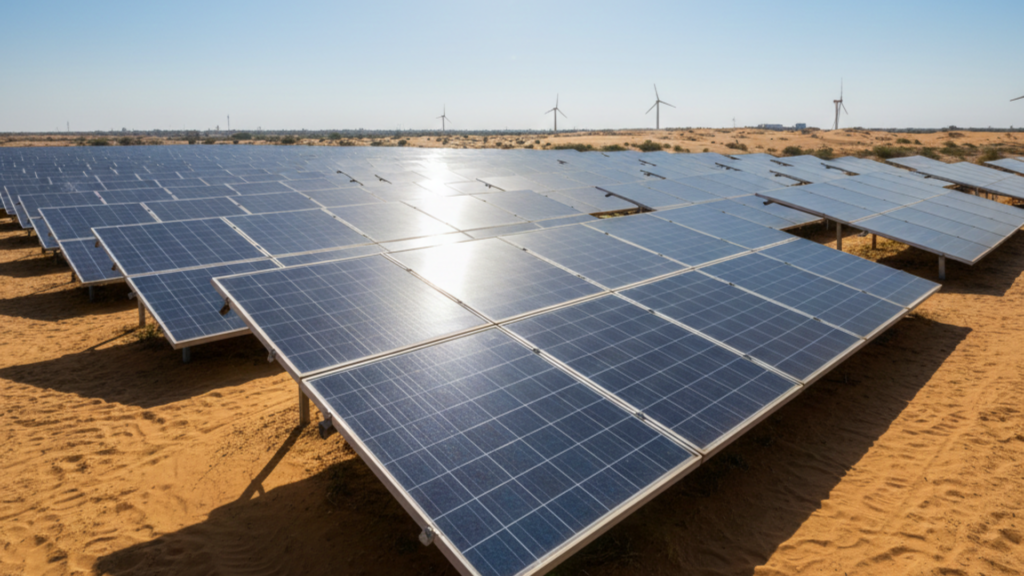
The primary reason to go solar here is the efficiency of the system. Let’s break down the benefits of solar energy in Rajasthan’s climate and why it yields better results than in any other Indian state.
1. High Solar Irradiance (Maximum Output)
Rajasthan receives an average solar radiation of 5.5 to 6.5 kWh/m²/day. This means a 1kW solar system in Rajasthan will produce significantly more units of electricity annually compared to a similar system in states like Kerala or West Bengal.
2. Low Cloud Cover
Unlike coastal or hilly regions, Rajasthan experiences very few cloudy or rainy days. This consistency ensures that your solar panels work at peak performance throughout the year, providing a reliable and predictable energy supply.
3. Arid Environment and Space
The dry, arid climate reduces the risk of moisture-related degradation often seen in humid climates. Additionally, the availability of flat rooftops and vast barren lands makes installation easier and more cost-effective.
4. Heat-Resistant Technology
With temperatures in Rajasthan often crossing 45°C, modern solar technology like TOPCon and Bifacial modules are specifically designed to handle high heat with lower temperature coefficients. This ensures that even on the hottest days, the performance drop is minimized.
Solar Installation Costs in Rajasthan (2026 Estimates)
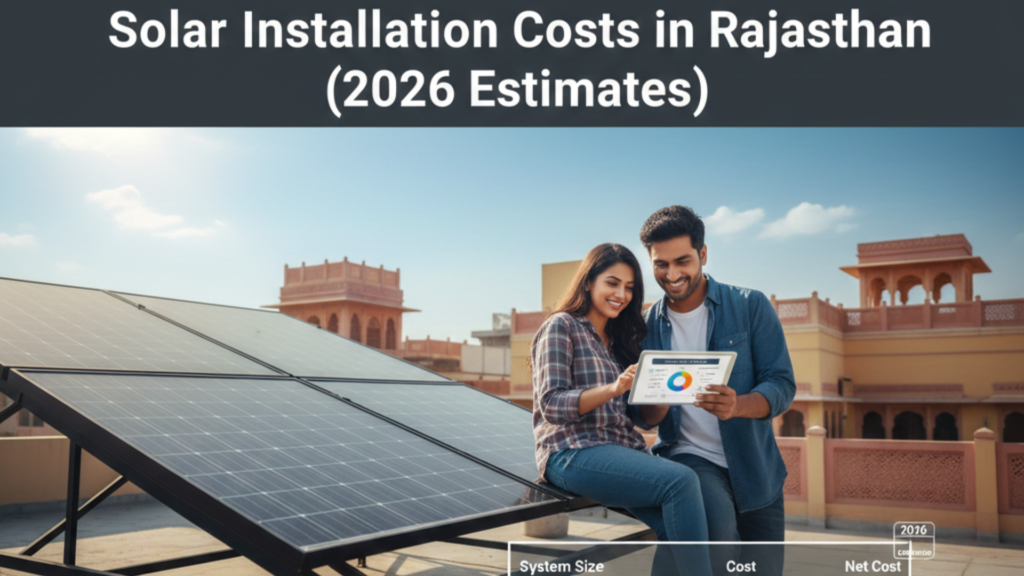
The cost of solar has become highly competitive due to advancements in manufacturing and local assembly. Below is the estimated cost for residential rooftop solar systems in Rajasthan.
Residential Solar Price Table (Before & After Subsidy)
| System Size | Type | Estimated Price (Before Subsidy) | Total Subsidy (Central + State) | Final Net Cost |
| 1 kW | On-Grid | ₹75,000 – ₹85,000 | ₹50,000 | ₹25,000 – ₹35,000 |
| 2 kW | On-Grid | ₹1,50,000 – ₹1,70,000 | ₹72,000 | ₹78,000 – ₹98,000 |
| 3 kW | On-Grid | ₹1,90,000 – ₹2,20,000 | ₹95,000 | ₹95,000 – ₹1,25,000 |
| 5 kW | On-Grid | ₹3,20,000 – ₹3,60,000 | ₹95,000 (Capped) | ₹2,25,000 – ₹2,65,000 |
| 10 kW | On-Grid | ₹5,50,000 – ₹6,30,000 | ₹95,000 (Capped) | ₹4,55,000 – ₹5,35,000 |
Note: Prices vary based on brand (Loom Solar, Waaree, Tata Solar), module type (Mono PERC vs. TOPCon), and mounting structure.
Government Schemes to Maximize the Benefits of Solar Energy in Rajasthan’s Climate
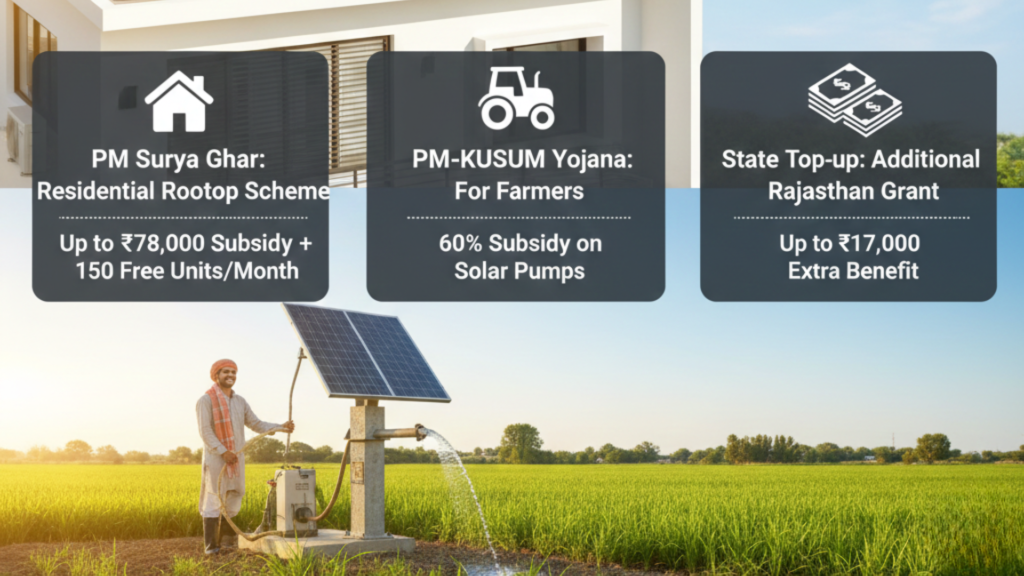
The 2026-27 Rajasthan Budget and Central policies have made solar more affordable than ever.
1. PM Surya Ghar: Muft Bijli Yojana
This is the flagship central scheme. In 2026, the subsidy has been streamlined:
- Up to 2 kW: ₹30,000 to ₹36,000 per kW.
- 3 kW and above: Capped at a maximum central subsidy of approximately ₹78,000 to ₹93,000.
- Direct Benefit Transfer (DBT): The amount is credited directly to your bank account within 30 days of installation.
2. Rajasthan State Top-up Subsidy
The Rajasthan government provides an additional state-level subsidy of ₹17,000 for residential systems of 1.1 kW and above. Combined with the central subsidy, a 3 kW system can receive a total benefit of up to ₹95,000 to ₹1,14,000.
3. PM-KUSUM Yojana (For Farmers)
This scheme helps farmers install solar pumps. The government provides a 60% subsidy, while the farmer only pays 10% upfront, with the remaining 30% available through bank loans.
4. 150 Free Units Update
As per the recent budget announcements, the Mukhyamantri Nishulk Bijli Yojana now provides 150 units of free electricity per month to households that install a minimum 1.1 kW solar rooftop plant. This replaces the old 100-unit free scheme for non-solar users.
Impact of Solar Energy on Commercial and Industrial (C&I) Sector

While residential uptake is booming, the C&I sector in Rajasthan is the biggest beneficiary of solar adoption. High commercial tariffs—ranging from ₹8 to ₹11 per unit—make solar an irresistible proposition for businesses.
Accelerated Depreciation Benefits
Companies can claim 40% accelerated depreciation in the first year of installation. This significant tax shield allows businesses to recover a large portion of their investment within the first 12 months.
Open Access Solar
Large-scale industries that do not have enough roof space can opt for “Open Access” solar. They can purchase solar power from a developer at a rate much lower than the DISCOM tariff, leading to massive savings in operational expenses (OPEX).
Understanding Net Metering in Rajasthan
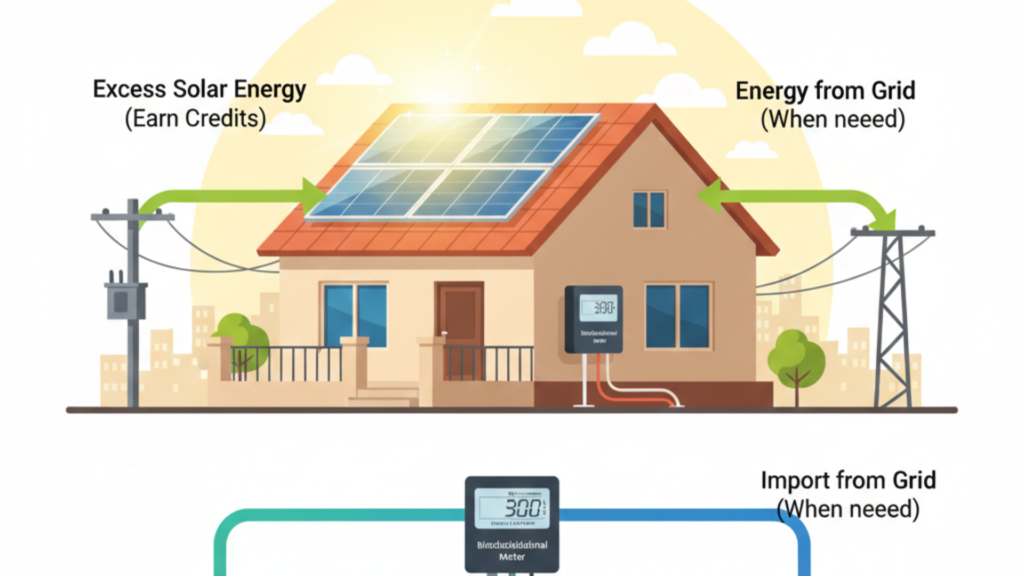
Net metering is the backbone of the solar economy in India. It is a billing mechanism that credits solar energy system owners for the electricity they add to the grid.
- Generation: Your panels produce electricity during the day.
- Consumption: Your home/office uses what it needs.
- Export: Excess energy is sent to the grid.
- Credit: At night, when the sun is down, you pull energy back from the grid. You are only billed for the “Net” units used.
Step-by-Step Process to Install Solar in Rajasthan
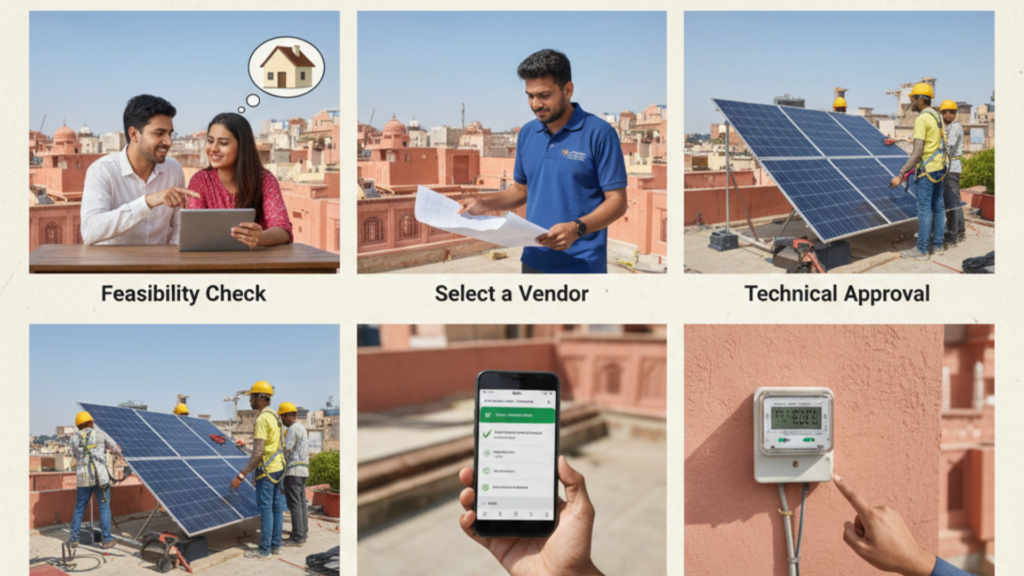
- Feasibility Check: Visit the [suspicious link removed] and register using your DISCOM (JVVNL, AVVNL, or JDVVNL) consumer number.
- Select a Vendor: Choose an MNRE-approved registered vendor. They will conduct a site survey of your roof.
- Technical Approval: Your DISCOM will review the application and provide “Feasibility Approval.”
- Installation: The vendor installs the panels, inverter, and mounting structures.
- Net Metering: The DISCOM installs a bidirectional net meter to track how much energy you export to the grid.
- Subsidy Claim: Once the inspection report is uploaded, your subsidy will be released.
Maintenance Tips to Retain the Benefits of Solar Energy in Rajasthan’s Climate
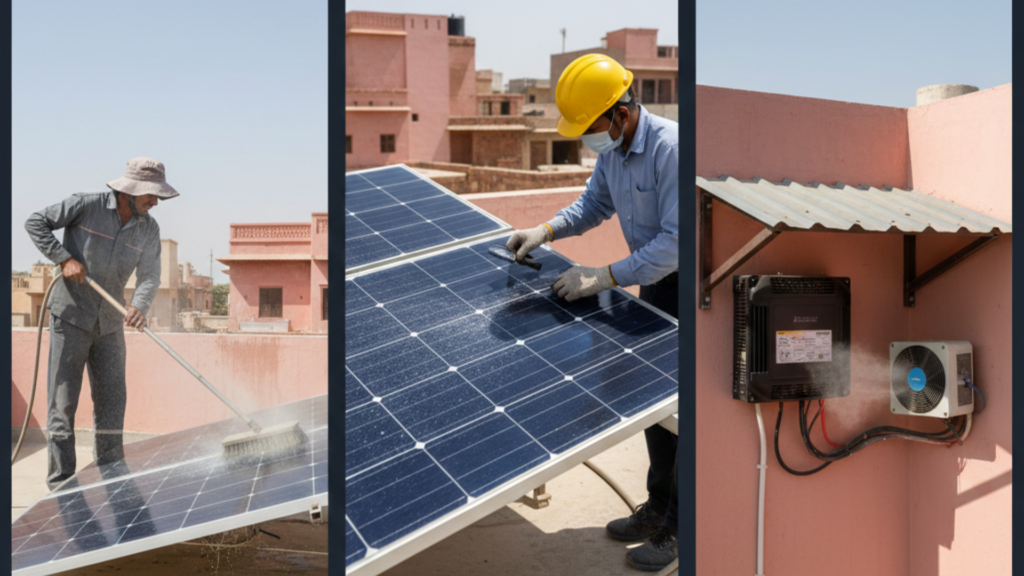
To maximize the benefits of solar energy in Rajasthan’s climate, regular maintenance is essential:
- Dust Management: Because of the desert environment, dust accumulates quickly. Clean your panels with water every 10–15 days to prevent “shading” losses.
- Check for Cracks: Extreme heat expansion can occasionally cause micro-cracks. Ensure you use panels with high mechanical load ratings.
- Inverter Cooling: Ensure your solar inverter is installed in a shaded, well-ventilated area to prevent overheating during peak summer.
Conclusion: Is Solar Worth It in 2026?
With the combined central and state subsidies, the payback period for a solar system in Rajasthan has dropped to just 3 to 4 years. Considering that panels come with a 25-year warranty, you are looking at over two decades of virtually free electricity.
From reducing your carbon footprint to achieving “Zero Electricity Bills,” the case for solar in the desert state is undeniable. The abundant sunlight isn’t just a weather condition here—it’s a financial asset waiting to be harvested.
Frequently Asked Questions (FAQ) About the Benefits of Solar Energy in Rajasthan’s Climate
1. Does the government provide a subsidy on solar batteries?
No, government subsidies like PM Surya Ghar are currently only available for On-Grid systems (without batteries). Hybrid or Off-Grid systems must be funded entirely by the consumer, though they offer the advantage of power backup during outages.
2. Can I get a bank loan for solar in Rajasthan?
Yes, most major banks like SBI, PNB, and ICICI offer “Solar Loans” at competitive interest rates (usually 1-2% higher than home loan rates). Some specialized green finance companies also offer EMI options.
3. What happens during a dust storm (Aandhi)?
Rajasthan is prone to dust storms. Modern solar mounting structures are designed to withstand wind speeds up to 150-170 km/h. It is crucial to ensure your vendor uses Hot Dip Galvanized (HDG) structures and proper civil foundations.
4. Is solar effective in winter in Rajasthan?
Yes! In fact, solar panels are often more efficient in cooler temperatures as long as there is bright sunlight. Rajasthan’s winter skies are usually clear, providing excellent generation.
5. How long do solar panels last?
Tier-1 solar panels come with a performance warranty of 25 to 30 years. While the efficiency may drop slightly (about 0.5% per year), they will continue to produce significant power for decades.