The “Pink City” of Jaipur is currently witnessing a green revolution. With electricity prices rising by nearly 7-10% annually in Rajasthan, homeowners are feeling the pinch of high utility bills, especially during the blistering summer months. However, 2026 has brought a golden opportunity. While the initial rooftop solar panel price in Jaipur might have seemed daunting in the past, a strategic combination of the Central Government’s PM Surya Ghar: Muft Bijli Yojana and the Rajasthan State Government’s Additional Subsidy has changed the game. Installing a solar plant has moved from a luxury to a “nearly free” necessity for the average household.
In this exhaustive guide, we will break down the current rooftop solar panel price in Jaipur, explore the technical requirements, and explain exactly how you can leverage subsidies to wipe out your electricity bill for the next 25 years.
The Solar Potential of Jaipur: Why Now?
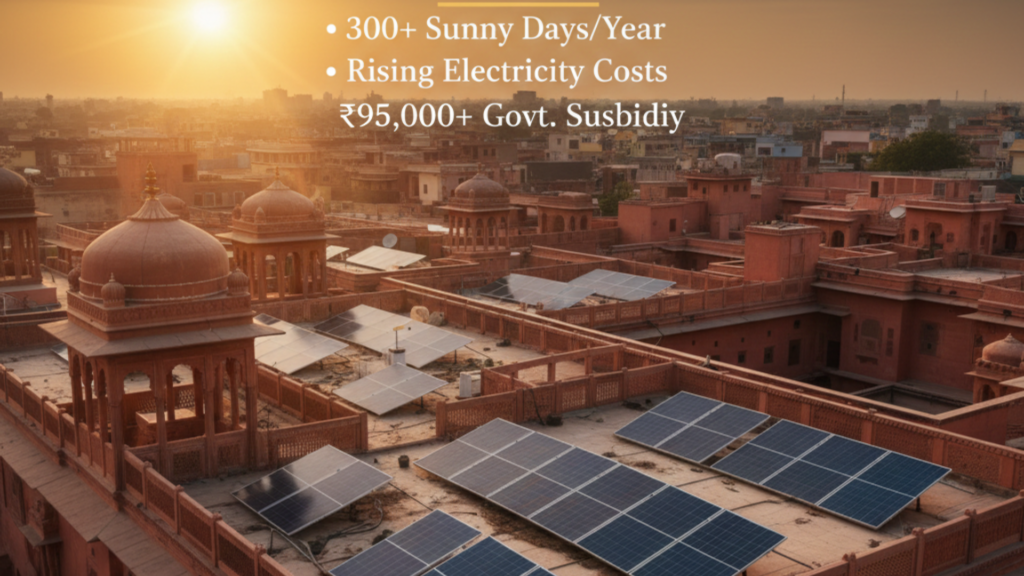
Jaipur sits in one of the world’s most favorable solar belts. With over 3,000 hours of sunshine per year, the efficiency of solar panels in Rajasthan is roughly 15-20% higher than in states like Kerala or West Bengal.
Why 2026 is the “Golden Year” for Solar:
- Technological Maturity: N-type TopCon and Bifacial panels are now affordable in the Jaipur market.
- Government Aggression: The Rajasthan government is pushing for “Solar in Every Home” to reduce the load on the aging coal-based power grid.
- Financial Incentives: The integration of state top-ups with central subsidies has reached its peak.
Understanding the Rooftop Solar Panel Price in Jaipur (2026)
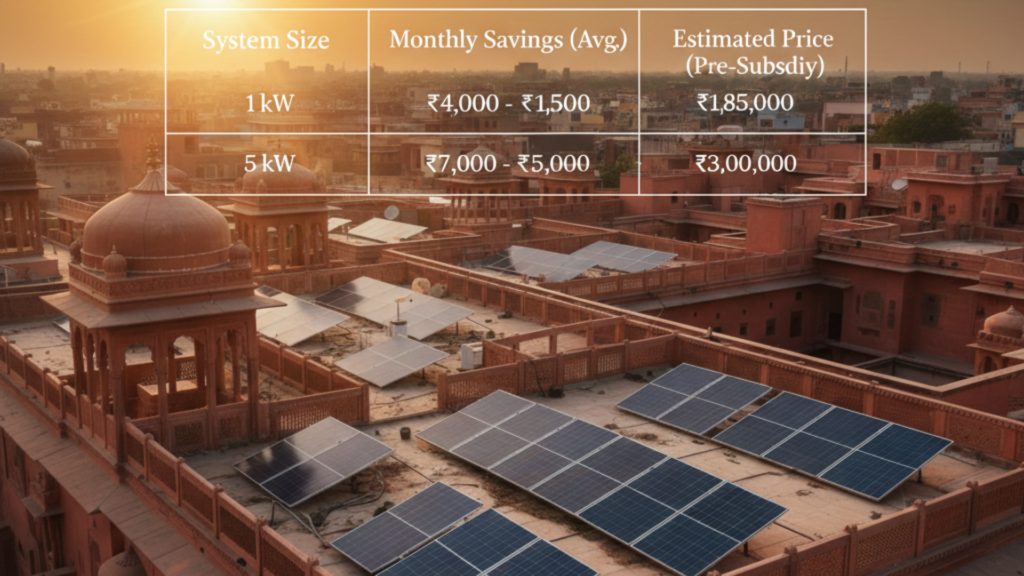
Before discussing “free” systems, we must look at the actual market cost. The price of solar in Jaipur is generally lower than the national average due to the proximity of panel manufacturing hubs in North India and a high density of certified installers in the city.
Table 1: Market Benchmarks for the Rooftop Solar Panel Price in Jaipur
| System Capacity | Expected Monthly Generation | Life Expectancy | Estimated Price (Pre-Subsidy) |
| 1 kW | 120 – 150 Units | 25 Years | ₹60,000 – ₹75,000 |
| 2 kW | 240 – 300 Units | 25 Years | ₹1,15,000 – ₹1,35,000 |
| 3 kW | 360 – 450 Units | 25 Years | ₹1,65,000 – ₹1,95,000 |
| 5 kW | 600 – 750 Units | 25 Years | ₹2,60,000 – ₹3,10,000 |
| 10 kW | 1200 – 1500 Units | 25 Years | ₹4,80,000 – ₹5,50,000 |
Note: Prices include high-efficiency Mono-PERC panels, structure, wiring, and on-grid inverter installation.
The “Nearly Free” Formula: How Subsidies Slash the Rooftop Solar Panel Price in Jaipur
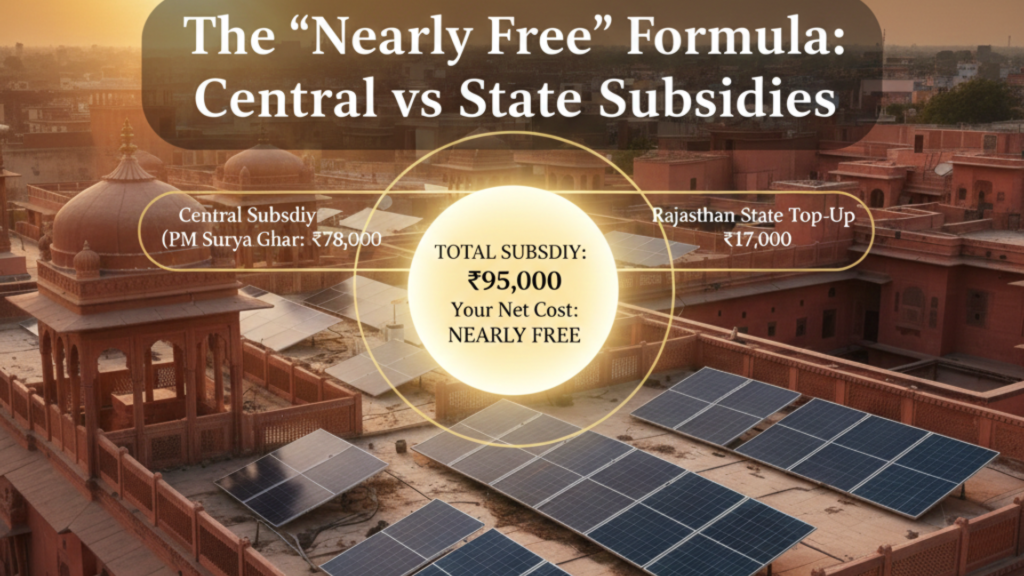
The phrase “Nearly Free” applies specifically to systems between 1kW and 3kW. For a typical Jaipur household, the financial math works out beautifully because of the double-subsidy layer.
The Central Subsidy (PM Surya Ghar)
This is a fixed financial assistance (CFA) provided by the Ministry of New and Renewable Energy (MNRE).
- ₹30,000 for 1 kW systems.
- ₹60,000 for 2 kW systems.
- ₹78,000 for systems 3 kW or larger.
The Rajasthan State Top-Up
In 2026, the Rajasthan Government announced an additional incentive of ₹17,000 for residential consumers. When you add this to the central amount, the out-of-pocket expense for the homeowner drops to an all-time low.
Table 2: Subsidy Impact on Final Price for Jaipur Residents
| System Size | Avg. Market Price | Central Subsidy | Rajasthan State Subsidy | Effective Net Cost |
| 1 kW | ₹68,000 | ₹30,000 | ₹17,000 | ₹21,000 |
| 2 kW | ₹1,25,000 | ₹60,000 | ₹17,000 | ₹48,000 |
| 3 kW | ₹1,80,000 | ₹78,000 | ₹17,000 | ₹85,000 |
ROI (Return on Investment) Analysis for Jaipur Households
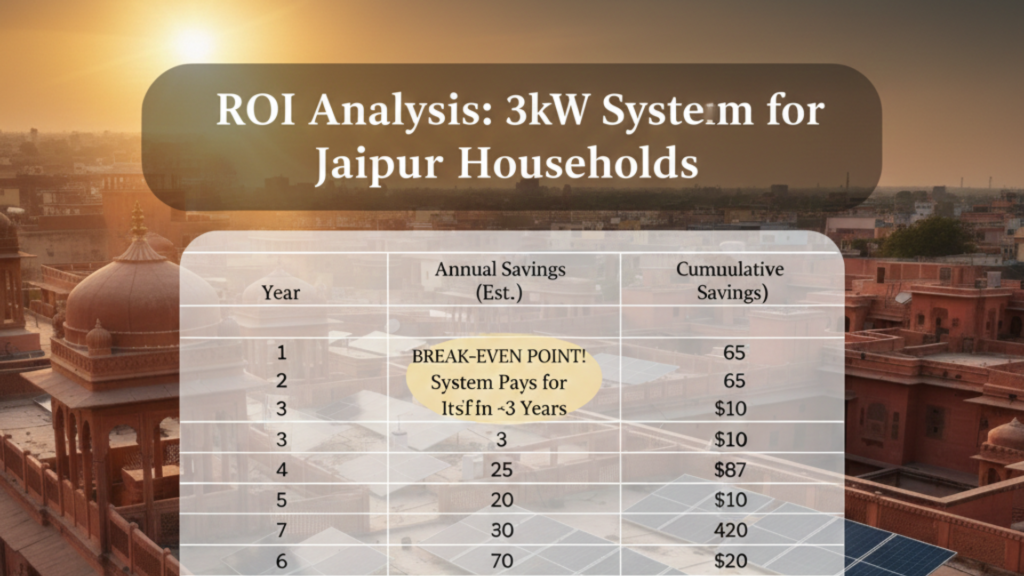
When you invest in solar, you aren’t just buying equipment; you are pre-paying for 25 years of electricity. In a city like Jaipur, where the per-unit cost for domestic slabs can reach ₹8.00–₹11.00 (including fixed charges and taxes), the ROI is incredibly fast.
Table 3: 5-Year Savings Projection for a 3kW System in Jaipur
| Year | Annual Generation (Units) | Savings (at ₹9/unit avg) | Cumulative Savings |
| Year 1 | 4,500 Units | ₹40,500 | ₹40,500 |
| Year 2 | 4,450 Units | ₹42,200 (Price Hike) | ₹82,700 |
| Year 3 | 4,400 Units | ₹44,000 | ₹1,26,700 |
| Year 4 | 4,350 Units | ₹46,000 | ₹1,72,700 |
| Year 5 | 4,300 Units | ₹48,000 | ₹2,20,700 |
The Result: By the end of Year 3, you have already recovered the rooftop solar panel price in Jaipur (post-subsidy). The remaining 22 years of electricity are effectively 100% free.
Technical Considerations: Choosing Components to Match the Rooftop Solar Panel Price in Jaipur
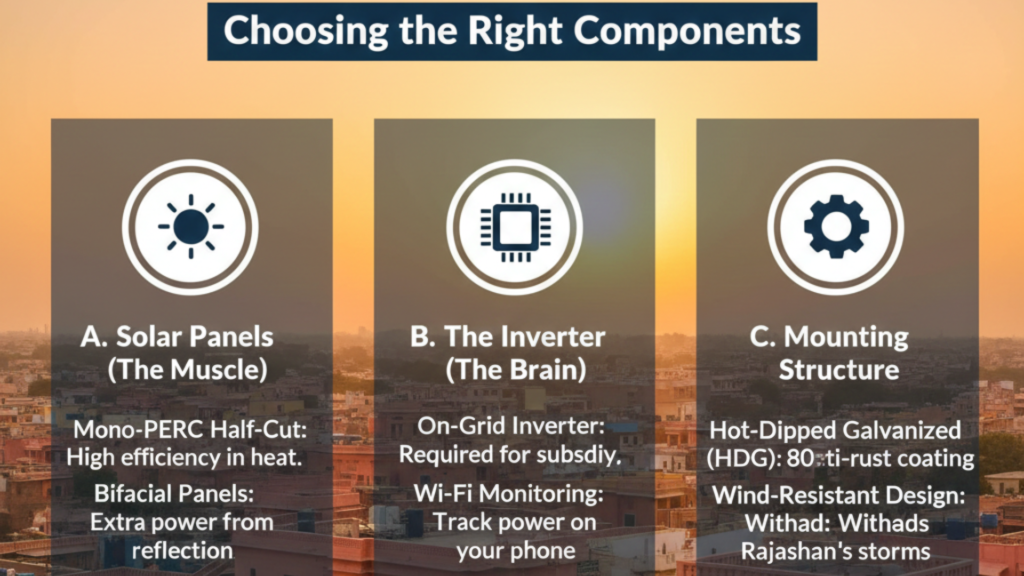
To ensure your system lasts 25 years in the harsh Rajasthani climate, you must look beyond the price tag.
A. Solar Panels (The Muscle)
For Jaipur, Mono-PERC Half-cut panels are highly recommended. They perform better in the high-heat conditions of Rajasthan compared to older Polycrystalline panels. If you have a small roof, Bifacial panels are worth the extra investment as they generate power from the reflected light on the roof surface.
B. The Inverter (The Brain)
Since you are aiming for a subsidy, you must install an On-Grid Inverter. Brands like Growatt, Sungrow, and Havells are popular in Jaipur. Ensure your inverter has Wi-Fi monitoring so you can track your daily generation through a smartphone app.
C. Mounting Structure
Jaipur experiences high wind speeds during the pre-monsoon “Loo” season. Ensure your vendor uses Hot-Dipped Galvanized (HDG) structures with a minimum of 80 microns coating to prevent rusting and structural failure.
How to Apply: Securing the Best Rooftop Solar Panel Price in Jaipur via JVVNL
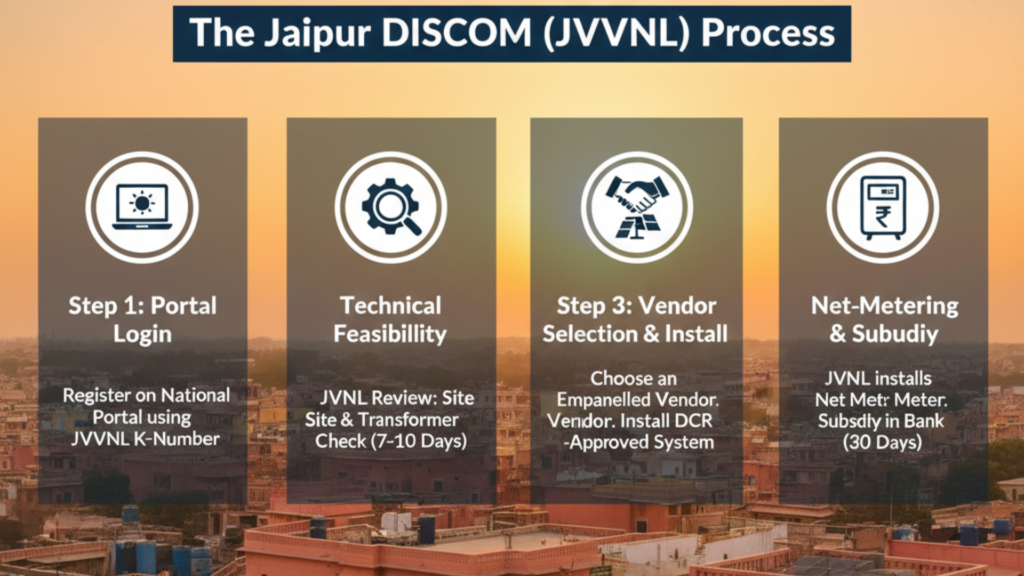
Applying for a solar subsidy in Jaipur is now a digitized, paperless process.
- Step 1: Portal Login: Register on the National Portal for Rooftop Solar using your JVVNL Consumer Account (K-Number).
- Step 2: Technical Feasibility: JVVNL will review your application to ensure your local transformer can handle the solar export. This usually takes 7-10 days.
- Step 3: Vendor Selection: Choose an empanelled vendor from the Jaipur list. Ensure they use ALMM-approved (Approved List of Models and Manufacturers) panels.
- Step 4: Installation & Net-Metering: After installation, the vendor applies for a “Net Meter.” This special meter tracks both the electricity you consume from JVVNL and the solar power you export back to them.
- Step 5: Subsidy Release: Once the inspection is completed by the JVVNL officer, the subsidy is credited to your bank account within 30 days.
Maintenance Tips for Jaipur’s Climate
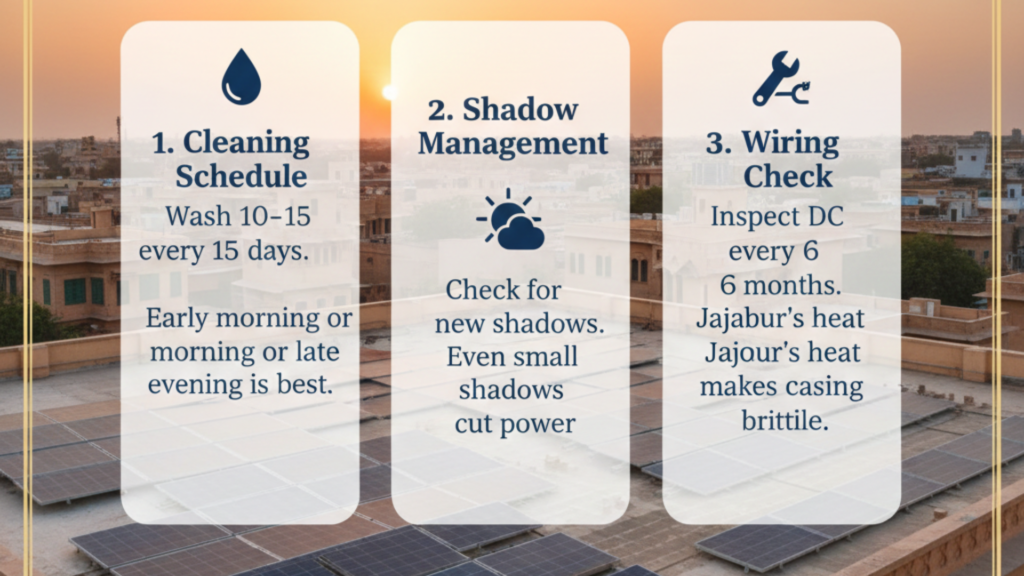
Dust is the biggest enemy of solar efficiency in Rajasthan. If a thin layer of sand settles on your panels, generation can drop by as much as 30%.
- Cleaning Schedule: Wash your panels every 10-15 days. Early morning or late evening is best to avoid “thermal shock” to the hot glass.
- Shadow Management: Check for new constructions or growing trees that might cast a shadow on your panels. Even a small shadow on one corner of a panel can significantly drop the output of the entire string.
- Wiring Check: Every 6 months, ensure that the DC cables are not exposed to direct friction on the roof floor, as Jaipur’s heat can make the casing brittle over time.
Conclusion: Take the Leap Today
The combination of the falling rooftop solar panel price in Jaipur and the aggressive 2026 subsidy policies has created a “now or never” window for homeowners. By installing a 3kW system, you are essentially securing a 90% discount on your long-term energy costs. Not only do you save money, but you also contribute to making Jaipur a cleaner, more sustainable city.
Frequently Asked Questions (FAQs)
Q1: What is the current Rooftop solar panel price in Jaipur for a 5kW system?
A 5kW system usually costs between ₹2.6L and ₹3.1L. While the subsidy is capped at the 3kW level (₹95,000 total), the high generation from a 5kW system makes it ideal for homes with 3+ Air Conditioners.
Q2: Can I get a subsidy if I install the system myself?
No. To be eligible for the Central and Rajasthan State subsidy, the installation must be done by a vendor registered with the National Portal and JVVNL.
Q3: Is a solar loan available in Jaipur?
Yes. Banks like SBI, PNB, and ICICI offer “Surya Ghar” loans. The interest rates are typically 1-2% lower than standard personal loans, and the EMI is often less than your current monthly electricity bill.
Q4: Do solar panels work during Jaipur’s monsoon?
Yes. Solar panels work on light, not heat. While generation is lower on cloudy days, they still produce enough to keep basic appliances running.
Q5: What is the benefit of “Net Metering” in Rajasthan?
Net metering allows you to “bank” your excess day-time energy with JVVNL. You can use this banked energy at night. At the end of the billing cycle, you only pay for the net difference.