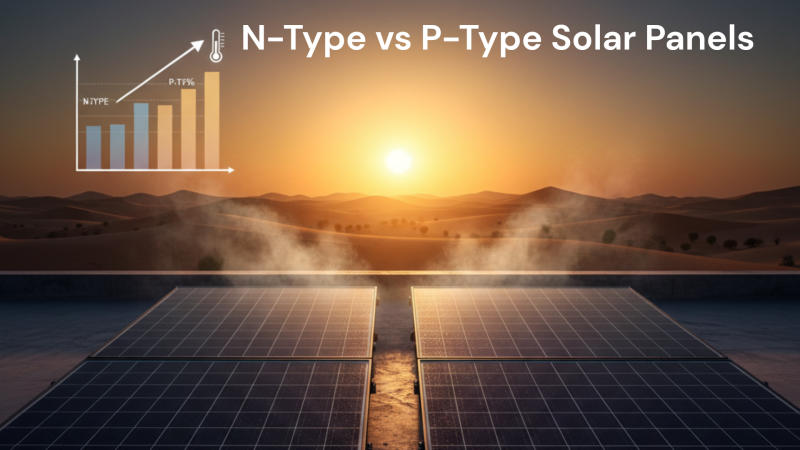
The solar energy landscape in India has reached a pivotal turning point in 2026, where choosing between N-Type vs P-Type solar panels for Rajasthan has become the most critical decision for any buyer. While Rajasthan has always been the primary hub for solar power due to its vast desert lands and high solar irradiance, the technology used to capture that sunlight is rapidly evolving to meet new challenges.
For years, homeowners and business owners relied on standard panels, but the rise of extreme summer temperatures has made the comparison of N-Type vs P-Type solar panels for Rajasthan more important than ever. In a climate where temperatures frequently cross 50°C, understanding these technical differences is the only way to determine which one is truly the superior investment for your long-term energy needs.
The Scientific Foundation: What Defines P-Type and N-Type Cells?
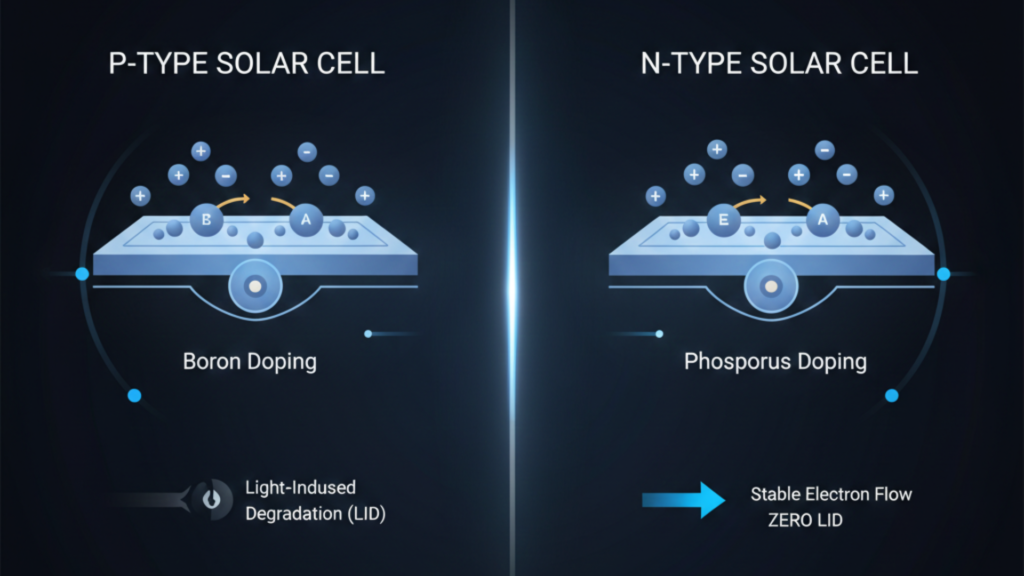
To understand why one panel performs better in the heat of Jodhpur or Bikaner, we must look at the atomic structure of the silicon wafers.
P-Type Solar Cells: The Traditional Standard
P-Type (Positive-type) cells have been the backbone of the solar industry for decades. These cells are created by “doping” a silicon wafer with Boron. Because Boron has one less electron than silicon, it creates a positive charge. While this method is inexpensive and well-understood, it has a fatal flaw known as Light-Induced Degradation (LID). When Boron-doped panels are first exposed to the harsh Rajasthan sun, the Boron reacts with Oxygen, causing an immediate drop in efficiency of about 2% to 3%.
N-Type Solar Cells: The 2026 Innovation
N-Type (Negative-type) cells represent the premium evolution of solar tech. Instead of Boron, these wafers are doped with Phosphorus. Phosphorus has one more electron than silicon, creating a negative charge. Phosphorus does not react with Oxygen, which means N-Type panels have zero Light-Induced Degradation. From the moment you install them, they perform at their maximum rated capacity without the “day-one power drop” seen in older models.
Why Desert Weather Favors N-Type vs P-Type Solar Panels for Rajasthan
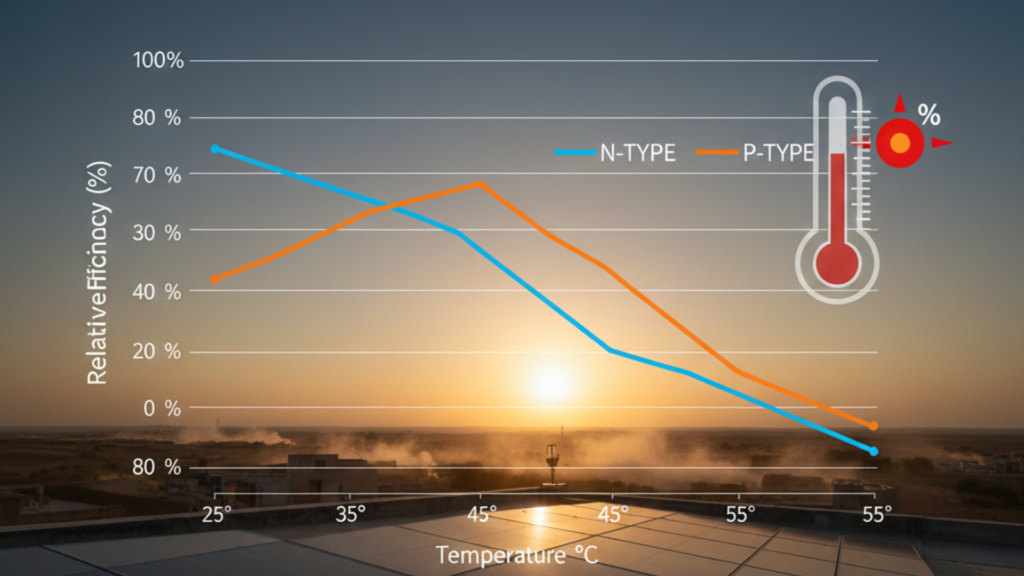
Rajasthan is famous for its “Golden Heat,” but for a solar panel, heat is actually an enemy. Most people assume that more heat equals more power, but the opposite is true. As a solar panel’s temperature increases, its ability to generate electricity decreases.
Temperature Performance of N-Type vs P-Type Solar Panels for Rajasthan
In technical terms, this is measured by the Temperature Coefficient. This figure indicates how much power a panel loses for every degree the temperature rises above 25°C.
In cities like Jaipur, Ajmer, and Kota, rooftop temperatures in May can easily exceed 55°C.
- P-Type Panels: Typically have a coefficient of -0.38% per degree.
- N-Type Panels: Usually have a coefficient of only -0.29% per degree.
This means that when it is 45°C outside in the Thar Desert, an N-Type panel is losing significantly less energy to heat than a P-Type panel. Over a full summer season, this leads to a massive difference in the total units (kWh) generated.
Detailed Comparison: N-Type vs P-Type Solar Panels for Rajasthan
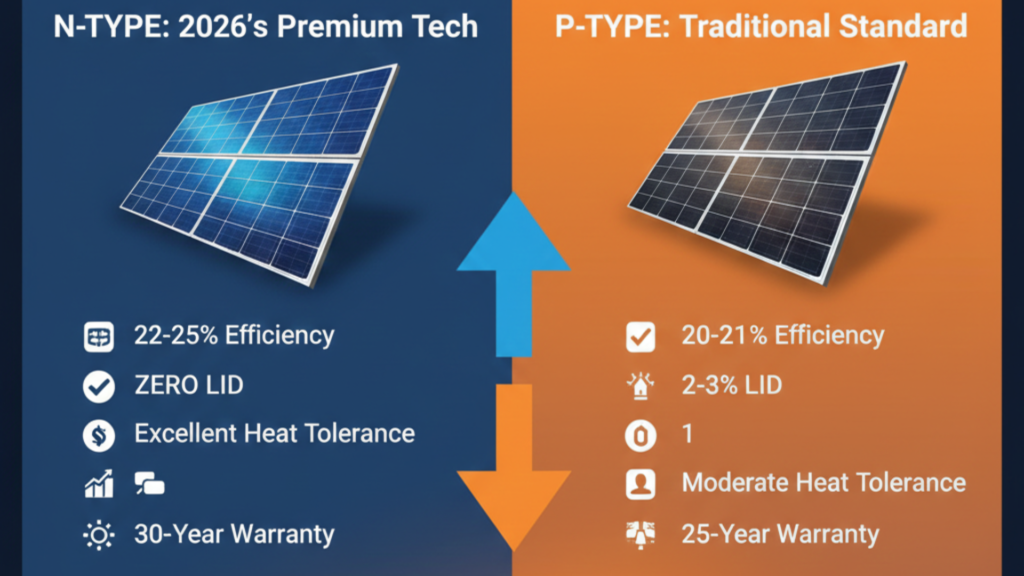
When selecting the right technology, you must compare them across various environmental and performance metrics specifically relevant to the Indian subcontinent.
Table 1: Detailed Technical Performance Comparison
| Performance Metric | P-Type (Mono PERC) | N-Type (TOPCon/HJT) | Impact for Rajasthan Users |
| Cell Efficiency | 20% to 21.5% | 22.5% to 25.8% | More power from smaller roofs |
| Initial Degradation (LID) | 2% to 3% Loss | 0% Loss | Higher output from day one |
| Heat Tolerance | Moderate | Excellent | Vital for 45°C+ temperatures |
| Low-Light Performance | Standard | Superior | More power during dawn/dusk |
| Bifacial Gain | Lower (60-70%) | Higher (80-85%) | Better use of reflected sand light |
| Product Warranty | 10 to 12 Years | 15 to 25 Years | Better long-term security |
Dust and Albedo Performance: N-Type vs P-Type Solar Panels for Rajasthan
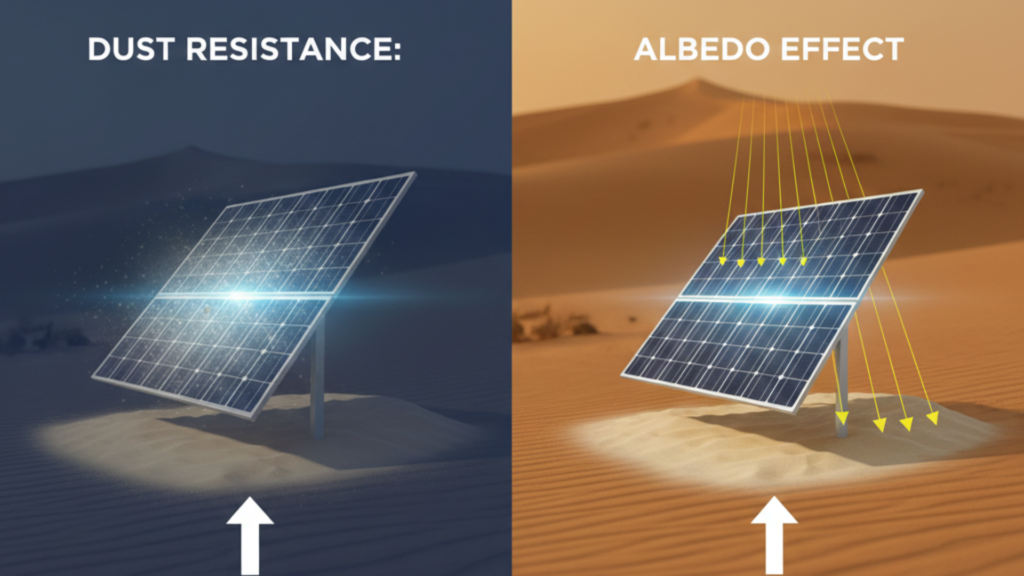
Rajasthan’s geography introduces two specific variables: heavy dust and highly reflective sandy soil (Albedo).
Dust Resistance and Maintenance
Dust is a major issue in Western Rajasthan. While both panels get dirty, N-Type panels—especially those using TOPCon (Tunnel Oxide Passivated Contact) technology—tend to have better “internal resistance” characteristics. This means that even when partially shaded by a thin layer of dust, the flow of electrons is slightly more efficient than in older P-Type architectures.
Capitalizing on the Albedo Effect
Many N-Type panels are Bifacial, meaning they have glass on both sides. In the sandy regions of Jaisalmer or Barmer, the ground reflects a lot of sunlight. N-Type bifacial cells are much better at converting this reflected light from the backside into electricity. While a P-Type bifacial panel might capture 65% of reflected light, an N-Type panel can capture up to 85% or more.
ROI Analysis of N-Type vs P-Type Solar Panels for Rajasthan
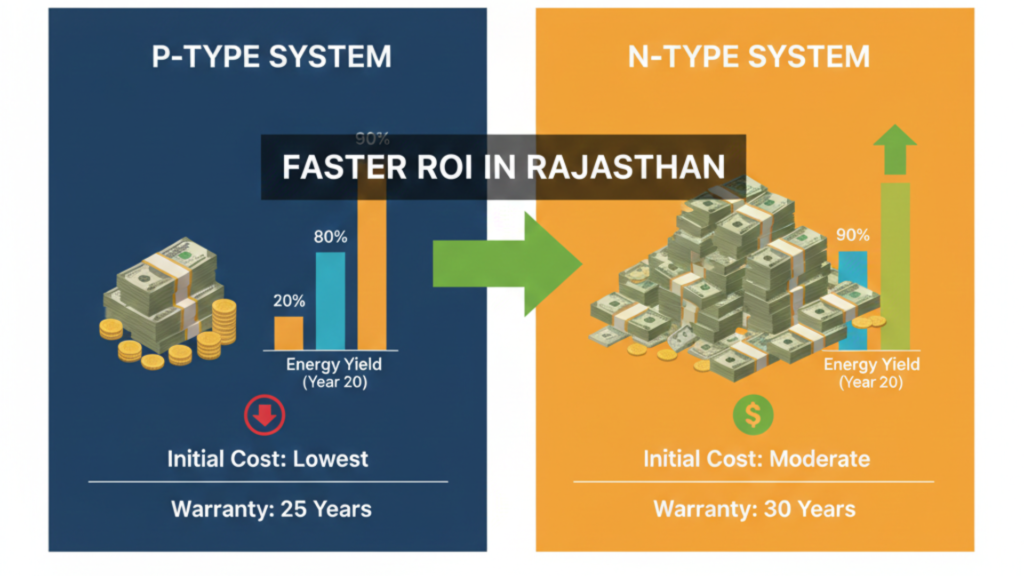
One of the main reasons people hesitate to buy N-Type is the “upfront cost.” In 2026, N-Type panels are roughly 10% to 15% more expensive than P-Type. However, for a Rajasthan-based project, the “Levelized Cost of Energy” (LCOE) is actually lower for N-Type.
Slower Degradation Equals More Profit
All solar panels degrade over time.
- P-Type panels degrade at a rate of about 0.7% to 0.8% per year.
- N-Type panels degrade at a much slower rate of 0.3% to 0.4% per year.
By Year 20, your N-Type system will still be producing nearly 90% of its original power, whereas a P-Type system might have dropped to 80% or less. If you are using the system to offset high commercial electricity tarrifs in Rajasthan, the N-Type system pays for itself much faster through increased generation.
Table 2: Financial ROI and Longevity Comparison
| Financial Metric | P-Type System | N-Type System |
| Installation Cost | Lowest | 10-15% Higher |
| 25-Year Total Yield | Standard | 15-20% Higher Total kWh |
| Payback Period | 4 to 5 Years | 3.5 to 4 Years (due to higher yield) |
| Performance at Year 30 | Often not warranted | Guaranteed ~85% to 87% |
| Maintenance Cost | Standard | Standard |
PM Surya Ghar Yojana: Savings with N-Type vs P-Type Solar Panels for Rajasthan
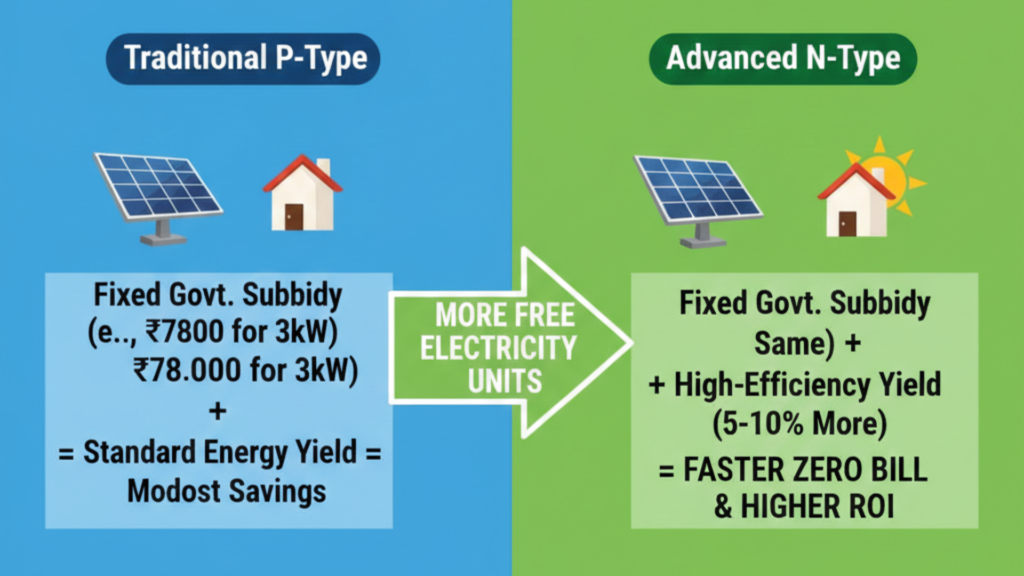
If you are applying for the PM Surya Ghar Muft Bijli Yojana in 2026, the government provides a fixed subsidy based on the capacity (kW) of the system. Since the subsidy is the same regardless of the panel type, it makes more sense to install the most efficient technology possible.
By choosing N-Type for your 3kW or 5kW subsidized system, you maximize the “free units” you get from the sun. In Rajasthan, where the goal is to reach “Zero Electricity Bill,” the higher efficiency of N-Type ensures you meet that goal even during months with high AC usage.
Installation Best Practices for Rajasthan
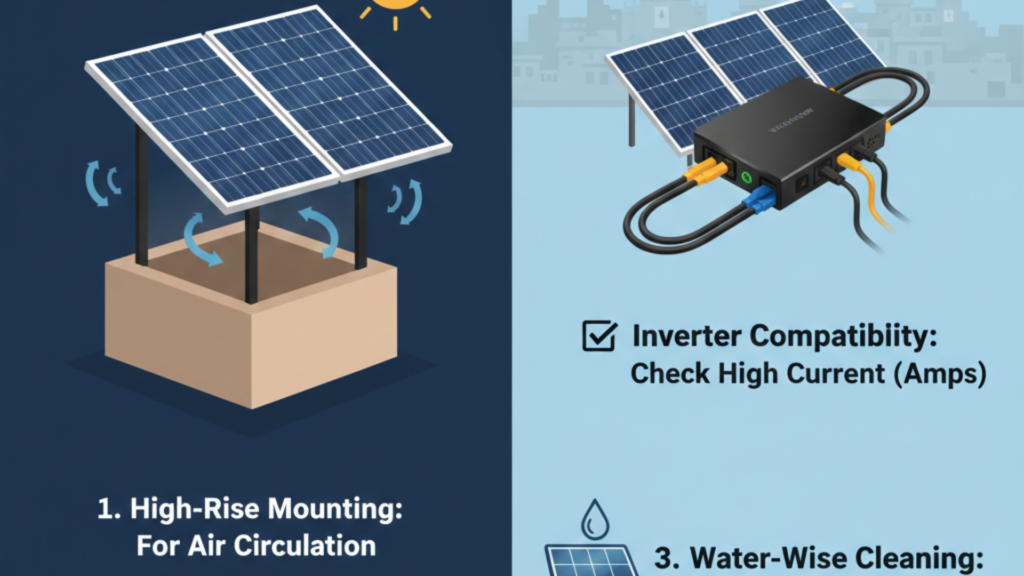
Installing N-Type vs P-Type solar panels for Rajasthan requires a professional approach to mounting and wiring.
- High-Rise Mounting: In hot areas, ensure the panels are mounted at least 1 foot above the roof surface. This allows for air circulation, which helps N-Type panels stay even cooler and perform at peak levels.
- String Inverter Compatibility: N-Type panels often have a higher current (Amps). Ensure your inverter can handle the high input current of 2026-model TOPCon modules.
- Water-Wise Cleaning: Since water is scarce in Rajasthan, N-Type panels’ higher efficiency means you can get the same power with fewer panels, reducing the amount of water needed for cleaning.
Conclusion: The Final Verdict for 2026
After evaluating the extreme thermal conditions of Rajasthan, the degradation statistics, and the 25-year financial outlook, the conclusion is clear. When we look at the performance of N-Type vs P-Type solar panels for Rajasthan, the data proves that technology matters more than price.
While P-Type panels remain a viable option for those on an extremely tight budget who only need a basic setup, N-Type solar panels are the definitive choice for Rajasthan. Their ability to withstand 45°C+ heat with minimal power loss, combined with their zero-LID performance and superior bifacial gains, makes them the most logical investment for 2026.
Whether you are a homeowner in Jaipur looking to slash your bill or a factory owner in Bhiwadi looking for industrial-grade power, choosing between N-Type vs P-Type solar panels for Rajasthan is about long-term reliability. N-Type technology provides the durability and efficiency that the Rajasthan sun demands.
Frequently Asked Questions (FAQs)
1. Why are N-Type panels better for Rajasthan specifically?
Rajasthan experiences extreme heat. N-Type panels have a lower temperature coefficient, meaning they lose less electricity production as the temperature rises compared to P-Type panels.
2. Does the PM Surya Ghar Yojana cover N-Type panels?
Yes, the subsidy is based on the system’s kW capacity, not the cell type. You can use your subsidy to install high-end N-Type panels.
3. How much more power does N-Type produce in a year?
On average, in a high-heat zone like Rajasthan, an N-Type system can produce 5% to 10% more energy annually than a P-Type system of the same size.
4. What is TOPCon and is it N-Type?
Yes, TOPCon (Tunnel Oxide Passivated Contact) is the most popular type of N-Type technology in 2026. It is highly recommended for residential rooftops.
5. Do N-Type panels last longer than P-Type?
Yes. Because they use Phosphorus instead of Boron, they are more stable. Most N-Type panels come with a 30-year performance warranty, while P-Type usually offers 25 years.
6. Are N-Type panels better for commercial use?
Absolutely. For commercial and industrial (C&I) clients in Rajasthan, the higher energy density and slower degradation of N-Type panels lead to a much better Internal Rate of Return (IRR).