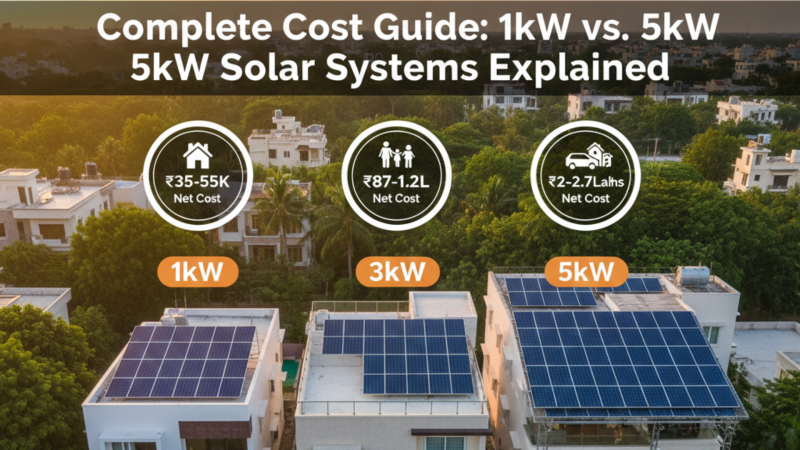
With electricity prices in India surging by 5–8% annually, homeowners are turning to solar energy as a permanent solution to high utility bills. However, the biggest hurdle for most is understanding the financial commitment. If you are searching for the 1kW / 3kW / 5kW Solar System Cost, this comprehensive guide provides an exhaustive breakdown of prices, technicalities, and the massive savings potential under the latest government schemes.
Understanding the 1kW / 3kW / 5kW Solar System Cost in India
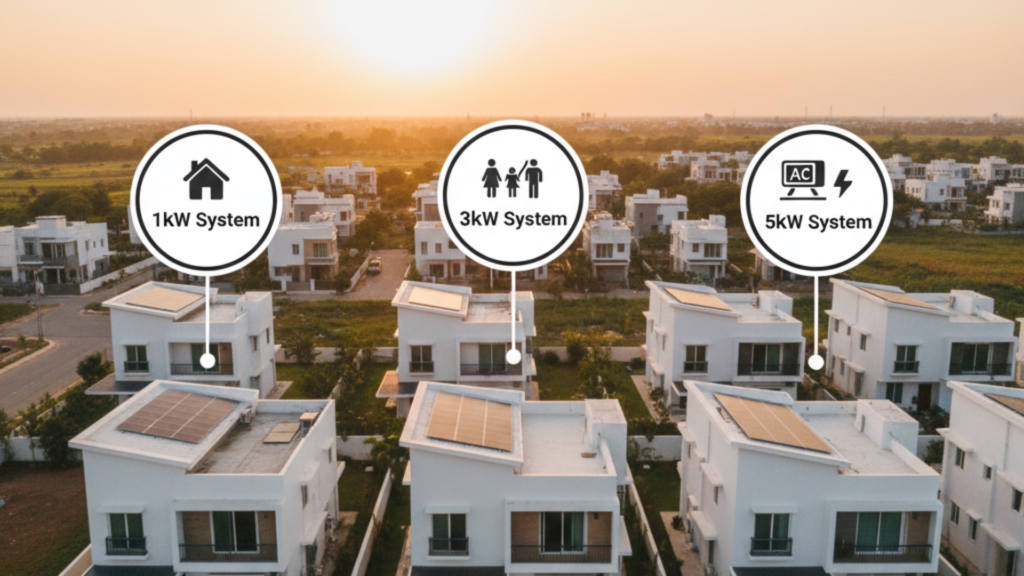
Investing in solar is not “one-size-fits-all.” The current market price for solar plant is dynamic. For residential consumers, the total setup expense is currently at its most competitive level due to the PM Surya Ghar: Muft Bijli Yojana.
1. The 1kW Solar System: Entry-Level Energy Independence
A 1kW system is designed for very small homes, independent shops, or rural households. It typically consists of 2 to 3 high-efficiency panels.
- Best for: Reducing small bills or powering basic essentials.
- Daily Output: 4–5 kWh (Units).
2. The 3kW Solar System: The Most Popular Capacity
The 3kW system is the “Goldilocks” of solar capacity for the Indian middle class. It covers the consumption of a standard 2BHK or 3BHK house and offers the highest “bang for your buck” regarding government subsidies.
- Best for: Families with 1 AC and standard appliances.
- Daily Output: 12–15 kWh (Units).
3. The 5kW Solar System: Premium Power for Heavy Loads
If your lifestyle includes multiple ACs, a water pump, or an Electric Vehicle (EV), the 5kW system is the right choice. It offers significant surplus energy that can be exported back to the grid for credits.
- Best for: Large homes, bungalows, and EV owners.
Daily Output: 20–25 kWh (Units).
Comparative Analysis: 1kW / 3kW / 5kW Solar System Cost Breakdown
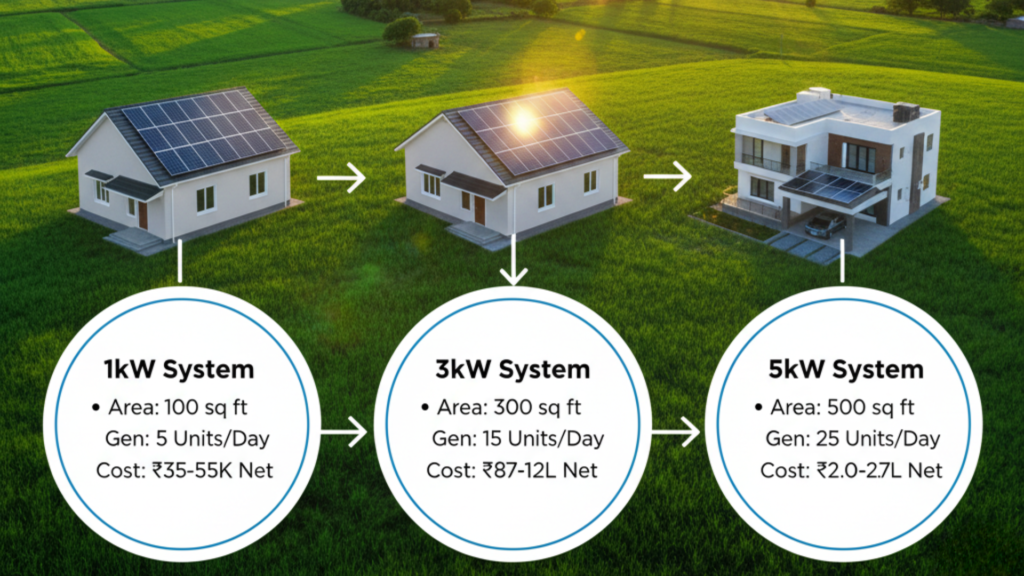
To help you visualize the investment, we have categorized the costs based on current market trends in India.
Table 1: Price, Area, and Generation Comparison
| Technical Specifications | 1kW Solar System | 3kW Solar System | 5kW Solar System |
| Gross Cost (Before Subsidy) | ₹65,000 – ₹85,000 | ₹1,65,000 – ₹2,10,000 | ₹2,80,000 – ₹3,50,000 |
| Solar Panel Efficiency | 19% – 21% | 20% – 22% | 21% – 23% |
| Shadow-Free Area Required | 100 sq. ft. | 300 sq. ft. | 500 sq. ft. |
| Annual Generation (Units) | 1,500 – 1,800 | 4,300 – 5,000 | 7,500 – 9,000 |
| Estimated Monthly Savings | ₹1,000 – ₹1,300 | ₹3,500 – ₹4,500 | ₹6,000 – ₹8,000 |
The Impact of Subsidies on 1kW / 3kW / 5kW Solar System Cost
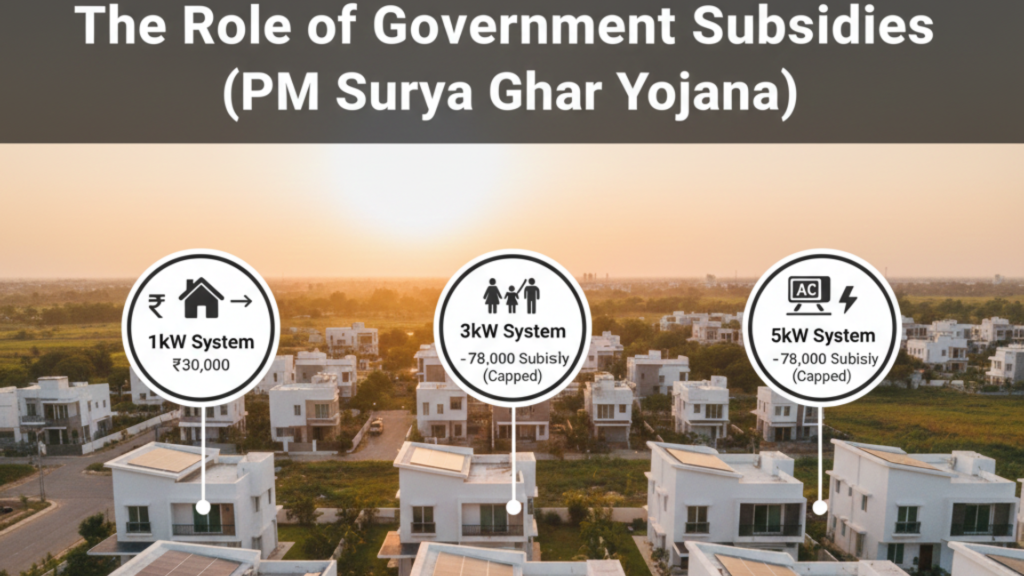
The Indian government has made the 1kW / 3kW / 5kW Solar System Cost much more attractive by offering a flat subsidy structure. This makes the “Net Cost” significantly lower for the end-user.
Table 2: Subsidy and Net Investment Breakdown
| System Capacity | Estimated Central Subsidy | Effective Net Cost |
| 1kW System | ₹30,000 | ₹35,000 – ₹55,000 |
| 2kW System | ₹60,000 | ₹70,000 – ₹90,000 |
| 3kW System | ₹78,000 | ₹87,000 – ₹1,20,000 |
| 5kW System | ₹78,000 (Capped) | ₹2,02,000 – ₹2,70,000 |
Pro Tip: To avail of this subsidy, you must use DCR (Domestic Content Requirement) panels and install your system through a DISCOM-empanelled vendor.
Components That Determine the 1kW / 3kW / 5kW Solar System Cost
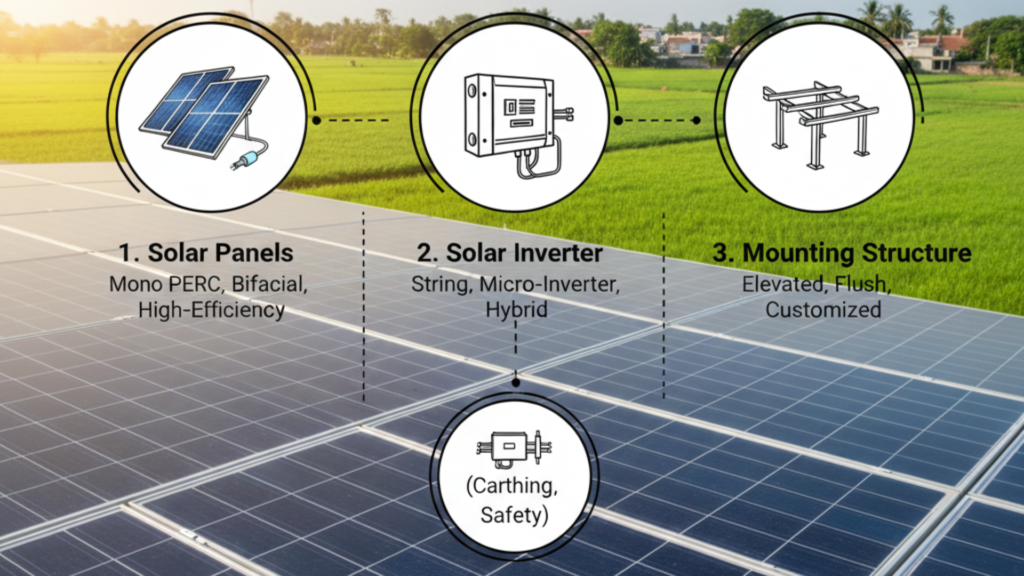
When you receive a quote, it isn’t just for the panels. Several high-tech components work together to power your home.
- Solar Panels: Monocrystalline PERC panels are now the industry standard in India. They perform better in the high temperatures found in states like Rajasthan or Maharashtra.
- Solar Inverter: This is the “brain” of the system. A high-quality string inverter or micro-inverter can change the 1kW / 3kW / 5kW Solar System Cost by ₹10,000 to ₹40,000.
- Mounting Structure: For rooftops with space constraints, high-rise structures (elevated structures) allow you to use the floor space beneath the panels, though they cost more than standard flush mounts.
- BOS (Balance of System): This includes DC/AC cables, Earthing kits, Lightning Arrestors, and the DCDB/ACDB boxes. Never compromise on these for safety.
Table 3: Appliance Load Capacity Guide
| System Size | What it can run simultaneously | Ideal Household Size |
| 1kW System | 4 LED Bulbs, 3 Fans, 1 TV, 1 Laptop, 1 Cooler | 1-2 People |
| 3kW System | All of 1kW + 1 Fridge, 1 Washing Machine, 1 HP Pump, 1 AC (Inverter type) | 3-5 People |
| 5kW System | All of 3kW + 2 ACs, Geyser, Microwave, EV Charging (Slow) | 5+ People / Large Villa |
Detailed Step-by-Step Installation Process
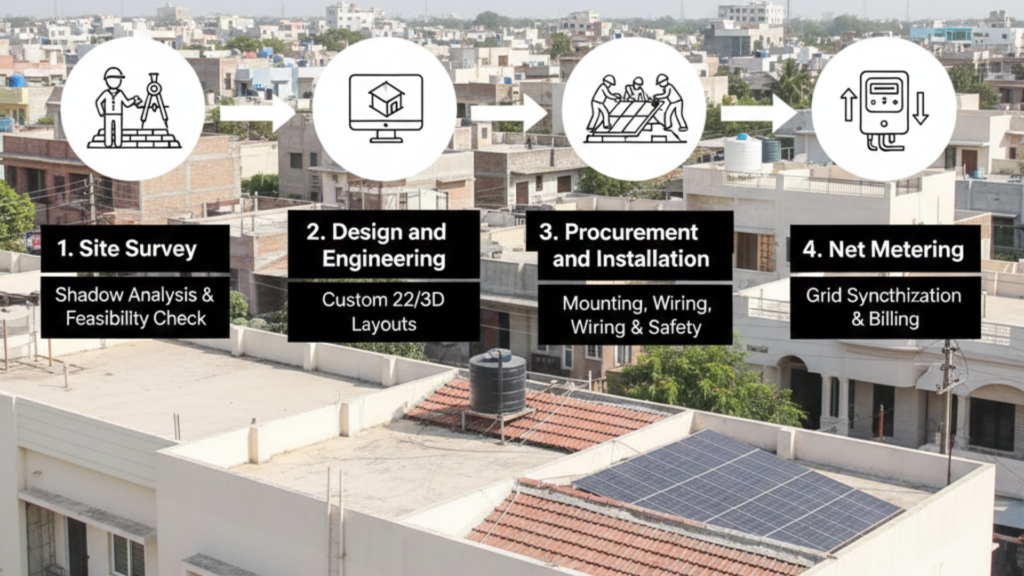
Understanding the installation process helps you justify the 1kW / 3kW / 5kW Solar System Cost. It is not just about placing panels; it’s an engineering project.
Step 1: Site Survey
An engineer visits your roof to check for shadows from nearby trees or buildings. They use tools like a “Sunpath Finder” to ensure maximum sun exposure.
Step 2: Design and Engineering
A 2D/3D layout is created to show how the panels will look and how the wiring will be routed to your electrical room.
Step 3: Procurement and Installation
Civil work (foundation for the structure) is followed by mechanical assembly and electrical wiring. This usually takes 2–4 days depending on the system size.
Step 4: Net Metering
This is the final step where your traditional meter is replaced with a Bi-directional Net Meter. This meter tracks how many units you gave to the grid and how many you took, adjusting your bill accordingly.
Maintenance to Protect Your 1kW / 3kW / 5kW Solar System Cost Investment
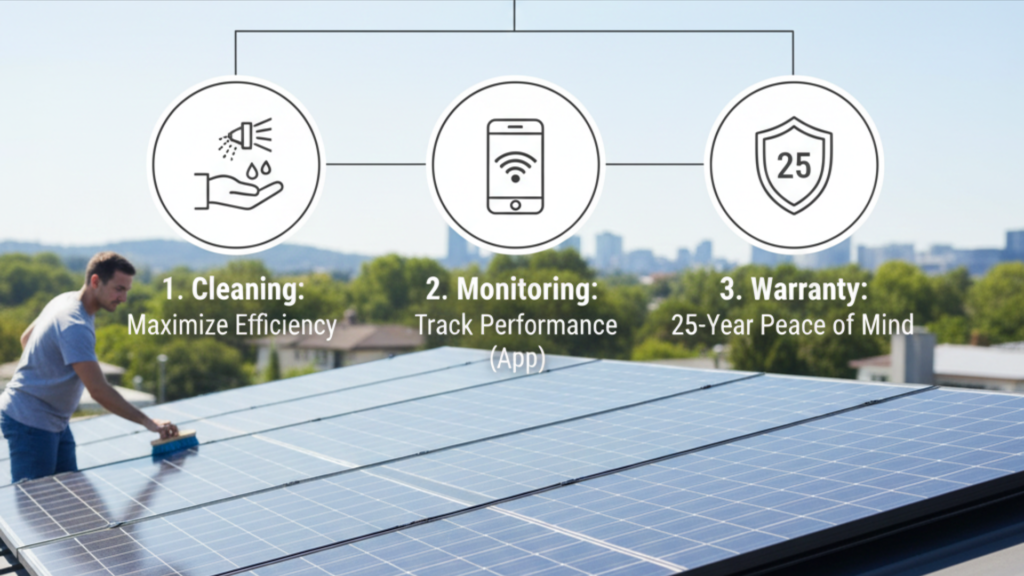
One reason these setups are considered high-value is the low maintenance required over time.
- Cleaning: In India’s dusty environment, cleaning panels with water every 15 days can improve generation by 15-20%.
- Monitoring: Most modern inverters come with Wi-Fi monitoring apps. You can track your daily generation on your smartphone from anywhere in the world.
- Warranty: Most panels come with a 10-year product warranty and a 25-year performance warranty.
Why 2026 is the Best Year to Go Solar in India
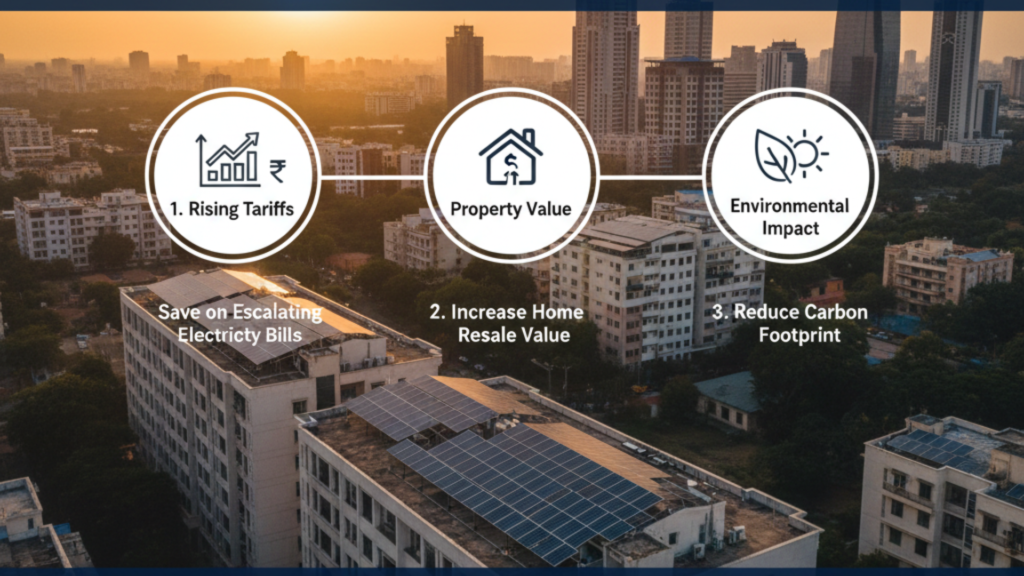
The cost of solar cells has reached a historic low globally. Combined with the Indian government’s aggressive push for green energy, the ROI (Return on Investment) has never been better.
- Rising Tariffs: Commercial and residential tariffs are rising. Solar locks in your energy cost for 25 years.
- Property Value: Homes with solar installations have a higher resale value in the Indian real estate market.
- Environmental Impact: A 5kW system offsets approximately 190 tons of carbon dioxide over its lifetime—equivalent to planting 300 trees.
Conclusion: Choosing the Right 1kW / 3kW / 5kW Solar System Cost for You
Deciding on your capacity depends on your monthly units.
- If your bill is under ₹1,500, go for 1kW.
- If your bill is between ₹2,000 – ₹5,000, the 3kW is your best bet.
- If your bill exceeds ₹6,000, the 5kW system will provide the quickest payback.
By switching to solar, you aren’t just saving money; you are becoming an independent power producer. Ensure you choose Tier-1 panels and reliable installers to make the most of your green energy journey.
Frequently Asked Questions (FAQs)
Q1. Is the 1kW / 3kW / 5kW Solar System Cost inclusive of the Net Meter?
Usually, the quote from the vendor includes the application process for the Net Meter, but the government department (DISCOM) may charge a separate fee for the meter itself and testing.
Q2. Can I expand my 1kW system to 3kW later?
Yes, but it is technically easier if you buy a larger inverter (3kW) initially. If you have a 1kW inverter, you will need to replace it entirely to upgrade to 3kW.
Q3. Do solar panels work during the monsoon?
Yes, solar panels work on light, not heat. While generation drops by 30-50% on very cloudy days, the rain actually helps by cleaning the dust off the panels, improving performance afterwards.
Q4. What is the difference between On-grid and Off-grid costs?
The total setup expense for off-grid systems is 40-60% higher because of the battery bank. Batteries need replacement every 5–7 years, making on-grid systems more popular for urban areas with stable grids.
Q5. How long does it take to get the subsidy?
Under the new PM Surya Ghar portal, the subsidy is typically credited to the user’s bank account within 30 to 45 days after the installation and inspection of the net meter.