The sun in Rajasthan is not just a source of heat; it is a goldmine of energy waiting to be tapped. With temperatures in cities like Jaipur, Jodhpur, and Bikaner soaring and electricity tariffs from DISCOMs (JVVNL, AVVNL, JdVVNL) rising annually, evaluating the solar panel cost for 5kW system and switching to green energy is the smartest financial move for a homeowner in 2025.
For the average middle-class Indian household running multiple air conditioners, a refrigerator, and a water pump, a 5kW solar system is the perfect capacity. It sits in the “sweet spot” of efficiency—large enough to zero out a ₹5,000+ monthly bill, but small enough to fit on a standard roof.
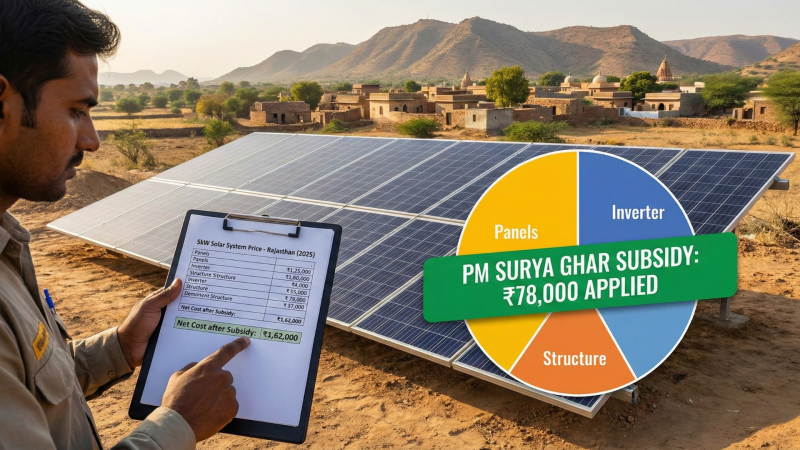
In this comprehensive guide, we will break down the solar panel cost for 5kW system in Rajasthan, covering the latest 2025 price trends, the flat ₹78,000 government subsidy, and the new net-metering rules that make your ROI faster than ever.
Why a 5kW Solar System is Ideal for Rajasthan Homes
Before we discuss money, it is crucial to understand power. Rajasthan receives some of the highest solar radiation (insolation) in India, averaging 5.5 to 6.5 kWh per square meter per day.
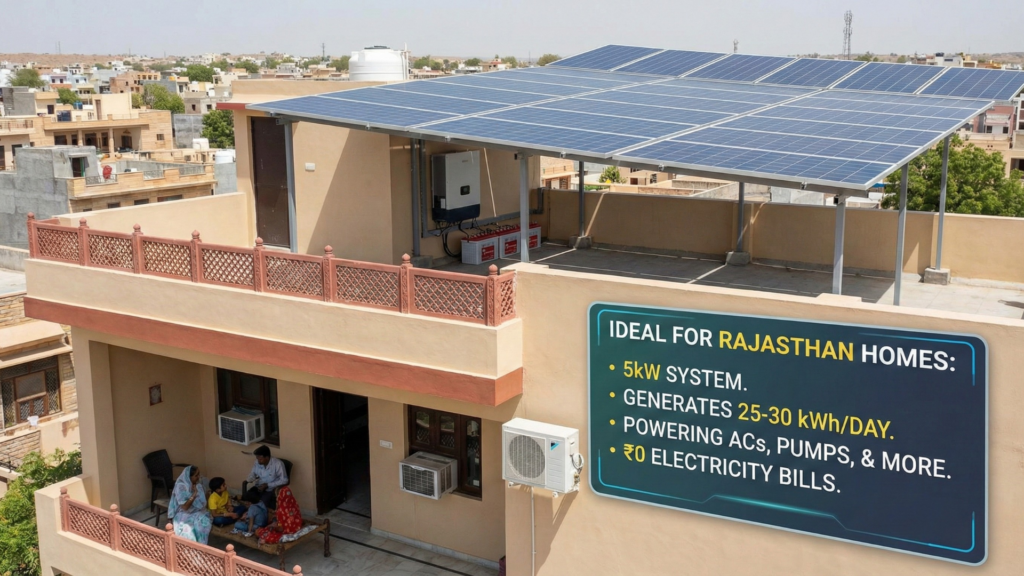
While a 5kW system in Delhi or Mumbai might generate 20 units a day, the same system in the clear skies of Rajasthan can generate 22 to 27 units per day.
- Monthly Generation: ~650 to 800 Units.
- Appliance Load: It can comfortably run:
- 2 x 1.5 Ton Inverter ACs (during day hours)
- 1 HP Submersible Pump
- Refrigerator, TV, Lights, and Fans
- Roof Space Needed: Approximately 450 to 500 square feet of shadow-free area.
If your electricity bill consistently crosses ₹6,000 per month, a 5kW system is your best defense against inflation.
Solar Panel Cost for 5kW System: Detailed Breakdown
The price of solar is not fixed; it fluctuates based on the technology you choose (Polycrystalline vs. Monocrystalline) and the brand (Tata, Adani, Waaree, etc.). However, for 2025, prices have stabilized.
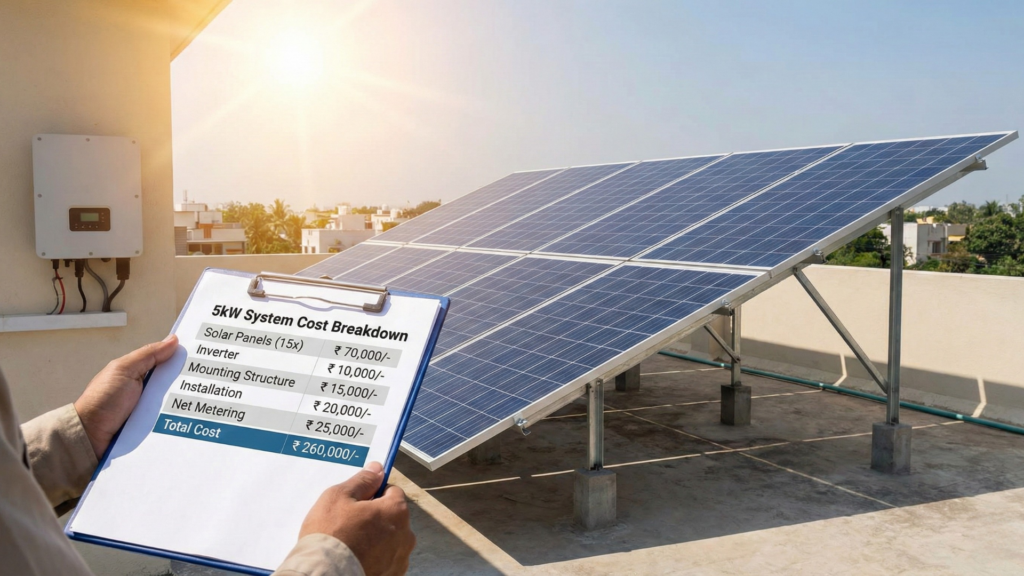
The table below provides a granular look at where your money goes. We have used market averages for Tier-1 brands in Rajasthan.
Table 1: Components affecting Solar panel cost for 5kW system
| Component | Specifications | Price Range (₹) | % of Total Cost |
| Solar Panels | 5kW (Bifacial or Mono PERC Half-Cut) | ₹1,10,000 – ₹1,30,000 | ~45% |
| Solar Inverter | 5kW On-Grid Inverter (IoT enabled) | ₹35,000 – ₹45,000 | ~15% |
| Mounting Structure | Hot-dipped Galvanized Iron (GI) | ₹25,000 – ₹35,000 | ~12% |
| BOS (Balance of System) | AC/DCDB, DC Cables (4sq mm), Earthing Kit | ₹15,000 – ₹20,000 | ~8% |
| Installation & Civil Work | Labor, transport, and civil foundation | ₹20,000 – ₹25,000 | ~10% |
| Net Metering & Liasoning | DISCOM fees (JVVNL/JdVVNL) + Bi-directional meter | ₹10,000 – ₹15,000 | ~5% |
| GST (Approx 5%-12%) | Taxes on components/services | ₹15,000 – ₹25,000 | ~5% |
| TOTAL GROSS COST | Before Subsidy | ₹2,30,000 – ₹2,95,000 | 100% |
Note: The “Gross Cost” is what you pay upfront to the vendor. The subsidy is refunded to you later by the government.
Impact of PM Surya Ghar Muft Bijli Yojana on Costs
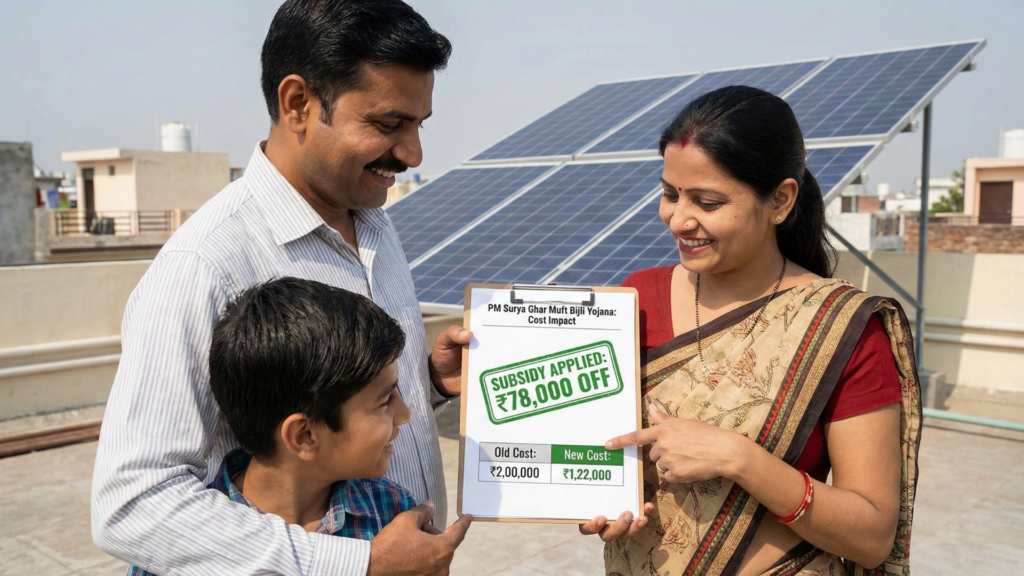
The PM Surya Ghar Muft Bijli Yojana has revolutionized solar adoption by simplifying the subsidy structure. Unlike previous years where percentages were calculated, 2025 offers a fixed flat subsidy for systems above 3kW.
The Subsidy Mathematics
For a 5kW system, the subsidy cap is reached at the 3kW mark.
- Subsidy Amount: ₹78,000 (Fixed Maximum).
- Condition: You must use DCR (Domestic Content Requirement) solar panels. These are panels manufactured in India (cells and modules both), which aligns with the “Make in India” initiative.
Table 2: Net Solar panel cost for 5kW system After Subsidy
This is the most important table for your budget planning. It compares the two most popular technologies in Rajasthan: Mono PERC (Standard) and Bifacial (Premium).
| System Type | Gross Price (Avg) | Govt. Subsidy | Net Effective Cost | Payback Period |
| Mono PERC (On-Grid) | ₹2,40,000 | – ₹78,000 | ₹1,62,000 | ~3.5 Years |
| Bifacial (On-Grid) | ₹2,80,000 | – ₹78,000 | ₹2,02,000 | ~4 Years |
| Hybrid (with Battery) | ₹4,20,000 | – ₹78,000 | ₹3,42,000 | ~6-7 Years |
Key Takeaway: For an investment of roughly ₹1.6 Lakhs, you secure free electricity for 25 years. This is why the solar panel cost for 5kW system is considered one of the highest-return investments in the Indian market today.
Types of Solar Technologies: What Works in Rajasthan?
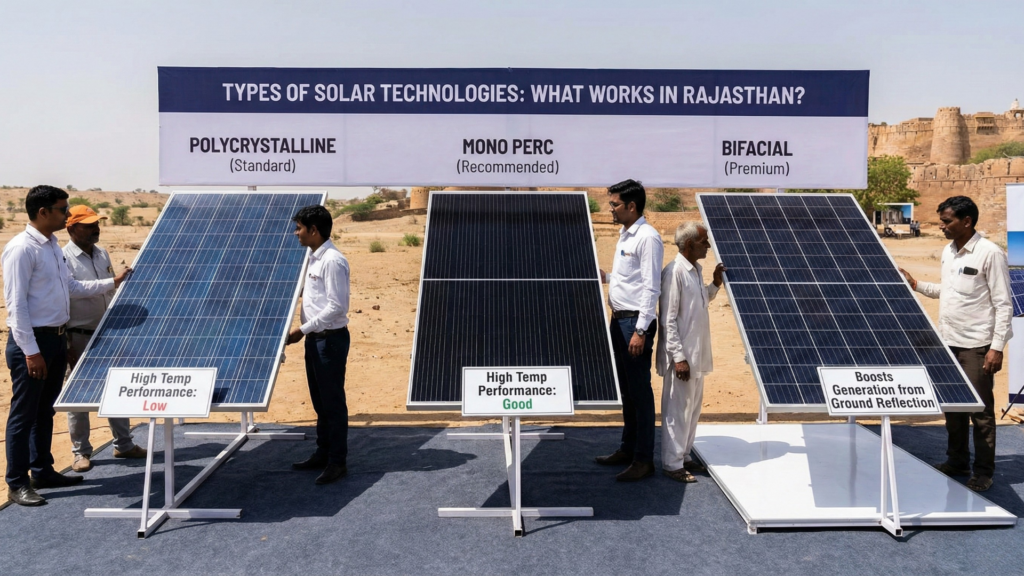
When you ask a vendor for a quote, they will ask you to choose between technologies. Here is a guide specifically tailored to the Rajasthan climate.
1. Polycrystalline Panels (Blue Panels)
- Technology: Older generation.
- Pros: Cheapest option.
- Cons: Low efficiency (16-17%). Requires more roof space. Performance drops significantly in high heat (above 40°C), making them less ideal for Rajasthan summers.
- Verdict: Avoid in 2025 unless on a very tight budget.
2. Mono PERC Half-Cut (Black Panels)
- Technology: Current standard.
- Pros: High efficiency (20-21%). Better performance in low light (cloudy days) and high heat.
- Verdict: Highly Recommended. It offers the best balance of performance and price.
3. Bifacial Solar Panels
- Technology: Premium. Generates power from both the front and back (using reflected light).
- Pros: Can generate 10-20% extra power.
- Why Rajasthan? Rajasthan is dusty and has light-colored ground/roofs. This high “albedo” (reflectivity) means Bifacial panels work exceptionally well here, catching sunlight reflected off your white roof terrace.
- Verdict: Best for maximizing generation if you have a white/reflective roof.
Understanding Net Metering in Rajasthan
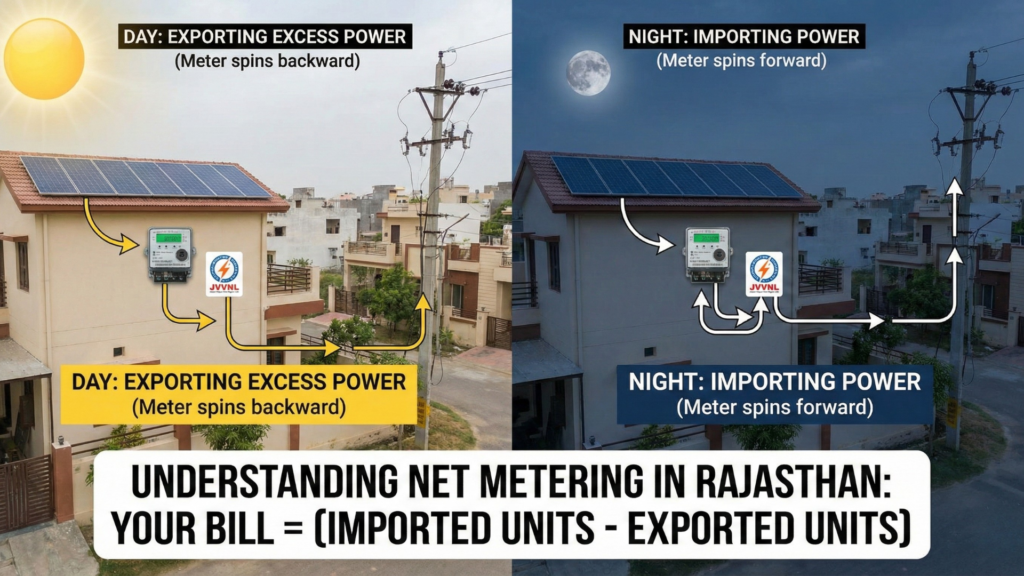
One of the biggest concerns for homeowners is: What happens to the extra electricity I generate?
Rajasthan’s Discoms (JVVNL, AVVNL, JdVVNL) operate on a Net Metering system.
- Import: When you use electricity from the grid (at night), the meter runs forward.
- Export: When your solar panels generate excess power (during the day), it is sent to the grid, and the meter runs backward.
- Bill: You only pay for the “Net” units (Import – Export).
Recently, the Rajasthan Electricity Regulatory Commission (RERC) improved the export rates. If you have surplus units at the end of the settlement period, the Discom now credits them at approx ₹3.26 per unit (up from lower previous rates). While this is lower than your buying price (₹8-9/unit), it ensures that your excess generation still earns you money.
ROI Analysis: Is it Worth It?
Let’s do the math for a standard Jaipur household.
- System Cost (Net): ₹1,65,000
- Daily Generation: 24 Units (Average)
- Annual Generation: 24 x 365 = 8,760 Units
- Cost of Electricity: ₹8.5 per unit (Average slab)
- Annual Savings: 8,760 units x ₹8.5 = ₹74,460
Note: Realistically, factoring in efficiency losses and weather, the payback is usually 3 to 3.5 years. After this period, your electricity is virtually free for the remaining 21+ years of the system’s life.
Financing: Solar Loans in India
If you do not want to pay the full solar panel cost for 5kW system upfront, financing is readily available.
- SBI Surya Ghar Loan: State Bank of India offers specific loans for rooftop solar with interest rates as low as 7% – 8.5%.
- No collateral required for loans up to ₹3 Lakhs.
- Tenure up to 10 years.
- SIDBI & private banks: also offer competitive “Green Energy” loans.
With the monthly EMI often being lower than your current electricity bill, the system is essentially cash-flow positive from Day 1.
Step-by-Step Installation Guide for Rajasthan Residents
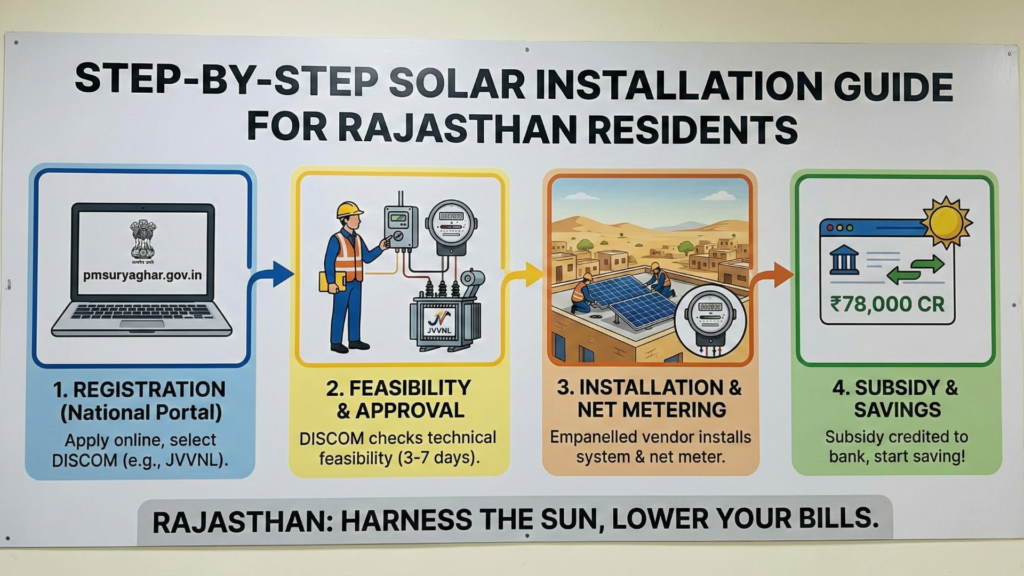
To ensure you get the subsidy and a legitimate system, follow this exact roadmap:
Step 1: Registration: Go to the National Portal for Rooftop Solar (pmsuryaghar.gov.in). Register using your mobile number and Electricity Consumer Number (K-Number in Rajasthan).
Step 2: Apply Online: Login and fill out the application form. Select your state (Rajasthan) and Discom (e.g., Jaipur Vidyut Vitran Nigam Ltd).
Step 3: Technical Feasibility: The Discom will review your application to check if the local transformer can handle the load. This usually takes 3-7 days.
Step 4: Vendor Selection: Once approved, you will see a list of “Empanelled Vendors” on the portal. Crucial: Only choose a vendor from this list to be eligible for the subsidy. Negotiate the solar panel cost for 5kW system based on the brands they offer.
Step 5: Installation & Net Metering: The vendor installs the system. Afterward, they apply for a Net Meter. DISCOM officials will visit, inspect the plant, and install the bi-directional meter.
Step 6: Commissioning & Subsidy: A commissioning certificate is generated online. You enter your bank details on the portal, and the ₹78,000 is credited directly to your account within 30 days.
Maintenance Tips for Rajasthan’s Climate
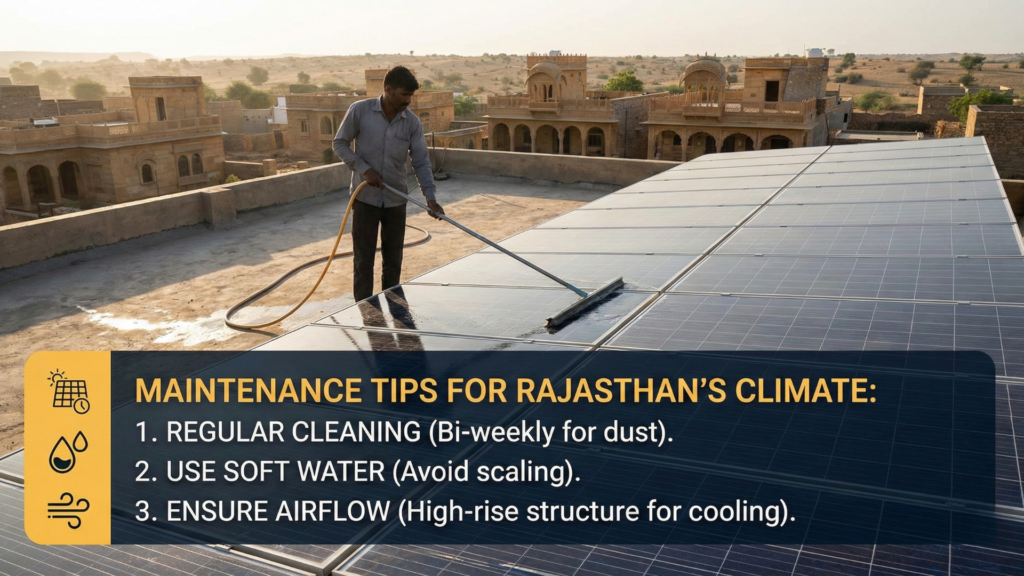
Rajasthan’s specific challenge is dust. A layer of dust can reduce generation by 15-20%.
- Cleaning Cycle: Clean your panels every 10-15 days. Early morning is best when the panels are cool.
- Water: Use soft water if possible. Hard water (common in Rajasthan) can leave calcium deposits (scaling) on the glass, permanently reducing efficiency. Use a wiper to dry them immediately.
- Heat Management: Ensure the mounting structure is “High Rise” or has a gap of at least 1-2 feet from the roof surface. This allows air circulation to cool the panels from beneath, maintaining efficiency during 45°C summers.
Conclusion: Is the Solar panel cost for 5kW system worth it?
The transition to renewable energy is gathering massive momentum. As we analyze the solar panel cost for 5kW system in 2025, it is clear that the combination of high solar efficiency in Rajasthan and the substantial ₹78,000 central subsidy has created a perfect market for homeowners.
You are not just buying a product; you are pre-paying for 25 years of electricity at a fraction of the cost. Whether you reside in the Pink City of Jaipur or the Blue City of Jodhpur, the sun is your greatest asset. By investing roughly ₹1.6 Lakhs today, you save over ₹15 Lakhs in electricity bills over the system’s lifetime.
The best time to plant a tree was 20 years ago. The best time to install solar is today.
FAQs on Solar panel cost for 5kW system
Q1. What is the exact solar panel cost for 5kW system in Rajasthan with subsidy?
The gross cost is typically between ₹2.3 Lakh and ₹2.8 Lakh. After the fixed subsidy of ₹78,000, your net out-of-pocket expense will be approximately ₹1.5 Lakh to ₹2.0 Lakh, depending on the panel brand.
Q2. How much area is required for a 5kW system?
You need approximately 500 square feet (roughly 50 square meters) of shadow-free roof area. The panels should ideally face South for maximum generation in India.
Q3. Can a 5kW system run an AC?
Yes, absolutely. A 5kW system generates enough power to run two 1.5-ton ACs comfortably during the day, along with other standard home loads.
Q4. What happens if I generate more electricity than I use?
Under Rajasthan’s Net Metering policy, excess units are “banked” with the electricity department. These units are adjusted against your night-time consumption. If units remain at the end of the settlement year, the Discom pays you at the rate of ₹3.26/unit.
Q5. Is the subsidy available for Off-Grid systems?
No. The PM Surya Ghar Muft Bijli Yojana subsidy is applicable only for On-Grid and Hybrid systems that are connected to the grid. Purely off-grid systems (with no grid connection) do not get this central subsidy.
Q6. Which solar panel brand is best for Rajasthan?
Top Tier-1 brands like Tata Power Solar, Adani Solar, Waaree, and Vikram Solar are highly recommended. For Rajasthan’s dusty environment, Bifacial panels from these brands are performing exceptionally well.
Q7. How long does the subsidy take to arrive?
Once the system is installed and the commissioning report is uploaded to the national portal, the subsidy is typically credited to your bank account within 30 days.