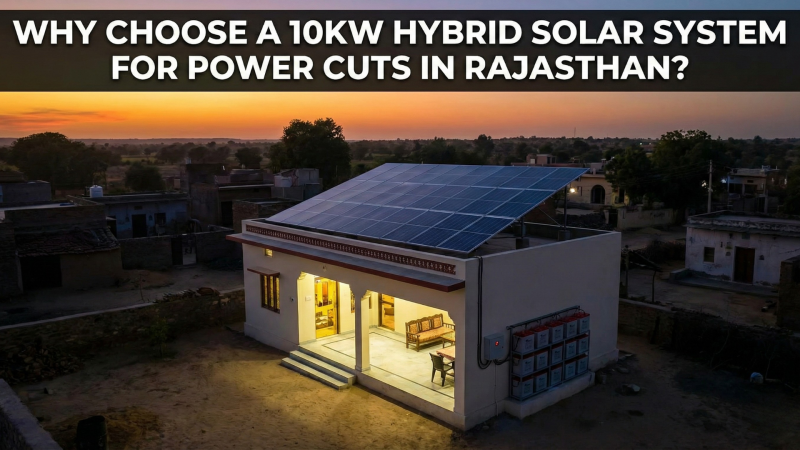
Living in Rajasthan presents a unique paradox. We reside in the “Sunshine State” of India, blessed with over 325 clear sunny days a year. Yet, ironically, homeowners in cities like Jaipur, Jodhpur, and Kota often face power curtailments exactly when they need electricity the most—during scorching summer afternoons or late-night dust storms. While many residents search for the best 10kW solar kits for home use to cut down their bills, most do not realize that a standard on-grid system shuts down during a power cut. If you want true energy independence for your villa or large home, a 10kW Hybrid Solar System is the only solution that keeps your ACs running when the grid fails.
The Price Range: How Much Does a 10kW System Actually Cost?
Before we dive into the technicalities, let’s look at the numbers. The price of a 10kW system in India depends heavily on the technology you choose. Broadly, there are three categories:
- On-Grid (Grid-Tied): The most common and affordable. It works with the government grid. No battery backup.
- Off-Grid: Completely independent with a large battery bank. Rare for cities, common for farmhouses.
- Hybrid: The modern premium choice. Works with the grid AND has battery backup for power cuts.
Table 1: 10kW Solar System Price Estimates (2025)
| System Type | Tech Spec | Approx Price Range (India) | Best For |
| On-Grid | Poly/Mono Panels + String Inverter | ₹4,00,000 – ₹4,80,000 | Homes with <1 hr power cut/day. |
| On-Grid Premium | Bifacial Panels + Micro/String Inverter | ₹5,00,000 – ₹5,50,000 | maximizing generation in limited space. |
| Hybrid (Lead Acid) | Mono Panels + Tall Tubular Batteries | ₹6,00,000 – ₹7,00,000 | Areas with frequent power cuts. |
| Hybrid (Lithium) | Bifacial Panels + Lithium (LiFePO4) Battery | ₹7,50,000 – ₹9,00,000 | Luxury homes needing 24/7 automation. |
Note: These prices usually include installation, structure, and commissioning but exclude net-metering government fees.
Component-Wise Cost Breakdown: Where Does Your Money Go?
To identify the best 10kW solar kits for home use, you must understand where your money goes. A “cheap” kit often cuts costs on the structure or wires, which are dangerous shortcuts.
A. Solar Panels Cost: Why Bifacial Modules are Essential for Best 10kW Solar Kits for Home Use
The panels are the engine of your system.
- Polycrystalline: (Blue color). Obsolete technology. Cheapest, but requires more roof space. Avoid these for a 10kW system in 2025.
- Mono-PERC Half Cut: (Black color). The current standard. High efficiency even in low light.
- Bifacial Modules: The top recommendation for Rajasthan. They generate power from the front and back (reflected light).
- Price Impact: Bifacial panels cost roughly ₹2-3 per watt more than standard Mono panels, adding approx ₹20,000 – ₹30,000 to the total cost, but they generate 10-15% more power.
B. Solar Inverter (25-30% of Cost)
- String Inverter: Used in On-Grid systems. Brands like Growatt, Solis, or Tata Power. Costs between ₹60,000 to ₹90,000.
- Hybrid Inverter: A complex computer that manages battery charging and grid export. Brands like Deye or GoodWe. Costs between ₹1,40,000 to ₹1,80,000.
C. Module Mounting Structure (10% of Cost)
This is often overlooked.
- Standard Layout: Panels are mounted close to the roof (1-2 feet height). Cheaper.
- High-Rise (Pergola) Structure: Panels are mounted 8-10 feet high on Galvanized Iron (GI) legs. This allows you to utilize the roof space underneath.
- Cost Impact: A high-rise structure requires much more steel and civil work (concrete foundations), adding ₹35,000 to ₹50,000 to the final bill.
D. Balance of System (BOS) (10% of Cost)
This includes DC wires (4sqmm/6sqmm), AC wires, Earthing kits (Chemical earthing), Lightning Arresters (LA), and Distribution Boxes (ACDB/DCDB).
- Warning: Cheap kits use Aluminium AC wires instead of Copper. Always insist on Polycab or Havells Copper cabling for safety.
How to Choose the Best 10kW Solar Kits for Home Use

When shopping for a kit, you aren’t just buying hardware; you are buying a 25-year commitment. Here is a checklist to ensure you get the best value:
- Panel Efficiency: Look for panels rated 540Wp or higher. This reduces the number of panels needed (approx 18 panels for 10kW) and reduces the weight on your roof.
- Inverter Warranty: The industry standard is 5 years. The best 10kW solar kits for home use will offer an option to extend this to 10 years for a small premium.
- Remote Monitoring: Ensure the kit includes a WiFi dongle. This allows you to check daily generation (in kWh) on your mobile phone.
- Serviceability: Choose brands that have a service center in your city (e.g., Jaipur). If your inverter fails, you cannot ship a 30kg device back to the factory. Local service is key.
The Subsidy Factor: PM Surya Ghar Yojana (2025)

A major question for buyers is: “How much subsidy will I get on a 10kW system?”
There is a common misconception that you get a subsidy on the entire 10kW. That is incorrect.
Under the PM Surya Ghar Muft Bijli Yojana, the central government subsidy is capped at a system capacity of 3kW. However, you can install a larger system (like 10kW) and still claim the maximum fixed subsidy amount available.
Calculation: Maximum Subsidy Available on Best 10kW Solar Kits for Home Use
- Subsidy for first 2kW: ₹30,000 per kW = ₹60,000
- Subsidy for additional 1kW: ₹18,000 per kW = ₹18,000
- Subsidy for capacity above 3kW: ₹0
- Total Maximum Subsidy: ₹78,000
So, if your 10kW On-Grid system costs ₹4,50,000, your effective cost after subsidy will be:
₹4,50,000 – ₹78,000 = ₹3,72,000
Note: Subsidies are generally credited directly to the customer’s bank account within 30-45 days after the system is commissioned and the net meter is installed.
Detailed ROI Analysis: Is a 10kW Solar System Worth the Investment?

For Indian middle-class families, Return on Investment (ROI) is the deciding factor. A 10kW system is a significant capital expenditure. Let’s see how fast it pays back.
Assumptions for Calculation:
- Location: Rajasthan (High solar irradiance).
- System: 10kW On-Grid.
- Total Cost (Net): ₹4,00,000 (Optimized price).
- Electricity Tariff: ₹8.5 per unit (Average high slab rate).
- Generation: 4 units per kW per day = 40 units/day.
Table 2: ROI & Savings Chart
| Metric | Calculation |
| Daily Generation | 40 Units |
| Monthly Generation | ~1,200 Units |
| Annual Generation | ~14,400 Units |
| Monthly Bill Saving | 1,200 units × ₹8.5 = ₹10,200 |
| Yearly Saving | ₹1,22,400 |
| Simple Payback Period | ₹4,00,000 / ₹1,22,400 = 3.2 Years |
| Total Savings in 25 Years | 14,400 units × 25 years × ₹8.5 = ₹30.6 Lakhs |
The Result: You recover your entire investment in just over 3 years. For the remaining 22 years of the system’s life, you are effectively generating free electricity worth over ₹30 Lakhs. This return (approx 30% per annum) beats any Fixed Deposit, Mutual Fund, or Real Estate investment.
What Can You Run on a 10kW System?
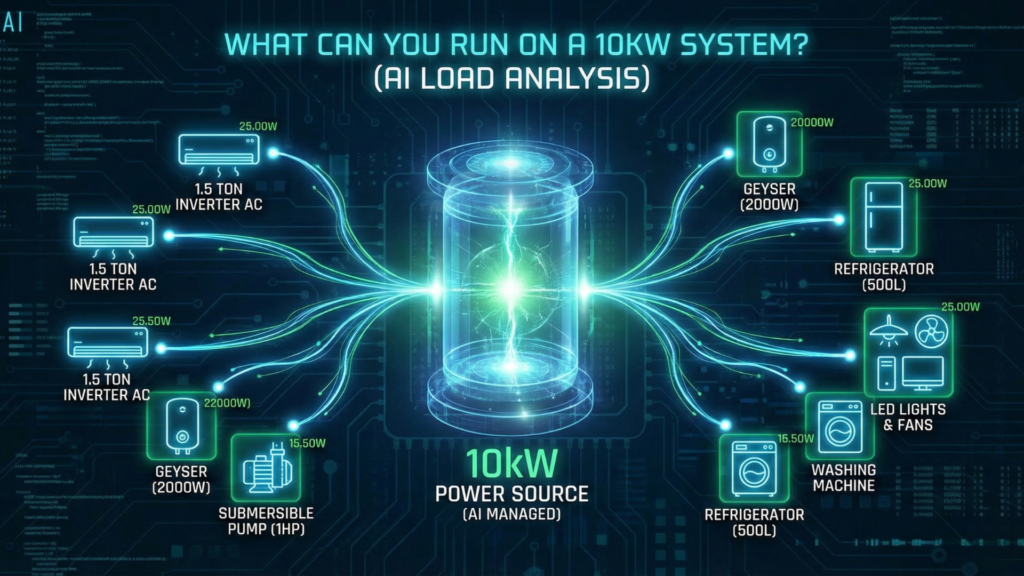
Many users confuse “kW” (Capacity) with “kWh” (Units).
- kW is the size of the engine.
- kWh is the amount of fuel it produces.
Managing ACs and Heavy Loads with the Best 10kW Solar Kits for Home Use
- Air Conditioners: You can run three 1.5 Ton ACs simultaneously during peak sun hours (11 AM to 3 PM) without drawing grid power.
- Water Heating: Heavy geysers (2000W) in winter.
- Water Pumps: Submersible pumps (1HP or 2HP) for water tanks.
- Electric Vehicles: If you have an EV (like a Tata Nexon EV), a 10kW system is ideal. Charging an EV requires roughly 30 units for a full charge. A 10kW system produces 40 units/day, covering your daily driving needs entirely.
Hidden Costs to Watch Out For When Buying the Best 10kW Solar Kits for Home Use

When budgeting for the best 10kW solar kits for home use, keep a buffer of ₹20,000 to ₹30,000 for these “hidden” expenses:
- Net Meter Charges: While the Net Meter itself might be provided by the DISCOM (Electricity Board), you often have to pay for testing fees, application processing fees, and sometimes the meter box itself.
- Load Extension: If your current sanctioned load is 5kW, you cannot install a 10kW solar system. You must apply to the electricity board to increase your load to 10kW. This involves a security deposit difference (approx ₹1500-₹2000 per kW).
- Cable Length: Standard quotes usually include 30-50 meters of DC cable. If your roof is on the 3rd floor and your meter is on the ground floor, extra cabling will be charged per meter.
- Civil Work: If your roof is uneven or weak, you might need to build concrete pedestals (blocks) to anchor the structure legs. This requires masons and cement, which is usually not included in the solar installer’s scope.
Installation Process: Step-by-Step
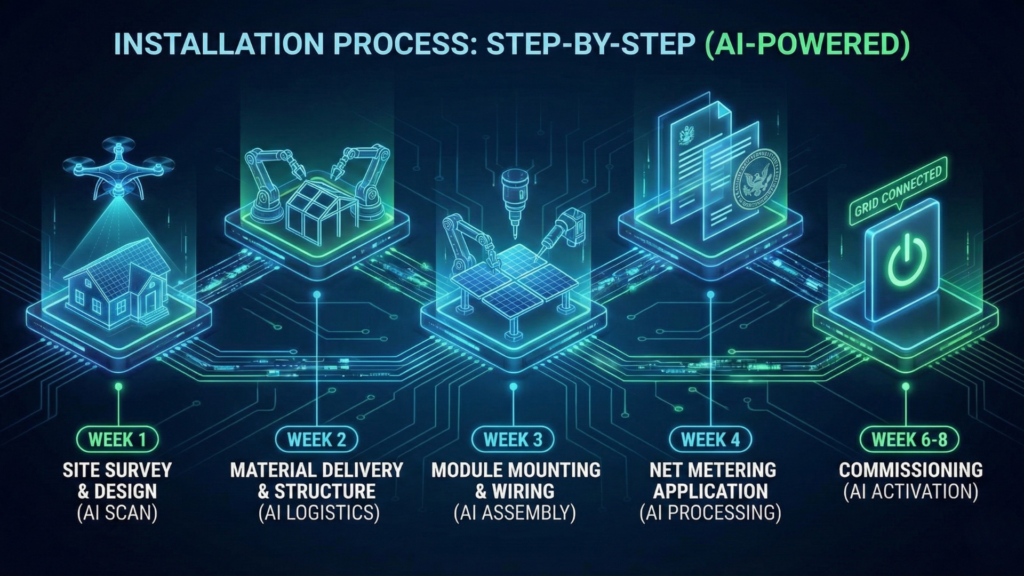
Installing a 10kW system takes time. It is not a one-day job.
- Week 1: Site Survey & Design. The engineer measures shadow-free area and designs the structure legs to withstand wind speeds (especially important in Rajasthan).
- Week 2: Material Delivery & Structure Installation. The heavy GI structure is assembled and anchored.
- Week 3: Module Mounting & Wiring. Panels are bolted down, and wiring is routed to the inverter.
- Week 4: Net Metering Application. The file is submitted to the DISCOM (JVVNL/Tata Power/etc.).
- Week 6-8: Commissioning. The government official visits, installs the Bi-Directional Meter (Net Meter), and the system is officially switched ON.
Conclusion: Final Verdict on Buying the Best 10kW Solar Kits for Home Use
A 10kW solar system is a transformative asset for any Indian homeowner. It moves you from being a passive consumer paying high bills to an active “Prosumer” (Producer + Consumer) of energy.
While the upfront cost of ₹4.5 Lakh to ₹8 Lakh seems high, the mathematics are undeniable. With a payback period of roughly 3 years and a lifespan of 25 years, it is arguably one of the safest financial decisions you can make in 2025.
Summary Recommendation:
- If you have reliable grid power: Go for a 10kW On-Grid System with Bifacial Panels (Approx ₹5 Lakh).
- If you face frequent power cuts: Invest in a 10kW Hybrid System with Lithium Battery (Approx ₹7.5 Lakh).
When searching for the best 10kW solar kits for home use, prioritize the installer’s reputation over the lowest price. A bad installation can ruin good equipment, but a good installation ensures 25 years of peace of mind.
Frequently Asked Questions (FAQ)
Q1: How much roof space is required for a 10kW Solar System?
A: You need approximately 900 to 1,000 square feet of shadow-free area. With modern high-efficiency 550W panels, this space requirement has reduced slightly compared to older technology.
Q2: Can I install a 10kW system if my sanctioned load is only 7kW?
A: No. As per most state electricity regulations (including Rajasthan), your solar system capacity cannot exceed your sanctioned load (usually capped at 80% or 100% depending on the state). You will need to apply for a load enhancement at your local electricity office first.
Q3: What happens to the excess power generated by my 10kW system?
A: If you have an On-Grid or Hybrid system with Net Metering, the excess power is exported to the grid. The electricity board records this as “Export Units.” These units are subtracted from your night-time consumption. If you export more than you consume in a month, the credit is carried forward to the next month’s bill.
Q4: How often do I need to clean the solar panels?
A: In dusty regions like Rajasthan, you should clean the panels every 7 to 10 days. A layer of dust can reduce efficiency by 15-25%. Installing a sprinkler system is highly recommended for a 10kW plant to make cleaning easy.
Q5: Is a 10kW system eligible for financing/loans?
A: Yes. Under the PM Surya Ghar scheme, collateral-free loans are available at concessional interest rates (around 7%) for systems up to 3kW. For larger 10kW systems, most PSU banks (SBI, PNB, Canara Bank) offer dedicated Solar Roof Loans with low interest rates and tenures up to 5-7 years.