For industrial giants in Rajasthan, electricity is not just a utility; it is a massive operational cost that eats into profit margins. With commercial grid tariffs hovering between ₹8.5 to ₹10 per unit, investing in a MW scale solar plant installation is no longer just an environmental choice—it is a financial necessity to stop bleeding cash and ensure long-term profitability.
The solution is not just “saving electricity”—it is changing where you buy it from. This is where Open Access Solar comes in.
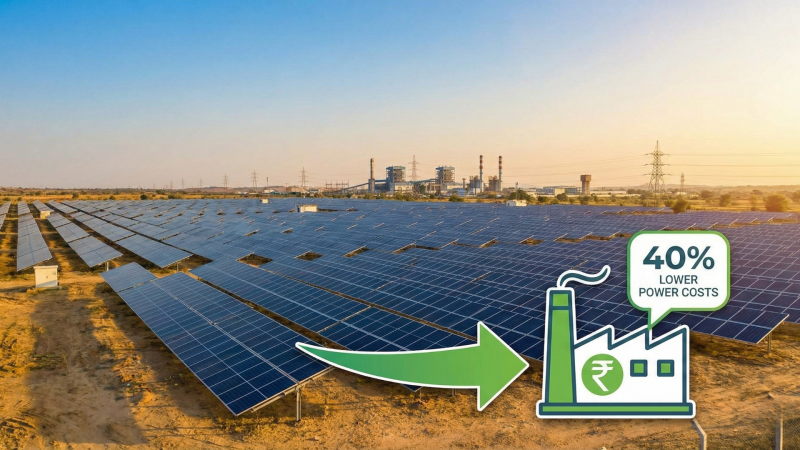
This guide details how Rajasthan’s industries can utilize the 2025 Green Energy Open Access Regulations to cut power costs by up to 40% through strategic solar investments.
What is Open Access Solar?
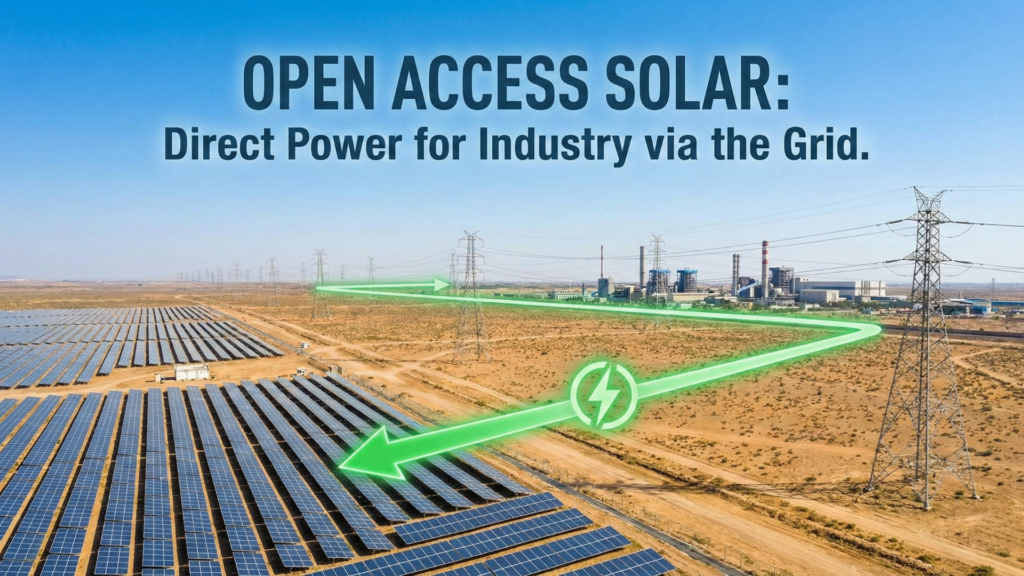
Open Access allows large consumers (industries, factories, and commercial buildings) to buy electricity directly from solar power generators, bypassing the expensive local DISCOM grid tariffs. Instead of buying power from the state electricity board (JVVNL, AVVNL, JDVVNL), you buy green power from a solar park located elsewhere in Rajasthan and pay a small “wheeling charge” to use the transmission lines.
This mechanism is the single most effective way for industries with a connected load of 100 kW and above to secure long-term, low-cost power.
The Role of MW Scale Solar Plant Installation in Open Access
To make Open Access work financially, you need scale. A MW scale solar plant installation is the backbone of this model. Unlike small rooftop setups, these are ground-mounted utility projects (usually 1 MW to 50 MW) installed in high-radiation zones like Jodhpur or Bikaner.
When you invest in a MW scale solar plant installation for Open Access, you are essentially building your own private power station miles away from your factory, yet consuming that power as if it were generated on-site.
Models of Ownership: Captive vs. Third-Party
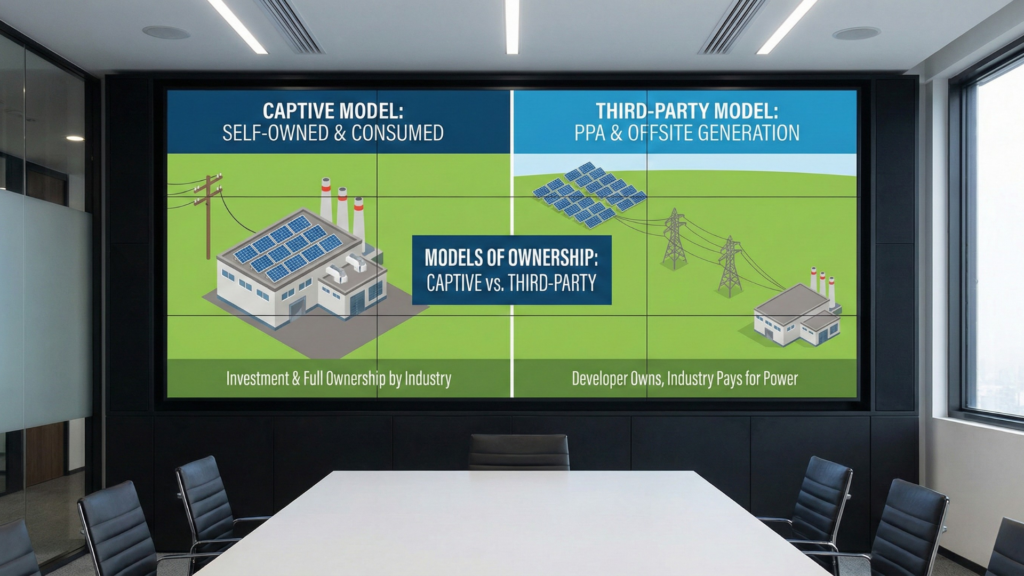
Before you commission a MW scale solar plant installation, you must decide on the business model. This choice dictates your legal status and the subsidies you receive.
Table 1: Captive vs. Third-Party Open Access Comparison
| Feature | Captive Open Access (Recommended) | Third-Party Open Access (PPA) |
| Ownership | Industry owns at least 26% equity in the solar project. | Developer owns 100% of the project. |
| Investment | High upfront CAPEX (Capital Expenditure). | Zero upfront investment (OPEX model). |
| Consumption Rule | You must consume at least 51% of generated power. | No minimum consumption obligation. |
| Cross-Subsidy Surcharge (CSS) | EXEMPTED (Huge Saving). | APPLICABLE (Increases cost significantly). |
| Additional Surcharge (AS) | EXEMPTED. | APPLICABLE. |
| Best For | Industries with cash reserves looking for max ROI. | Companies wanting green power without CAPEX. |
Pro Tip: For most industries in Rajasthan, the Captive Model is superior because exemption from the Cross-Subsidy Surcharge (CSS) saves roughly ₹1.50–₹2.00 per unit immediately.
Rajasthan Green Energy Open Access Regulations 2025

The Rajasthan Electricity Regulatory Commission (RERC) released updated regulations in 2025 that significantly impact MW scale solar plant installation projects.
Key Regulatory Highlights for 2025-2026
- Eligibility Reduced: Now, any consumer with a contract demand of 100 kW (previously higher) can apply for Open Access.
- Banking Provisions: Industries can “bank” (store) unutilized solar power with the grid. However, RERC now deducts 8% of banked energy as “Banking Charges.”
- BESS Mandate: For new projects above 5 MW, installing a Battery Energy Storage System (BESS) is now mandatory for a portion of the capacity to ensure grid stability.
- Green Hydrogen Incentives: Special waivers are available if the solar power is used for Green Hydrogen production.
Financial Analysis of MW Scale Solar Plant Installation
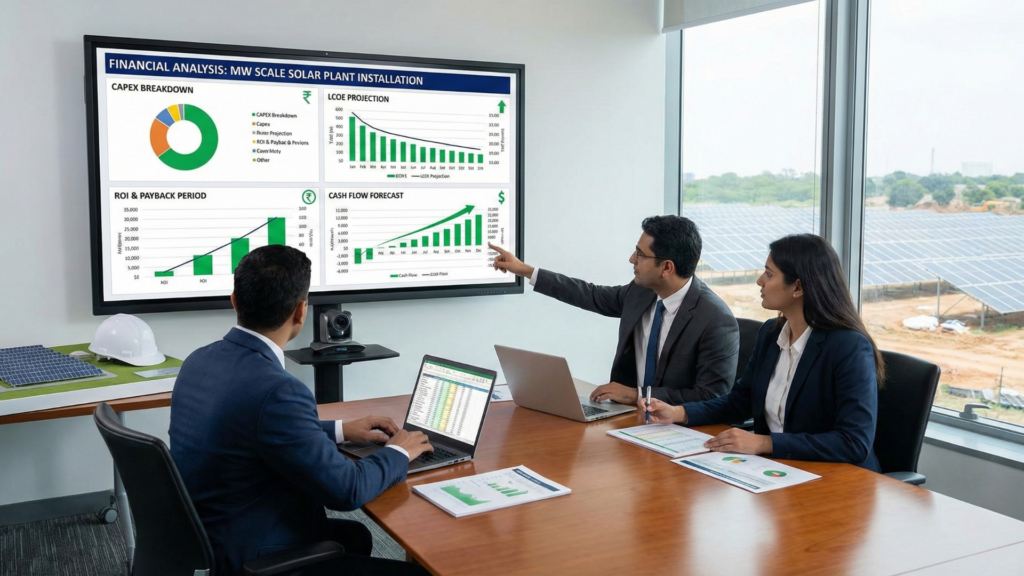
The primary motivation for a MW scale solar plant installation is financial. Let’s look at the costs involved in wheeling power from a solar park in Bikaner to a factory in Jaipur.
Table 2: Open Access Charges in Rajasthan (Estimated 2025-26)
| Charge Component | Cost (Approximate) | Note |
| Solar Generation Cost | ₹2.60 – ₹2.90 / kWh | The base cost of producing power. |
| Transmission Charges | ₹0.20 – ₹0.35 / kWh | Paid to RVPN (State Transmission Utility). |
| Wheeling Charges | ₹0.05 – ₹0.15 / kWh | Paid if using DISCOM network (33kV/11kV). |
| Banking Charges | 8% of Energy | deducted in kind (units). |
| Cross Subsidy Surcharge | ₹0.00 (Captive) / ₹1.80+ (Third-Party) | The biggest differentiator. |
| Electricity Duty (ED) | ₹0.40 – ₹0.60 / kWh | Varies by industry type. |
| Landed Cost (Total) | ₹4.00 – ₹4.50 / kWh | Compared to Grid Tariff of ₹9.50 |
ROI on MW Scale Solar Plant Installation
By executing a MW scale solar plant installation under the Captive model, an industry effectively locks in a power rate of roughly ₹4.50/unit for 25 years.
- Grid Rate: ₹9.50/unit
- Captive Solar Rate: ₹4.50/unit
- Savings: ₹5.00 per unit
Payback Period: Typically 3 to 4 years.
Steps to Execute a MW Scale Solar Plant Installation
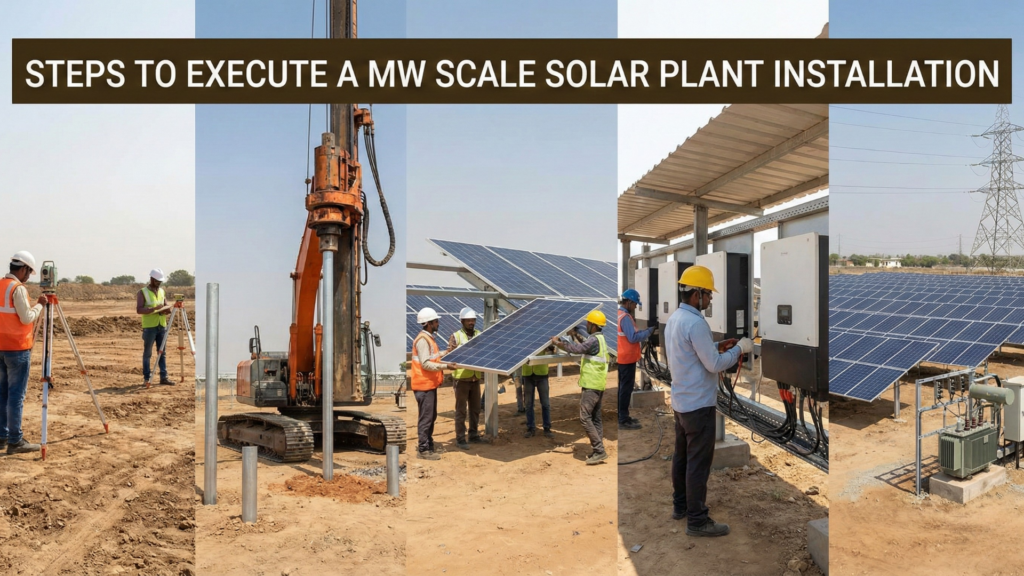
Successful execution requires navigating Rajasthan’s specific bureaucratic landscape.
- Feasibility Study: Analyze your factory’s load curve. If you run 24/7 operations, you will need a hybrid solution (Solar + Wind or Solar + Storage) because solar only generates during the day.
- Land Acquisition: Secure land in a high-radiation zone. Industrial hubs often lease land in “Solar Parks” to avoid land conversion hurdles.
- NOC & Connectivity: Apply for a No Objection Certificate (NOC) from your local DISCOM (e.g., JVVNL) and grid connectivity approval from RVPN.
- EPC Contractor Selection: Choose an EPC partner experienced specifically in MW scale solar plant installation. Utility-scale engineering is different from rooftop solar; it requires high-voltage transmission lines (33kV or 132kV).
- Commissioning: Once built, the plant must be inspected by the Electrical Inspector to Government (EIG) before power injection begins.
Table 3: Estimated Annual Savings (1 MW Captive Plant)
| Parameter | Value |
| Plant Capacity | 1 MW (DC) |
| Annual Generation | ~15,00,000 Units (kWh) |
| Grid Tariff (Commercial) | ₹9.50 / kWh |
| Captive Solar Landed Cost | ₹4.50 / kWh |
| Savings Per Unit | ₹5.00 / kWh |
| Annual Savings | ₹75,00,000 (75 Lakhs) |
| 25-Year Total Savings | ~₹18 Crores |
Strategic Benefits Beyond Cost Savings
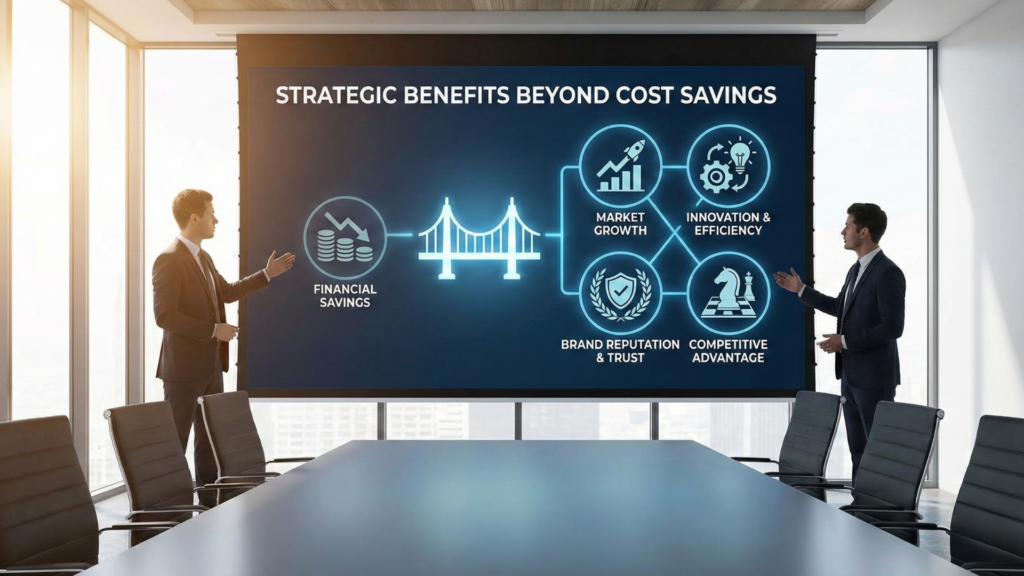
While the focus is often on the MW scale solar plant installation cost, the secondary benefits are massive for modern businesses:
- RPO Compliance: Large industries have a “Renewable Purchase Obligation” (RPO). Captive solar automatically fulfills this legal requirement.
- Green Branding: Export-oriented units (textiles, handicrafts) in Rajasthan face pressure from European and US buyers to be “Net Zero.” Running on solar boosts your export value.
- Price Hedge: Grid tariffs rise by 3-5% every year. Your solar cost is fixed. You are immune to inflation for the next two decades.
Conclusion
For industries in Rajasthan, the era of paying ₹10 per unit for electricity is over. The regulatory framework for MW scale solar plant installation is mature, and the financial logic is undeniable.
Whether you choose a Captive model for maximum savings or a Third-Party model for zero CAPEX, the move to Open Access is not just an environmental choice—it is a survival strategy in a competitive market.
Ready to calculate your exact savings? Start by auditing your last 12 months of electricity bills to determine your precise “Base Load” for sizing your solar plant.
FAQs: Open Access & MW Scale Solar Plant Installation
Q1: What is the minimum capacity required for a MW scale solar plant installation in Rajasthan?
While the regulation allows Open Access for consumers with 100 kW demand, a “MW scale” installation typically implies a project size of 1 MW and above. However, you can install smaller capacities (e.g., 500 kW) under the same Open Access rules if your load permits.
Q2: Can I install the solar plant on my factory premises?
Yes, but that is called “Behind-the-Meter” or Rooftop Solar. Open Access specifically refers to a MW scale solar plant installation located off-site (e.g., in a solar park) that wheels power to your factory through the grid.
Q3: What happens to the solar power generated on holidays when my factory is closed?
This is where “Banking” comes in. The surplus power generated during holidays is fed into the grid and “banked.” You can withdraw this power later (e.g., at night or on working days), subject to an 8% banking charge by the DISCOM.
Q4: Is the Cross-Subsidy Surcharge (CSS) permanent?
CSS is determined annually by the RERC. It applies to Third-Party Open Access but is currently exempted for Captive Power Plants, which is why the Captive model is highly recommended for utility-scale projects.
Q5: How much land is required for a 1 MW solar plant?
You typically need 4 to 5 acres of clear, flat land for a 1 MW installation. In Rajasthan’s solar parks, this land is often readily available for lease.