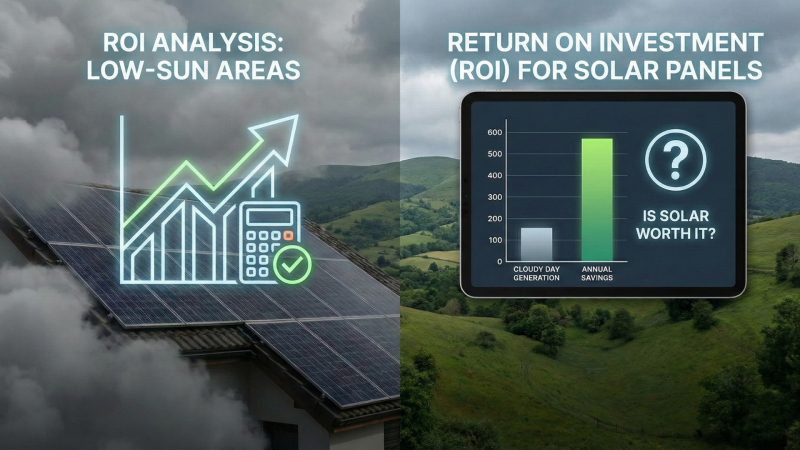
The biggest myth stopping Indian homeowners from going solar is the belief that panels need scorching heat to work. While sunlight intensity matters, many are surprised to learn that the return on investment (ROI) for solar panels remains highly attractive even in cloudy regions like Kerala, Shillong, or the misty hills of Himachal. The financial math might look different than it does in Rajasthan, but modern technology ensures that your savings continue even when the sun plays hide-and-seek.
If you are worried about whether your money will be wasted, this guide covers everything. We will break down the Return on Investment (ROI) for solar panels in low-light areas, backing it up with data, real-world Indian scenarios, and financial calculations.
The Science: Do Solar Panels Work in “Low-Sun” Weather?
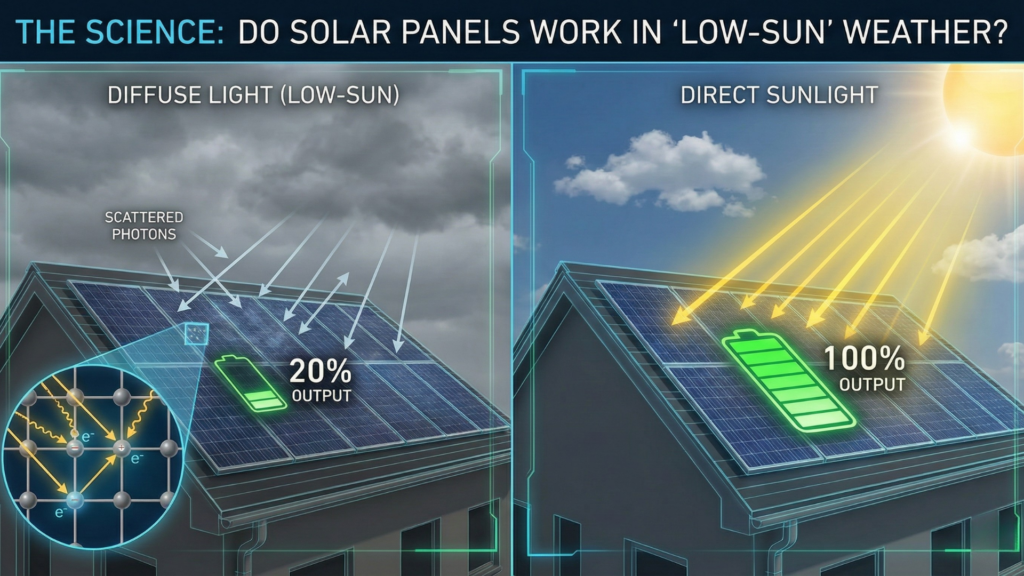
Before we calculate money, we must understand the physics. Solar panels (especially modern Photovoltaic or PV cells) do not stop generating power when a cloud blocks the sun. They utilize “Diffuse Light”—sunlight that is scattered by particles in the clouds.
- Sunny Days: Panels operate at 100% capacity.
- Light Cloud Cover: Panels operate at roughly 60% to 80% capacity.
- Heavy Rain/Overcast: Panels operate at roughly 10% to 25% capacity.
While the output drops, it never hits zero. Furthermore, rain helps improve Return on investment (ROI) for solar panels by washing away dust layers that usually reduce efficiency by 15-20% in dusty Indian cities.
1. Calculating the Return on Investment (ROI) for Solar Panels in India
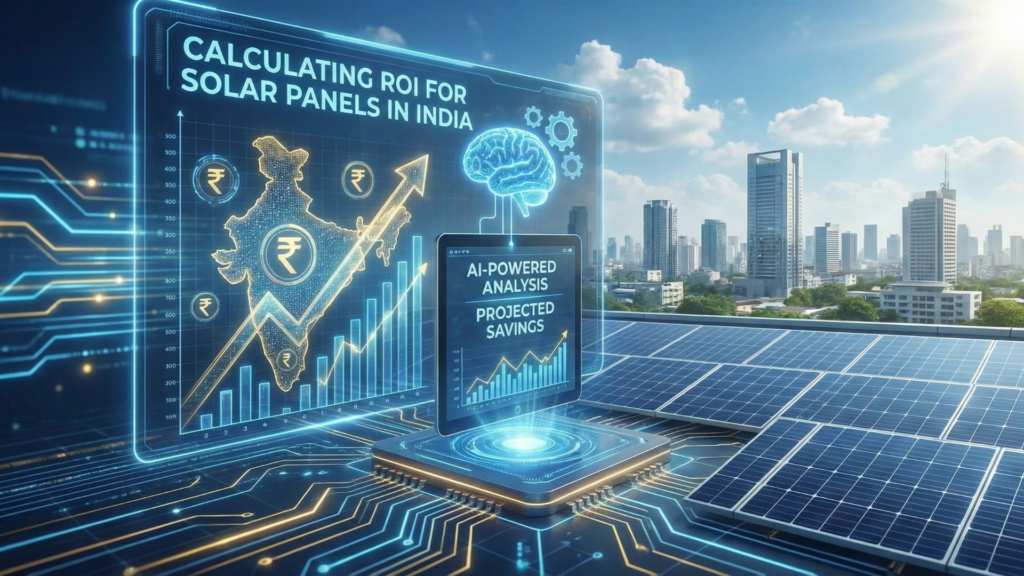
To understand if solar is worth it for you, we need to look at the numbers. In a cloudy climate, your system generates fewer units per year, which extends your payback period—but often not by as much as you think, thanks to high electricity tariffs in many Indian states.
Table 1: Solar Generation Estimation (Sunny vs. Cloudy Cities in India)
Comparison of a standard 3kW Residential System
| Feature | Sunny City (e.g., Jaipur/Nagpur) | Cloudy/Low-Sun City (e.g., Shillong/Coorg) |
| System Size | 3 kW On-Grid | 3 kW On-Grid |
| Avg. Daily Generation | 12 – 13 Units (kWh) | 8 – 9 Units (kWh) |
| Annual Generation | ~4,500 Units | ~3,000 Units |
| Grid Electricity Rate | ₹8 / unit | ₹7 / unit |
| Annual Savings | ₹36,000 | ₹21,000 |
| Efficiency Drop | 0% (Baseline) | ~30% lower generation |
Insight: Even with 30% less sunlight, a cloudy region still saves roughly ₹21,000 per year. The key to a good Return on investment (ROI) for solar panels here isn’t just generation—it’s the cost of the electricity you are replacing.
2. Factors That Protect Your ROI in Cloudy Regions
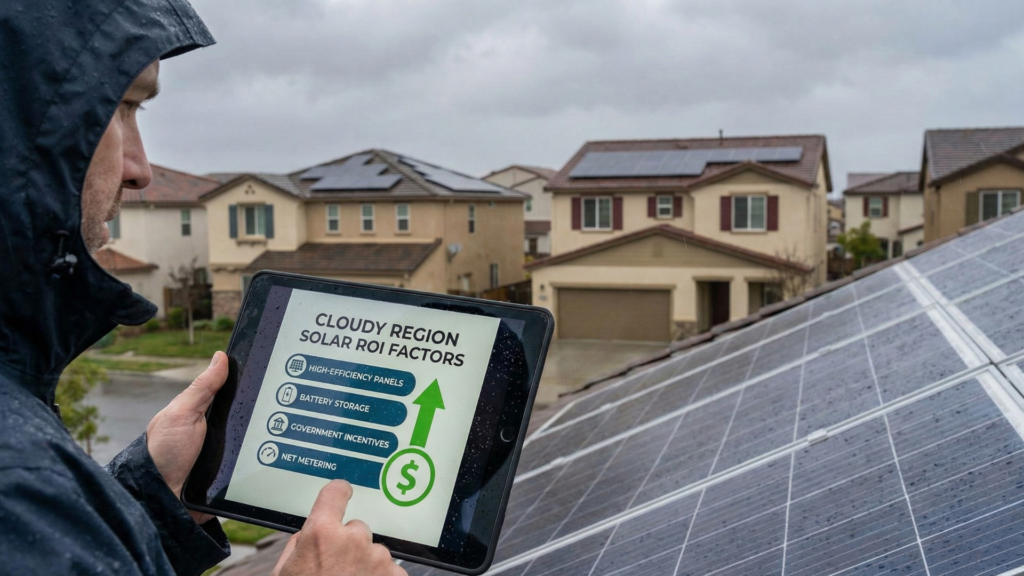
If you live in a low-light area, three factors will save your investment:
A. Net Metering acts as a “Virtual Battery”
In India, the sunniest months (March–May) often precede the cloudiest months (June–August). With Net Metering, the excess power you generate during summer is “banked” with the grid. During the cloudy monsoon, you draw this power back for free. This balances out your annual returns, ensuring your Return on investment (ROI) for solar panels remains stable year-round.
B. Rising Grid Tariffs
Electricity prices in India rise by roughly 5-7% every year. As grid electricity becomes more expensive, the value of every unit your solar panels generate increases. Even if your panels work at 70% efficiency due to clouds, the value of that 70% is getting higher every year.
C. Government Subsidies (PM Surya Ghar Muft Bijli Yojana)
The Central Government subsidy significantly lowers the upfront cost. For a 3kW system, the subsidy can be up to ₹78,000 (subject to current policy changes). This drastic reduction in initial cost makes the ROI attractive even if your generation is lower.
3. Financial Analysis: Real Return on Investment (ROI) for Solar Panels

Let’s calculate the final verdict. Is the payback period reasonable for a family in a cloudy region?
Table 2: Estimated ROI & Payback for Low-Sun Regions (3kW System)
Assumption: Using High-Efficiency Monocrystalline Panels
| Financial Component | Cost / Value (Estimated) |
| Total System Cost (3kW) | ₹1,60,000 |
| Less: Central Govt. Subsidy | – ₹78,000 |
| Net Cost to Customer | ₹82,000 |
| Annual Bill Savings (Low Sun) | ₹21,000 (approx) |
| Payback Period | ~3.9 Years |
| ROI (First 5 Years) | ~28% |
| Total Lifetime Savings (25 Years) | ₹5,25,000+ |
Verdict: even in a cloudy climate, recovering your investment in under 4 years is excellent. Any financial instrument that returns your capital in 4 years and gives free returns for the next 21 years is a winning asset.
4. How to Maximize Return on Investment (ROI) for Solar Panels in Low-Light
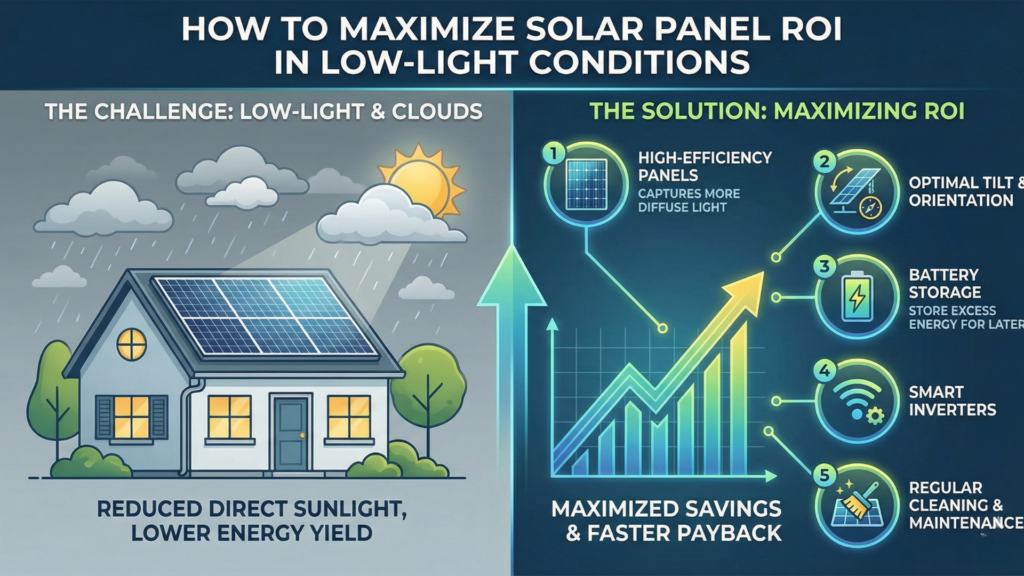
If you are in a cloudy area, you cannot install standard panels and hope for the best. You need to optimize:
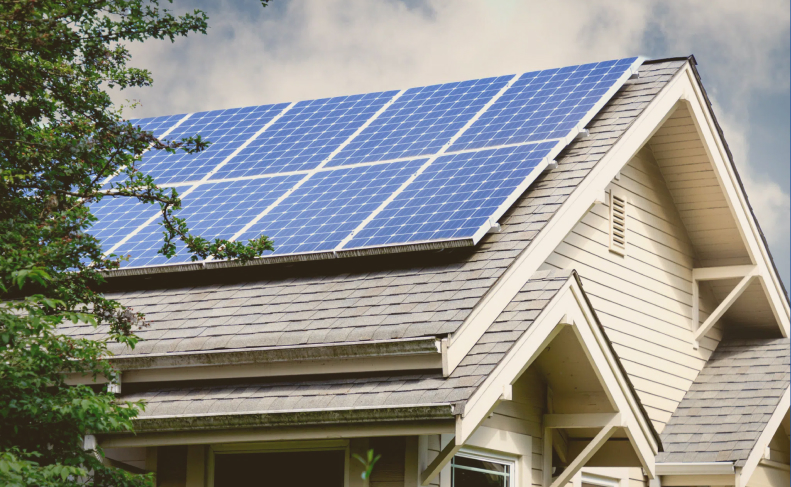
- Choose Monocrystalline or Bi-Facial Panels: Unlike older Polycrystalline (blue) panels, Monocrystalline (black) panels are highly efficient in low-light and diffuse light conditions. Bi-facial panels can even capture light reflected from the ground/roof.
- Oversize the Inverter: Use an MPPT (Maximum Power Point Tracking) solar inverter. It is smarter at squeezing out every bit of voltage during fluctuating cloud cover.
- Opt for a Hybrid System: If your area suffers from power cuts during rains, a Hybrid inverter with Lithium battery backup ensures you use your generated power rather than losing it when the grid goes down.
Conclusion: Is the ROI for Solar Panels Good in Cloudy Areas?
So, is solar worth it in cloudy climates? Yes, absolutely.
While you may not generate as much power as someone in the Thar Desert, the Return on investment (ROI) for solar panels in cloudy Indian regions is still financially robust. With the current subsidies reducing the entry cost, the payback period is typically under 4 years. Considering solar panels last for 25 years, you are looking at over two decades of virtually free electricity, regardless of the weather.
Don’t let the clouds fool you—solar is still one of the safest investments you can make for your home in 2025.
Frequently Asked Questions (FAQ)
Q1: Will my solar system shut down completely during heavy rains?
No. Solar panels work on light, not heat. During heavy rains, generation drops to 10-25%, but it does not stop. If you have a battery system, it will continue to charge slowly.
Q2: Which solar panel is best for cloudy areas in India?
Monocrystalline PERC panels are the best choice. They use high-purity silicon which is much better at converting low-intensity light into electricity compared to standard polycrystalline panels.
Q3: How does the “Return on investment (ROI) for solar panels” compare to Fixed Deposits (FD)?
An FD typically gives 6-7% returns annually. A solar system in a cloudy area (as shown in Table 2) can give an ROI of roughly 25-28% annually through savings. Solar beats FD by a wide margin.
Q4: Do I need batteries for cloudy areas?
If your area has frequent power cuts during monsoon, yes, you need a Hybrid System with batteries. If you rarely face power cuts, an On-Grid System with Net Metering is more financially profitable as batteries add to the cost.
Q5: Does rain damage solar panels?
No, solar panels are waterproof and built to withstand hail and heavy rain. In fact, rain is beneficial as it cleans the dust off your panels naturally, improving their efficiency for the next sunny day.