The global shift toward renewable energy has transformed from a corporate social responsibility initiative into a strategic financial necessity. For the industrial sector in India—ranging from textile mills in Rajasthan to heavy manufacturing units in Gujarat—energy remains one of the highest operational expenses. As of 2026, the industrial solar plant setup cost has reached a point of high stability and technological maturity, making it the most viable time for large-scale investment.
In this comprehensive guide, we will break down the financial and technical requirements for three of the most common industrial capacities: 100kW, 500kW, and 1MW.
The Financial Landscape of Solar for Industries
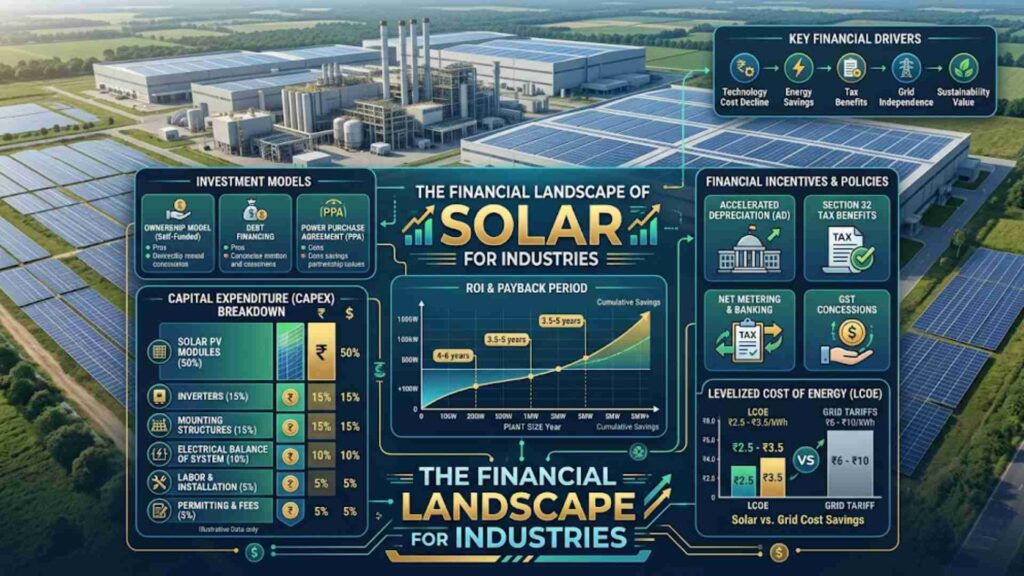
The decision to transition to solar power is primarily driven by the “Levelized Cost of Energy” (LCOE). While grid electricity prices for industrial consumers often hover between ₹8 and ₹12 per unit, solar power can be generated at an effective cost of less than ₹2.50 per unit over a 25-year period.
Primary Drivers of the Industrial Solar Plant Setup Cost
Understanding the cost requires looking at the individual components that make up a high-performance system in 2026:
- Solar PV Modules: The “engine” of the system. We have moved beyond standard Mono-PERC panels. Today, N-Type TOPCon (Tunnel Oxide Passivated Contact) and Bifacial modules are the industry standards. They offer efficiency rates of 22-23% and better performance in high-temperature regions like Jaipur and Kota.
- Inverter Technology: Modern industrial systems utilize high-capacity string inverters with multiple MPPTs (Maximum Power Point Trackers). This ensures that if one part of the array is shaded, the rest of the system continues to produce at maximum capacity.
- Balance of System (BOS): This includes the high-tension (HT) and low-tension (LT) cables, lightning arrestors, earthing systems, and monitoring hardware (SCADA).
- Structure and Civil Works: Industrial roofs often require specialized mounting solutions. Whether it’s a shed-mounted system or a ground-mounted facility, the structure must be designed to last 25 years against extreme weather.
Deep Dive: 100kW Industrial Solar Plant Setup Cost
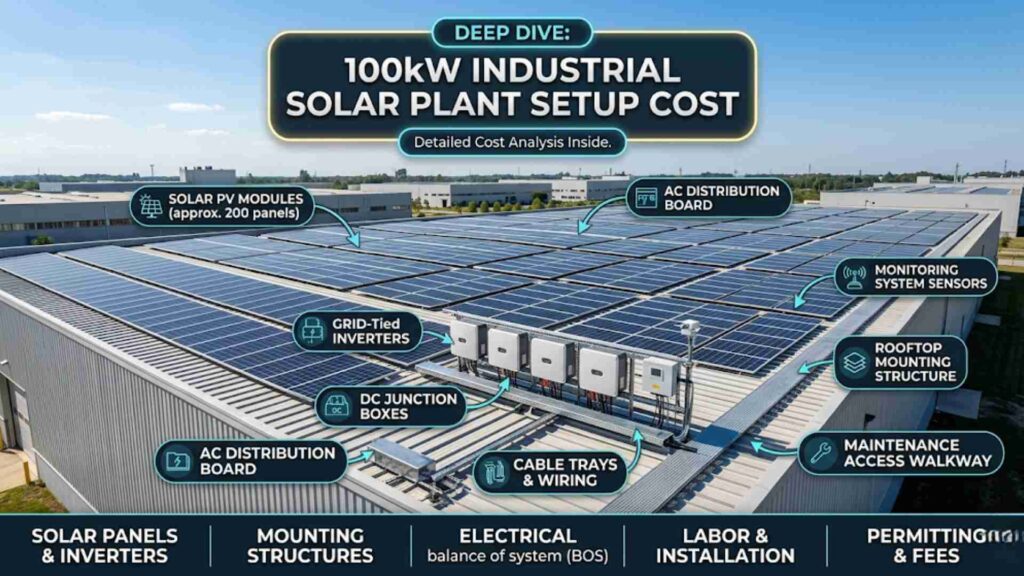
A 100kW system is the “entry-level” for industrial applications. It is most suitable for Micro, Small, and Medium Enterprises (MSMEs), cold storage facilities, and large showrooms.
Capital Expenditure (CAPEX) for 100kW
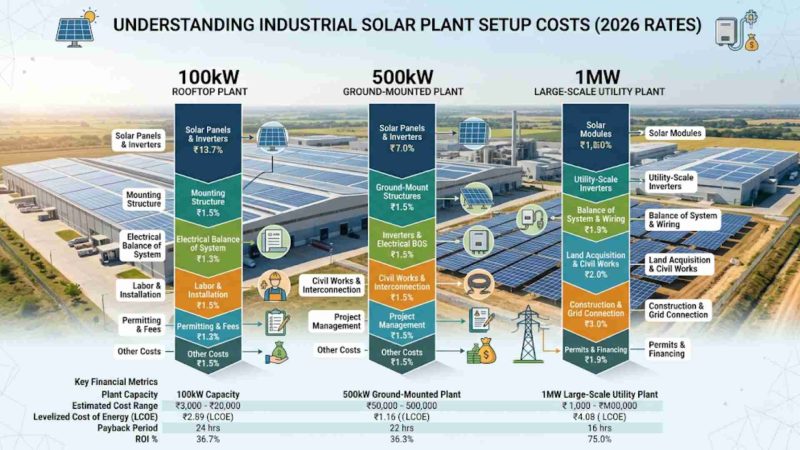
The industrial solar plant setup cost for a 100kW system typically ranges from ₹42 Lakh to ₹52 Lakh. Because this is a smaller project, the “per kilowatt” cost is slightly higher due to the lack of bulk logistics discounts.
- Technology Choice: Most 100kW systems use high-efficiency Mono-facial TOPCon panels to save space on limited rooftop areas.
- Space Requirement: You will need approximately 8,000 to 10,000 square feet of shadow-free area.
- Generation Potential: A well-optimized 100kW plant in a sunny region like Rajasthan will produce approximately 1,50,000 to 1,65,000 units (kWh) per year.
- Monthly Savings: At a grid rate of ₹9/unit, a 100kW system can save a business roughly ₹1.1 Lakh to ₹1.3 Lakh per month on electricity bills.
Scaling Up: 500kW Industrial Solar Plant Setup Cost
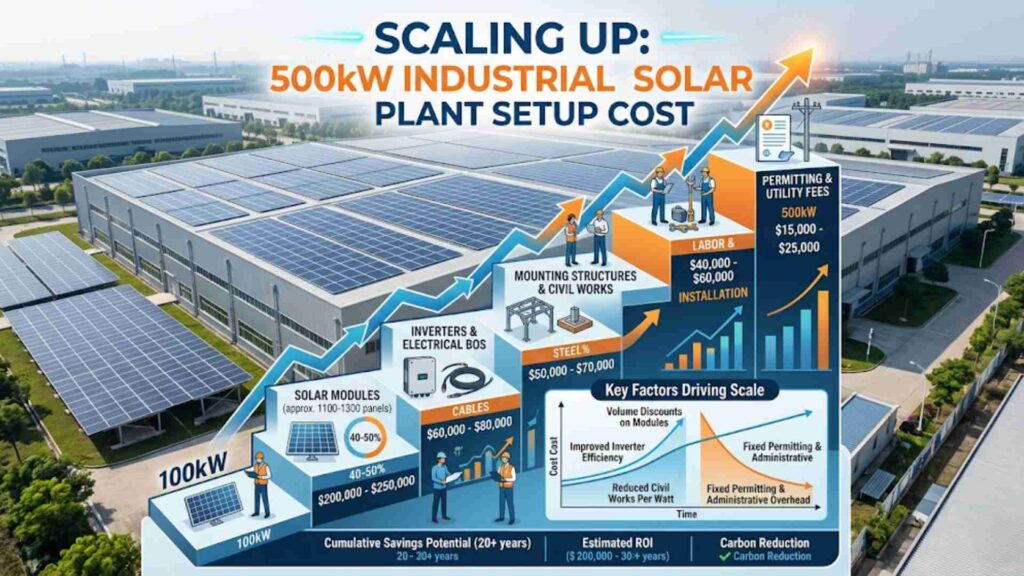
For medium-scale manufacturing units, such as plastic molding factories or food processing plants, a 500kW system is the standard. This capacity allows the business to utilize significant tax benefits while covering a large portion of their daytime load.
Operational Economics of a 500kW System
The total industrial solar plant setup cost for a 500kW system ranges between ₹1.9 Crore and ₹2.3 Crore.
- Economies of Scale: At 500kW, you begin to see a reduction in the cost-per-watt. Procurement of inverters and panels in bulk lowers the total price.
- Infrastructural Needs: This capacity usually requires a dedicated transformer and potentially an upgrade to the internal HT (High Tension) panel of the factory.
- ROI Timeline: With the 40% Accelerated Depreciation (AD) benefit available under Indian tax laws, most 500kW systems achieve a full “payback” within 3.8 to 4.2 years.
The Megawatt Standard: 1MW Industrial Solar Plant Setup Cost
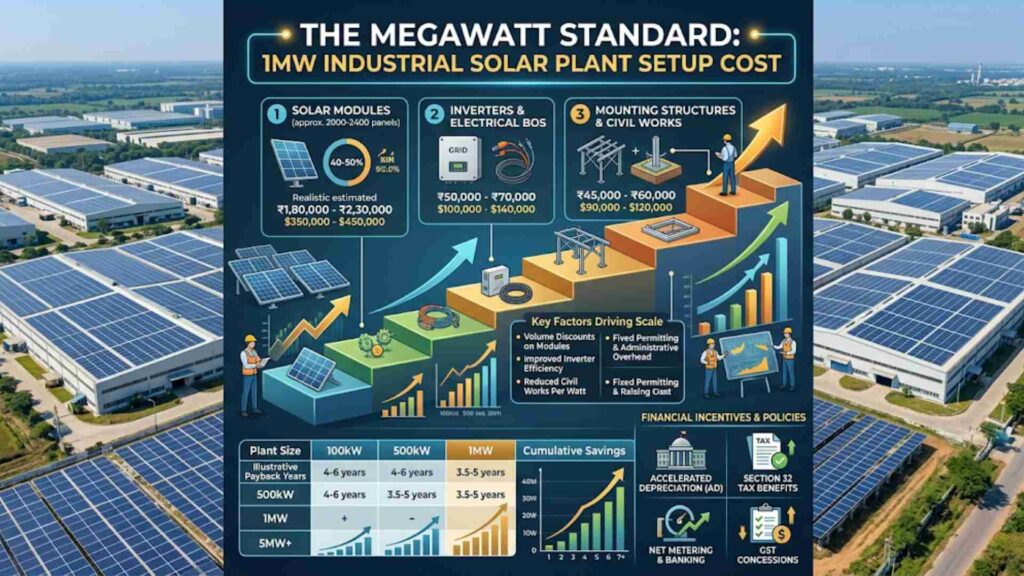
A 1MW (1000kW) solar plant is a massive asset. It is the benchmark for large textile mills, cement plants, and industrial parks.
Cost Breakdown for a 1MW Solar Facility
For a 1MW project, the industrial solar plant setup cost typically falls between ₹3.8 Crore and ₹4.5 Crore.
| Component | Estimated Allocation (1MW) |
| Solar Modules (TOPCon/Bifacial) | ₹2.1 Cr – ₹2.4 Cr |
| Inverters (Central or Large String) | ₹35 L – ₹45 L |
| Mounting Structure (High-Grade GI) | ₹40 L – ₹50 L |
| Cabling & Electrical BOS | ₹30 L – ₹40 L |
| Labor, Licensing & Commissioning | ₹25 L – ₹35 L |
- Land vs. Roof: A 1MW plant requires about 1 lakh square feet of roof space or roughly 4 to 5 acres of land.
- Bifacial Advantage: For ground-mounted 1MW plants, using Bifacial modules (which capture light from both sides) can increase energy yield by 10-15%, significantly lowering the LCOE.
Factors Influencing Cost and Performance in 2026
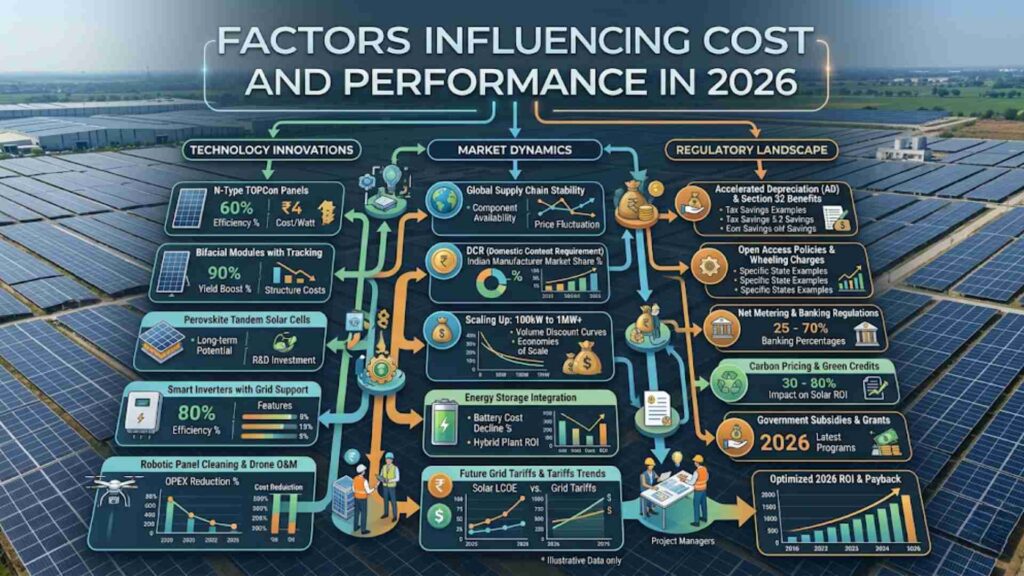
Technical Variables in Industrial Solar Plant Setup Cost
- Module Quality: While Tier-1 Chinese brands are available, many Indian manufacturers now offer high-quality DCR (Domestic Content Requirement) modules which are sometimes required for specific government-linked projects.
- Inverter Efficiency: Choosing an inverter with a higher efficiency rating (98.5%+) and a robust warranty (10 years) might increase the initial industrial solar plant setup cost by 5%, but it ensures much higher uptime.
- Net Metering Policy: Different states have different regulations. In Rajasthan, for instance, the banking of solar energy is a major advantage for industries that operate 24/7.
- Cleaning Systems: For large plants (500kW+), automated robotic cleaning systems are becoming common. While this adds to the setup cost, it prevents the 10-15% generation loss caused by dust (soiling), which is common in arid regions.
Taxation and Incentives: The Hidden Discount
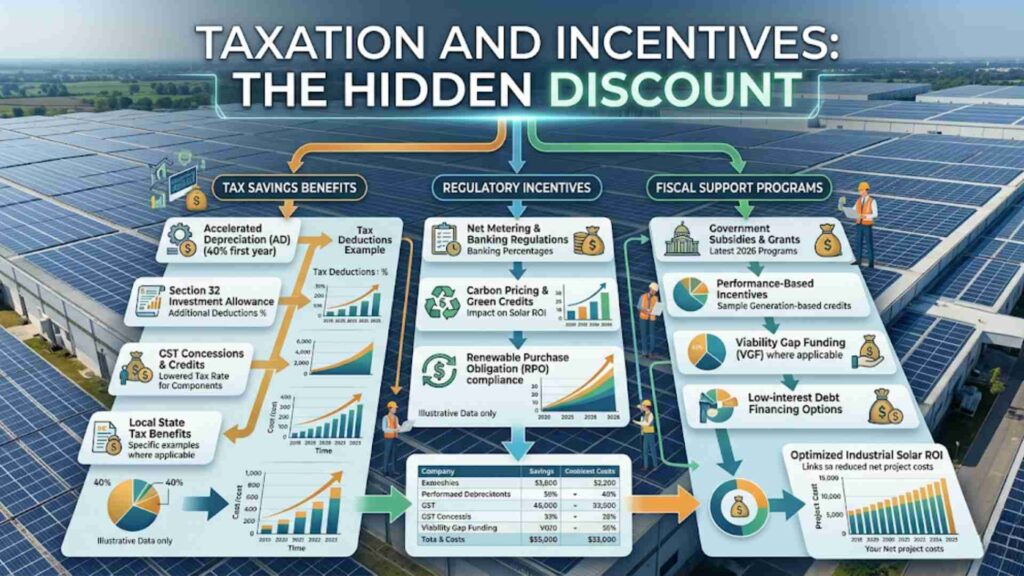
One of the reasons the industrial solar plant setup cost is so attractive in India is the government’s support for commercial renewable energy.
- Accelerated Depreciation (AD): Businesses can claim 40% depreciation in the first year of installation. This acts as a massive tax shield for profitable companies, effectively reducing the “real” cost of the plant by nearly 25%.
- Section 32 Benefits: Additional investment allowances can be claimed by manufacturing companies.
- GST Impact: Solar components are generally taxed at a lower GST bracket. These concessional rates help in keeping the initial investment low. Always consult a tax expert for the latest 2026 compliance rules.
Conclusion: Investing in Energy Independence
Industrial solar plant setup cost is no longer just an expense. It is a smart capital investment. This setup often offers an IRR exceeding 20-25%. You can start with a 100kW system. Alternatively, you can scale up to a 1MW plant.
The result remains the same for every business. It provides protection against rising grid tariffs. It also ensures a significant reduction in your carbon footprint. Choose high-efficiency TOPCon technology for better results.
Partner with a reliable EPC provider. This allows Indian industries to lock in electricity costs. You can secure these low rates for the next 25 years.
Frequently Asked Questions (FAQs)
Q1. What is the current setup cost per kW for industries in 2026?
Ans: For industrial scales, the cost ranges between ₹38,000 and ₹52,000 per kW. Larger systems like 1MW plants benefit from lower per-kW pricing.
Q2. How much space is needed for a 1MW industrial solar plant?
Ans: You typically need 1,00,000 sq. ft. for a rooftop installation or approximately 4 to 5 acres for a ground-mounted setup.
Q3. Is there any government subsidy for industrial solar?
Ans: There are no direct cash subsidies for industries, but you can save significantly through 40% Accelerated Depreciation (AD) and GST concessions.
Q4. What is the average ROI (Return on Investment) period?
Ans: Most industries recover their industrial solar plant setup cost within 3.5 to 4.5 years, depending on their state’s electricity tariff.
Q5. Which technology is best for industrial use right now?
Ans: N-Type TOPCon and Bifacial modules are the gold standard in 2026 due to their high efficiency and better performance in hot climates.