Searching for the Best solar inverter for home in India is the most critical step if you want to reduce your electricity bills and survive frequent power cuts. With electricity tariffs rising in states like Maharashtra, Karnataka, and Delhi, and the government pushing aggressive initiatives like the PM Surya Ghar Muft Bijli Yojana, there has never been a better time to switch to solar. However, the heart of any solar system is not just the panels—it is the inverter.
Choosing the right machine dictates how efficiently your system converts sunlight into usable electricity for your fans, lights, and heavy appliances. Whether you are dealing with voltage fluctuations in a Tier-2 city or looking for zero bills in a metro, this guide will help you select the Best solar inverter for home in India.
Understanding the Types to Find the Best Solar Inverter for Home in India
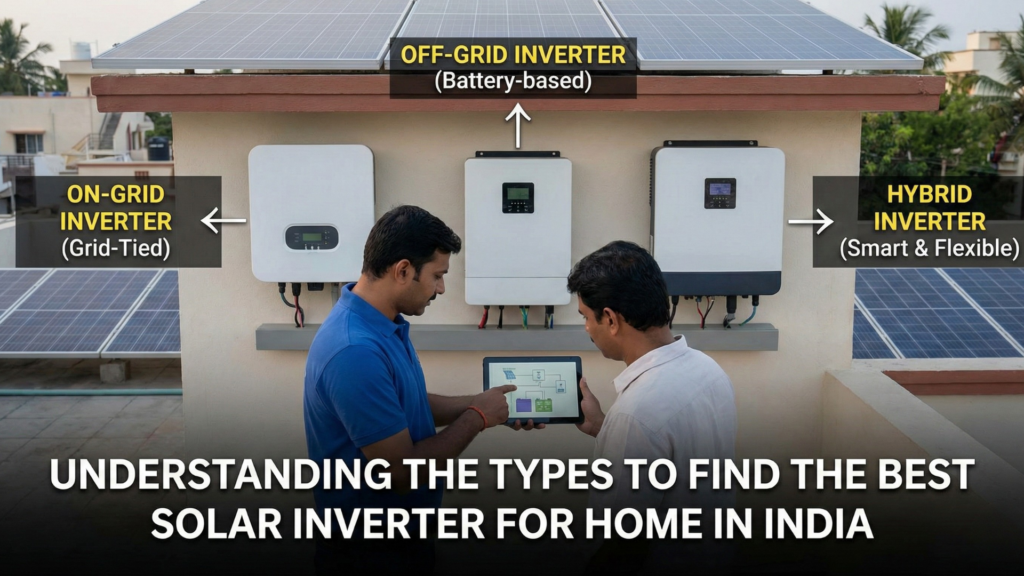
Before you look at brands or prices, you must understand which type of inverter suits your local grid conditions. In India, grid stability varies wildly between urban and rural areas. To find the Best solar inverter for home in India, you must choose between On-Grid, Off-Grid, and Hybrid systems.
1. On-Grid Inverters (Grid-Tied)
These are the most common in Indian cities with stable electricity. They work in sync with the government grid.
- How it works: It converts DC power to AC. If you generate excess power, it is sent back to the grid (Net Metering), and you get credits on your electricity bill.
- Drawback: It shuts down during a power cut for safety reasons (Anti-Islanding).
2. Off-Grid Inverters (Standalone)
Ideal for areas with frequent power cuts (rural India or remote farmhouses).
- How it works: It stores energy in a battery bank. It does not connect to the government grid’s export meter.
- Drawback: Expensive due to battery costs; you cannot sell excess power to the DISCOM.
3. Hybrid Inverters (The Smart Choice)
Increasingly considered the Best solar inverter for home in India for modern households.
- How it works: It combines the best of both worlds. It charges batteries for backup and exports excess power to the grid.
Table 1: Comparison to Help You Choose the Best Solar Inverter for Home in India
| Feature | On-Grid Inverter | Off-Grid Inverter | Hybrid Inverter |
| Grid Connection | Required (Mandatory) | Not Required | Optional (Can work with/without) |
| Battery Backup | No | Yes (Mandatory) | Yes (Optional) |
| Power Cuts | System shuts down | Works perfectly | Works perfectly |
| Net Metering | Yes (Reduces Bill) | No | Yes |
| Cost | Low (₹) | Medium (₹₹) | High (₹₹₹) |
| Ideal For | Metro cities (Delhi, Mumbai) | Villages/Towns with load shedding | Premium homes needing backup & savings |
Step-by-Step Guide: How to Select the Best Solar Inverter for Home in India
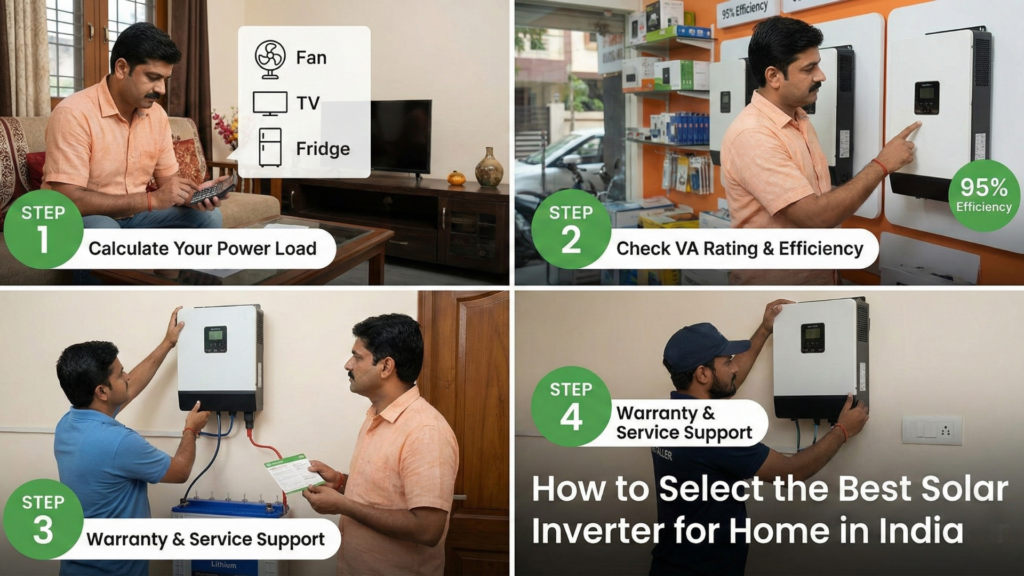
Selecting the right inverter involves some math and technical checks. Follow this 5-step process to ensure you buy the Best solar inverter for home in India for your specific needs.
Step 1: Calculate Your Power Load (The “Watt” Math)
You cannot buy an inverter without knowing what you want to run. In India, a typical middle-class home runs fans, tube lights, a TV, a fridge, and a mixer.
- List appliances: E.g., 4 Fans (70W each = 280W) + 4 LEDs (9W each = 36W) + 1 TV (100W) = Total ~416W.
- Surge Power: Appliances with motors (Fridges, Washing Machines) need 3x power to start.
- Tip: If your total connected load is 3 kW, do not buy an inverter of exactly 3 kW. Always keep a 20-25% buffer.
Step 2: Check the VA Rating and Efficiency
The capacity of an inverter is measured in Volt-Amperes (VA), not just Watts.
- Formula: Power (Watts) ÷ Power Factor (usually 0.8) = VA Rating.
- Example: If you need 800 Watts, you need an inverter of: 800 ÷ 0.8 = 1000 VA (1 kVA).
The Best solar inverter for home in India will have an efficiency of over 93-95%, ensuring minimal energy loss during conversion.
Step 3: Verify Technology (PWM vs. MPPT)
- PWM (Pulse Width Modulation): Older technology, cheaper, but less efficient. Good for very small, low-budget setups.
- MPPT (Maximum Power Point Tracking): This is the gold standard in 2026. An MPPT inverter extracts 30% more power from your solar panels, especially during Indian winters or cloudy monsoon days.
- Verdict: Always choose MPPT if budget permits.
Step 4: Battery Compatibility (Lead-Acid vs. Lithium)
India is transitioning from bulky Tubular batteries to sleek Lithium-ion batteries.
- Most traditional Indian inverters (Luminous, Microtek) support Tubular batteries perfectly.
- Newer “Smart” inverters support Lithium-ion, which charges faster and lasts longer.
- Ensure the inverter usually supports 12V, 24V, or 48V depending on your battery bank size.
Step 5: Warranty and Service Support
In India, “After-Sales Service” is king. Electronic components can fail due to heat or voltage fluctuations.
- Look for brands that offer onsite service.
- Standard warranty is 2 years, but the Best solar inverter for home in India often comes with a 5 to 10-year warranty (especially On-grid string inverters).
Top Brands Offering the Best Solar Inverter for Home in India (2026 Edition)
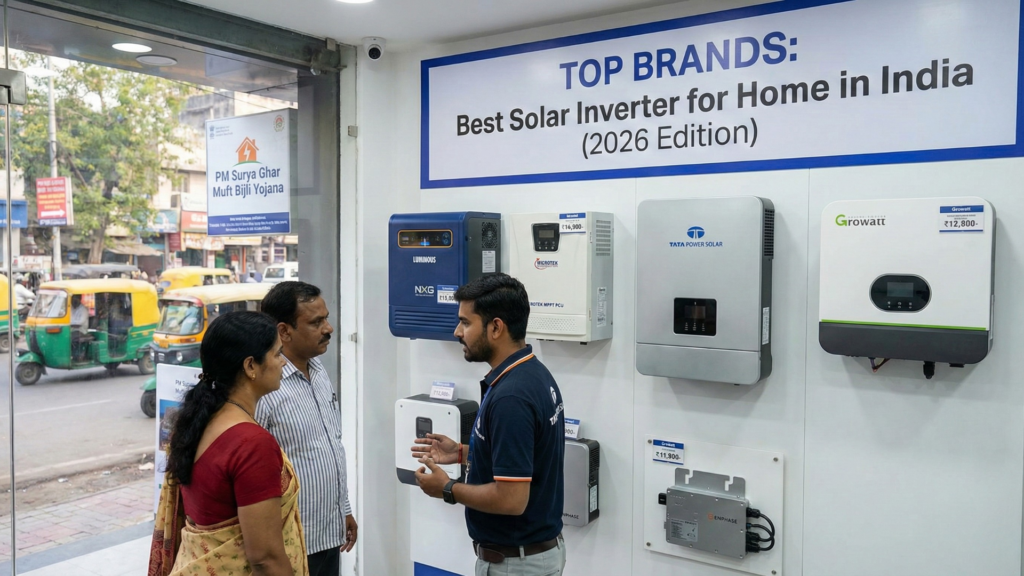
The Indian market is a mix of homegrown giants and international tech leaders. Based on market presence, service network, and technology, here are the top contenders.
1. Luminous (The Household Name)
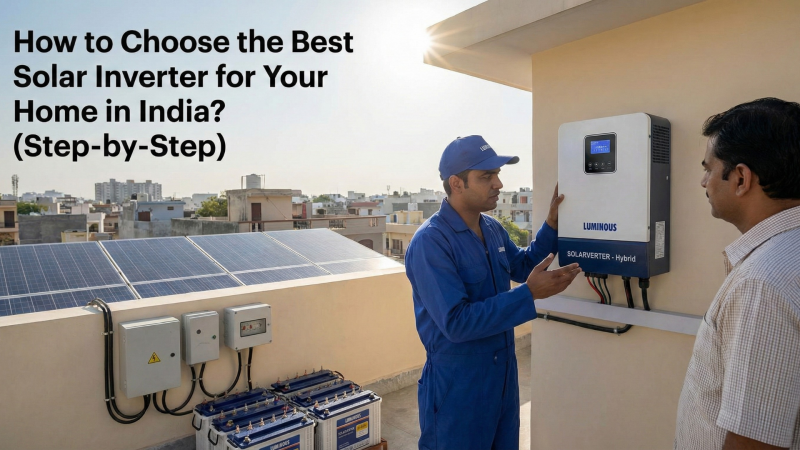
Luminous is arguably the most popular brand for residential use in India. Their NXG and Solarverter series are robust, handle voltage fluctuations well, and service centers are available even in Tier-3 towns.
2. Microtek (Budget Friendly)
Known for durability, Microtek offers excellent off-grid solutions. Their MPPT-based PCUs (Power Conditioning Units) are very successful in regions with frequent power cuts.
3. Tata Power Solar (Trust & Quality)
Part of the Tata group, they offer premium on-grid solutions. If you are looking for long-term reliability and the Best solar inverter for home in India for large rooftop projects (3kW+), Tata is a safe bet.
4. Growatt / Sungrow (Global Tech)
For high-efficiency on-grid and hybrid systems, these international brands are dominating the Indian market. They offer advanced Wi-Fi monitoring apps so you can check generation on your phone.
Table 2: Top 5 Brands for Best Solar Inverter for Home in India
| Brand | Best For | Technology | Approx. Price (3kVA – 5kVA) | Warranty |
| Luminous | Home Backup (Off-Grid/Hybrid) | MPPT / PWM | ₹35,000 – ₹55,000 | 2-5 Years |
| Microtek | Budget Off-Grid | PWM / MPPT | ₹30,000 – ₹45,000 | 2 Years |
| Tata Power | Grid-Tie (On-Grid) | String Inverter | ₹40,000 – ₹65,000 | 5-10 Years |
| Enphase | Premium Efficiency | Micro-Inverter | High (Per panel cost) | 25 Years |
| Growatt | Modern Hybrid/On-Grid | MPPT (High Eff.) | ₹45,000 – ₹80,000+ | 5-10 Years |
Note on Price: Prices fluctuate based on GST and dealer margins. Hybrid inverters are significantly more expensive than standard On-grid ones.
Government Subsidies and the “Best Solar Inverter for Home in India”
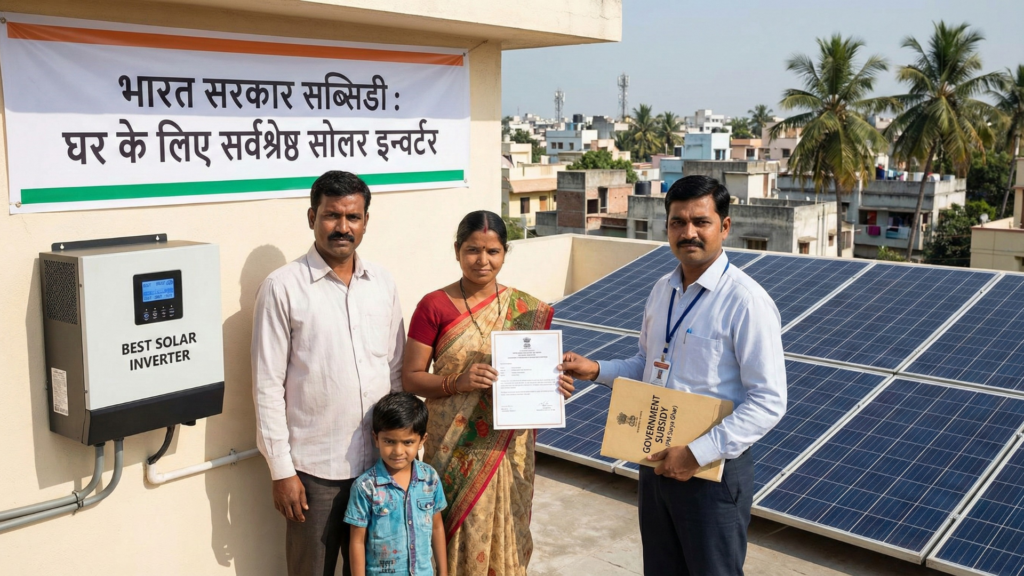
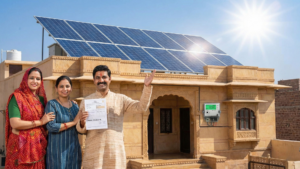
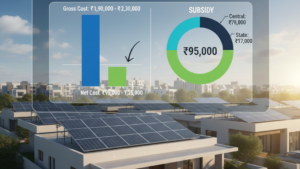
You cannot discuss solar in India without mentioning subsidies. The PM Surya Ghar Muft Bijli Yojana has changed the game.
To avail of the Central Financial Assistance (subsidy), your inverter and solar panels must be DCR (Domestic Content Requirement) compliant or certified by the BIS (Bureau of Indian Standards).
- The Benefit: The government provides a subsidy of ₹78,000 for systems up to 3kW capacity.
- The Condition: You usually need an On-Grid system to avail of this subsidy.
- Selection Tip: When asking a vendor for the Best solar inverter for home in India, explicitly ask: “Is this inverter model approved for the PM Surya Ghar subsidy scheme?”
Technical Features of the Best Solar Inverter for Home in India
When reading the spec sheet, keep an eye out for these Indian-context features:
- Wide Voltage Range: Indian grids often suffer from low voltage. A good inverter should operate between 170V to 280V without disconnecting.
- Wi-Fi Monitoring: Modern inverters come with a dongle. This allows you to see exactly how many units (kWh) you generated today via a mobile app.
- IP65 Protection: If you plan to install the inverter on a balcony or terrace, ensure it is IP65 rated (Dust and Water-resistant).
Conclusion
Choosing the Best solar inverter for home in India is a balance between your budget, your local power situation, and your future goals.
- Go for On-Grid (Tata, Growatt) if you live in a city with 24×7 power and want to reduce your bill to zero using government subsidies.
- Go for Off-Grid (Luminous, Microtek) if you live in a rural area and need power backup more than bill savings.
- Go for Hybrid if you have the budget and want energy independence (Backup + Savings).
Final Tip: Don’t just buy the product; buy the installation service. A poorly installed inverter with loose wiring can catch fire or underperform. Always choose a certified installer (Vendor) listed on your state’s DISCOM portal.
Frequently Asked Questions (FAQ)
Q1: Which is the No. 1 solar inverter company in India?
There is no single “No. 1” as it depends on use. Luminous is widely considered the leader for residential off-grid/hybrid inverters, while Tata Power Solar and Growatt are leaders in the on-grid segment.
Q2: What is the price of a 3kW solar inverter in India?
A good quality 3kW On-grid inverter costs between ₹35,000 to ₹50,000. A 3kW Hybrid inverter (which takes batteries) can cost between ₹60,000 to ₹90,000.
Q3: Can I run an AC on a solar inverter?
Yes, you can. To run a 1.5 Ton AC, you typically need a solar system of at least 3 kVA to 5 kVA capacity. You must ensure your battery bank (if off-grid) is large enough to sustain the load.22
Q4: Is a Hybrid inverter better than an On-grid inverter?
A Hybrid inverter is technically superior because it offers battery backup and bill savings.23 However, it is much more expensive. If you rarely face power cuts, an On-grid inverter is the Best solar inverter for home in India in terms of Return on Investment (ROI).
Q5: How long do solar inverters last?
String inverters (On-grid) typically last 10 to 15 years. Battery-based inverters usually have a lifespan of 8 to 12 years, though the batteries themselves will need replacement every 3-5 years (Lead-acid) or 7-10 years (Lithium).