
Every business wants to cut operational costs, achieve energy independence, and boost its sustainability credentials. The key to unlocking these benefits lies in selecting the correct Types of Solar Power system for your specific commercial needs. Going solar for a factory, office complex, or warehouse is a far more complex decision than a residential installation. This guide breaks down the primary solar technologies, ensuring you make a financially sound, future-proof decision.
1. Comparing the Core Types of Solar Power Systems
When evaluating commercial solar, you should primarily focus on three active PV configurations.
| System Type | Primary Function | Ideal For | Key Advantage |
| Grid-Tied (On-Grid) Solar | Generates electricity and feeds excess back to the utility grid (via Net Metering). | Businesses with reliable grid access and high daytime usage (offices, schools). | Lowest complexity and upfront cost. |
| Off-Grid Solar | Operates completely independent of the utility grid, using batteries for storage. | Remote locations with poor or no grid access (mining, rural factories). | Complete energy independence; no reliance on utility. |
| Hybrid Solar | Connected to the grid but includes battery storage for backup power. | Businesses needing reliable backup power during outages (data centers, hospitals). | Uninterrupted power supply; combines grid efficiency with battery security. |
Understanding Commercial Grid-Tied Solar Systems
This is the most common system. Grid-tied solar systems generate electricity and seamlessly feed any excess back to the utility grid through Net Metering. This configuration is ideal for businesses that have reliable grid access and high daytime energy usage (such as offices and schools). Because these systems do not require expensive battery storage, they boast the lowest upfront cost and complexity.
When to Choose Off-Grid Types of Solar Power
Off-grid solar power systems operate completely independent of the utility. Consequently, they require dedicated battery storage to capture energy for night-time use. Businesses should choose this option only for remote locations where grid access is poor or unavailable (for instance, rural factories or mining operations).
The Security of Hybrid Solar Power Solutions
A hybrid system connects to the grid but strategically includes battery storage for backup power. Therefore, this option is perfect for businesses that need an uninterrupted power supply during utility outages (like data centers and hospitals), combining the grid’s efficiency with battery security.
2. Choosing the Right Commercial Panel Technology
The next crucial layer involves the specific PV panel technology. This choice impacts efficiency, space requirements, and total cost.
| Panel Type | Material & Appearance | Key Commercial Benefit | Best Application |
| Monocrystalline | Single, pure silicon crystal (Black color) | Highest efficiency; saves space | Limited rooftop space, high energy demand. |
| Polycrystalline | Multiple silicon fragments (Blue/Speckled) | Most budget-friendly price point | Large ground mounts, ample rooftop space. |
| Bifacial | Dual-sided power generation | Up to 25% higher energy yield | Flat roofs with reflective surfaces, carports. |
Monocrystalline: High-Efficiency Solar Panel Types for Limited Space
Made from a single, pure silicon crystal, Monocrystalline panels are known for their high efficiency (often over 20%). Thus, they are the best option for businesses with limited roof space but high power demands, as they generate the maximum output per square foot.
Polycrystalline: Budget-Friendly Solar Power Panel Options
Polycrystalline panels are made by melting multiple silicon fragments together. However, they are slightly less efficient than their mono counterparts. Because of their lower manufacturing cost, these panels work well for businesses that have ample, open roof or ground space where maximizing cost-efficiency is the primary goal.
Why Bifacial Panels are the Future of Commercial Solar Power
Bifacial panels represent an emerging technology. These panels generate power from both the front (direct sunlight) and back (reflected light). This feature makes them ideal for flat rooftops and ground-mounts, consequently offering a significant boost in total energy yield.
3. Site-Specific Factors & Installation Types of Solar Power
A successful commercial project hinges on a thorough site assessment and the right installation method.
Evaluating Rooftop and Ground Mount Solar Installation Types
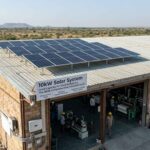
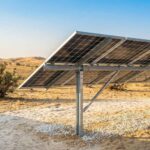
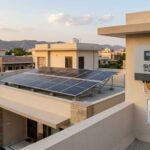
The most common method is the Rooftop Mount, where panels are affixed to the roof structure. Alternatively, if roof space is limited, Ground Mounts utilize adjacent land. Many businesses also install Solar Carports over parking lots, providing both power and shade.
Key Commercial Considerations: Sizing and Energy Audit
Your system must be sized to meet your specific needs. A certified provider will analyze your Peak Energy Usage, total Annual Consumption, and future growth plans to design a perfectly tailored solution.
Frequently Asked Questions (FAQ) About Commercial Types of Solar Power
Q1: What are the main types of solar power used in commercial settings?
A: The primary types of solar power systems for businesses are Grid-Tied (On-Grid) PV systems. Less common, but necessary, are Hybrid (grid-tied with battery backup) and Off-Grid systems.
Q2: Which solar panel type is the most efficient for my business rooftop?
A: Monocrystalline solar panels are the most efficient type of solar panel available, generating the most power per square foot.
Q3: What is the average ROI for installing these types of solar power systems?
A: The payback period for commercial solar is typically 3 to 7 years, thanks to reduced energy costs and lucrative tax incentives.
Q4: Is there a difference between commercial and residential solar power types?
A: Yes. Commercial installations involve much larger systems (MW vs. kW), higher-wattage panels, and complex financial incentives, unlike residential setups.
Q5: Can I get battery storage with a commercial grid-tied system?
A: Yes, that is a Hybrid solar power system. Businesses needing reliable backup power commonly choose this system.