Switching to solar energy is no longer just an environmental statement; despite the initial Rooftop solar installation cost, it is one of the smartest financial decisions an Indian homeowner can make in 2026. With electricity tariffs in states like Maharashtra, Karnataka, and Delhi touching ₹8–₹12 per unit, the sun offers a way to essentially “lock in” your electricity price at near-zero for the next 25 years.
However, the biggest hurdle for most people isn’t the technology—it’s the math. Questions like “Is it really worth the investment?” and “When will I break even?” are common. To answer these, you need to look beyond the sticker price and understand the Return on Investment (ROI).
This guide breaks down how to calculate your solar ROI, explains the payback period, and provides a realistic look at the Rooftop solar installation cost in India today.
Rooftop Solar Installation Cost in India (2025-26)
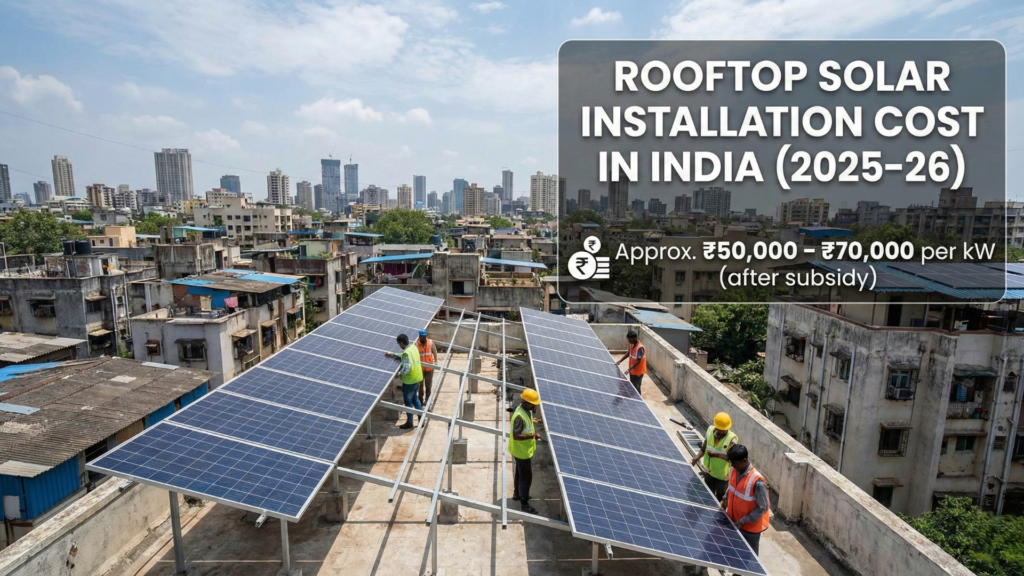
Before we calculate returns, we must establish the investment. The cost of solar has dropped significantly over the last decade, but it varies based on system size, technology (Mono-PERC vs. Polycrystalline), and battery storage (Hybrid vs. On-Grid).
For the average Indian household, an On-Grid Solar System (connected to the government grid without batteries) is the most economically viable option. It allows you to use ‘Net Metering’ to export excess power to the grid and reduce your bill to zero.
The following table provides a realistic breakdown of the Rooftop solar installation cost after accounting for the PM Surya Ghar: Muft Bijli Yojana subsidy, which is a game-changer for residential ROI.
Table 1: Estimated Rooftop Solar Price List with Subsidy (India)
| System Capacity | Avg. Monthly Bill (Approx.) | Estimated Market Price (Before Subsidy) | Govt. Subsidy (PM Surya Ghar)* | Net Cost to Consumer (Approx.) |
| 1 kW | ₹1,000 – ₹1,500 | ₹70,000 – ₹80,000 | ₹30,000 | ₹40,000 – ₹50,000 |
| 2 kW | ₹1,500 – ₹2,500 | ₹1,40,000 – ₹1,60,000 | ₹60,000 | ₹80,000 – ₹1,00,000 |
| 3 kW | ₹2,500 – ₹4,000 | ₹1,80,000 – ₹2,20,000 | ₹78,000 | ₹1,02,000 – ₹1,42,000 |
| 5 kW | ₹5,000+ | ₹3,00,000 – ₹3,50,000 | ₹78,000 (Max Cap) | ₹2,22,000 – ₹2,72,000 |
> Note: Subsidy amounts are based on the latest central government schemes (₹30k/kW for first 2kW, ₹18k for the additional kW). State-specific subsidies may offer additional benefits.As you can see, the Rooftop solar installation cost for a 3kW system—the “sweet spot” for a typical Indian family with 2-3 ACs—becomes incredibly attractive after the ₹78,000 subsidy.
Understanding Solar ROI and Payback Period
Return on Investment (ROI) helps you compare solar against other investments like Fixed Deposits (FDs) or Mutual Funds. While an FD might give you 7% returns, a well-optimized solar system can deliver an ROI of 20% to 30% annually.
The Payback Period is simply the amount of time it takes for the savings on your electricity bill to equal the total cost of installation. Once you cross this period, your electricity is effectively free for the remaining lifespan of the panels (usually 25 years).
Factors That Influence Your Rooftop Solar Installation Cost and ROI
While the table above gives averages, your specific ROI depends on three critical variables:
- Local Electricity Tariff: The higher your per-unit rate (e.g., ₹9/unit in Mumbai vs. ₹5/unit in smaller towns), the faster your payback.
- Solar Irradiance: A rooftop in Rajasthan or Gujarat will generate more units per kW than one in Himachal Pradesh, leading to higher savings.
- Shadow-Free Area: ROI drops if your panels are shaded by nearby buildings or trees, as generation suffers.
How to Calculate Payback Period: A Step-by-Step Guide
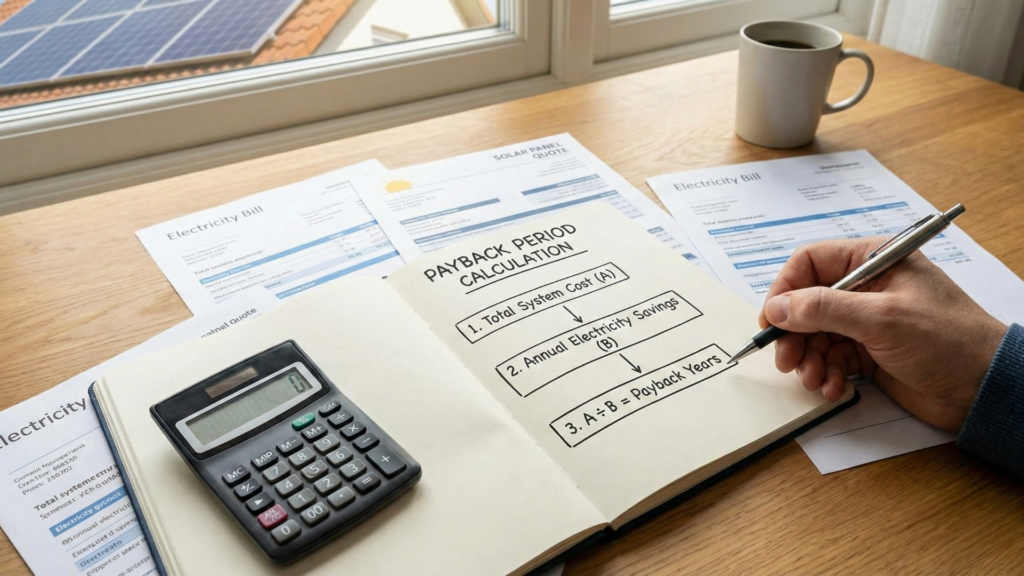
To calculate your exact ROI, you need to run the numbers based on your specific consumption. Let’s take a practical example of a household in a Tier-2 city installing a 3kW On-Grid System.
The Scenario:
- System Size: 3 kW
- Total Investment (Net): ₹1,30,000 (after subsidy)
- Daily Generation: ~12 Units (Average for India)
- Annual Generation: ~4,380 Units (12 units x 365 days)
- Electricity Tariff: ₹8 per unit
Table 2: ROI & Payback Calculation Example (3kW System)
| Parameter | Calculation | Value |
| Total Project Cost | Hardware + Installation – Subsidy | ₹1,30,000 |
| Daily Savings | 12 Units x ₹8/unit | ₹96 |
| Monthly Savings | ₹96 x 30 days | ₹2,880 |
| Annual Savings | ₹2,880 x 12 months | ₹34,560 |
| Payback Period | Total Cost ÷ Annual Savings | ~3.7 Years |
| 10-Year Savings | (Annual Savings x 10) – Maintenance | ₹3,45,600 |
| 25-Year Savings | (Annual Savings x 25) – Inverter Replacement | ₹8,00,000+ |
Analyzing the Results
In this example, the homeowner recovers their entire Rooftop solar installation cost in less than 4 years. Since solar panels come with a performance warranty of 25 years, this leaves 21 years of pure profit.
If you deposited that same ₹1,30,000 in a bank, it would take roughly 10 years to double. With solar, you have recovered your capital in 4 years and potentially multiplied it by 6x or 7x over the system’s lifetime.
Hidden Costs vs. Long-Term Gains
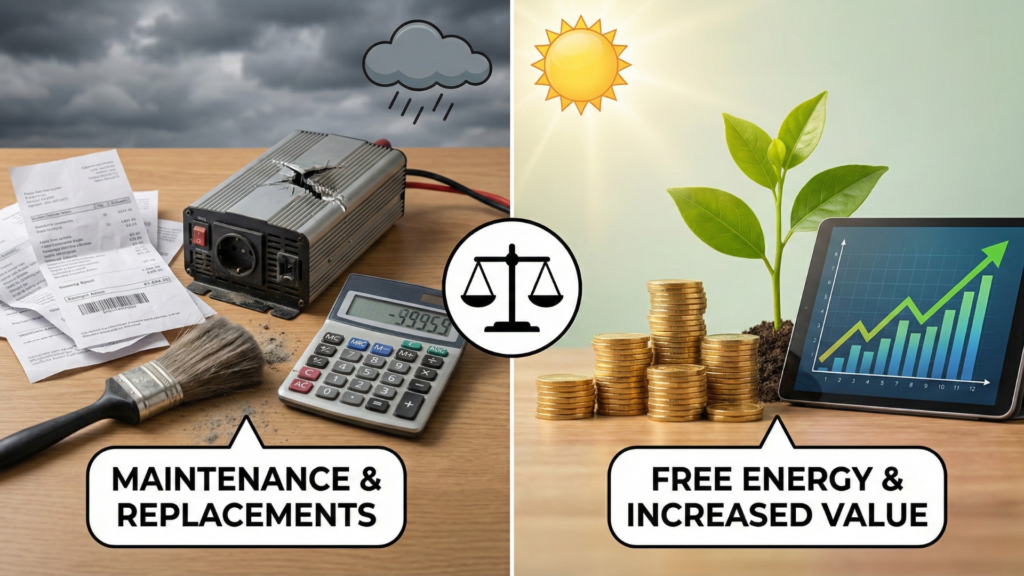
When researching Rooftop solar installation cost, many homeowners forget to factor in maintenance. Fortunately, solar systems are “solid-state” technology with no moving parts, meaning maintenance is minimal.
- Cleaning: Dust is the enemy of ROI. In dusty Indian cities, you may need to clean panels every 15 days. This costs virtually nothing if done yourself or ₹500/visit if outsourced.
- Inverter Replacement: While panels last 25 years, the solar inverter typically has a life of 10-12 years. You should budget for one inverter replacement (approx. ₹20,000 – ₹30,000) during the system’s life.
Even with these minor costs, the ROI remains superior to almost any other low-risk financial instrument available in the market.
Conclusion
Calculating your solar ROI isn’t just about the math; it’s about securing your energy future. As grid tariffs continue to rise by 2-5% annually, your savings from solar actually increase over time, improving your ROI further each year.
The current Rooftop solar installation cost is at a historic low due to government subsidies like the PM Surya Ghar Yojana. With a payback period of just 3 to 5 years, the question is no longer if you should go solar, but how soon you can get it installed. By acting now, you not only save lakhs in electricity bills but also contribute to a greener India.
FAQs on Rooftop Solar Installation Cost in India
1. Does the Rooftop solar installation cost vary by state in India?
Yes. While component costs (panels, inverters) are similar across India, installation labor charges and state-specific subsidies can vary. However, the central subsidy (PM Surya Ghar) remains uniform across all states.
2. What happens to my solar ROI if I don’t have a Net Meter?
Without Net Metering, your ROI will drop significantly. Net Metering allows you to “bank” the excess power you generate during the day and use it at night. Without it, the excess energy is wasted unless you invest in expensive batteries, which increases the Rooftop solar installation cost and lengthens the payback period.
3. Is the subsidy amount deducted from the bill or refunded later?
Under the new DBT (Direct Benefit Transfer) scheme, you usually pay the vendor the full amount or a partial amount, and the subsidy is credited directly to your bank account within 30-45 days after the system is commissioned and inspected by the DISCOM.
4. Can I get a loan for rooftop solar?
Yes, most public sector banks in India offer “Solar Loans” at concessional interest rates (often around 7% – 9%) specifically to cover the Rooftop solar installation cost. This allows you to pay for the system using the money you save on electricity bills.
5. How much roof space do I need for a 3kW system?
You need approximately 300 square feet of shadow-free area for a 3kW system. As a thumb rule, 1 kW requires about 100 sq. ft. of space.