Electricity tariffs in India are on a constant upward trajectory, prompting homeowners to look for sustainable alternatives. For a small family or a household looking to offset their basic electricity consumption, a 1kW solar plant is the ideal entry point. However, finding accurate information about the Cost of 1kW solar system for home can be confusing due to the variety of components, subsidies, and system types available in the market.
This comprehensive guide will provide a transparent breakdown of pricing, the government subsidy structure (PM Surya Ghar Yojana), and a technical analysis of what you are actually paying for. By the end of this article, you will know exactly how much you need to invest and how much you will save.
Overview: What is the Cost of 1kW Solar System for Home?
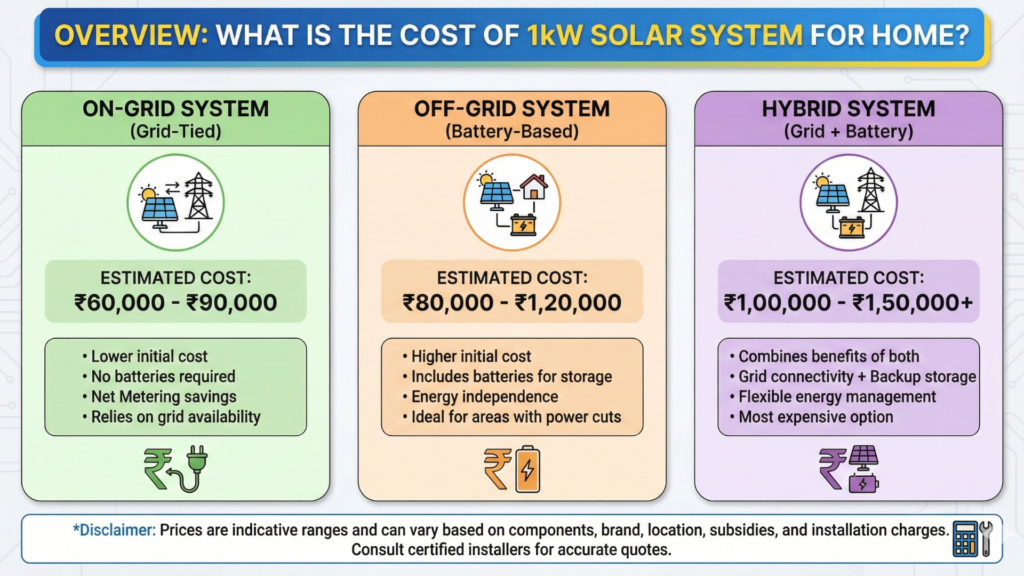
The price of a solar system is not a “one-size-fits-all” figure. It fluctuates based on technology, brand, and most importantly, the type of system you choose. Broadly speaking, the market is divided into grid-connected (On-Grid) and battery-based (Off-Grid) systems.
If we look at the current market trends, the estimated Cost of 1kW solar system for home typically ranges as follows:
- On-Grid System (Grid-Tie): ₹60,000 – ₹70,000 (Before Subsidy)
- Off-Grid System (With Battery): ₹80,000 – ₹1,00,000 (No Subsidy)
- Hybrid System: ₹1,20,000 and above.
While the upfront numbers might look high, the net cost for an On-Grid system drops drastically once you factor in government subsidies, making it highly affordable for the common man.
How System Type Affects the Cost of 1kW Solar System for Home
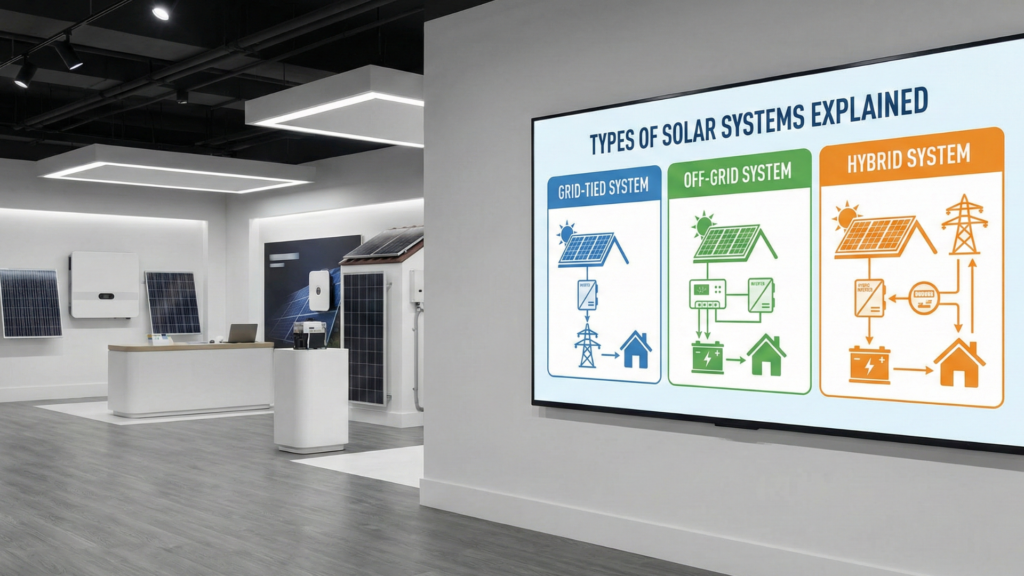
To understand the price tag, you must first understand the technology. The Cost of 1kW solar system for home varies significantly depending on whether you need batteries or not.
1. On-Grid Solar System (The Subsidy Friendly Option)
This is the most popular choice for urban homes in India. The system is connected directly to the government electricity grid.
- Mechanism: Solar panels generate power during the day. If you generate more than you use, the excess is “exported” to the grid. At night, you “import” electricity from the grid. A Net Meter records this exchange.
- Cost Benefit: It is the cheapest option because it does not require expensive batteries. Plus, it is the only system eligible for the Central Government Subsidy.
2. Off-Grid Solar System (The Backup Option)
This system works independently of the grid and requires a battery bank to store energy for night use.
- Mechanism: Solar energy charges the batteries. The home load runs on this stored energy.
- Cost Factor: Batteries are the most expensive component of a solar setup and have a shorter lifespan (3-5 years) compared to panels. This increases the recurring Cost of 1kW solar system for home over time.
- Use Case: Ideal for remote villages or areas with frequent power cuts (load shedding).
Detailed Component Cost Breakdown of a 1kW Solar System for Home
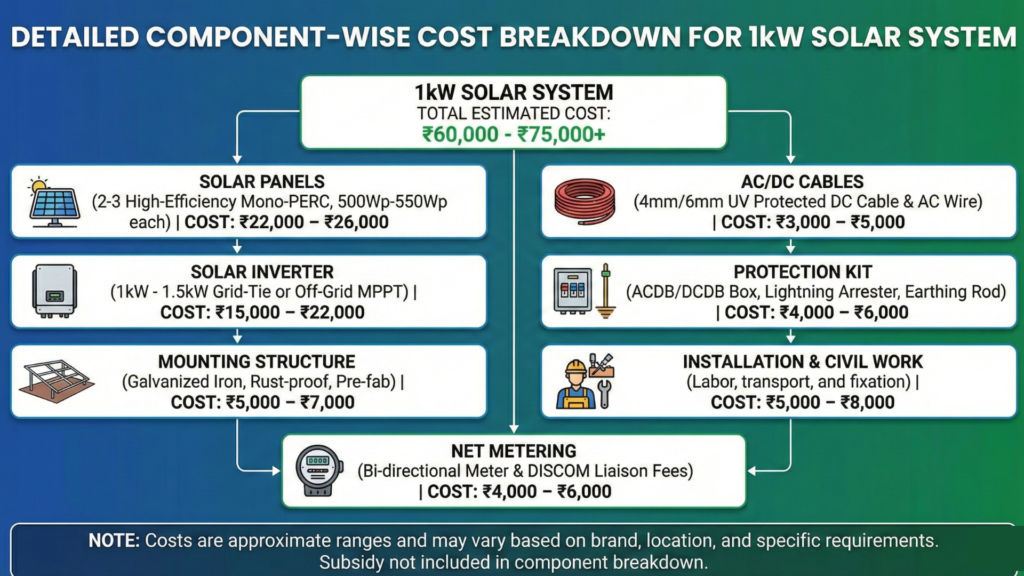
When you receive a quotation from a vendor (like Tata Power, Waaree, or Luminous), it includes several components. To ensure you aren’t being overcharged, here is a detailed price breakdown of a standard 1kW system.
Table 1: Estimated Bill of Materials for 1kW System
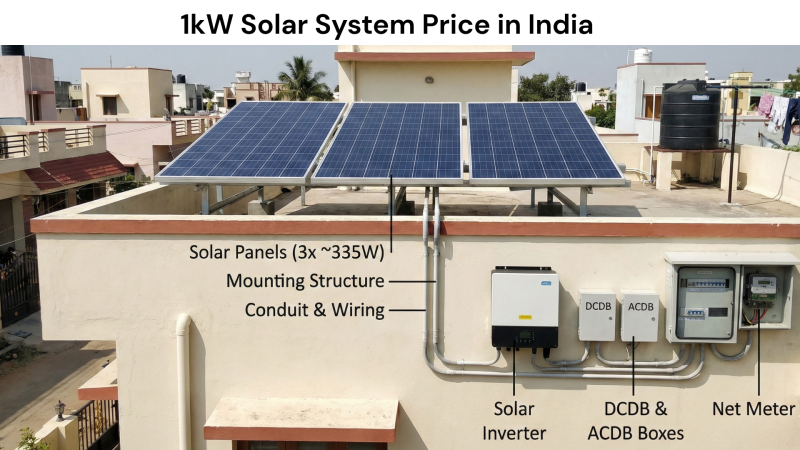
| Component | Specifications | Estimated Cost (₹) |
| Solar Panels | 2-3 High-Efficiency Mono-PERC Panels (500Wp – 550Wp each) | ₹22,000 – ₹26,000 |
| Solar Inverter | 1kW – 1.5kW (Grid-Tie or Off-Grid MPPT) | ₹15,000 – ₹22,000 |
| Batteries | 150Ah / 12V Solar C10 Battery (Only for Off-Grid) | ₹15,000 – ₹18,000 |
| Mounting Structure | Galvanized Iron (GI), Rust-proof, Pre-fab | ₹5,000 – ₹7,000 |
| AC/DC Cables | 4mm/6mm UV Protected DC Cable & AC Wire | ₹3,000 – ₹5,000 |
| Protection Kit | ACDB/DCDB Box, Lightning Arrester, Earthing Rod | ₹4,000 – ₹6,000 |
| Installation & Civil Work | Labor, transport, and fixation | ₹5,000 – ₹8,000 |
| Net Metering | Bi-directional Meter & DISCOM Liaison Fees | ₹4,000 – ₹6,000 |
| TOTAL (Approx) | On-Grid / Off-Grid | ~₹65,000 / ~₹95,000 |
How Solar Panel Technology Impacts the 1kW Solar System Price
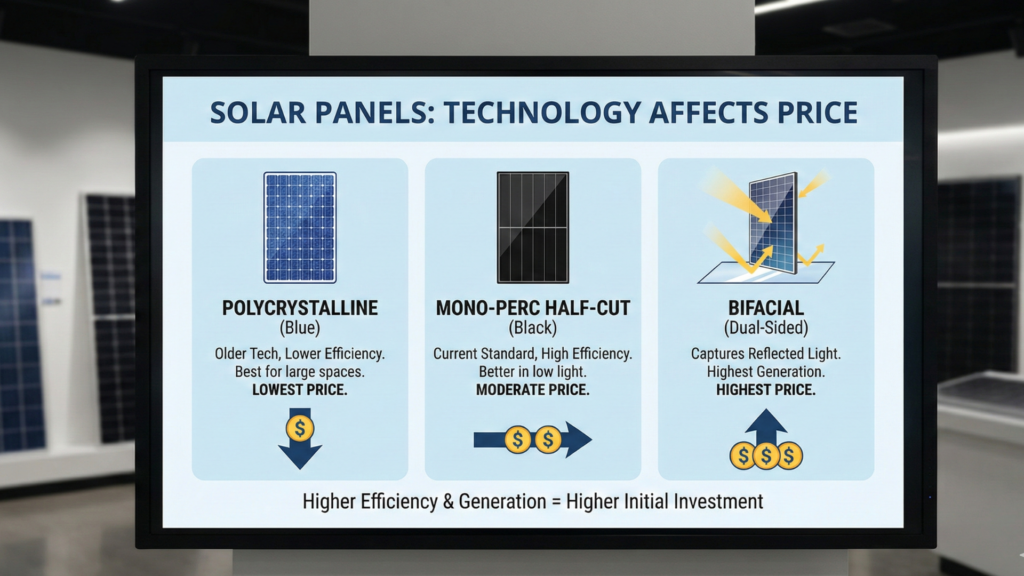
A significant portion of the Cost of 1kW solar system for home goes into the solar photovoltaic (PV) modules. Choosing the right technology is crucial for long-term generation.
Polycrystalline Panels (Blue)
These are the older generation panels. They are cheaper but require more roof space and are less efficient in low-light conditions (cloudy days or early mornings).
- Verdict: Avoid these for small 1kW systems where space is limited.
Mono-PERC Half-Cut Panels (Black)
These are the current market standard. They are made from a single crystal structure, offering higher efficiency.
- Why choose them: They perform better in low light and partial shadow. While they cost slightly more (approx ₹2-3 per watt extra), the increased generation justifies the cost.
- Verdict: Highly Recommended.
Bifacial Panels
These panels generate power from both the front and back (by capturing reflected light from the roof).
- Verdict: Usually an overkill for a small 1kW setup unless you have a white-painted roof to reflect sunlight.
Reducing the Cost of 1kW Solar System for Home with Subsidy (PM Surya Ghar)
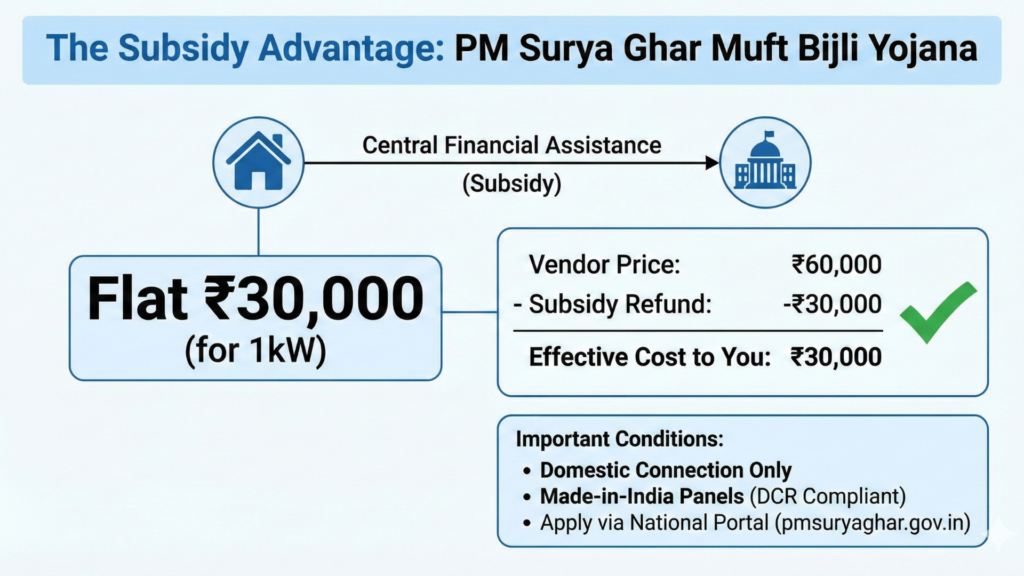
The game-changer for the Cost of 1kW solar system for home is the Central Financial Assistance (CFA), commonly known as the subsidy. Under the PM Surya Ghar Muft Bijli Yojana, the government bears a significant portion of the cost.
How the Subsidy Works
For a residential household installing a grid-connected system:
- Subsidy Amount: You can receive a flat subsidy of ₹30,000 for a 1kW system.
- Net Cost Calculation:
- Vendor Price: ₹60,000
- Subsidy Refund: -₹30,000
- Effective Cost to You: ₹30,000
Important Conditions
- Domestic Only: The connection must be residential. Commercial or industrial meters are not eligible.
- Made in India: The solar panels used must be DCR (Domestic Content Requirement) compliant, meaning the solar cells and modules must be manufactured in India.
- Process: You must apply via the National Portal (pmsuryaghar.gov.in) and use an empaneled vendor.
Load Capacity: What Can a 1kW System Run?
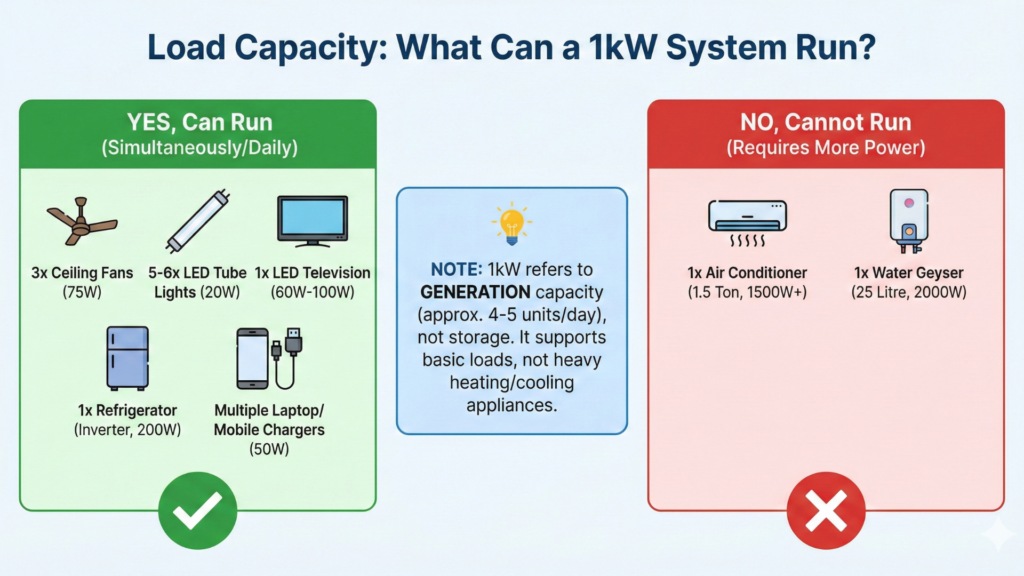
A common misconception is that “1kW” refers to the storage capacity. In reality, it refers to the generation capacity. A 1kW system typically generates 4 to 5 units (kWh) of electricity per day.
Before worrying about the Cost of 1kW solar system for home, you must ensure it meets your load requirements.
Table 2: Appliance Feasibility Chart
| Appliance | Quantity | Wattage (Approx) | Can 1kW Solar Run It? |
| Ceiling Fans | 3 | 75W | Yes (Easily) |
| LED Tube Lights | 5-6 | 20W | Yes |
| Television (LED) | 1 | 60W – 100W | Yes |
| Refrigerator | 1 (Single Door) | 200W | Yes (Modern Inverter models) |
| Laptop/Mobile | Multiple | 50W | Yes |
| Water Pump | 0.5 HP | 370W | Yes (Only during peak sun hours) |
| Air Conditioner | 1.5 Ton | 1500W+ | NO (Requires 3kW+) |
| Water Geyser | 25 Litre | 2000W | NO |
Summary: A 1kW system can easily handle the lighting, cooling (fans), and entertainment load of a 2BHK home, along with a standard refrigerator. It cannot support heavy heating or cooling loads like ACs or Geysers.
Hidden Costs Impacting the Final Price of a 1kW Solar System
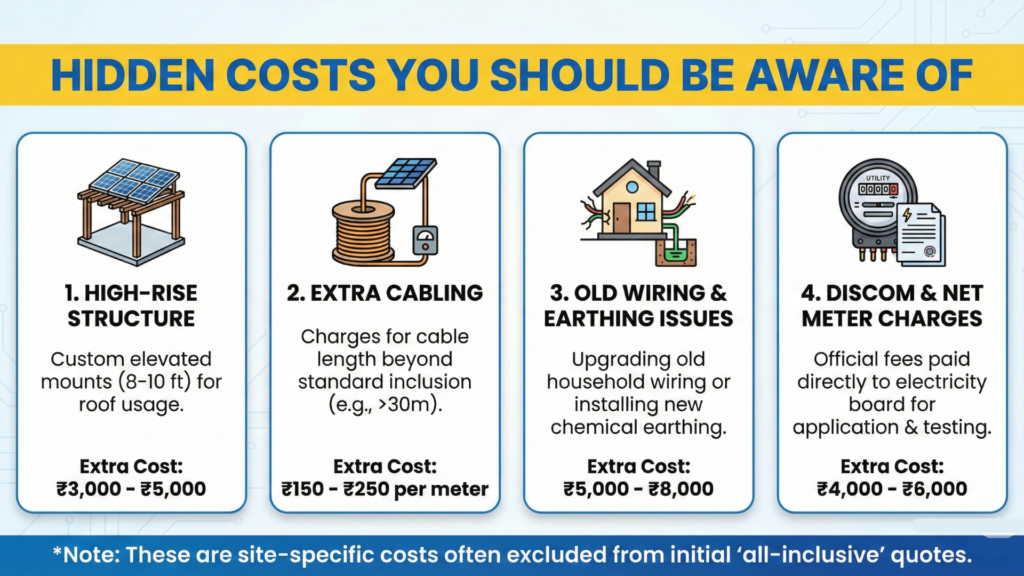
When researching the Cost of 1kW solar system for home, you will often see “All-Inclusive” deals. However, specific site conditions can lead to extra charges. Being aware of these will save you from last-minute surprises.
- High-Rise Structures: Standard installation mounts panels about 2-3 feet off the ground. If you want a “Pergola” style structure (raised 8-10 feet high) to utilize the roof space for gardening or sitting, the steel cost increases significantly. Expect to pay an extra ₹3,000 – ₹5,000 for this customization.
- Extra Cabling: Vendors typically include 20 to 40 meters of AC/DC cable in the package. If your rooftop is located on the 4th floor and your energy meter is on the ground floor, the extra cable length will be charged per meter.
- Old Wiring Issues: For an On-Grid system, your home’s earthing must be perfect. If your house has old wiring with weak earthing, the installer may require you to install a new chemical earthing pit, which costs extra.
- Discom Charges: While the solar vendor handles the paperwork, the official fees for the Net Meter application, testing, and agreement are sometimes payable directly to the electricity board (DISCOM) by the customer.
ROI Analysis: Recovering the Cost of 1kW Solar System for Home
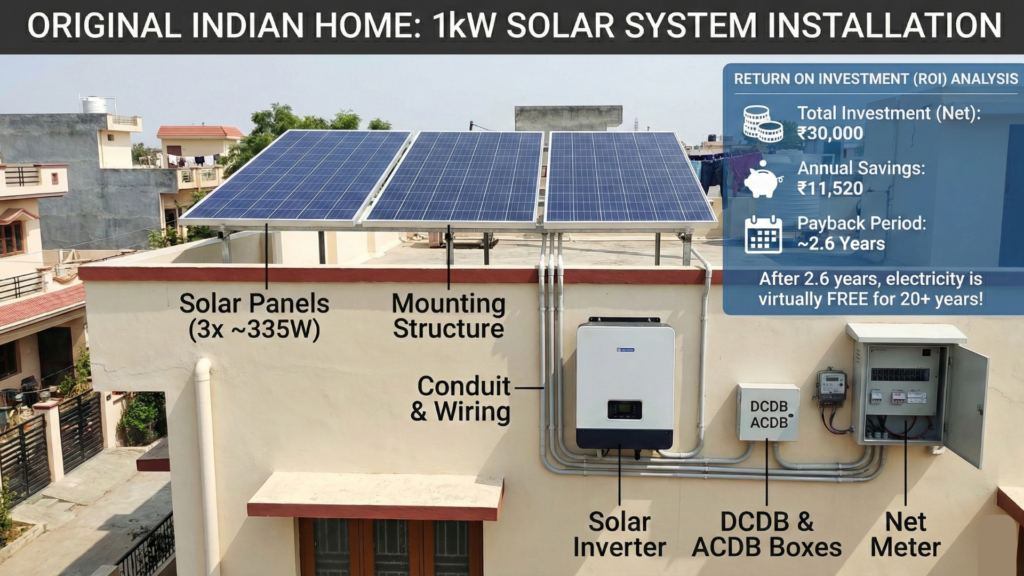
Solar is an asset, not a liability. Let’s analyze the financial logic behind the Cost of 1kW solar system for home.
- Initial Investment (Post-Subsidy): Approx ₹30,000 – ₹35,000.
- Monthly Electricity Bill Savings: Approx ₹1,000 (Based on 120 units generation x ₹8/unit tariff).
- Annual Savings: ₹12,000.
- Break-Even Point (ROI): 2.5 to 3 Years.
Once you recover your initial ₹35,000 in the first 3 years, the electricity generated for the next 22 years is effectively free profit. Given that solar panels degrade very slowly (0.5% per year), your asset will continue to yield returns for decades.
Installation Checklist
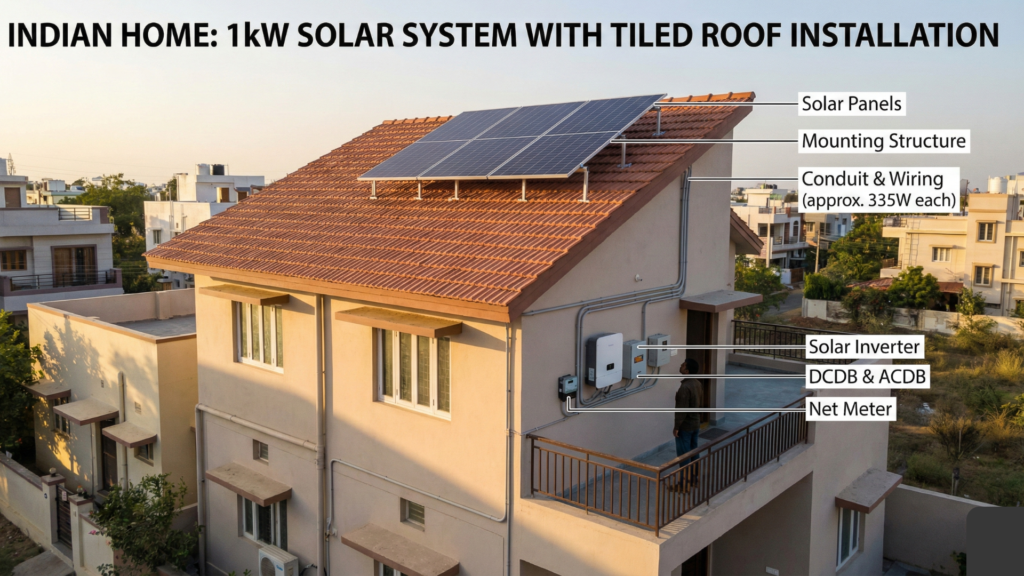
To ensure your investment in the Cost of 1kW solar system for home yields the best results, follow this checklist:
- Direction: Ensure panels face SOUTH. India is in the northern hemisphere, so south-facing panels capture maximum sunlight.
- Shadow Analysis: Ensure no water tanks, nearby buildings, or trees cast a shadow on the panels between 9 AM and 4 PM. Even a small shadow on one corner of a panel can drop the efficiency of the entire system by 30-50%.
- Cleaning Path: Ensure there is space left around the panels so you can easily clean them. Dust accumulation is the #1 enemy of solar generation.
- Galvanized Structure: Insist on a hot-dipped Galvanized Iron (GI) structure. Do not accept painted black iron, as it will rust within a few monsoons.
Conclusion
In conclusion, the Cost of 1kW solar system for home is more affordable today than it has ever been, largely thanks to falling component prices and robust government support.
For a net investment of approximately ₹30,000 to ₹35,000 (for an on-grid subsidy model), you can secure your home against rising energy inflation. If you live in an area with stable electricity, an On-Grid Mono-PERC system is your best bet. If you struggle with power outages, investing extra in an Off-Grid system with a tubular battery is a necessity, not a luxury.
Solar is not just about saving money; it is about energy independence. By installing a simple 1kW system, you reduce your carbon footprint and contribute to a greener planet while keeping your wallet happy.
Frequently Asked Questions (FAQ)
Q1. What is the total Cost of 1kW solar system for home with battery backup?
A. An off-grid system with a 150Ah solar battery typically costs between ₹80,000 and ₹95,000. Note that these systems are not eligible for the government subsidy.
Q2. Can a 1kW solar system run an Air Conditioner (AC)?
A. No. An AC requires a high starting current and continuous power usage that a 1kW system cannot support. You would need at least a 3kW On-Grid system to support an AC load efficiently.
Q3. How much roof space is required for a 1kW system?
A. You need approximately 80 to 100 square feet of shadow-free roof area. This is roughly the size of a small bedroom or a large balcony.
Q4. Do I get the subsidy on the total Cost of 1kW solar system for home immediately?
A. No. You have to pay the full amount to the vendor first. Once the system is installed and the net meter is commissioned by the electricity department, the subsidy (approx ₹30,000) is credited directly to your bank account within 30 days.
Q5. What is the maintenance cost of a 1kW solar system?
A. Solar systems are low maintenance. The only regular task is cleaning the panels with water every 10-15 days to remove dust. There are no moving parts, so wear and tear is minimal.
Q6. Which solar panel brand is best for a 1kW system?
A. Top Indian manufacturers include Tata Power Solar, Waaree Energies, Adani Solar, and Luminous. Sticking to these Tier-1 brands ensures you get DCR-compliant panels that are eligible for subsidies and have valid warranties.