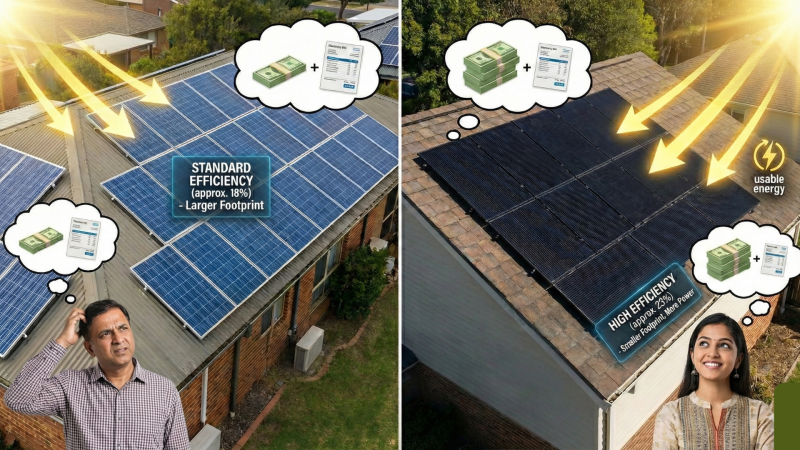
When you start researching solar power for your home, one technical term pops up more than any other: efficiency. You’ll see percentages like 20%, 22%, or even 24% stamped on datasheets, often accompanied by a higher price tag. But what do these numbers actually mean for your electricity bill?For many homeowners, the concept can be confusing. Does a 20% efficient panel only work 20% of the time? (Spoiler: No). Is it worth paying extra for high-efficiency models? In this guide, we will have solar panel efficiency explained in plain English, breaking down how it impacts your roof space, your budget, and your long-term energy savings.
Solar Panel Efficiency Explained: The Basics
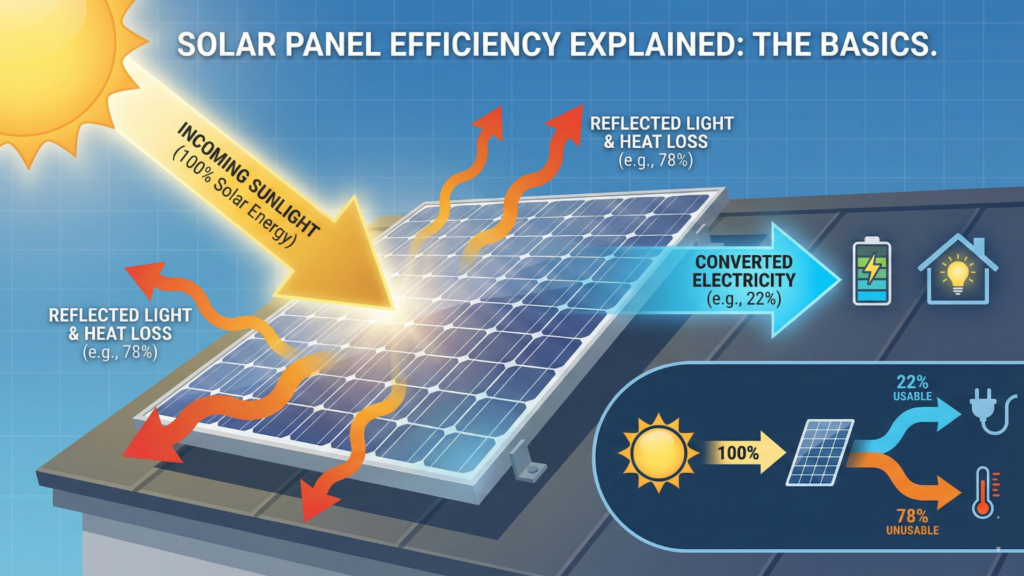
At its simplest level, solar panel efficiency measures how well a solar panel converts sunlight into usable electricity.
The sun blasts your roof with a massive amount of energy. If a solar panel has an efficiency rating of 20%, it means that the panel can capture 20% of that solar energy and turn it into electricity for your home. The remaining 80% is largely reflected away or turned into heat.
While 20% might sound low compared to other machines (like electric motors which can be 90% efficient), in the world of photovoltaics, it is actually quite impressive. Just a decade ago, standard residential panels struggled to reach 15%. Today, thanks to advancements in monocrystalline technology and PERC (Passivated Emitter and Rear Cell) designs, efficiency standards have skyrocketed.
Why Is “Solar Panel Efficiency Explained” Such a Hot Topic?
The reason this keyword—and concept—is trending is that efficiency determines power density. The more efficient a panel is, the more power it can generate per square foot.
- High Efficiency: You generate more power in less space.
- Low Efficiency: You need a larger roof area to generate the same amount of power.
The Evolution of Efficiency: What is “Good” in 2024-2025?
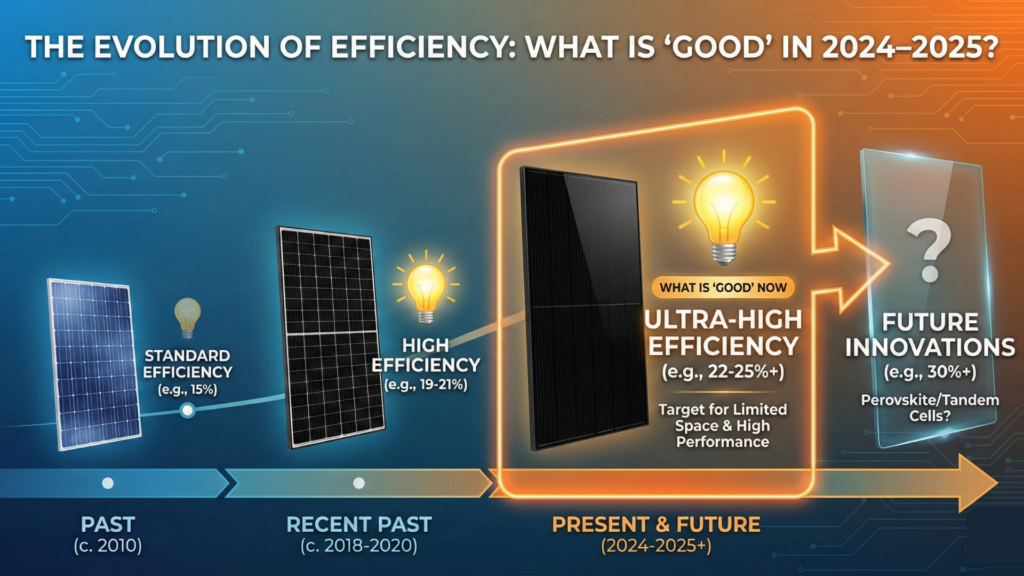
To understand what you should be buying, you need a benchmark. The solar industry moves fast. A panel that was considered “premium” five years ago might be considered “standard” today.
Currently, residential solar panels fall into three main categories:
- Standard Efficiency (17% – 20%): Often older polycrystalline models or budget-friendly options. These are great if you have a huge roof and a tight budget.
- High Efficiency (20% – 23%): This is the “sweet spot” for most modern homeowners. These are typically Monocrystalline panels (often black-on-black aesthetics) that offer a great balance of performance and price.
- Ultra-High Efficiency (23% – 25%+): These are top-tier models from brands like SunPower (Maxeon), REC, or Aiko. They use advanced N-type cells or heterojunction technology (HJT). They are the most expensive but perform best in low light and high heat.
Table 1: Standard vs. High-Efficiency Panels Comparison
To help you decide which tier is right for you, here is a breakdown of how they compare in cost and application.
| Feature | Standard Efficiency Panels | High-Efficiency Panels | Ultra-High Efficiency Panels |
| Efficiency Range | 17% – 19% | 20% – 22.9% | 23% – 25%+ |
| Panel Technology | Polycrystalline (Blue hue) | Monocrystalline PERC (Black) | N-Type / Heterojunction (IBC) |
| Wattage per Panel | 300W – 350W | 400W – 450W | 460W – 500W+ |
| Cost | Low (₹) | Moderate (₹₹) | High (₹₹₹) |
| Space Required | High (Needs more panels) | Moderate | Low (Maximum power density) |
| Best For… | Large roofs, budget projects, or ground mounts. | Most typical residential homes. | Small roofs, premium aesthetics, or heavy energy users. |
Solar Panel Efficiency Explained: Does it Matter for You?
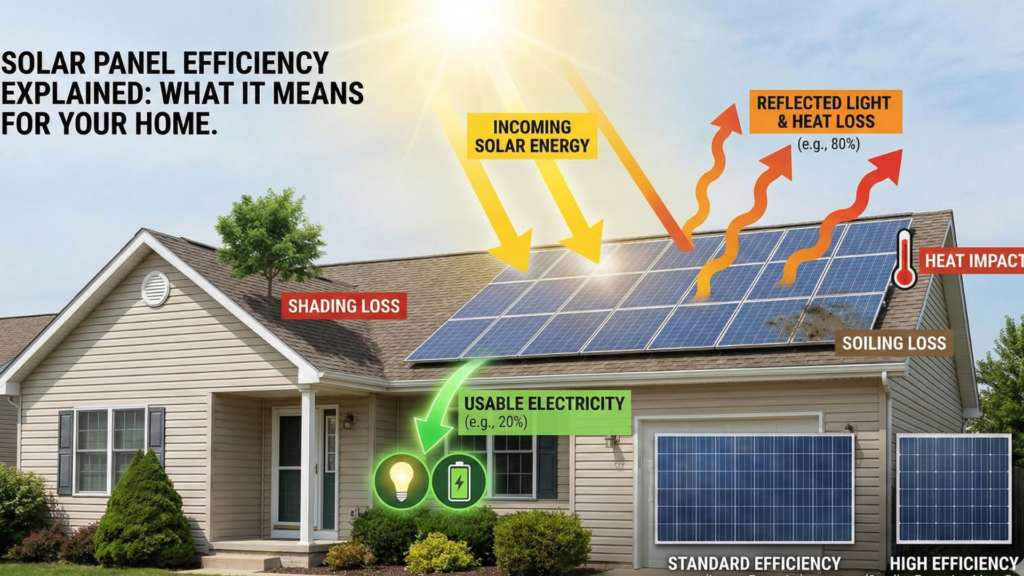
This is the big question. Does an average homeowner named Sandeep living in a sunny area actually need 24% efficiency? Not always.
Scenario A: The Space-Constrained Roof
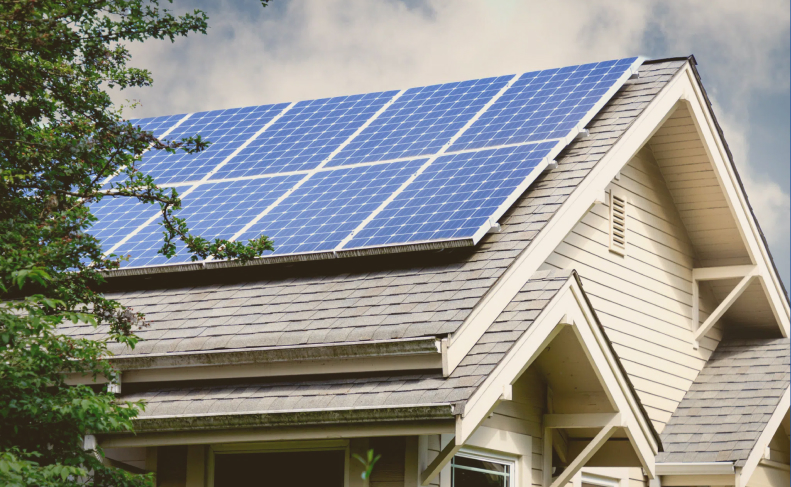
If you have a small roof, or your roof has many obstacles (chimneys, vents, skylights), efficiency is critical. You have limited real estate to generate electricity. By using ultra-high-efficiency panels, you might be able to squeeze a 6kW system onto a roof that would only fit a 4kW system using standard panels. In this case, efficiency equals viability.
Scenario B: The Large, Open Roof
If you have a massive, unshaded roof or ample land for a ground mount, paying a premium for the highest efficiency might be a waste of money. You can achieve the same total power output (e.g., 10kW) by simply installing more of the cheaper, standard-efficiency panels. In this context, the “cost per watt” is more important than efficiency percentage.
5 Real-World Factors That Kill Solar Efficiency
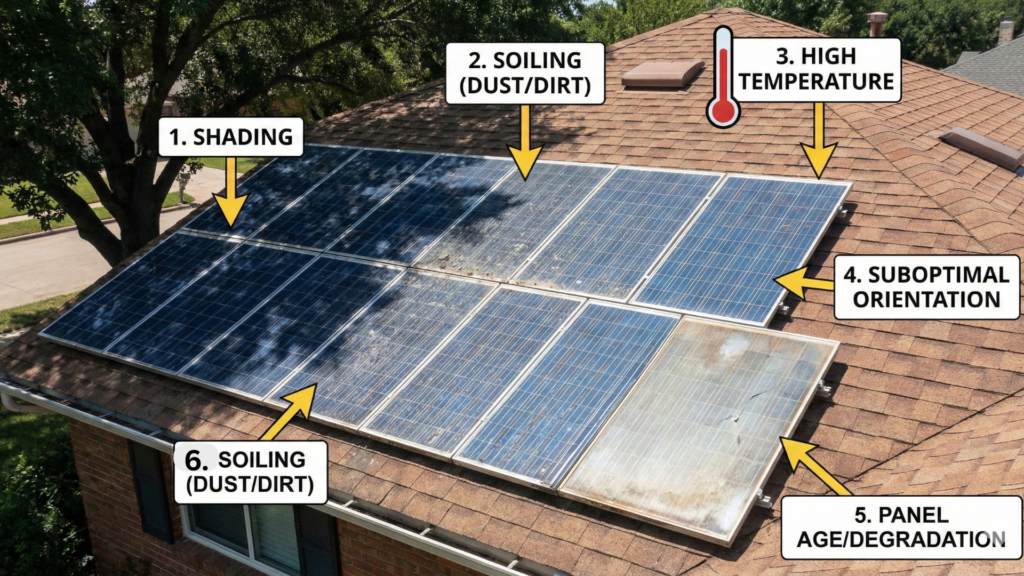
When manufacturers test solar panels, they do it in a lab under “Standard Test Conditions” (STC)—basically a perfect environment with a specific light intensity and a cool temperature of 25°C.
Your roof is not a lab. In the real world, several environmental factors will drag that efficiency number down. Having solar panel efficiency explained requires looking at these “efficiency killers.”
1. Temperature (The Heat Paradox)
Paradoxically, solar panels hate heat. As the temperature rises, the chemical reaction inside the silicon cells slows down, and voltage drops. This is measured by the Temperature Coefficient.
- Standard panels might lose 0.40% of their power for every degree Celsius over 25°C.
- High-efficiency panels often have a better coefficient (around 0.25%), meaning they perform better on hot summer days.
2. Shading
Even a small amount of shade on a single panel can disproportionately affect the output of the entire string of panels. Modern panels use “bypass diodes” to mitigate this, but shade remains the #1 enemy of efficiency.
3. Dust and Dirt (Soiling)
A layer of dust, pollen, or bird droppings blocks light from reaching the silicon. In dry areas like Rajasthan, “soiling” can reduce output by 5-10% if panels aren’t cleaned.
4. Orientation and Tilt
Panels are most efficient when sunlight hits them perpendicularly (at a 90-degree angle). Since the sun moves across the sky, fixed roof panels are rarely at the perfect angle. South-facing roofs (in the Northern Hemisphere) capture the most light, while East/West roofs will be roughly 15-20% less efficient.
Table 2: Environmental Impact on Efficiency
| Factor | Impact on Efficiency | How to Mitigate |
| High Heat | Reduces voltage; output drops by 10-25% on hot days. | Choose panels with a low Temperature Coefficient (-0.30% or better). Ensure an air gap under panels for airflow. |
| Shade | Can drop output to 0% for affected cells; affects whole string. | Use Microinverters or Power Optimizers to isolate shaded panels. Trim trees. |
| Dust/Debris | Blocks sunlight; 5-15% annual loss in dry areas. | Clean panels 2-4 times a year, or rely on heavy rainfall if you live in a wet climate. |
| Panel Age | Silicon degrades naturally; ~0.5% loss per year. | Buy panels with a high Performance Warranty (e.g., guaranteed 90% output at year 25). |
| Wrong Angle | Reduces direct light absorption. | Install on the south-facing roof slope or use tilt-frames to optimize the angle. |
The Economics: Is High Efficiency Worth the Price?
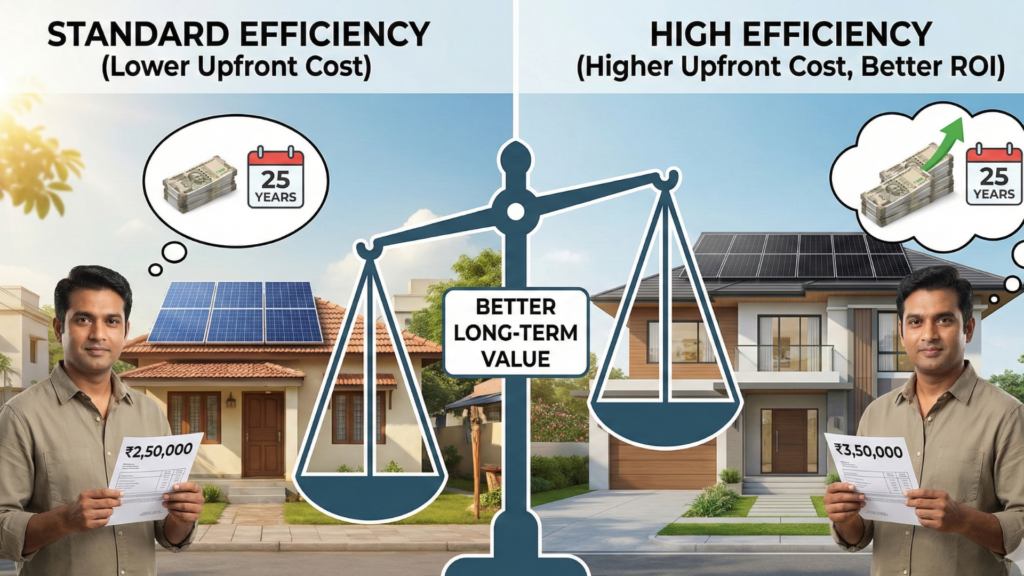
When looking at quotes, you might see a “Standard” package for ₹2,50,000 and a “Premium High-Efficiency” package for ₹3,50,000. Is the extra ₹1,00,000 worth it?
Calculated Return on Investment (ROI):
High-efficiency panels generally degrade slower. A standard panel might degrade at 0.7% per year, ending up at 80% capacity after 25 years. A premium panel might degrade at only 0.25% per year, ending up at 92% capacity.
That difference means the high-efficiency system will produce thousands of extra kilowatt-hours (kWh) over the lifetime of the system—often effectively paying for the upfront cost difference and then some.
The “Solar Panel Efficiency Explained” Verdict:
- Go High Efficiency if: You have a small roof, high energy bills, live in a very hot climate, or plan to stay in the home for 20+ years.
- Go Standard Efficiency if: You have plenty of roof space, a strict budget, or plan to move within 10 years.
Conclusion: Solar Panel Efficiency Explained – Final Thoughts
Understanding solar panel efficiency is the key to making a smart investment in your home’s energy future. While it is easy to get caught up in the marketing hype of “record-breaking” percentages, the reality is that for most homeowners, the “best” efficiency is the one that fits your roof and your budget.
To summarize the core concept of solar panel efficiency explained: it is a measure of power density. It determines how much energy you can harvest from a limited space. As we move through 2025, expect standard panels to inch closer to the 23% mark, making solar an even more powerful tool for energy independence.
Whether you choose a workhorse standard panel or a race-car-performance premium panel, the most important step is simply making the switch to renewable energy.
FAQ: Solar Panel Efficiency Explained
1. What is a good efficiency rating for solar panels in 2025?
A “good” efficiency rating for residential solar panels in 2025 is between 20% and 22%. Anything above 22% is considered high-efficiency and is excellent for maximizing power on smaller roofs.
2. Does solar panel efficiency decrease over time?
Yes. All solar panels experience “degradation.” typically losing about 0.5% to 0.8% of their efficiency per year. However, high-quality panels degrade slower and often come with warranties guaranteeing they will still produce 90% of their original power after 25 years.
3. Solar panel efficiency explained: Does temperature affect it?
Absolutely. Solar panels actually perform worse in extreme heat. Efficiency ratings are tested at 25°C. For every degree above that, the panel becomes slightly less efficient. This is why looking for a low “temperature coefficient” is important for homeowners in hot climates.
4. Are high-efficiency solar panels more expensive?
Yes, high-efficiency panels (like those using N-Type or IBC technology) are more expensive to manufacture and thus cost more upfront. However, they can offer better long-term value by generating more electricity over the system’s life and performing better in low-light conditions.
5. How can I calculate the efficiency of my current panels?
You can estimate it using this formula: (Power Output in Watts) ÷ (Surface Area in m² × 1000). However, the easiest way is to look at the manufacturer’s datasheet under “Module Efficiency.”