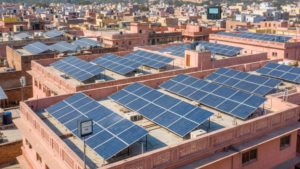
In the Pink City, the sun doesn’t just bring heat; it brings a massive opportunity for savings. With electricity rates in Jaipur (governed by JVVNL) rising annually, understanding the exact Solar Installation Cost in Jaipur has become a financial necessity for homeowners and businesses alike. Before you start searching for the Best solar installation company near me, it is crucial to know that Rajasthan has one of the highest solar irradiation levels in India, making Jaipur the perfect candidate for high-efficiency solar power generation.
However, the biggest hurdle for most homeowners is understanding the pricing. You might hear quotes ranging from ₹50,000 to ₹80,000 per kW, leaving you confused. Why is there such a difference?
This guide provides a transparent breakdown of the Price per Watt in Jaipur, explains the subsidy benefits under the PM Surya Ghar: Muft Bijli Yojana, and guides you on how to filter through the noise to find the right installation partner.
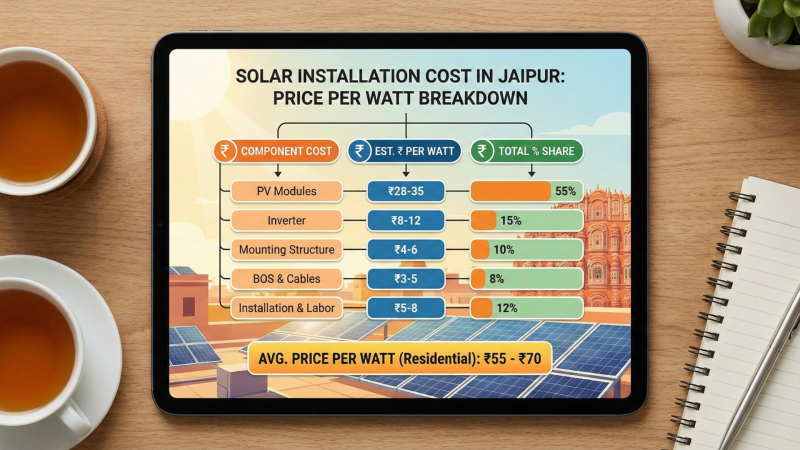
Understanding the Price Per Watt Model
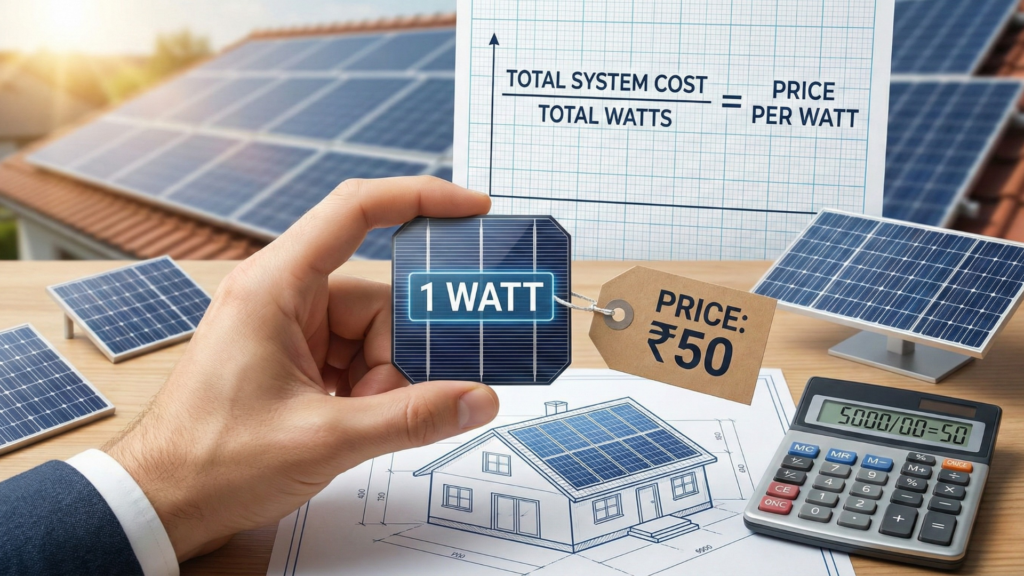
Before we look at the total cost, it is essential to understand the “Price per Watt” metric. In the solar industry, costs are often calculated based on the capacity of the system.
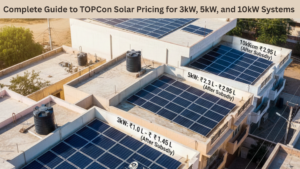
As of late 2024 and entering 2025, the average cost of solar installation in Jaipur ranges between ₹45 to ₹75 per watt for residential systems. This variation depends heavily on the technology used (Polycrystalline vs. Monocrystalline vs. Bi-facial) and the brand of the inverter.
Factors Influencing Solar Costs in Jaipur
- System Type: On-Grid (cheapest), Off-Grid (expensive due to batteries), or Hybrid.
- Module Efficiency: Mono-PERC panels cost more than Poly panels but generate more power in less space.
- Structure Height: If you need a raised structure (High-rise) to use the roof space underneath, the cost of galvanized iron (GI) increases.
- Net Metering Charges: Fees paid to JVVNL (Jaipur Vidyut Vitran Nigam Ltd) for the bi-directional meter.
Cost Breakdown by System Size (Residential)
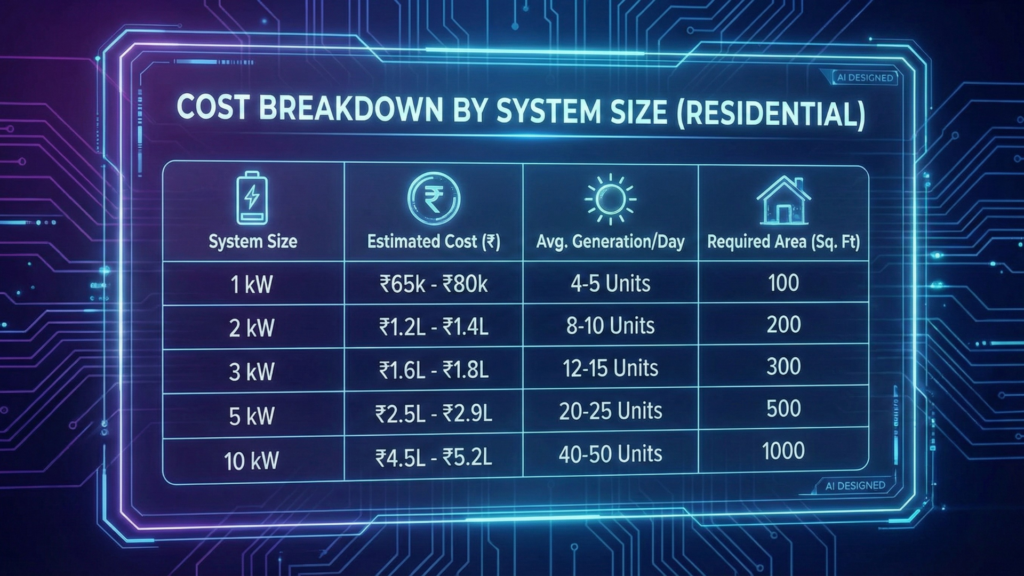
To give you a realistic idea of investment, we have broken down the costs for the most common residential system sizes in Jaipur.
Note: The prices below are estimated market rates before applying government subsidies.
Table 1: Solar Installation Cost in Jaipur (Pre-Subsidy)
| System Size | Technology Type | Estimated Price Range (₹) | Avg. Generation / Day | Required Area (Sq. Ft) |
| 1 kW | Mono-PERC | ₹65,000 – ₹80,000 | 4 – 5 Units | 100 |
| 2 kW | Mono-PERC | ₹1,20,000 – ₹1,40,000 | 8 – 10 Units | 200 |
| 3 kW | Mono-PERC | ₹1,60,000 – ₹1,80,000 | 12 – 15 Units | 300 |
| 5 kW | Mono-PERC | ₹2,50,000 – ₹2,90,000 | 20 – 25 Units | 500 |
| 10 kW | Mono-PERC | ₹4,50,000 – ₹5,20,000 | 40 – 50 Units | 1000 |
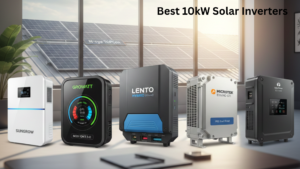
Prices may vary based on the specific brand of panels (e.g., Tata, Adani, Waaree) and inverters (e.g., Growatt, GoodWe, Enphase).
How to Choose the Best Solar Installation Company Near Me?
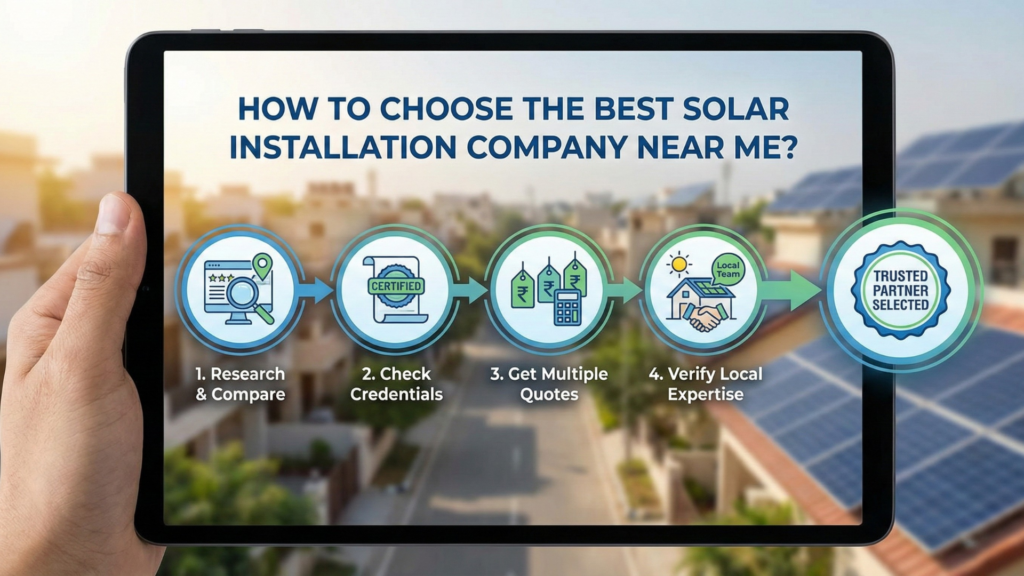
When you finally decide to invest, you will likely open Google and search for the “best solar installation company near me.” You will be bombarded with ads and local listings. How do you choose the right partner?
Installing solar is a 25-year relationship. You aren’t just buying a product; you are buying a service. Here is why the “lowest price” isn’t always the best choice.
1. Check for ALMM Approved Modules
The Ministry of New and Renewable Energy (MNRE) maintains an “Approved List of Models and Manufacturers” (ALMM). To be eligible for the government subsidy, your installer must use ALMM-approved Indian panels. A reputable company will never suggest non-approved imported panels for a subsidized residential project.
2. Liasioning with JVVNL
The hardest part of going solar in Jaipur is not the installation; it is the paperwork. The best solar installation company near me will handle the entire “Net Metering” process with the local electricity board. If an installer asks you to handle the JVVNL file application yourself, that is a red flag.
3. After-Sales Service
Solar systems have no moving parts, but inverters can trip, and wires can face wear and tear. Ensure your installer has a local office in Jaipur or nearby districts (like Sikar or Alwar) to provide quick service.
Component-Wise Cost Analysis
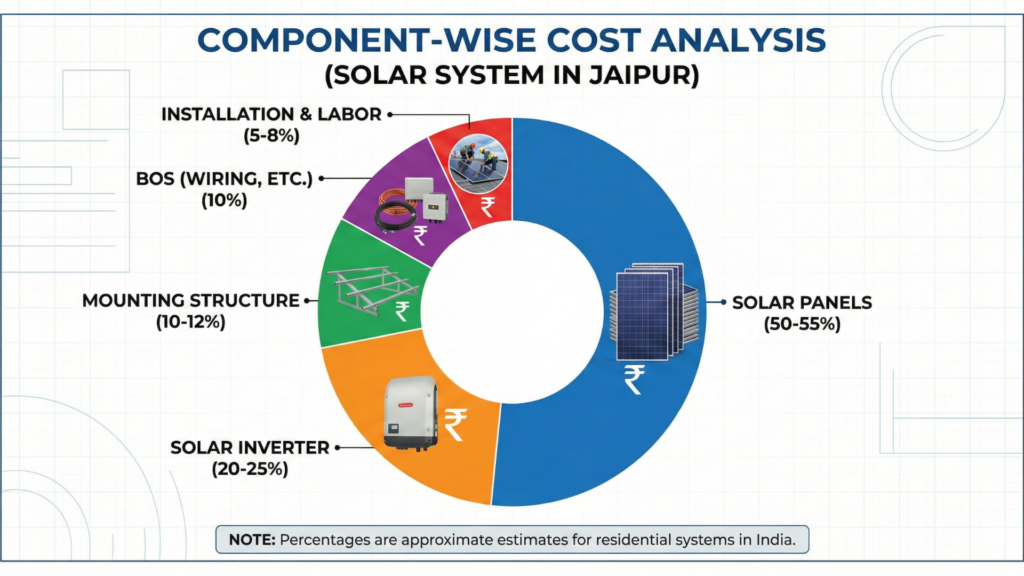
Where exactly does your money go? Understanding the split helps you negotiate better. If a vendor is offering a very low price, check if they are compromising on the structure or the BOS (Balance of System) components like wires and earthing kits.
Table 2: Percentage Breakdown of Solar Costs
| Component | Share of Total Cost | What to Look For |
| Solar Panels (Modules) | 50% – 55% | Look for Half-Cut Mono PERC (Higher efficiency). |
| Solar Inverter | 20% – 25% | The “brain” of the system. Look for 7-10 year warranties. |
| Mounting Structure | 10% – 12% | Must be Hot Dip Galvanized Iron (HDGI) to prevent rust. |
| BOS (Wires, ACDB/DCDB) | 10% | UV protected DC cables and pure copper AC cables. |
| Installation & Labor | 5% – 8% | Experienced technicians ensure safety and aesthetics. |
The Subsidy Factor: PM Surya Ghar Yojana
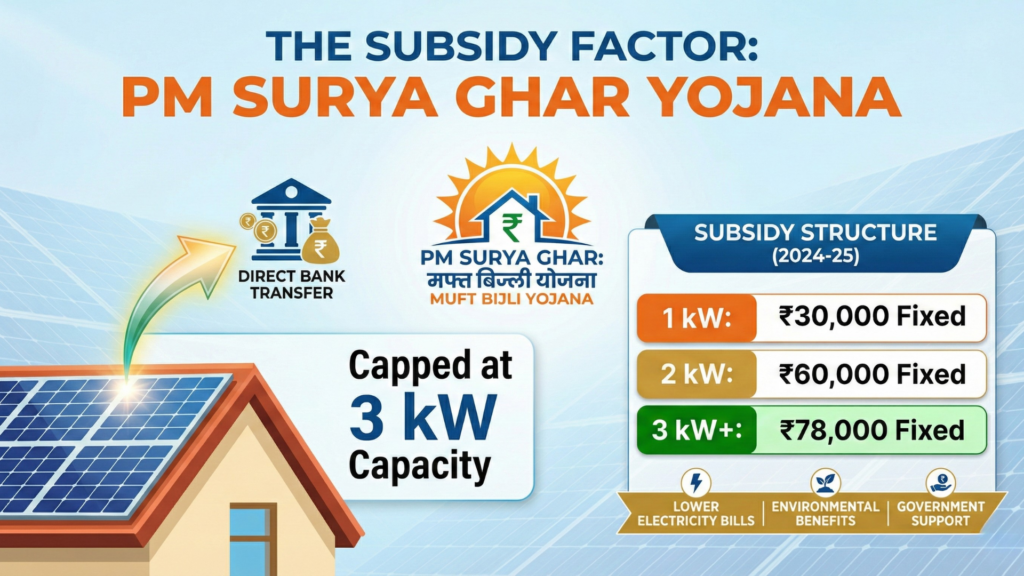
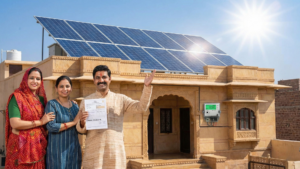
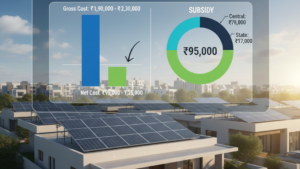
For Indian homeowners, the Return on Investment (ROI) is significantly accelerated by the PM Surya Ghar: Muft Bijli Yojana. This central government scheme transfers the subsidy amount directly to the consumer’s bank account within 30 days of commissioning.
The subsidy is capped at 3 kW capacity. This means even if you install 5 kW, you will receive the subsidy applicable for 3 kW.
Table 3: Government Subsidy Structure (2024-25)
| System Capacity | Central Subsidy Amount (Fixed) | Customer Contribution (Approx.) |
| 1 kW | ₹30,000 | ₹35,000 – ₹45,000 |
| 2 kW | ₹60,000 | ₹60,000 – ₹70,000 |
| 3 kW | ₹78,000 | ₹85,000 – ₹1,00,000 |
| Above 3 kW | Fixed at ₹78,000 | Remaining Full Cost |
Note: Subsidy amounts are subject to MNRE updates. Always verify with your vendor.
Checklist Before Hiring the Best Solar Installation Company Near Me
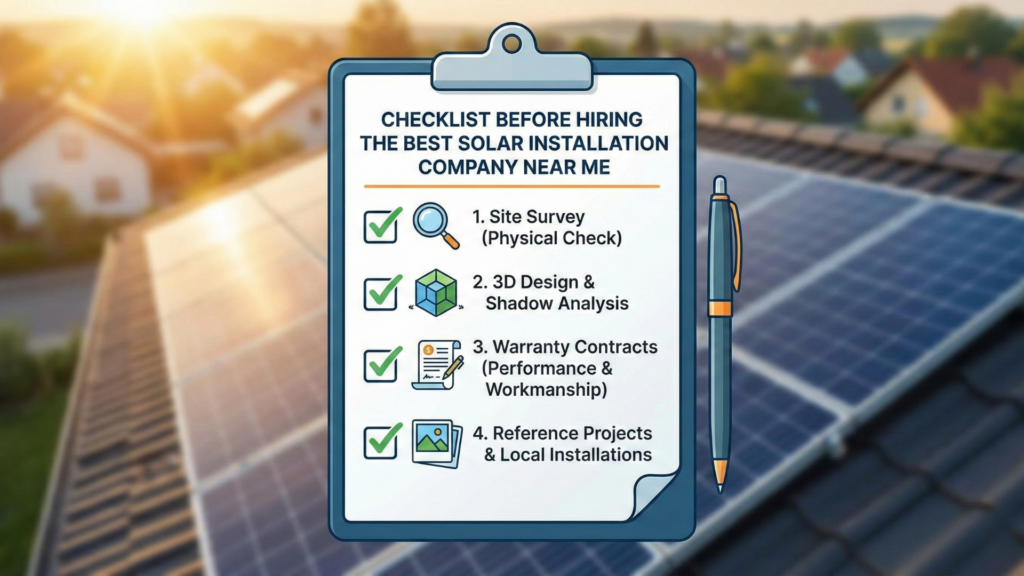
Before you sign the cheque, ensure your chosen vendor checks these boxes. This ensures your investment is safe and your system performs optimally for decades.
- Site Survey: Did they visit your roof physically to check for shadow-casting objects (water tanks, nearby buildings)? A quote given without a site survey is often inaccurate.
- 3D Design: Professional companies provide a 3D shadow analysis report showing how the panels will look and perform.
- Warranty Contracts: Ensure you get two warranties:
- Performance Warranty: Usually 25 years on panels.
- Workmanship Warranty: Usually 5 years from the installer for wiring and structure issues.
- Reference Projects: Ask to see photos of their previous installations in Jaipur, Vaishali Nagar, Mansarovar, or Jagatpura.
Conclusion
Switching to solar in Jaipur is a financial no-brainer. With a 3 kW system, you can save approximately ₹3,000 to ₹4,000 per month on electricity bills. Considering the net cost after subsidy (approx. ₹90,000 – ₹1 Lakh), your Return on Investment (ROI) period is typically just 2.5 to 3 years. For the remaining 22+ years, your electricity is virtually free.
However, the efficiency of your system depends entirely on the quality of installation. Do not just look for the cheapest price per watt. Look for reliability, quality of structure, and grid liaison capabilities.
When you begin your search for the best solar installation company near me, prioritize those who are transparent about their pricing and component list. Solar is a long-term asset; invest in it wisely.
FAQs About Finding the Best Solar Installation Company Near Me
Q1: What is the current price per watt for solar in Jaipur?
A: For residential on-grid systems, the price ranges between ₹45 to ₹60 per watt depending on the system size and panel technology. Smaller systems have a higher price per watt compared to larger ones.
Q2: How do I find the best solar installation company near me in Jaipur?
A: Look for vendors who are registered vendors under the PM Surya Ghar scheme, have good Google reviews, offer on-site surveys, and provide comprehensive after-sales support for net metering.
Q3: Is the solar subsidy available for commercial buildings in Rajasthan?
A: No, the PM Surya Ghar subsidy is strictly for residential consumers. Commercial and industrial sectors can, however, avail of tax benefits like Accelerated Depreciation (AD).
Q4: Can I run my AC on a 3kW solar system?
A: In an On-Grid system, your solar power is exported to the grid, and you draw power from the grid to run heavy loads like ACs. A 3kW system generates enough units (approx. 360-400 units/month) to offset the bill of running a 1.5-ton AC for several hours a day.
Q5: What happens to solar power during a power cut in Jaipur?
A: Standard On-Grid solar systems shut down during a power cut for safety reasons (anti-islanding). If you need power during outages, you must opt for a Hybrid Solar System with battery backup, which costs significantly more.