Switching to solar energy is one of the most impactful decisions you can make for your wallet and the planet. However, the first hurdle most homeowners face is understanding the technical differences between system types. If you have been searching for the differences between an On-grid vs Off-grid solar system, you are already asking the right questions.
Choosing the wrong system can lead to unexpected costs or a setup that doesn’t meet your energy needs. This guide will break down everything you need to know—from how they work and what they cost to a detailed comparison—to help you decide which On-grid vs Off-grid solar system fits your lifestyle.
What is the Main Difference Between On-Grid and Off-Grid Solar?
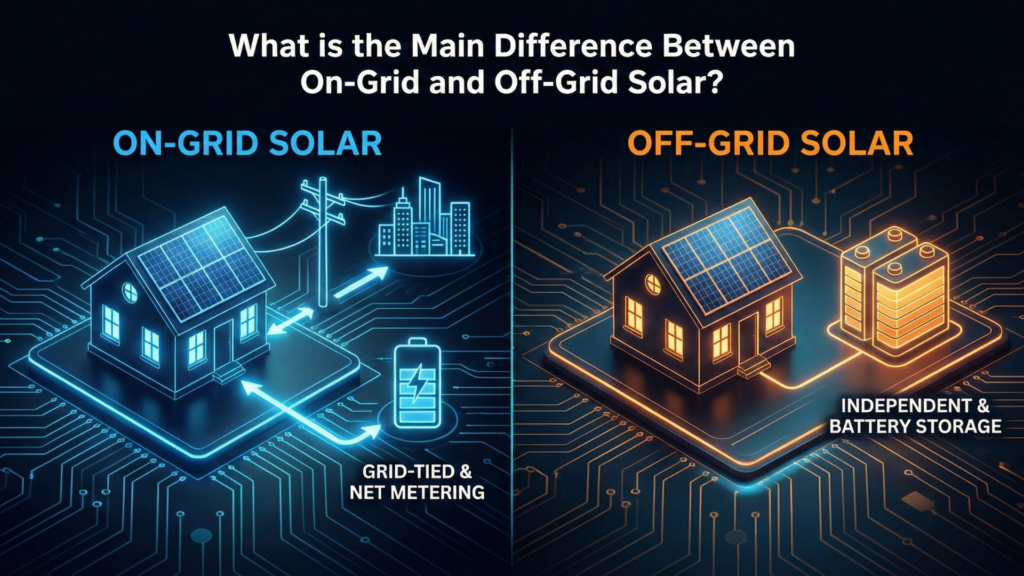
Before diving into the technicalities, it helps to visualize the difference simply:
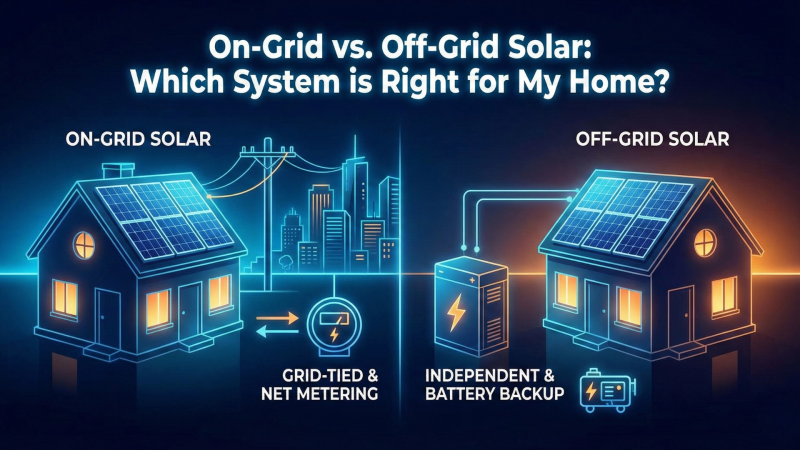
- On-Grid: Think of this as a partnership with your utility company. You are still connected to the wires on your street.
- Off-Grid: Think of this as complete independence. You cut the cord and rely entirely on your own equipment.
Let’s explore these two options in depth.
1. Deep Dive: On-Grid Solar System
An on-grid solar system (also known as grid-tied) is the most common residential solar setup. As the name suggests, your home remains connected to your local utility grid.
How Does an On-Grid System Work?
Your solar panels generate electricity during the day. If you produce more power than you use, the excess is sent back to the public electricity grid. Conversely, at night or during cloudy days when your panels aren’t producing enough, you draw power from the grid just like a normal home.
Key Benefits of On-Grid Solar (Net Metering)
The biggest financial advantage of an on-grid system is Net Metering. This is a billing mechanism where the utility company credits you for the excess electricity you export to the grid.
- If you export 100 units and consume 120 units, you only pay for the net 20 units.
- In some months, if you export more than you use, your bill could be zero (or even negative, depending on local policy).
Pros and Cons of On-Grid Systems
| Advantages | Disadvantages |
| Lower Upfront Cost: No expensive batteries are required. | No Backup During Outages: For safety reasons (anti-islanding), on-grid inverters shut down during a power cut. You will lose power even if the sun is shining. |
| High ROI: You save money via net metering credits. | Dependency: You are still reliant on the utility grid for night-time power. |
| Maintenance Free: Without batteries, there are fewer parts to degrade or replace. | Paperwork: Requires approvals and net-metering agreements with your local electricity provider. |
2. Deep Dive: Off-Grid Solar System
When comparing an On-grid vs Off-grid solar system, the off-grid option represents total freedom. You are your own power plant.
How Does an Off-Grid System Work?
An off-grid solar system is completely disconnected from the public utility grid. Because you cannot draw power from the street at night, you must store the solar energy you generate during the day. This requires a robust battery bank.
The Importance of Battery Backup in Off-Grid
In an off-grid setup, the battery is the heart of the system.
- Daytime: Panels power your home and charge the batteries.
- Nighttime: The home draws power stored in the batteries.
If your batteries run dry (after several cloudy days), you lose power unless you have a backup diesel generator.
Pros and Cons of Off-Grid Systems
| Advantages | Disadvantages |
| Total Independence: You are immune to grid failures, blackouts, and rising electricity prices. | High Initial Cost: Batteries are expensive and can double the cost of the system. |
| Remote Capability: Perfect for rural areas, farmhouses, or cabins where the grid doesn’t reach. | Maintenance: Batteries degrade over time and will need replacement every 5–10 years. |
| No Bills: You will never receive a utility bill again. | Limited Capacity: You must carefully manage your energy usage; you cannot run unlimited appliances if the battery is low. |
Detailed Comparison: On-grid vs Off-grid solar system
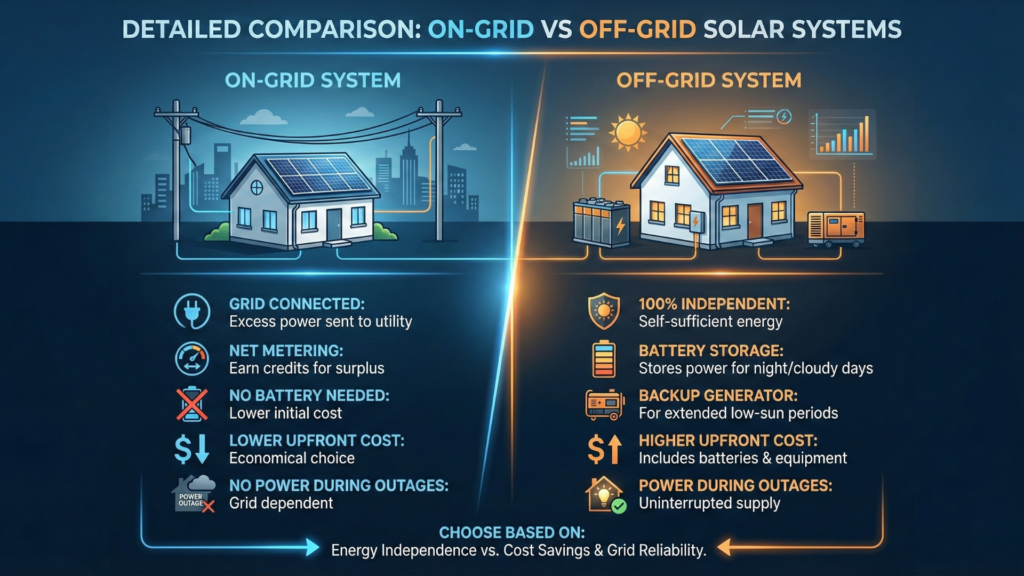
To give you a clear snapshot, here is a side-by-side comparison of the technical and functional differences.
| Feature | On-Grid Solar System | Off-Grid Solar System |
| Grid Connection | Connected to local utility. | Completely disconnected. |
| Electricity Bill | Reduced significantly (can be near zero). | Zero (Total elimination). |
| Backup Power | None (System shuts off during power cuts). | Available (Runs on battery). |
| Primary Component | Solar Panels + Grid-Tie Inverter. | Panels + Off-Grid Inverter + Batteries. |
| Suitability | Urban areas with reliable electricity. | Rural areas or places with frequent cuts. |
| Cost | More affordable (30-40% cheaper). | Expensive due to battery bank. |
| Energy Waste | None (Excess is sold to the grid). | Possible (Excess energy is lost if batteries are full). |
Which System fits your needs? (Scenario Analysis)
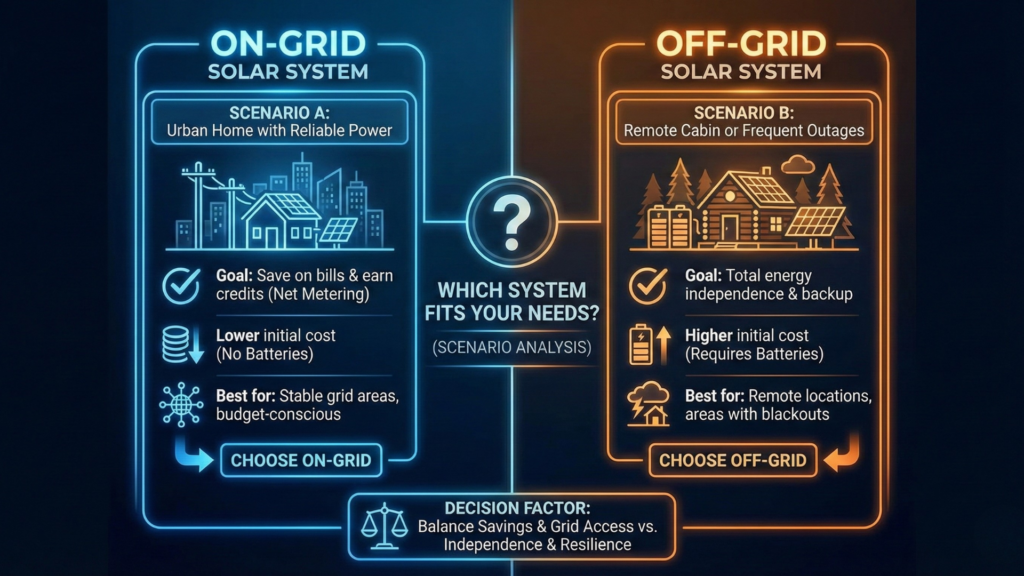
When deciding between an On-grid vs Off-grid solar system, your location and lifestyle are the deciding factors.
Scenario A: When to Choose On-Grid Solar
If you rarely experience power cuts and your main goal is to save money on your monthly electricity bill, the On-grid system is the clear winner.
- Why: You don’t need to pay for batteries because the grid acts as your virtual battery. The Return on Investment (ROI) is fast (usually 3–5 years).
Scenario B: When to Choose Off-Grid Solar
If your local grid is unstable, or you experience “load shedding” for hours every day, an on-grid system will frustrate you because it will shut down during those outages. Here, an Off-grid system is better.
- Why: Reliability is more valuable than ROI in this case. You need lights and fans running regardless of what the utility company does.
Scenario C: You are building a remote cabin
If bringing electricity lines to your property is too expensive or impossible, Off-grid is your only choice. It is the standard solution for remote farmhouses and eco-resorts.
Cost Analysis: On-Grid vs Off-Grid Solar System
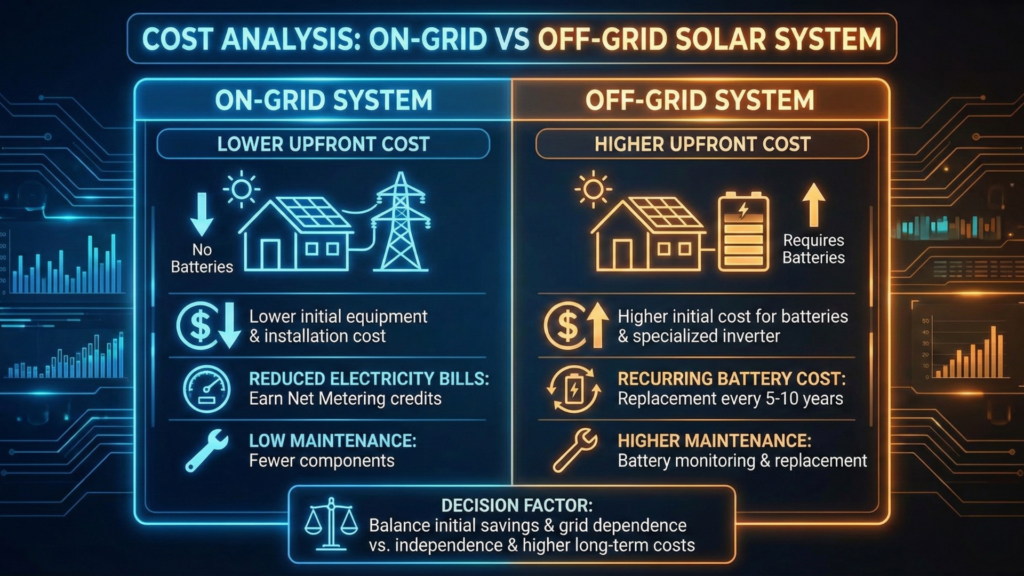
Cost is often the biggest deal-breaker. Below is an estimated cost breakdown for a standard home system (e.g., 3kW to 5kW range).
Note: Prices vary by region and brand, but the ratios remain consistent.
Comparison Table 2: Cost & ROI Breakdown
| Cost Factor | On-Grid System | Off-Grid System |
| Initial Equipment | Medium (Panels + Inverter) | High (Panels + Inverter + Batteries) |
| Installation | Standard | Complex (Requires battery rack & safety setup) |
| Recurring Costs | Low (Panel cleaning only) | High (Battery replacement every 5-7 years) |
| Payback Period | 3 to 5 years | 8 to 12 years |
| Financial Incentive | Eligible for Govt. Subsidies (in many countries) | Often excluded from standard subsidies |
Key Takeaway on Cost: An off-grid system generally costs 30% to 50% more than an on-grid system of the same capacity purely because of the battery bank.
The Third Option: Hybrid Solar Systems
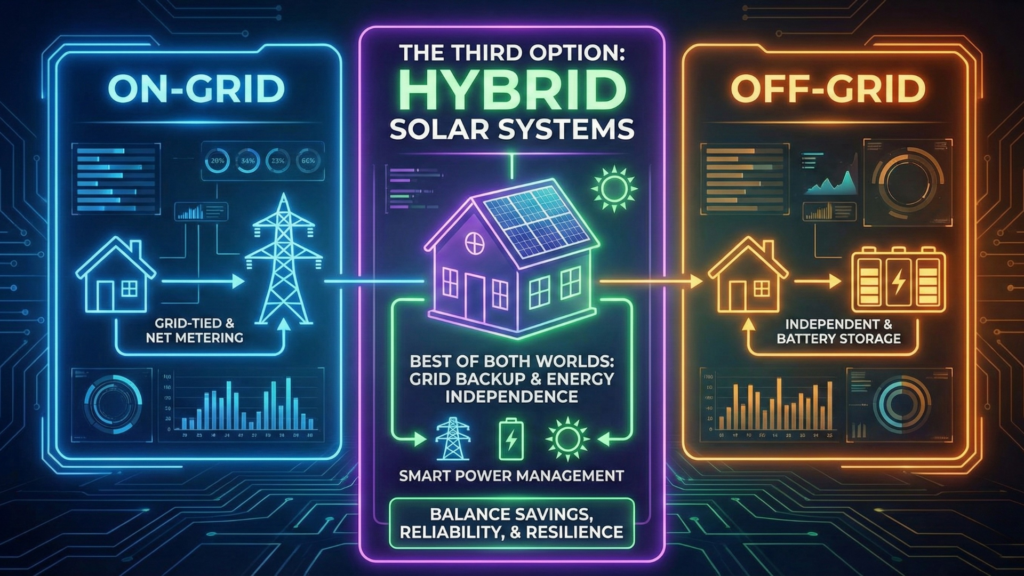
If you are reading about On-grid vs Off-grid solar systems and feeling stuck because you want the savings of On-grid but the backup of Off-grid, there is a third option: The Hybrid System.
A Hybrid system is connected to the grid and has a battery bank.
- Normal operation: It works like an on-grid system, selling excess power to save you money.
- Power Cut: It automatically switches to battery mode, keeping your lights on.
- Downside: It is the most expensive option of all because it requires sophisticated hybrid inverters and batteries.
Conclusion on On-Grid vs Off-Grid Solar System Choice
The debate of On-grid vs Off-grid solar system ultimately comes down to one question: Do you value Savings or Independence more?
- Choose On-Grid if: You live in an urban area with stable electricity, you want the best financial return on your investment, and you simply want to eliminate your electricity bill.
- Choose Off-Grid if: You live in a remote location, you suffer from frequent and long power outages, or you are determined to sever all ties with utility companies regardless of the cost.
For 90% of homeowners, the On-Grid system is the most practical and financially sound choice. However, if energy security is your primary concern, the investment in Off-Grid (or Hybrid) storage is well worth the price.
Frequently Asked Questions (FAQs) About On-Grid vs Off-Grid Solar System
1. Can an on-grid solar system work during a power cut?
No. For safety reasons, on-grid inverters have a feature called “anti-islanding.” This stops the system from feeding electricity back into the grid during a blackout, which could electrocute line workers fixing the wires. If you need power during an outage, you need an off-grid or hybrid system.
2. Which is cheaper: On-grid or Off-grid?
An On-grid solar system is significantly cheaper. It requires fewer components (no batteries) and has lower maintenance costs.Off-grid systems require a significant investment in batteries, which also need to be replaced periodically.
3. Can I convert my on-grid system to off-grid later?
Converting a pure on-grid system to a pure off-grid system is difficult and expensive because you would need to replace the inverter and add batteries. However, you can often convert an on-grid system to a Hybrid system by adding a compatible battery inverter and storage, though this requires professional retrofitting.
4. How long do the batteries in an off-grid system last?
This depends on the battery technology.
- Lead-Acid/Tubular batteries: Typically last 3–5 years.
- Lithium-Ion/LiFePO4 batteries: Can last 10–15 years but have a much higher upfront cost.
5. Do I need permission to install an off-grid system?
Generally, you do not need utility permission for a strictly off-grid system since you are not touching their infrastructure. However, you may still need local building permits or electrical safety inspections depending on your local government regulations.On-grid systems always require permission from the electricity provider (DISCOM).