
Are you searching for the best solar panels for home use to slash your rising electricity bills? You have come to the right place. With electricity tariffs in India increasing by 5-10% annually, finding the best solar panels for home installation is no longer a luxury but a financial necessity. Whether you live in a scorching city like Jaipur or a humid one like Chennai, choosing the right solar system can save you lakhs over 25 years.
In this detailed guide, we will cover everything from the types of panels available in India to a transparent price breakdown. We have optimized this checklist to help you identify the best solar panels for home requirements, ensuring you get maximum efficiency and government subsidy benefits.
Understanding Solar Panel Types: Which is Right for You?
Before you buy, you must understand that not all solar panels are created equal. The best solar panels for home installation depend largely on your roof space, budget, and local weather conditions.
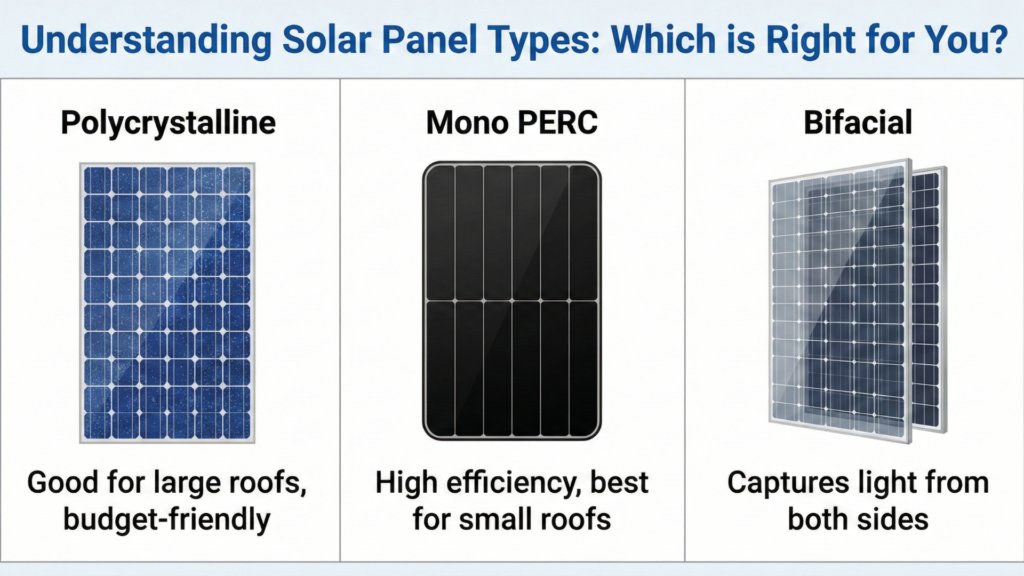
In the Indian market, three primary technologies dominate: Polycrystalline, Monocrystalline (Mono PERC), and the newer Bifacial panels.
Table 1: Comparison of Solar Panel Technologies
| Feature | Polycrystalline Panels | Mono PERC Panels | Bifacial Panels |
| Appearance | Blue, speckled look | Black, uniform look | Black, glass-on-glass |
| Efficiency | 16% – 17% | 19% – 22% | 22% – 27% |
| Space Required | High (Needs more roof area) | Low (Best for small roofs) | Low to Medium |
| Low Light Performance | Average | Excellent | Superior |
| Price Point | Budget-friendly | Moderate | Premium |
| Best For | Large rooftops, ample space | Urban homes, limited space | Reflective roofs, high ROI |
Pro Tip: If you live in an urban area with limited rooftop space (like a flat or a small terrace), Mono PERC panels are currently the best solar panels for home use in India because they generate more power per square foot.
Key Factors to Choose the Best Solar Panels for Home
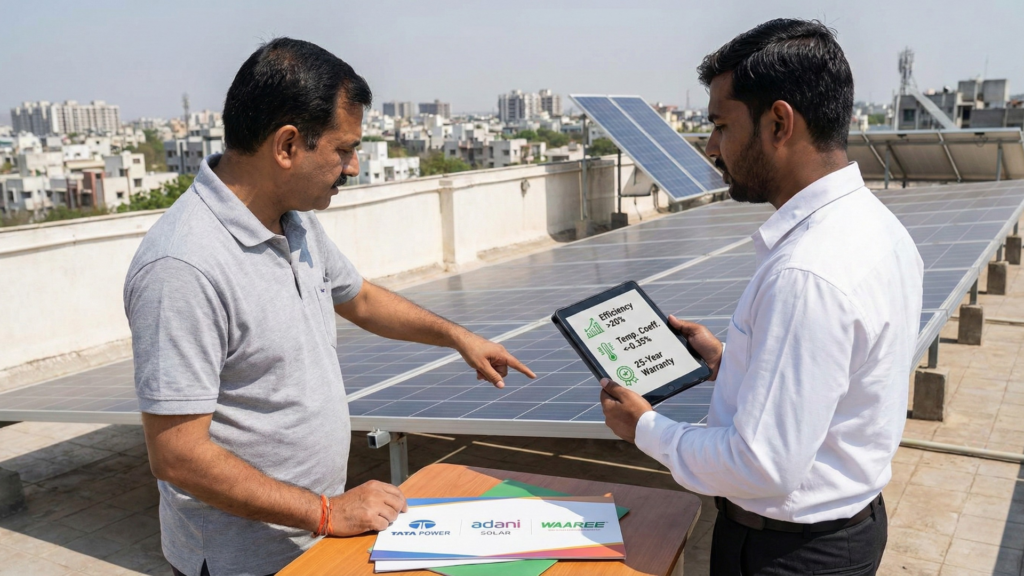
When you are scrolling through brochures from Tata Power, Adani, or Waaree, it is easy to get overwhelmed by technical jargon. Here is a simplified checklist of the critical factors you need to evaluate.
1. Solar Panel Efficiency
Efficiency measures how well a panel converts sunlight into electricity. In India’s dusty conditions, you want high-efficiency panels. Look for panels with >20% efficiency. Higher efficiency means you need fewer panels to generate the same amount of electricity, which is crucial if your roof is small.
2. Temperature Coefficient
India is a hot country. Ironically, solar panels hate extreme heat; their performance drops as the temperature rises. The “Temperature Coefficient” tells you how much efficiency is lost for every degree rise in temperature.
- Good rating: -0.35%/°C or lower.
- Why it matters: A lower number means the panel will perform better during a scorching Indian summer in May or June.
3. Warranty and Durability
The best solar panels for home come with two types of warranties:
- Product Warranty: Covers manufacturing defects (typically 10-12 years).
- Performance Warranty: Guarantees the panel will produce at least 80-90% of its original power after 25 years.
- Checklist Item: Ensure the brand offers a 25-year performance warranty.
4. Brand Reputation and Service
In India, service availability is as important as the product itself. Top Indian brands like Tata Power Solar, Adani Solar, Waaree Energies, and Loom Solar have extensive service networks. Avoid unbranded or “imported” panels without a local service center, as claiming warranties can become a nightmare.
Top Solar Brands and Price Estimates in India (2025)
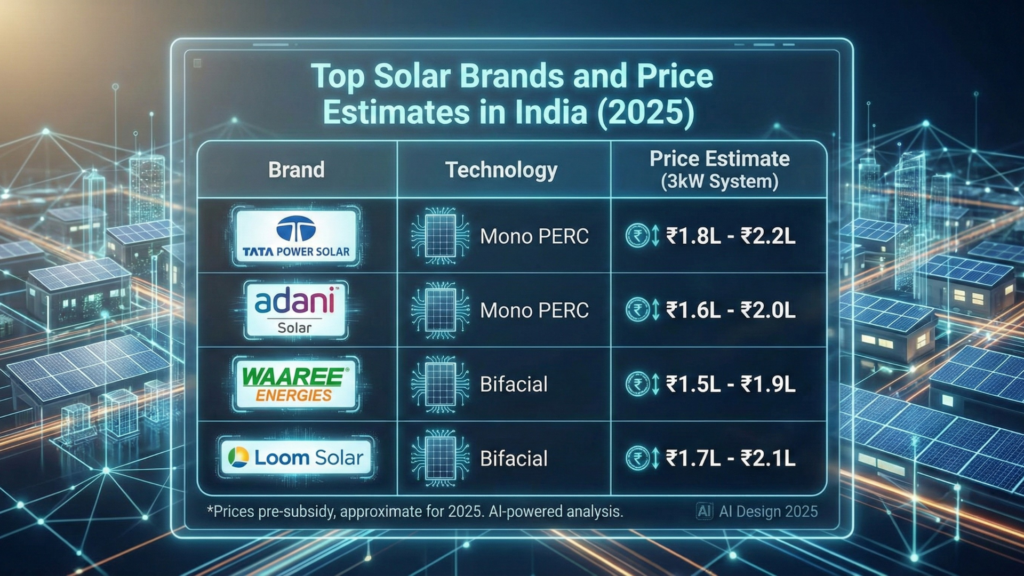
Pricing is often the deciding factor. While you want the best solar panels for home, you also need a system that fits your budget and offers a good Return on Investment (ROI).
Below is an estimated price breakdown for a standard 3kW Solar System, which is the most common size for an Indian household (running fans, lights, a fridge, and one AC).
Table 2: Estimated Cost of 3kW Solar System in India
| Component / Brand | Estimated Price (Pre-Subsidy) | Remarks |
| Tata Power Solar | ₹1,80,000 – ₹2,20,000 | Premium service, high trust factor. |
| Adani Solar | ₹1,60,000 – ₹2,00,000 | Excellent high-efficiency Mono PERC modules. |
| Waaree Energies | ₹1,50,000 – ₹1,90,000 | Great value for money, wide availability. |
| Loom Solar | ₹1,70,000 – ₹2,10,000 | Known for latest tech (Bifacial/Shark series). |
| Local/Assembled | ₹1,20,000 – ₹1,40,000 | Not Recommended (Poor warranty support). |
Note: Prices vary by state and do not include the government subsidy.
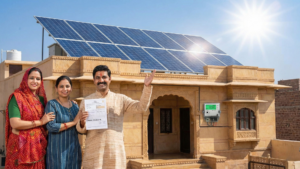
Subsidies for the Best Solar Panels for Home: PM Surya Ghar Yojana
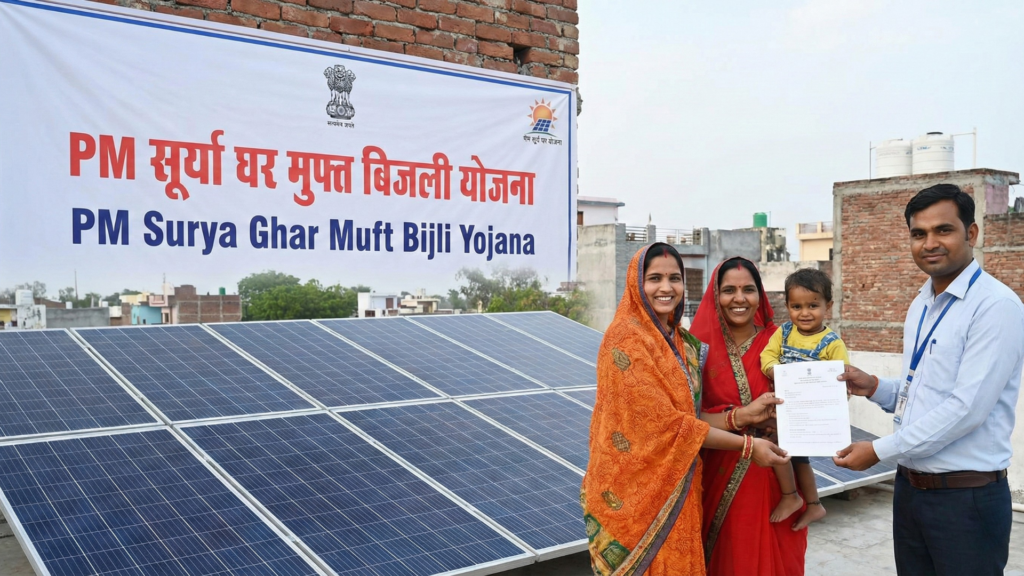
You cannot discuss the best solar panels for home in India without mentioning the massive government support available right now. The PM Surya Ghar Muft Bijli Yojana has revolutionized residential solar adoption.
Subsidy Structure (Updated 2025)
- Up to 2kW: Subsidy of ₹30,000 per kW.
- Additional capacity (up to 3kW): ₹18,000 per kW.
- Maximum Subsidy: For a system of 3kW or larger, the total subsidy is capped at ₹78,000.
Example Calculation:
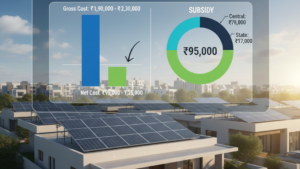
If you install a 3kW system costing ₹1,80,000:
- Total Cost: ₹1,80,000
- Govt Subsidy: (-) ₹78,000
- Net Cost to You: ₹1,02,000
This drastically reduces your break-even period (ROI) to just 3-4 years.
Installing the Best Solar Panels for Home: Critical Factors
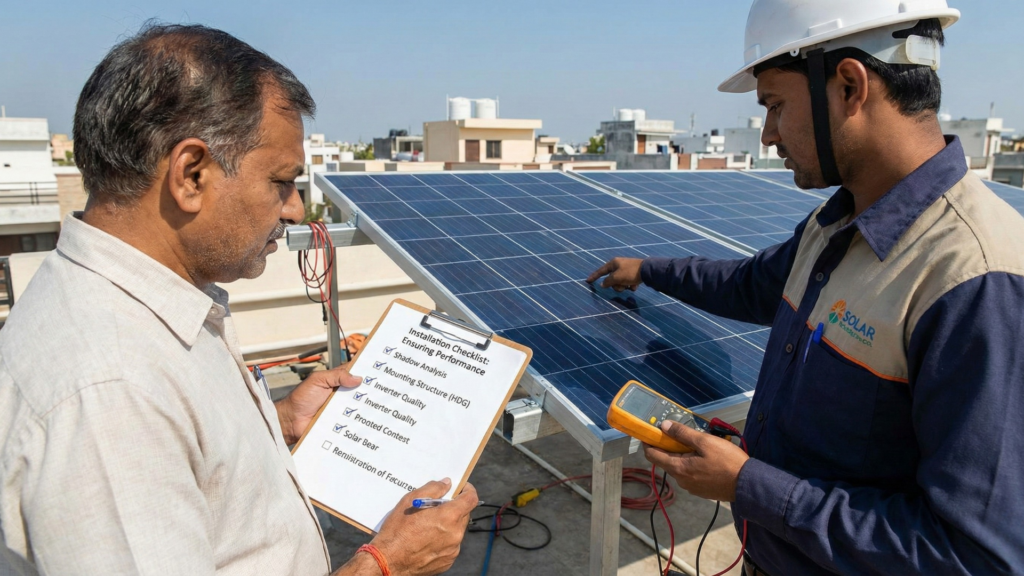
Even the best solar panels for home will fail if installed incorrectly. Use this checklist when speaking to your installer:
- Shadow Analysis: Ensure the installer checks your roof for shadows from nearby trees, water tanks, or tall buildings between 9 AM and 4 PM.
- Mounting Structure: Ask for Hot Dip Galvanized (HDG) structures. These are rust-proof and can withstand heavy monsoons and high winds. Avoid standard iron structures which rust quickly.
- Inverter Quality: The solar inverter is the brain of the system. Brands like Growatt, GoodWe, or Microtek are standard. Ensure the inverter capacity matches or slightly exceeds your panel capacity.
- Earthing and Lightning Protection: This is non-negotiable. Ensure the installer provides a proper Lightning Arrester (LA) and separate earthing pits for the AC and DC sides to protect your expensive equipment during storms.
Conclusion: Choosing the Best Solar Panels for Home
Selecting the best solar panels for home is a balance between technology, budget, and brand trust. For most Indian households in 2025, Mono PERC panels from a Tier-1 brand like Tata or Adani offer the perfect sweet spot of efficiency and affordability.
When you combine these high-efficiency panels with the PM Surya Ghar subsidy, solar becomes not just an environmental choice, but a financially smart one. You are essentially pre-paying for your electricity at a fraction of the cost for the next 25 years.
Ready to switch? Start by checking your last 3 months’ electricity bills to determine your average unit consumption, then consult a local certified vendor to get a shadow analysis of your roof.
Frequently Asked Questions (FAQ)
1. Which type of solar panel is best for home use in India?
For most Indian homes, Mono PERC panels are the best choice. They work efficiently in low light and high temperatures and require less roof space compared to older Polycrystalline panels.
2. What is the cost of the best solar panels for a 3kW home system?
A 3kW system typically costs between ₹1.6 Lakh to ₹2.2 Lakh before subsidy. After the central government subsidy (approx. ₹78,000), the cost can drop to around ₹1 Lakh.
3. How much roof space do I need for solar panels?
You generally need about 100 square feet (roughly 10 sq. meters) per 1kW of solar capacity. So, for a standard 3kW home system, you need roughly 300 sq. ft. of shadow-free area.
4. Do solar panels work during power cuts?
Standard On-Grid solar systems do not work during power cuts for safety reasons (to prevent electrocuting line workers). If you need power during outages, you must opt for a Hybrid System which includes batteries, but this costs significantly more.
5. How long do solar panels last?
The best solar panels for home are built to last 25 to 30 years. Most Tier-1 brands provide a performance warranty guaranteeing 25 years of output.