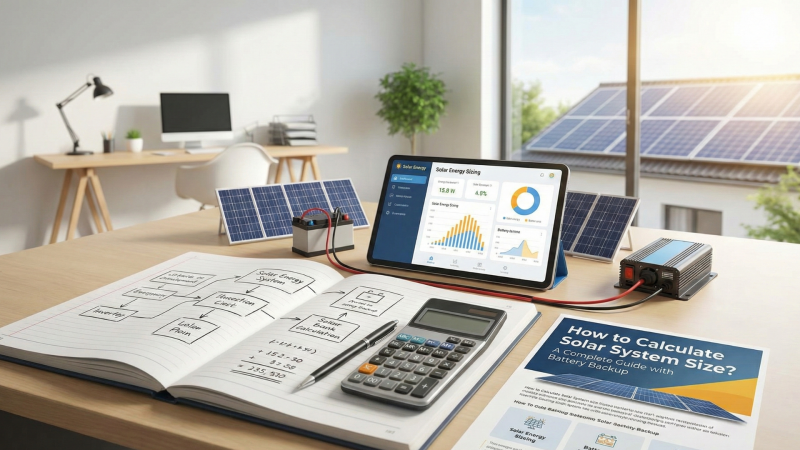
Switching to solar energy is one of the smartest financial and environmental decisions a homeowner can make. However, the most common hurdle isn’t the installation itself—it is the calculation behind it. Many people ask, “How to calculate solar system size?” without realizing that a wrong calculation can lead to wasted money or unexpected power outages.Whether you are looking to go completely off-grid or simply want a reliable hybrid system to combat load shedding, understanding the sizing of your panels and battery backup is crucial. This guide will walk you through the step-by-step process of designing a solar power system tailored to your specific energy needs.
Why Is It Important to Know How to Calculate Solar System Size?
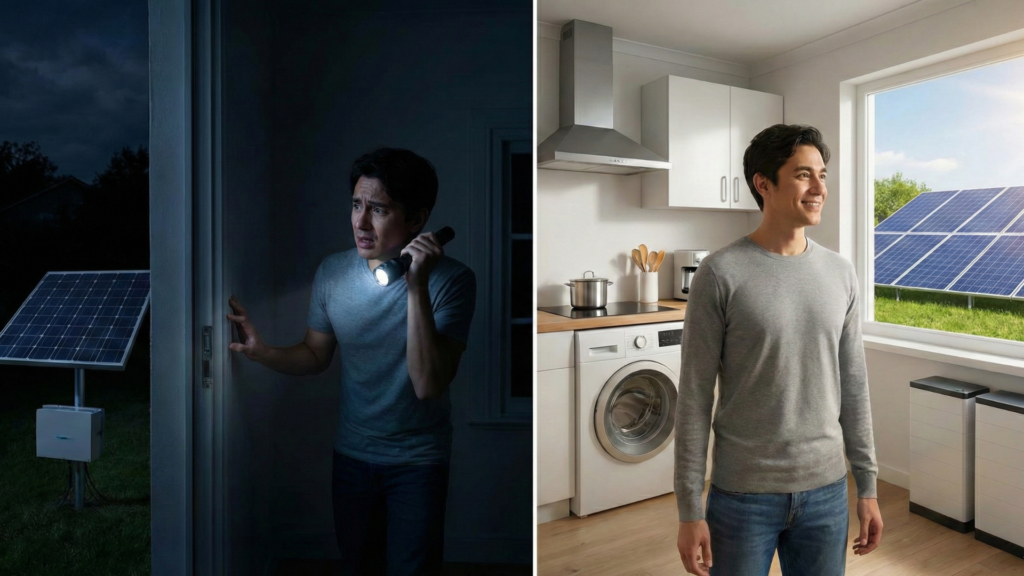
Before diving into the numbers, it is essential to understand why precision matters. If you overestimate your system size, you will spend thousands of dollars on batteries and panels you don’t need. Conversely, if you underestimate it, your system will shut down during the night or on cloudy days, leaving you in the dark.
Learning how to calculate solar system size empowers you to:
- Maximize ROI: Get the best return on investment by purchasing only what you need.
- Ensure Energy Security: Guarantee that your battery backup lasts through the night.
- Protect Your Equipment: Correct sizing prevents inverters and batteries from overloading.
Step 1: Determine Your Daily Energy Consumption
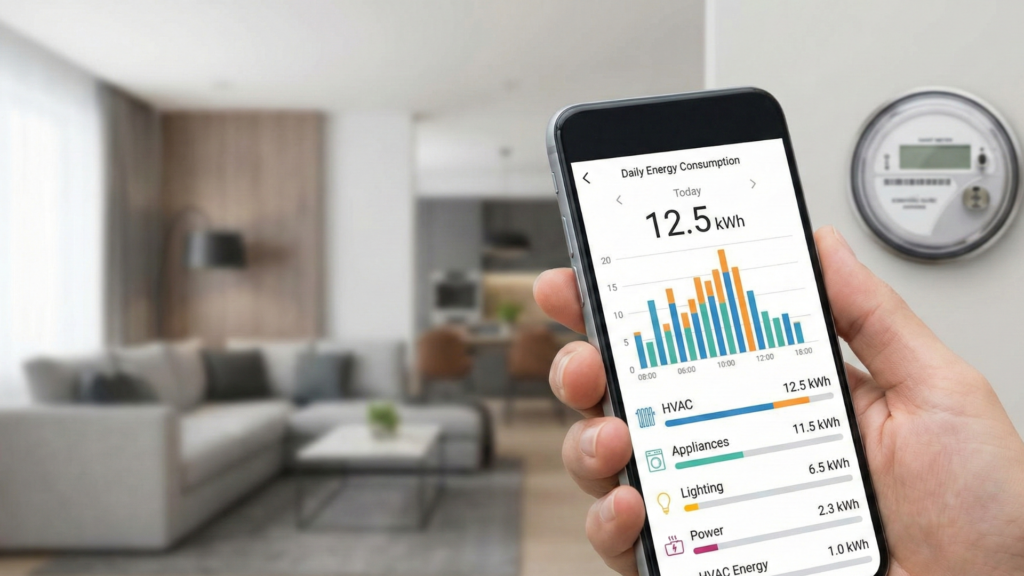
The first step in answering “how to calculate solar system size?” is auditing your energy usage. You cannot size a system if you don’t know how much power you consume.
You can find this information on your monthly electricity bill (look for “Average Daily kWh”), but for a more accurate system design, it is better to calculate the load of specific appliances you intend to run.
The Simple Formula for Energy Consumption
To find the daily energy consumption in Watt-hours (Wh), use this simple logic:
Daily Energy (Wh) = Wattage of Appliance x Hours Used Per Day
Table 1: Typical Home Load Calculation
Below is a sample calculation for a standard medium-sized home looking to run essential loads during a power outage.
| Appliance | Quantity | Power Rating (Watts) | Daily Usage (Hours) | Total Daily Energy (Wh) |
| LED Bulbs | 10 | 10W | 6 | 600Wh |
| Ceiling Fans | 4 | 75W | 10 | 3,000Wh |
| Refrigerator (Inverter) | 1 | 200W | 24 (Cycles ~8h) | 1,600Wh |
| LED TV (50 inch) | 1 | 100W | 4 | 400Wh |
| Laptop/Wi-Fi Router | 2 | 50W | 8 | 800Wh |
| Water Pump (1HP) | 1 | 750W | 0.5 | 375Wh |
| TOTAL | 6,775Wh (6.8 kWh) |
Note: In this example, the household needs approximately 6.8 kWh of energy per day.
Step 2: Determine Your Location’s Peak Sun Hours
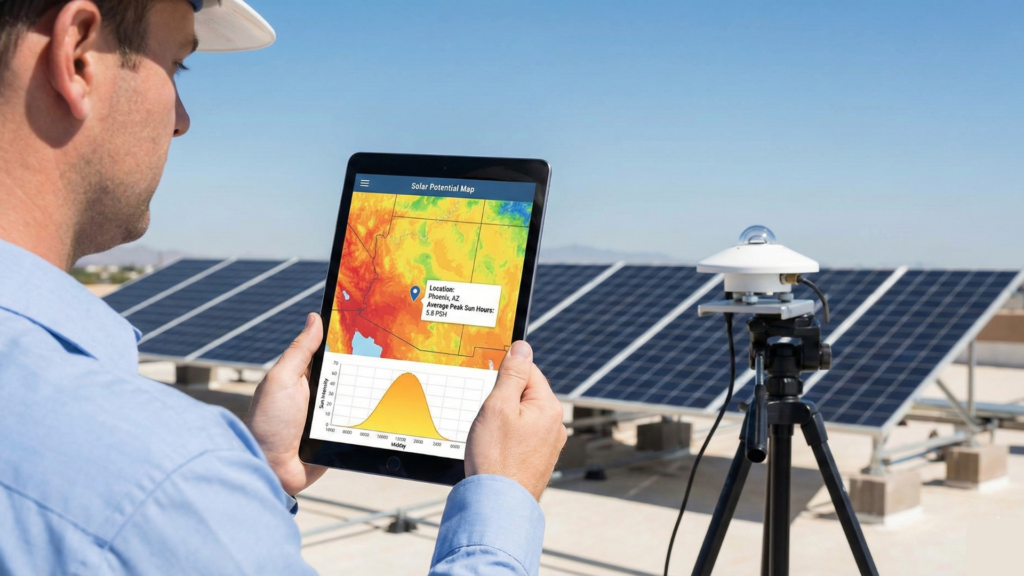
One of the biggest misconceptions when learning how to calculate solar system size is confusing “daylight hours” with “Peak Sun Hours.”
- Daylight Hours: The total time the sun is in the sky (e.g., 7 AM to 6 PM).
- Peak Sun Hours: The equivalent number of hours where the sun provides 1,000 watts of power per square meter.
For example, in a sunny location like Jaipur or California, you might get 5 to 6 Peak Sun Hours. In cloudy regions like London or Seattle, you might only get 3 to 4.
General Rule of Thumb:
- Excellent Sun: 5.5 – 6 hours
- Average Sun: 4 – 5 hours
- Poor Sun: 3 – 3.5 hours
For our calculation, we will assume an average of 5 Peak Sun Hours.
Step 3: How to Calculate Solar System Size (Panel Array)

Now that we have the daily usage (6,775Wh) and the sun hours (5 hours), we can calculate the solar panel capacity.
However, solar panels are not 100% efficient. We must account for System Losses caused by dust, wiring resistance, inverter efficiency (usually 90-95%), and heat. We typically add a 30% safety margin (or divide by an efficiency factor of 1.3) to account for these losses.
The Calculation Logic for Solar Panels
To find the panel size, take your Daily Energy Usage, divide it by Peak Sun Hours, and then multiply by 1.3 for safety.
Required Panel Output = (Daily Energy Usage / Peak Sun Hours) x 1.3
Applying our numbers:
- Daily Usage: 6,775Wh
- Divide by Sun Hours: 6,775 / 5 = 1,355 Watts
- Add 30% Margin: 1,355 x 1.3 = 1,761 Watts
Result: You need a solar array of approximately 1,800 Watts (1.8 kW).
If you are using 550W Mono-PERC panels, the math is simply:
1800 divided by 550 equals 3.27.
You would round up to 4 Panels.
Step 4: How to Calculate Solar System Size for Battery Backup

This is the most critical part for off-grid or hybrid systems. Solar panels only produce power during the day. If you want to run that refrigerator or fan at night, you need batteries.
When calculating battery size, you must consider two major factors:
- Days of Autonomy: How many days do you want power if it is cloudy and the panels produce zero energy? (Usually 1 or 2 days).
- Depth of Discharge (DoD): You cannot drain a battery to 0%.
- Lead Acid / Tubular Battery: 50% DoD (You can only use half the capacity).
- Lithium-Ion / LiFePO4: 80-90% DoD (You can use most of the capacity).
Battery Sizing Logic: Autonomy and DoD
Battery Capacity = (Total Daily Load x Days of Autonomy) / Depth of Discharge
Table 2: Battery Technology Comparison & Sizing
Using our 6,775Wh daily load example with 1 Day of Autonomy.
| Feature | Lead-Acid / Tubular | Lithium-Ion (LiFePO4) |
| Depth of Discharge (DoD) | 50% (0.5) | 80% (0.8) |
| Calculation | 6,775 / 0.5 | 6,775 / 0.8 |
| Required Capacity (Wh) | 13,550 Wh | 8,468 Wh |
| System Voltage | 48V System | 48V System |
| Amp-Hours (Ah) Needed | 13,550 / 48V = 282 Ah | 8,468 / 48V = 176 Ah |
| Battery Lifespan | 3-5 Years | 10-15 Years |
| Maintenance | High (Water topping) | Zero Maintenance |
Recommendation: While Lead-Acid looks cheaper initially, you need double the capacity to get the same usable energy. For a modern system, a 200Ah 48V Lithium Battery bank is the superior choice for this load.
Step 5: Sizing the Inverter
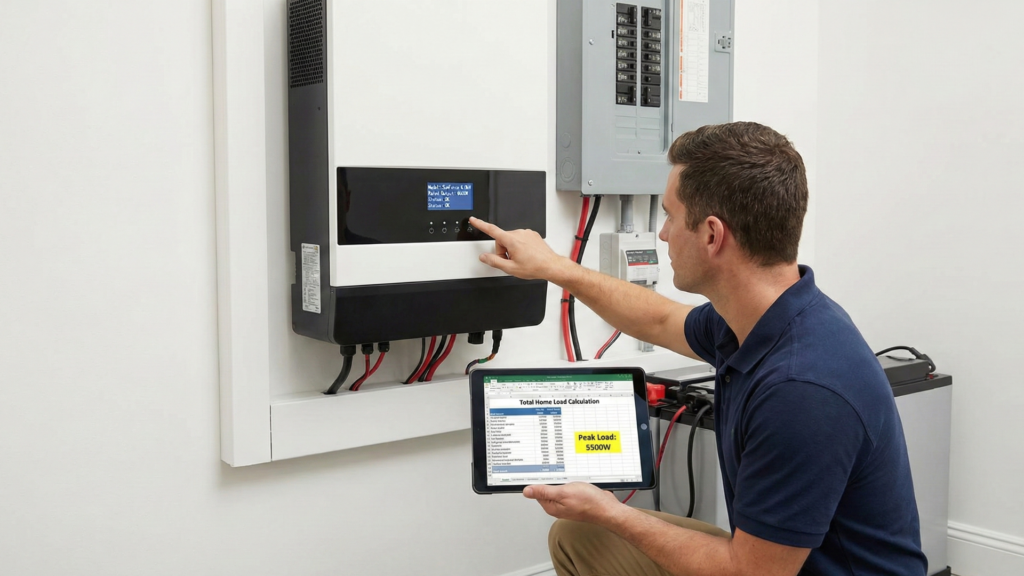
When learning how to calculate solar system size, many users forget the inverter. The inverter converts DC power (panels/battery) to AC power (appliances).
To size the inverter, you do not look at daily usage; you look at Peak Load (how many watts you pull at the exact same moment).
- Continuous Load: Sum of all appliances running simultaneously (e.g., Lights + Fan + TV + Fridge = 800W).
- Surge Load: Appliances with motors (pumps, fridges, ACs) require 3x their rated power to start.
Calculation:
If your total running load is 1000W, and you have a fridge and pump, your surge requirement might be 2500W.
A 3kVA (3000 Watt) Inverter would be the safe choice to handle startup spikes.
Factors That Can Affect Your Solar System Size Calculation
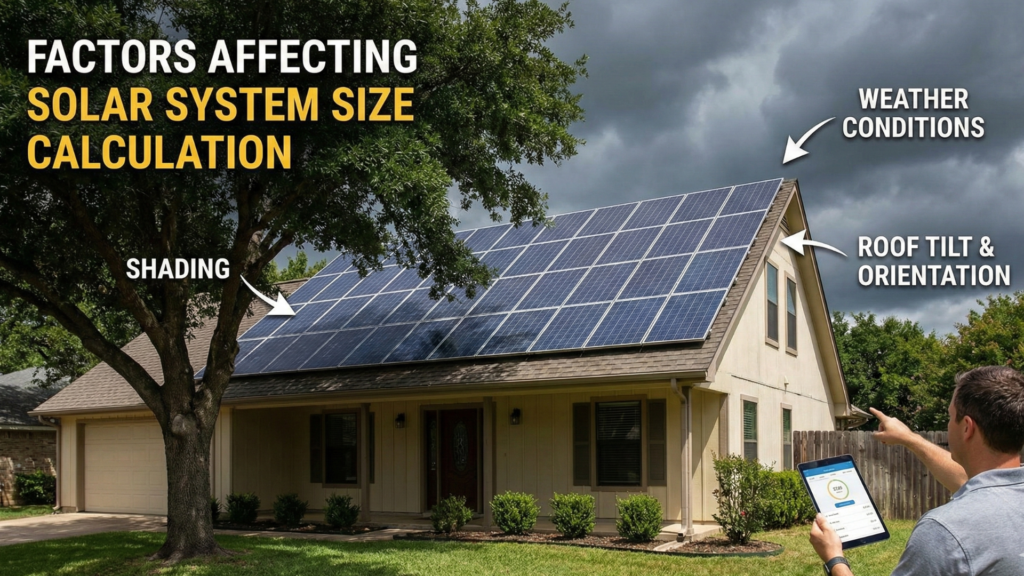
Even if you know how to calculate solar system size perfectly using formulas, real-world conditions can affect performance.
1. Panel Orientation and Tilt
In the Northern Hemisphere (India, USA, Europe), panels should face South. If your roof faces East or West, you lose efficiency, meaning you will need to increase your system size by 10-20% to compensate.
2. Shading
Even small shadows from a chimney or tree can drop solar output significantly. If you have shading issues, consider using Half-Cut Cell panels or Micro-inverters, which handle shade better than standard string inverters.
3. Temperature Coefficient
Solar panels actually hate heat. As the temperature rises above 25°C, efficiency drops. If you live in a region with 45°C summers, calculate an extra 5-10% capacity into your panel array.
Common Mistakes When Learning How to Calculate Solar System Size
- Ignoring Phantom Loads: Devices left in “standby” mode (TVs, microwaves) still consume power. This can add up to 10% of your bill.
- Confusing kW and kWh: kW is the rate of power (horsepower), kWh is the volume of energy (gas in the tank). You size panels in kW, but you size batteries based on kWh.
- Undersizing the Charge Controller: If your solar panels produce 50 Amps of current, but your controller is rated for 40 Amps, you are wasting energy and risking a fire.
Conclusion: Final Thoughts on How to Calculate Solar System Size
Understanding how to calculate solar system size is the bridge between a solar system that saves money and one that causes frustration.
To summarize our example for a medium home:
- Daily Load: ~6.8 kWh
- Solar Panels: 2kW (approx 4 panels of 550W)
- Battery: 200Ah / 48V Lithium-Ion (or 300Ah / 48V Tubular)
- Inverter: 3kVA Hybrid Inverter
By following the steps outlined in this guide—analyzing your load, determining peak sun hours, and calculating battery backup based on DoD—you can design a robust energy system. Always remember to round up your calculations to account for cloudy days and future appliance additions.
Frequently Asked Questions About How to Calculate Solar System Size
Q1. How do I calculate exactly how many solar panels I need?
A. To calculate the number of panels, divide your Daily Energy Usage (kWh) by the product of Peak Sun Hours and Panel Efficiency. For example: If you use 10kWh and have 5 Sun Hours, you need 2kW. If using 500W panels, you need 4 panels.
Q2. Can I run an Air Conditioner (AC) on solar?
A. Yes, but ACs consume a lot of power. To run a 1.5 Ton AC, you generally need a minimum of a 3kW to 5kW solar system and a heavy-duty battery bank if you plan to run it at night.
Q3. What is the difference between On-Grid and Off-Grid sizing?
A. How to calculate solar system size differs for both. Off-grid requires a large battery bank to store energy for the night. On-grid (Grid-tie) systems don’t strictly need batteries because the utility grid acts as your backup, allowing you to install a smaller, cheaper system.
Q4. How much battery backup do I need for a 5kW solar system?
A. It depends on your night consumption. If you use 50% of your energy at night (approx 10-12 units), you would need a 10kWh Lithium battery or a 20kWh Lead Acid battery bank.
Q5. Does the size of the house determine the solar system size?
A. No. A large house with two people might use less energy than a small house with a family of six. Always calculate based on electricity bill units (kWh), not the square footage of the home.