If you live in Rajasthan, you know the drill: as soon as March arrives, the ceiling fans speed up, the coolers are filled with water, and the air conditioners start humming. But along with the relief from the scorching desert heat comes the inevitable dread—the electricity bill. For millions of households in Jaipur, Jodhpur, Udaipur, and Kota, the monthly electricity bill is not just an expense; it is a financial shock. With JVVNL, AVVNL, and JdVVNL rates climbing year after year, families are constantly searching for “How to reduce electricity bill in India.”
You have probably tried the standard advice: switching to LED bulbs, running the AC at 24°C, and scolding kids for leaving lights on. But let’s be honest—these are small fixes for a big problem. The bill rarely drops by more than a few hundred rupees.
The Rising Cost of Electricity in Rajasthan
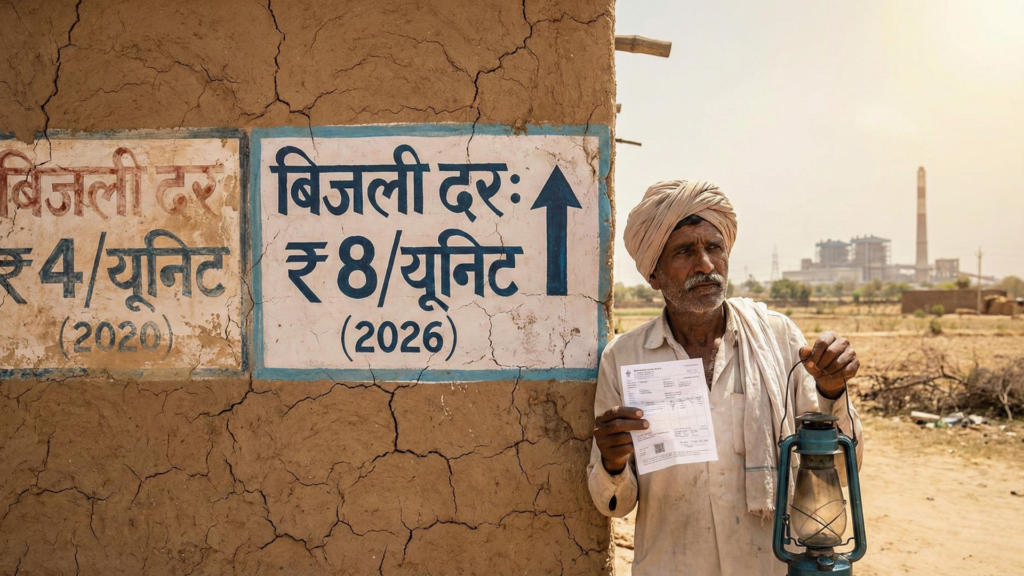
To understand why solar is urgent, you first need to understand what you are paying for. Rajasthan has some of the highest electricity tariffs in North India.
In 2026, a typical middle-class household in Rajasthan falls into the higher consumption slabs (above 300 or 500 units) during summer. The tariff for these slabs is approximately ₹7.65 to ₹7.95 per unit.
But that is not all. Your bill also includes:
- Fixed Charges: You pay this just for having a connection (₹400+ for domestic loads).
- Electricity Duty: A percentage tax on your consumption.
- Fuel Surcharge (FPPAS): An variable charge that often quietly increases your bill.
When you add it all up, a family using 2 ACs can easily see bills of ₹5,000 to ₹8,000 per month. That is ₹60,000 to ₹90,000 a year literally burnt up in wires.
Searching for “How to reduce electricity bill in India” without considering solar is like trying to empty a swimming pool with a spoon. You need a pump. Solar is that pump.
How to Reduce Electricity Bill in India: The Solar Solution
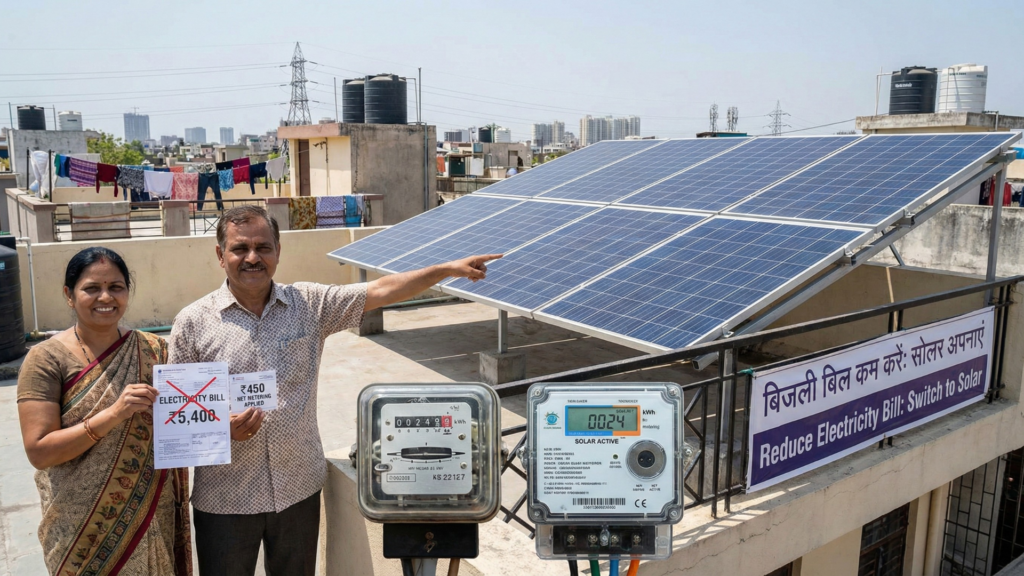
Solar energy is an offensive strategy against high bills. Instead of consuming less, you produce your own power.
The Science Simplified
Solar panels work on the “Photovoltaic Effect.” When sunlight hits the silicon cells in your solar panels, it knocks electrons loose, creating direct current (DC) electricity.
Since your home appliances (AC, Fridge, TV) run on Alternating Current (AC), a device called an Inverter converts this DC power into usable AC power.
Why Rajasthan is the Best Place for Solar
Rajasthan is the “Solar State” of India for a reason. We receive the highest solar radiation in the country—about 6-7 kWh per square meter per day.
- Sunny Days: Over 325 days of clear sun per year.
- High Yield: A 1kW system in Jaipur generates more units per year than the same system in Mumbai or Delhi.
This natural advantage means your Return on Investment (ROI) is faster here than anywhere else in India.
Net Metering Explained: How to Reduce Electricity Bill to Zero in India
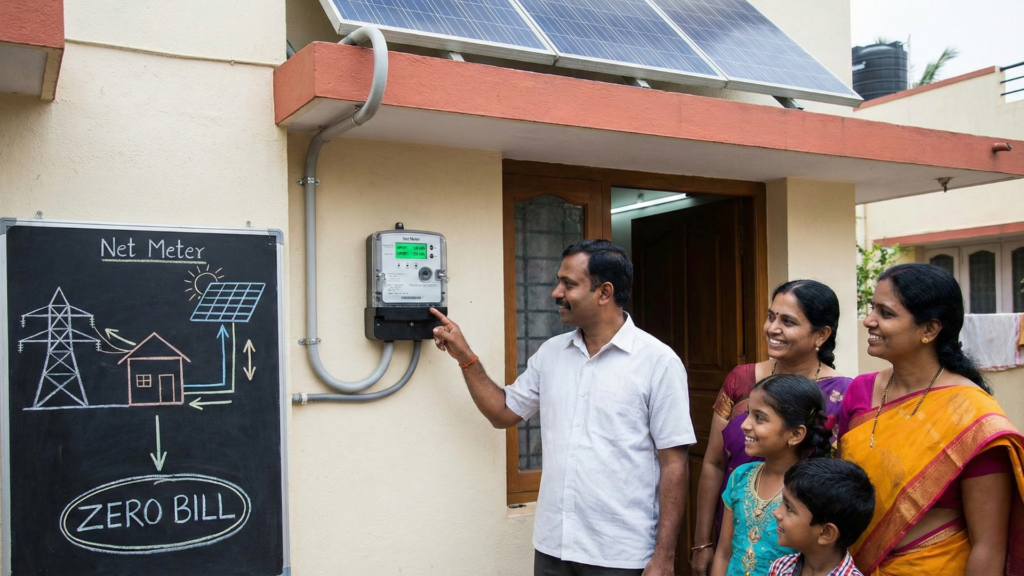
Many people ask, “What happens at night when the sun isn’t shining? Do I need expensive batteries?”
No. The secret to a zero bill without batteries is Net Metering.
When you install an On-Grid Solar System (the most common type for homes), the electricity department (JVVNL/AVVNL) replaces your old meter with a Bi-directional Meter (Net Meter). This meter records two things:
- Import: Electricity you take from the grid (mostly at night).
- Export: Electricity your solar panels send to the grid (mostly during the day when you are at work and consumption is low).
How the Bill Becomes Zero
Your monthly bill calculation changes to this formula:
Billable Units = (Units Imported from Grid) − (Units Exported to Grid)
Scenario:
- In May, your panels generate 400 units.
- Your home consumes 150 units during the day (directly from solar).
- You export the remaining 250 units to the grid.
- At night, you import 200 units from the grid for lights and AC.
Net Calculation:
- You “gave” the grid 250 units.
- You “took” back 200 units.
- Net Billable Units: -50 Units.
Result: Your energy charge is ZERO. The extra 50 units are “banked” in your account and can be used in cloudy months like July or August. If your system is sized correctly, you will never pay for energy charges again. You only pay the small fixed monthly charges.
Financial Breakdown: Solar vs. Non-Solar Bill
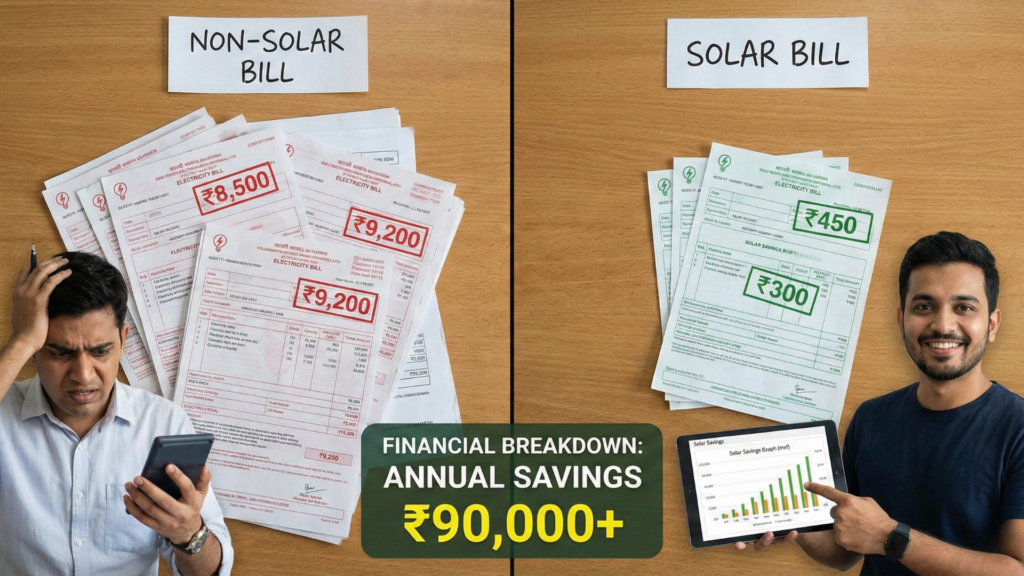
Let’s look at the hard numbers. We will compare a typical Jaipur household with a 3kW connected load consuming an average of 450 units per month.
Table 1: Monthly Electricity Bill Comparison (Rajasthan Rates 2026)
| Bill Component | Without Solar System | With 3kW On-Grid Solar System |
| Average Monthly Units | 450 Units | 450 Units |
| Solar Generation (Avg) | 0 Units | ~360 – 400 Units |
| Net Billable Units | 450 Units | 50 – 90 Units |
| Tariff Slab Applied | Top Slab (₹7.65+) | Bottom Slab (₹4.75) |
| Energy Charges | ₹3,440 | ₹237 – ₹420 |
| Fixed Charges & Duty | ₹450 | ₹450 |
| Total Estimated Bill | ₹3,890 – ₹4,000 | ₹600 – ₹800 |
| Monthly Savings | ₹0 | ₹3,200+ |
| Annual Savings | ₹0 | ₹38,000 – ₹40,000 |
Note: With a slightly larger system (e.g., 4kW), you can cover those remaining 50-90 units and bring the energy charge strictly to zero.
Is Solar Affordable? The ROI & Subsidy Calculation
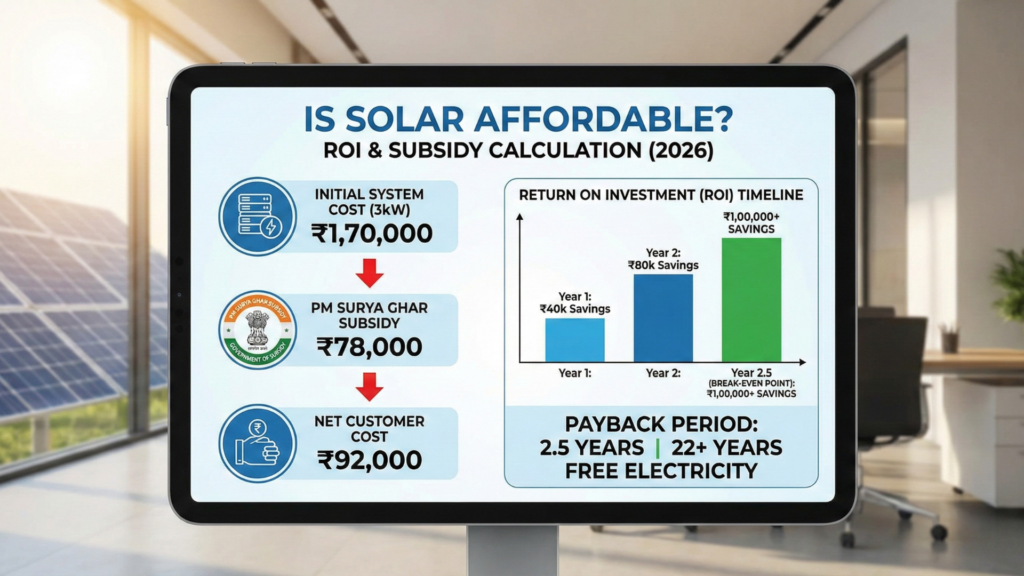
In 2026, the PM Surya Ghar: Muft Bijli Yojana is in full swing, making solar cheaper than ever.
The central government provides a direct subsidy to your bank account, and the Rajasthan government often adds a top-up for specific categories.
Table 2: 3kW Solar System Investment & Payback Analysis
| Component | Estimated Cost |
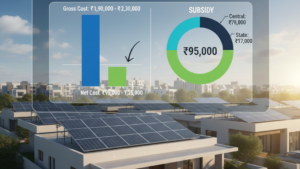
| Total System Cost (3kW) | ₹1,60,000 – ₹1,80,000 |
| PM Surya Ghar Subsidy | – ₹78,000 |
| Net Cost to Customer | ₹82,000 – ₹1,02,000 |
| Annual Electricity Savings | ₹40,000 (approx) |
| Payback Period | 2 to 2.5 Years |
| Warranty Period | 25 Years (Panels) |
| Free Electricity Life | 22+ Years |
Think about it: You break even in just 2.5 years. Ideally, a solar system is an asset that generates tax-free income (savings) for decades. If you put that ₹1 Lakh in a Fixed Deposit, you would earn ₹7,000 a year. In Solar, you “earn” ₹40,000 a year in savings. That is a 40% annual return on your investment!
Types of Solar Systems to Reduce Electricity Bill in India
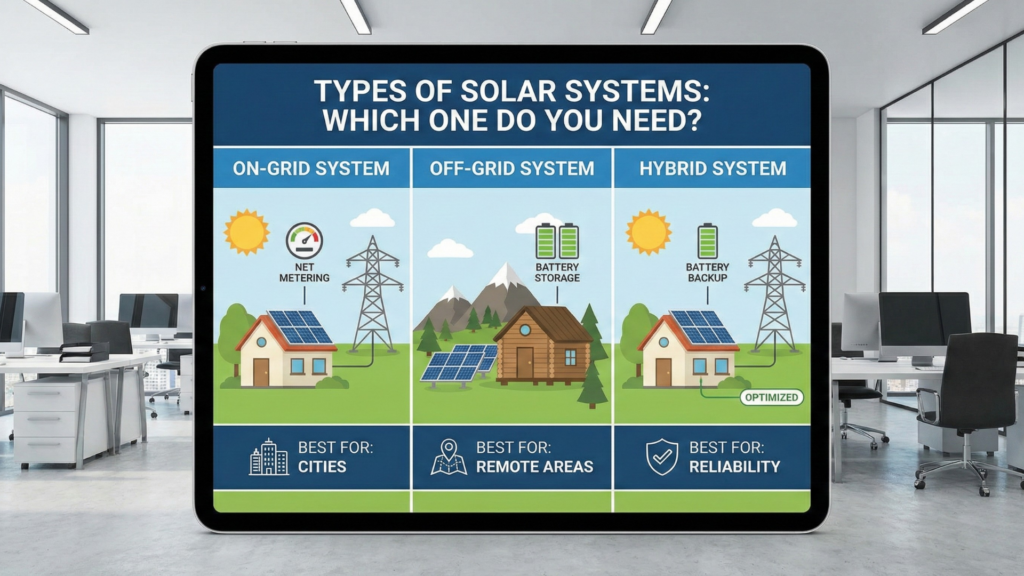
When researching “How to reduce electricity bill in India,” you will encounter three main types of systems. Choosing the right one is crucial for Rajasthan.
1. On-Grid System (Grid-Tied)
- Best For: Cities like Jaipur, Kota, Jodhpur with rare power cuts.
- How it works: Connected to the JVVNL grid. Uses Net Metering.
- Pros: Cheapest, highest subsidy, lowest maintenance.
- Cons: It shuts down during a power cut. (Safety requirement for line workers).
- Verdict: 90% of homes should choose this.
2. Off-Grid System
- Best For: Remote farmhouses (Dhanis) in rural Rajasthan with no grid access.
- How it works: Uses batteries to store power.
- Pros: Works 24/7, total independence.
- Cons: Expensive (batteries cost a lot), batteries need replacement every 5-6 years, NO SUBSIDY.
3. Hybrid System
- Best For: Areas with frequent power cuts but grid access.
- How it works: Connected to grid + has small battery backup.
- Pros: Best of both worlds. Keeps lights on during cuts and reduces bill.
- Cons: Expensive upfront cost.
Step-by-Step Guide to Going Solar in Rajasthan
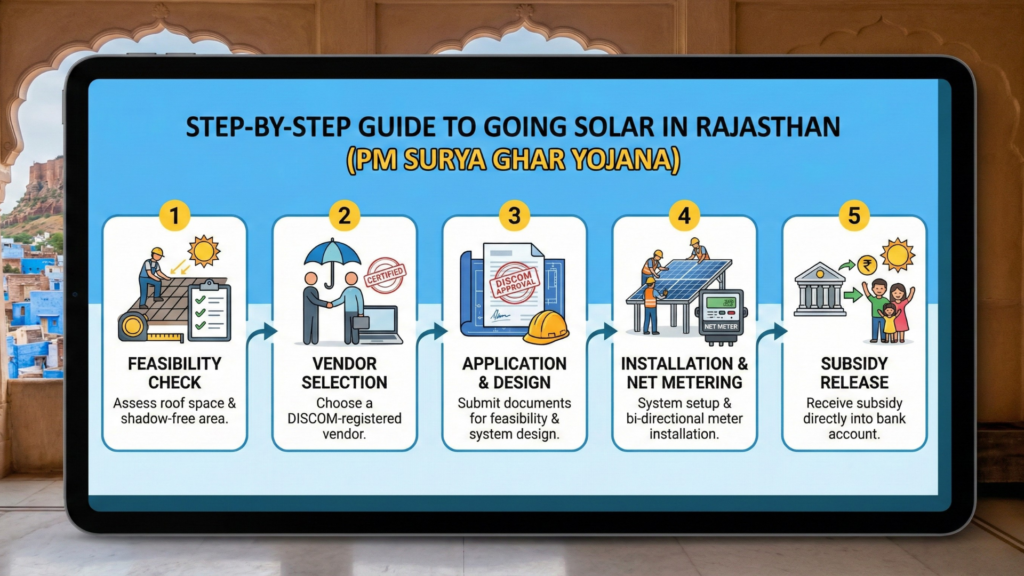
Ready to switch? Here is the roadmap for a hassle-free installation in 2026.
Step 1: Feasibility Check
Do you have roof space? You generally need roughly 100 sq. ft. of shadow-free area per 1kW. For a 3kW system, you need ~300 sq. ft. Ensure no water tanks or neighbor’s buildings cast a shadow between 9 AM and 4 PM.
Step 2: Vendor Selection
Don’t just Google “Solar Installers.” Go to the National Portal for Rooftop Solar and select a vendor registered with your local DISCOM (JVVNL/AVVNL). This is mandatory for the subsidy.
Step 3: Application & Design
Your vendor will apply to the DISCOM for a “Technical Feasibility Report.” Once approved, they will design the structure. In Rajasthan, always ask for Galvanized Iron (GI) elevated structures so you can still use your roof for drying clothes or papads!
Step 4: Installation & Net Metering
The physical installation takes 1-2 days. The vendor will then request the Net Meter. DISCOM officials will visit, test the system, and install the new meter.
Step 5: Subsidy Release
Once the “Commissioning Certificate” is generated, the subsidy comes directly into your bank account within 30-45 days.
Solar Panel Maintenance Tips to Reduce Electricity Bill in India
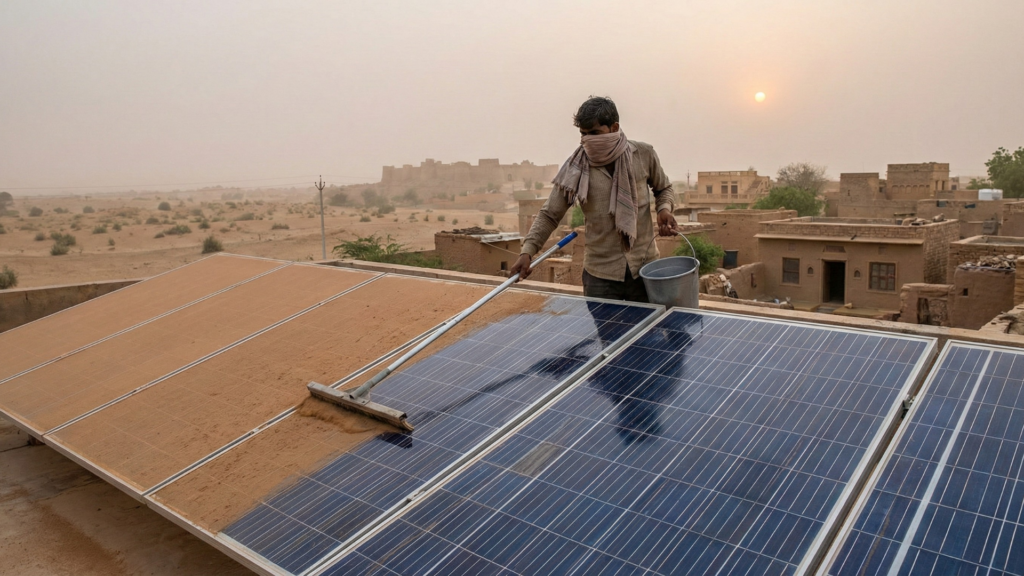
Living in a desert state poses one specific challenge: Dust.
Layer of dust on your panels can reduce generation by 15% to 25%.
If you are serious about how to reduce electricity bill in India using solar, you must keep them clean.
- Cleaning Frequency: In Rajasthan, clean your panels every 15 days (or weekly during dust storms/Andhi).
- Method: Use a simple wiper and water. Do NOT use detergent or abrasive scrubs; they damage the anti-reflective coating.
- Time: Clean early in the morning (before 8 AM). Never throw cold water on hot panels in the afternoon—the glass can crack due to thermal shock!
5 Other Practical Ways to Reduce Electricity Bill
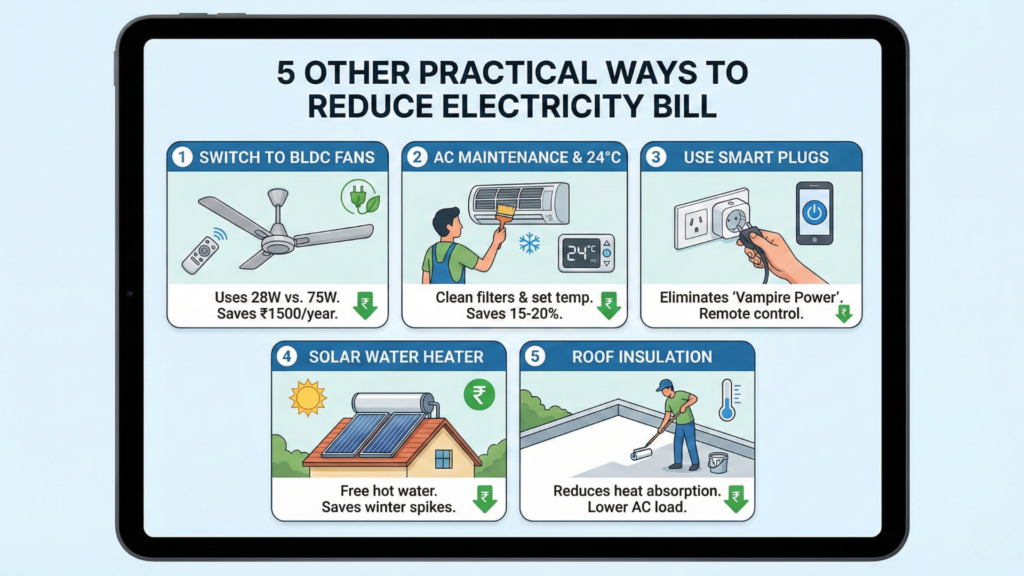
While waiting for your solar installation, you can start saving today with these appliance upgrades.
1. The BLDC Fan Revolution
Old ceiling fans consume 75-80 Watts. New BLDC (Brushless DC) fans consume only 28 Watts.
- Math: If you run 3 fans for 10 hours a day, switching to BLDC saves roughly ₹1,500 to ₹2,000 per year. They pay for themselves in 2 years.
2. AC Service & Temperature Setting
A choked AC filter makes the compressor work harder. Service it before the summer peak. Also, set the temperature to 24°C instead of 18°C. Every degree lower increases consumption by 6%. 24°C is healthy and efficient.
3. Smart Plugs for “Vampire Power”
Set-top boxes, microwaves, and stabilizers consume power even when “off” (standby mode). Use smart plugs or simply switch them off from the main socket.
4. Switch to Solar Water Heaters
If you use electric geysers in winter, your bill spikes. A solar water heater (thermal, not PV) is a separate system that heats water directly from the sun. It’s mandatory for large plots in Jaipur for a reason—it works perfectly.
5. Proper Insulation
In Rajasthan, heat enters through the roof. Painting your roof with Solar Reflective Paint (white cool roof paint) can drop top-floor temperatures by 3-5°C, reducing the load on your AC significantly.
Conclusion: The Future is Free Energy
So, can solar panels really reduce your electricity bill to zero? Absolutely.
For residents of Rajasthan, the combination of high solar radiation, the PM Surya Ghar subsidy, and expensive grid electricity makes solar the most logical investment in 2026. It is no longer a luxury; it is a necessity for financial planning.
You stop worrying about “how to reduce electricity bill in India” and start worrying about how to spend your savings!
Your Next Step:
Don’t wait for the next heatwave. Take out your last 12 electricity bills, calculate your average monthly units, and call a certified solar vendor today. The sun is shining—make it pay your bills.
FAQs: How to Reduce Electricity Bill in India Using Solar Panels
Q1: What is the price of a 1kW solar panel system in Rajasthan with subsidy?
A: After the PM Surya Ghar subsidy (approx ₹30,000 for 1kW), a 1kW On-Grid system in Rajasthan effectively costs between ₹25,000 to ₹35,000 depending on the brand (Tata, Adani, Waaree, etc.).
Q2: Can I run my 1.5 Ton AC on a 3kW solar system?
A: Yes! A 1.5 Ton AC consumes about 1.5 kW to 1.8 kW. A 3kW solar system generates enough power during peak sun hours to run the AC and still export excess power to the grid.
Q3: Does the solar panel work during the rainy season or winter in Rajasthan?
A: Rainy Season: Generation drops by 15-25% due to clouds, but it does not stop. Modern panels work on daylight, not just direct heat.
Winter: Solar panels actually work better in cooler temperatures! The clear winter sun in Rajasthan generates excellent power, though the daylight hours are slightly shorter.
Q4: What if I live in an apartment in Jaipur? Can I get solar?
A: Under the new 2025-26 regulations, check for “Virtual Net Metering”. This allows apartment owners to buy a share in a community solar plant and get credits on their bill, even if they don’t have a roof. Check with JVVNL for the latest rollout status of this scheme.
Q5: What is the lifespan of a solar panel system?
A: Tier-1 solar panels come with a Performance Warranty of 25 years. Even after 25 years, they continue to produce electricity at about 80% efficiency. Inverters typically have a warranty of 5-10 years and may need one replacement during the system’s life.
Q6: Is a loan available for solar installation?
A: Yes, all major banks (SBI, Canara, PNB) offer “Solar Loans” at low interest rates (often related to home loan rates). Some schemes even offer zero-processing fees for PM Surya Ghar applicants.