Are you tired of rising electricity bills? Dreaming of a cabin deep in the woods or a mobile home adventure without being tied to the utility company? The world of solar power offers a compelling solution, and if true energy independence is your goal, you need an Off-Grid Solar System.
This comprehensive guide is designed specifically for beginners. We will break down the components, estimated costs, and simple steps required to design and install your very own Off-Grid Solar System, giving you the knowledge you need to harness the sun’s power, no matter where you are in India.
What is an Off-Grid Solar System? Understanding the Basics
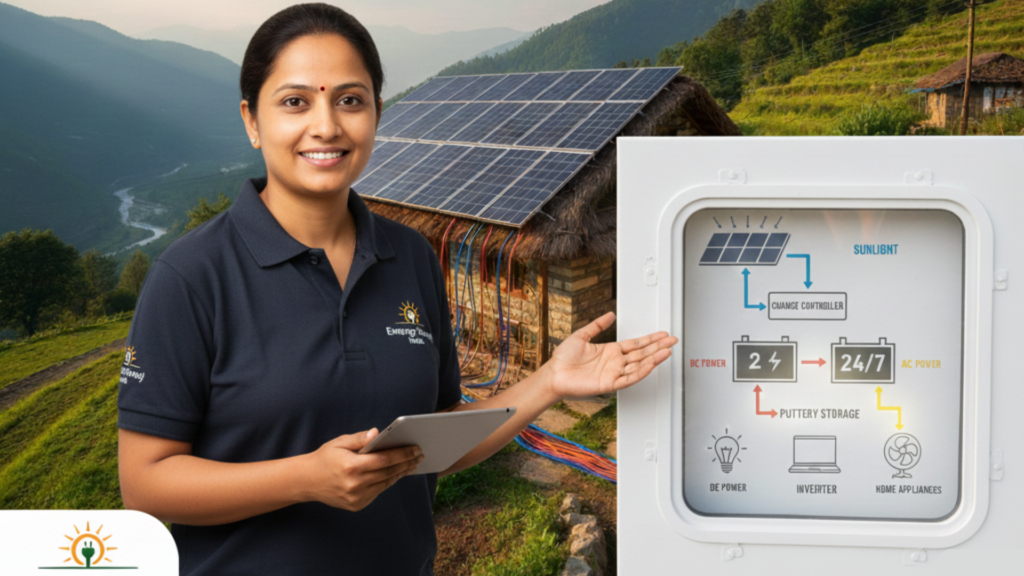
An Off-Grid Solar System (also known as a standalone power system or remote area power supply) is a complete electrical system that operates independently of the public electricity grid. Unlike grid-tied solar, which uses the utility company’s lines for backup and to send excess power, an off-grid system must generate and store all the electricity required by the home or property.
The allure of going off-grid is simple: total energy autonomy. This is the ideal solution for remote homes, farmsteads, boats, tiny homes, or anyone who wants a backup system immune to power outages.
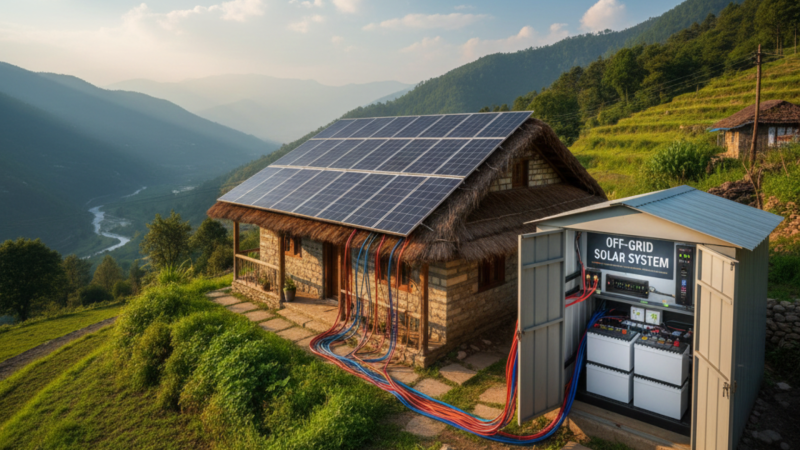
The Anatomy of an Off-Grid Solar System: 5 Key Components
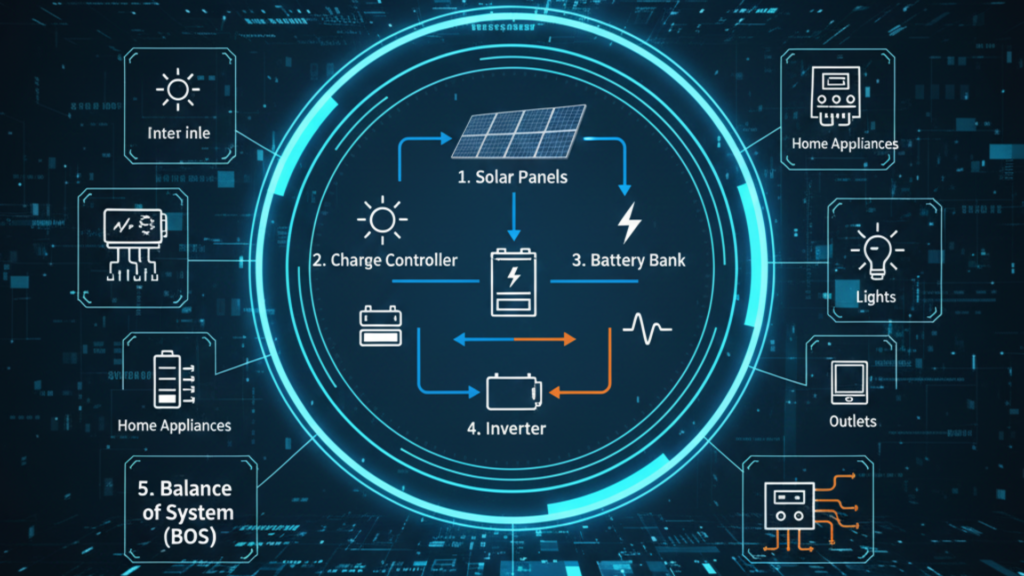
To function reliably 24/7, an Off-Grid Solar System requires several specific components that work together in harmony. Understanding these five parts is the first step toward successful installation.
| Component | Primary Function | Why It’s Essential for an Off-Grid Solar System |
| 1. Solar Panels (PV Modules) | Convert sunlight into DC (Direct Current) electricity. | This is the power generation source. Without panels, there is no electricity to use or store. |
| 2. Charge Controller | Regulates the voltage and current coming from the solar panels to the batteries. | Prevents overcharging or deep discharging the batteries, extending their lifespan and ensuring system safety. |
| 3. Battery Bank | Stores the generated electricity for use when the sun isn’t shining (at night or on cloudy days). | The most critical component for a true Off-Grid Solar System—it provides power autonomy. |
| 4. Inverter | Converts the DC power stored in the batteries into AC (Alternating Current) power. | Most household appliances (lights, TVs, computers) require AC power to operate. |
| 5. Balance of System (BOS) | Includes all wiring, mounting racks, fuses, disconnects, and combiners. | Provides the physical structure and ensures all components are safely and correctly connected. |
Phase 1: Planning Your Off-Grid Solar System (The Load Calculation)
Before you buy a single solar panel, you must determine how much energy you actually need. This step is non-negotiable and dictates the size (and cost) of your entire Off-Grid Solar System. This process is called a Load Calculation.
Step 1: List All Appliances and Their Wattage
Go through your home and list every device that will use power. Check the nameplate on the device for its power rating in Watts (W) or find it in the owner’s manual.
Step 2: Estimate Daily Hours of Use
For each appliance, estimate how many hours it will run per day. Be realistic and consider peak usage (e.g., summer months for air conditioning).
Step 3: Calculate Daily Energy Use (Watt-Hours)
To find the energy each appliance uses per day, multiply the appliance’s power (Watts) by the estimated hours of daily use. The result is the daily Watt-hour (Wh) consumption.
Example: A 100 Watt TV running for 5 hours a day consumes 100 W X 5 hours = 500 Wh
Step 4: Determine Total Daily Energy Need
Add up the daily Watt-hours (Wh) for all your appliances to get your Total Daily Energy Consumption. This number is the core metric your Off-Grid Solar System must meet.
Pro-Tip for Beginners: Look for DC appliances (especially lighting) to avoid the power losses associated with converting DC to AC. Energy efficiency is your best friend when going off-grid.
Phase 2: Sizing the Components of Your Off-Grid Solar System
Once you know your total daily energy consumption, you can accurately size the solar panels, battery bank, and charge controller using simple scaling.
1. Sizing the Battery Bank (The Heart of Your Autonomy)
The battery bank determines your autonomy—how many days you can run your system without any new charge from the sun. Off-grid systems typically aim for 3-5 days of autonomy to cover rainy or overcast periods.
| Factor | Description | Simple Sizing Rule |
| Days of Autonomy | How many days the battery can power your home without sun. | Aim for 3 to 5 days, especially in locations with unpredictable weather. |
| Depth of Discharge (DOD) | The amount of energy you safely pull from the battery. | Use 50% for Lead-Acid or 80-90% for Lithium-Ion (LiFePO4) to protect battery life. |
| System Voltage (V) | The standard voltage of your entire system (12V, 24V, or 48V). | 48V is common for larger homes as it is more efficient. |
How to find Battery Capacity (Ah):
- Calculate Total Required Energy: Multiply your Total Daily Wh by your desired Days of Autonomy.
- Account for DOD: Divide the result by the allowable Depth of Discharge (e.g.,0.80 for Lithium).
- Find the Amp-Hours (Ah): Divide that final number by your System Voltage (V). This gives you the required Amp-Hours (Ah) capacity.
2. Sizing the Solar Panel Array
The solar panels must generate enough power to recharge the battery bank and run the daily loads. This calculation relies on your location’s Peak Sun Hours (PSH)—the average number of hours per day of effective sunlight.
How to find Panel Array Size (Watts Peak – Wp):
- Take Your Total Daily Wh (from the Load Calculation).
- Divide by Your PSH: Use the Peak Sun Hours for your location during the worst month of the year (usually winter).
- Divide by System Efficiency: Divide the result by a system efficiency factor (e.g., 0.75 or 75%) to account for losses in wiring, dust, and temperature. The final number is the minimum total wattage required for your solar array.
3. Sizing the Charge Controller
The charge controller needs to safely handle the maximum current (Amps) output from the solar panel array.
How to find Charge Controller Size (Amps):
- Divide the Total Panel Array Wattage (Wp) by your System Voltage (V).
- Apply a Safety Factor: Multiply the result by 1.25. This 25% safety margin is mandated by electrical standards to handle potential voltage spikes from the panels in cold weather. Always round up to the next available charge controller size (e.g., 60A or 80A).
4. Sizing the Inverter
The inverter needs to be capable of handling the highest expected surge load—the maximum power (Watts) you will draw at any single moment.
- Select an inverter that is 25% to 30% larger than the maximum power you calculated from all appliances running simultaneously (your maximum instantaneous load).
- Always choose a Pure Sine Wave inverter for sensitive electronics, as the modified sine wave version can damage devices.
Phase 3: Installation and System Maintenance
The physical installation of your Off-Grid Solar System is the final step, but safety and correct wiring are paramount.
1. Mounting the Solar Panels
Panels must be mounted securely and angled for optimal winter performance (since winter usually has the fewest sun hours).
- Fixed Mounts: Simple, durable, and common for roofs and ground arrays.
- Tracking Mounts: Follow the sun, potentially increasing energy harvest by 25-40%, but they are more complex and expensive.
2. Wiring and Safety
- Wiring Method: Panels are wired in series to increase voltage and in parallel to increase current. The specific configuration depends on your charge controller type (MPPT is generally recommended) and battery voltage.
- Fusing and Disconnects: Safety devices like fuses and switches are crucial and required on both the DC (panel-to-controller and controller-to-battery) and AC (inverter-to-load) sides. Safety first!
Note: For systems above 500W, consider hiring a licensed electrician for the final wiring and hookup to ensure compliance with local codes and system safety.
3. Battery Management
Proper battery care is the most important factor in the longevity of your Off-Grid Solar System.
- Lead-Acid: Requires regular checks of water/electrolyte levels and must be kept in a well-ventilated enclosure.
Lithium (LiFePO4): Virtually maintenance-free, offering a longer life and deeper discharge capabilities, making them the preferred modern choice despite a higher initial cost.
Cost Considerations: Is an Off-Grid Solar System Worth the Investment?
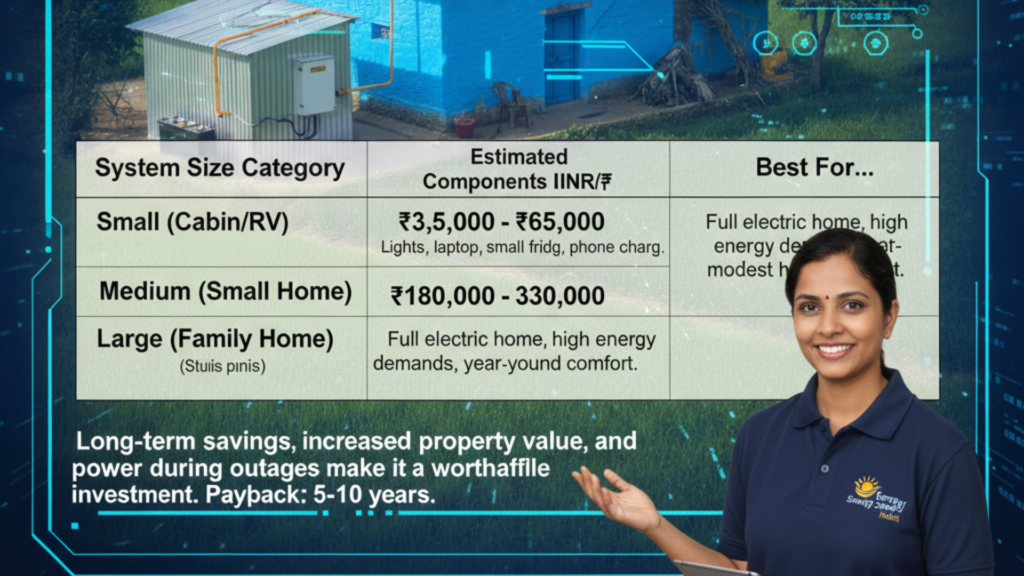
The initial cost of a quality Off-Grid Solar System is substantial, but the long-term benefit is free, clean energy and independence.
| System Size Category | Daily Consumption (Wh) | Estimated Components Cost (INR/₹) | Best For… |
| Small (Cabin/RV) | 1,000 – 3,000 Wh | ₹3,00,000 – ₹6,00,000 | Lights, laptop, small fridge, phone charging. |
| Medium (Small Home) | 4,000 – 8,000 Wh | ₹7,50,000 – ₹15,00,000 | Standard appliances, water pump, TV, modest heating/cooling. |
| Large (Family Home) | 10,000 – 20,000+ Wh | ₹18,00,000 – ₹35,00,000+ | Full electric home, high energy demands, year-round comfort. |
Note: These estimates are for component costs only and do not include installation, wiring, or permits, which can add significant cost. Costs can vary widely based on battery choice (Lead-Acid vs. Lithium) and brand.
While the upfront cost is high, the savings on monthly utility bills, the increased property value, and the assurance of power during grid outages make the Off-Grid Solar System a worthwhile long-term investment. The payback period for a well-designed system can be as short as 5 to 10 years.
Conclusion: Your Journey to Off-Grid Energy Independence
Designing and installing an Off-Grid Solar System is a challenging but incredibly rewarding endeavor. It requires careful planning, accurate load calculations, and a commitment to understanding the technology. By mastering the five core components—panels, controller, battery, inverter, and BOS—you take the first major step toward achieving complete energy autonomy.
Whether you are seeking refuge from blackouts or pursuing a lifestyle far from civilization, an Off-Grid Solar System is the gateway to a sustainable and independent future. Start with your load calculation today, and begin harnessing the endless power of the sun!
FAQ (Frequently Asked Questions) Off-Grid Solar System
Q1: Is it cheaper to go off-grid than staying connected to the utility grid?
A: Not initially. The upfront cost for an Off-Grid Solar System (especially the battery bank) is higher than a grid-tied system. However, in the long term, once the system is paid for, your ongoing energy cost is virtually zero, potentially saving you more than utility bills over 20+ years.
Q2: How long do the batteries in an Off-Grid Solar System last?
A: It depends on the battery chemistry and how well they are maintained.
- Deep-Cycle Lead-Acid: Typically last 3 to 7 years.
- Lithium-Ion (LiFePO4): Can last 10 to 15 years or more, offering significantly better cycle life and less maintenance.
Q3: Can I run an air conditioner with an Off-Grid Solar System?
A: Yes, but it requires a very large and expensive system. Air conditioning units are major energy hogs and significantly increase the size requirement for both your solar panels and your battery bank. If you need AC, prioritize highly efficient mini-split systems.
Q4: What happens on very cloudy or rainy days?
A: On cloudy days, your panels will still generate power, but at a reduced rate (often 10-25% of peak capacity). This is why having multiple days of autonomy (storage) in your battery bank is critical for an Off-Grid Solar System.
Q5: Do I need a generator as a backup for my Off-Grid Solar System?
A: It is highly recommended. A fossil fuel generator provides a crucial backup for extended periods of poor weather or unexpected high loads, ensuring your battery bank never reaches a critically low level, which can damage the batteries.