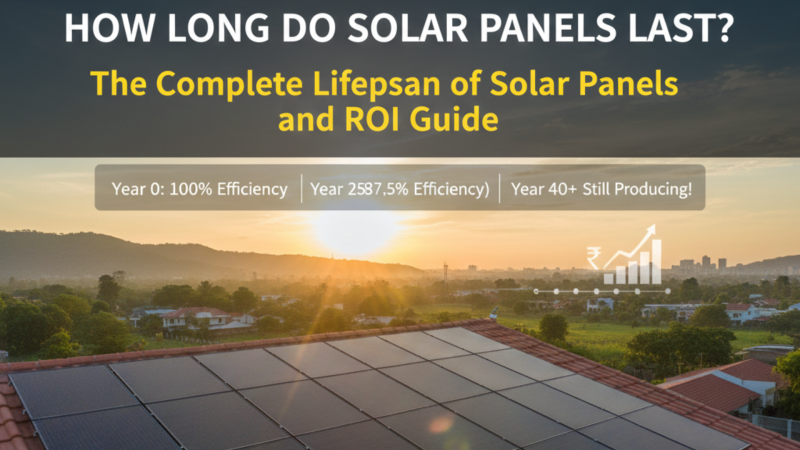
If you’re considering a solar energy system for your home or business, one of the most critical questions is, “How long do solar panels last?” The answer is incredibly reassuring: modern, high-quality solar panels are built for the long haul. The accepted useful lifespan of solar panels is 25 to 30 years. However, panels do not suddenly stop working at 30 years. This figure is the period manufacturers guarantee a minimum power output (typically 80% to 90% capacity). In reality, well-maintained solar panels often generate usable electricity for 35, 40, or even more years. They simply operate at a reduced efficiency.
Understanding this lifespan is key. It helps you accurately calculate your long-term Return on Investment (ROI). It also ensures your renewable energy source delivers maximum value for decades.
The Science of Degradation: How Lifespan of Solar Panels is Measured
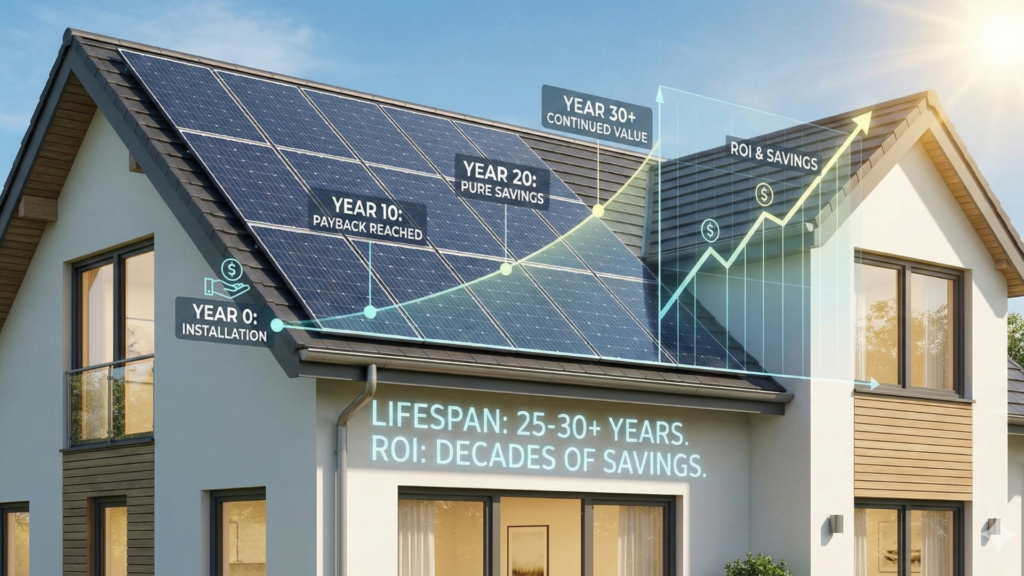
Solar panels do not fail instantly; they experience a slow, gradual reduction in power output known as the degradation rate. This is a natural, predictable process.
Measuring the Annual Degradation Rate and Panel Lifespan
Most high-quality crystalline silicon solar panels (Monocrystalline and Polycrystalline) are engineered with an annual degradation rate of approximately 0.5% to 0.8% per year after the first year.
- Year 1: A slightly higher initial degradation often occurs (around 1% to 3%), known as Light-Induced Degradation (LID) or LeTID (Light and Elevated Temperature-Induced Degradation).
- Years 2-25/30: The degradation rate stabilizes at the low annual rate of 0.5%-0.8%.
For example, a panel with a 0.5% annual degradation rate will still produce about 87.5% of its original power after 25 years. Newer, premium technologies (like TOPCon or Heterojunction) are pushing this rate even lower, sometimes closer to 0.3% to 0.4% per year, promising a longer and more efficient life.
Table 1: Degradation Rate Comparison by Panel Type
| Solar Panel Type | Typical Useful Lifespan (Years) | Annual Degradation Rate (Approx.) | Expected Output at Year 25 (Approx.) |
| Monocrystalline (High-Quality) | 25 – 30+ | 0.3% – 0.5% | 87.5% – 92% |
| Polycrystalline (Standard) | 20 – 25 | 0.6% – 0.8% | 80% – 85% |
| Thin-Film (Less Common for Residential) | 10 – 20 | 0.8% – 1.5% | Lower, more variable |
Solar Panel Warranties: Essential for Long-Term Lifespan Protection
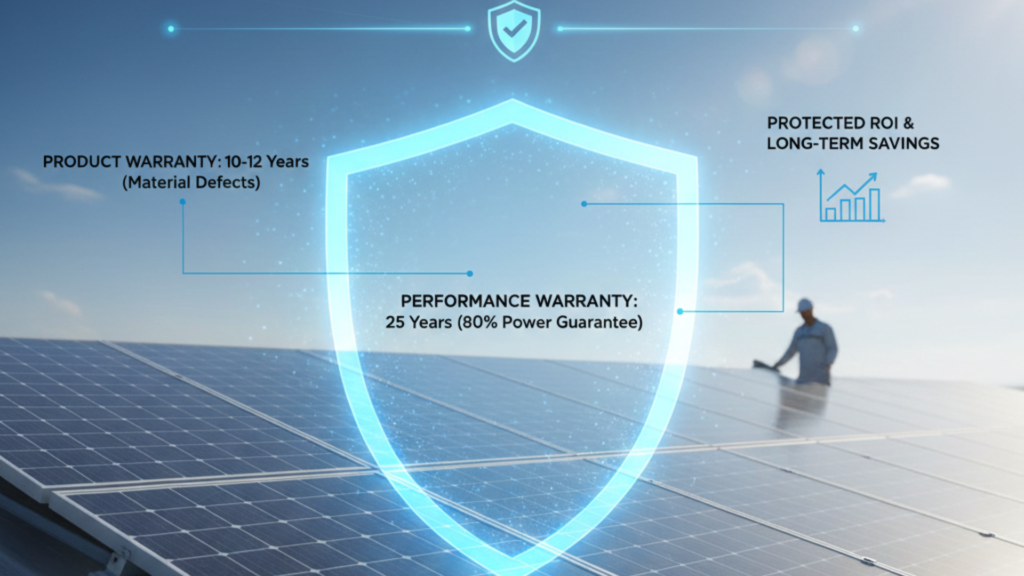
The lifespan of solar panels is closely tied to the manufacturer’s warranties, which act as a powerful layer of financial protection for your investment. There are generally two main types of warranties:
1. Product (or Materials) Warranty
This warranty covers physical defects in the panel materials, manufacturing flaws, and environmental factors like premature corrosion or water ingress.
- Typical Coverage: 10 to 12 years, with premium brands offering 15 or even 25 years.
2. Performance (or Power) Warranty
This is the most direct indicator of the panel’s expected lifespan. It guarantees that the power output will not drop below a certain threshold over a defined period.
- Typical Guarantee: 90% power output after 10 years, and 80% or more power output after 25 years. Premium warranties now often guarantee 85% to 92% output after 25 years.
The 25-year performance warranty is the reason the 25-year mark is the widely cited lifespan of solar panels. It is the manufacturer’s promise of minimum productivity.
Factors That Significantly Affect the Lifespan of Solar Panels

While 25-30 years is the benchmark, several factors in the real world can either extend or shorten the useful life of your solar panels. Making informed choices in these areas will maximise your system’s longevity.
1. Quality of Materials, Manufacturing, and Panel Lifespan
The composition of the solar panel itself is paramount. Tier-1 manufacturers use high-purity silicon cells, durable frames (often anodized aluminium), high-transmission glass, and advanced encapsulation materials that resist moisture and UV light penetration. Lesser quality panels may experience earlier failures like microcracks, delamination, or Potential-Induced Degradation (PID).
2. Quality of Installation and its Impact on Panel Longevity
A professional, correct installation is non-negotiable for maximizing the lifespan of solar panels.
- Proper Racking and Mounting: Ensures the panels are securely held and prevents mechanical stress from high winds or snow loads, which can cause internal cell damage.
- Correct Wiring and Sealing: Prevents moisture ingress, electrical faults, and system failures. Improper wiring can lead to hotspots, a major cause of localized degradation.
3. Climate, Environment, and Panel Resilience
The location of your solar array plays a significant role:
- Extreme Heat: High ambient temperatures can temporarily lower efficiency and, over time, accelerate the degradation of materials.
- Humidity and Salt Air (Coastal Areas): These conditions can accelerate corrosion of the frame and potentially damage the electrical components.
- Severe Weather: Panels are tested to withstand hail and heavy snow loads, but frequent exposure to extreme events can increase the risk of physical damage.
4. Maintenance, Cleaning, and Sustained Panel Lifespan
While solar panels are low-maintenance, they are not zero-maintenance.
- Regular Cleaning: Keeping panels free of heavy dust, dirt, or bird droppings ensures maximum light absorption and prevents the creation of hotspots due to shaded areas.
- System Monitoring: Advanced monitoring tools allow you to track your system’s daily performance. A sudden, unexplained drop in output is a clear sign that a component (like the inverter or a single panel) needs inspection and repair, thereby safeguarding the lifespan of solar panels.
Calculating Your ROI: Maximizing the Long-Term Value
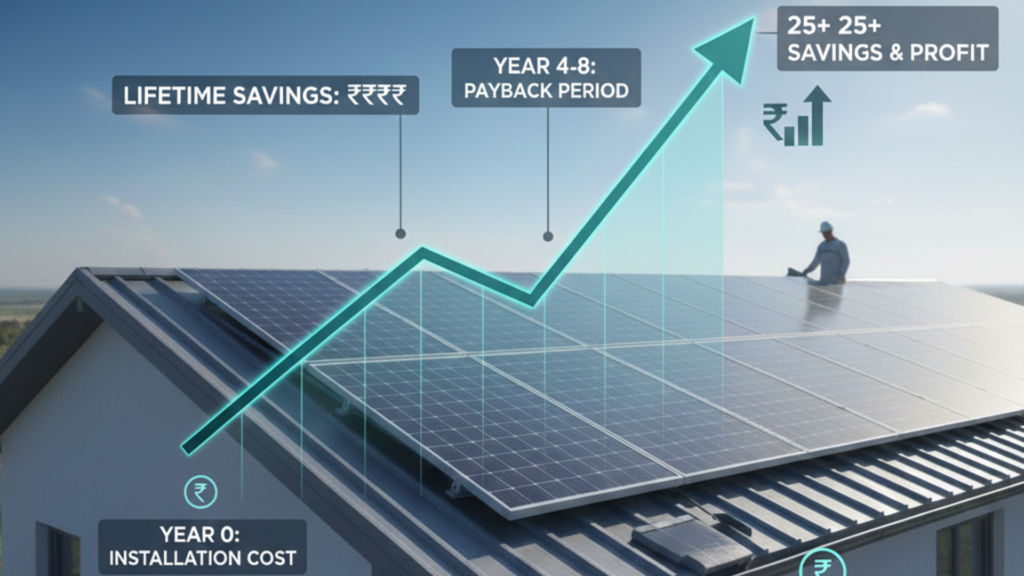
The substantial lifespan of solar panels is what makes solar energy an excellent financial investment with a high ROI. Your investment essentially continues to pay you back for decades after the initial setup cost is recovered.
The Solar Payback Period
The payback period is the time it takes for your cumulative electricity bill savings to equal the initial cost of your solar system.
Payback Period (Years) = (Total System Cost – Subsidies or Incentives) / Annual Energy Savings
In many regions with high electricity costs and strong solar irradiance, the payback period can be as short as 4 to 8 years.
ROI After Payback Period and Extended Lifespan Value
Once the system has paid for itself (e.g., in year 7), the remaining 18 to 23+ years of the guaranteed lifespan represent pure, tax-free savings.
- Savings over 25 years: If your system saves you ₹1,25,000 annually, the total saving over 25 years (excluding inflation/electricity rate hikes) is ₹31,25,000 (₹1.25 Lakhs $\times$ 25 years).
- Extended Savings: If the system lasts for 35 years, that’s an additional 10 years of savings, potentially adding another ₹12,50,000 (at current rates) to your total ROI.
Component Lifespan: A Holistic View
While the solar panels have the longest lifespan, other essential components of the solar system will likely need to be replaced, which must be factored into your long-term ROI calculation.
Table 2: Lifespan of Core Solar System Components
| Component | Function | Typical Lifespan (Years) | Estimated Replacement Frequency | Cost Consideration |
| Solar Panels | Converts sunlight to DC power. | 25 – 30+ (Guaranteed) | Rarely Replaced (Unless Damaged) | Highest Upfront Cost, Lowest Long-Term Maintenance |
| Inverter (String) | Converts DC to Usable AC power. | 10 – 15 | Once (Mid-Lifespan) | Moderate Cost, Critical for Operation |
| Microinverters/Optimizers | Converts/Optimizes power per panel. | 20 – 25+ | Zero to Once | Higher Initial Cost, Often Covered by Longer Warranty |
| Solar Battery (Storage) | Stores excess energy for later use. | 10 – 15 (Cycle Life Dependent) | Once or Twice | High Initial Cost, Improves ROI via Energy Independence |
| Racking/Mounting | Physically secures panels to the roof. | 25+ | Rarely Replaced | Low/Moderate Initial Cost |
Conclusion: The Durable Lifespan of Solar Panels Ensures Long-Term Value
The decision to invest in solar energy is one built on a foundation of long-term sustainability and financial stability. The impressive lifespan of solar panels is 25 to 30 years and often beyond. This ensures your initial investment will generate substantial electricity savings. It also promises a robust financial return for decades.
You must prioritize high-quality panels and ensure professional installation. Also, conduct minimal routine maintenance. By doing this, you can confidently maximize your system’s performance. Watch your renewable energy investment pay dividends for the foreseeable future.
Frequently Asked Questions (FAQ) about Solar Panel Lifespan
Q1: Does the solar panel warranty mean my panels will stop working after 25 years?
A: A: No. The 25-year performance warranty does not mean the panels stop working. It guarantees a minimum power output (80% or more) after 25 years. Panels continue to produce electricity for many years past this mark. They just operate at a slightly lower efficiency.
Q2: What is the main sign that my solar panels need replacement?
A: The key sign is a continuous, significant drop in energy production. This drop must be something that cleaning or inverter repair cannot fix. If panels operate significantly below the guaranteed power output (e.g., less than 80% after 25 years), replacement is often financially smart. Newer, more efficient technology is usually the better option.
Q3: How do new technologies like TOPCon affect the lifespan of solar panels?
A: Newer technologies, such as TOPCon, use superior cell structures.3 This results in a much lower annual degradation rate (often 0.35% per year). Thus, they retain a higher percentage of their original efficiency for longer. This effectively extends the useful lifespan of solar panels and increases the system’s lifetime energy yield
Q4: Are solar panels environmentally safe when they reach the end of their life?
A: The solar industry is increasingly focused on recycling. While not all panels are currently recycled, robust recycling processes are being developed and implemented globally to recover valuable materials like silicon, glass, and aluminium, minimising environmental impact.