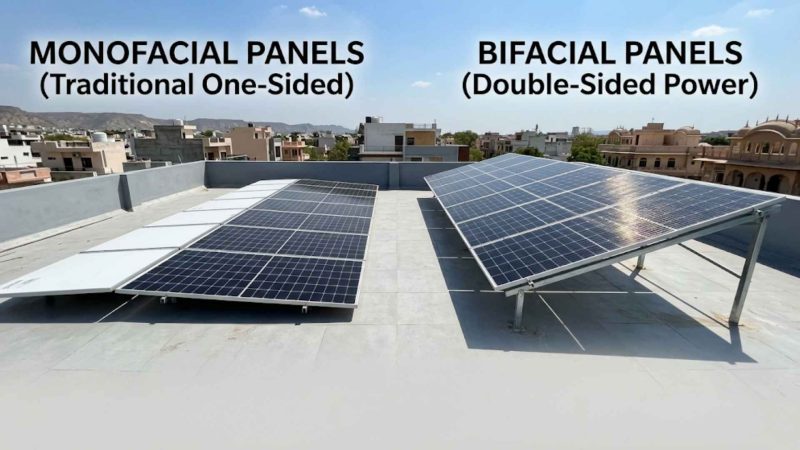
Switching to solar energy is one of the smartest financial decisions a property owner in India can make, but the technical jargon can often feel overwhelming. When you begin comparing modern modules, the most critical factor to evaluate is the difference between Monofacial and Bifacial solar panels to ensure you maximize your daily energy generation. While traditional setups have relied on single-sided capture, the emergence of dual-sided technology has changed the ROI calculations for homeowners in Rajasthan and Gujarat, where sunlight is abundant and ground reflectivity is high.
Understanding the fundamental difference between Monofacial and Bifacial solar panels allows you to choose a system that fits your specific rooftop architecture and budget. While one technology excels in simple, low-profile installations, the other offers a massive boost in efficiency by capturing sunlight that would otherwise be wasted. In this comprehensive guide, we will break down the costs, durability, and performance metrics of both options to help you decide which panel deserves a spot on your roof for the next 25 years.
The Architectural Foundation: Understanding the Core Difference Between Monofacial and Bifacial Solar Panels
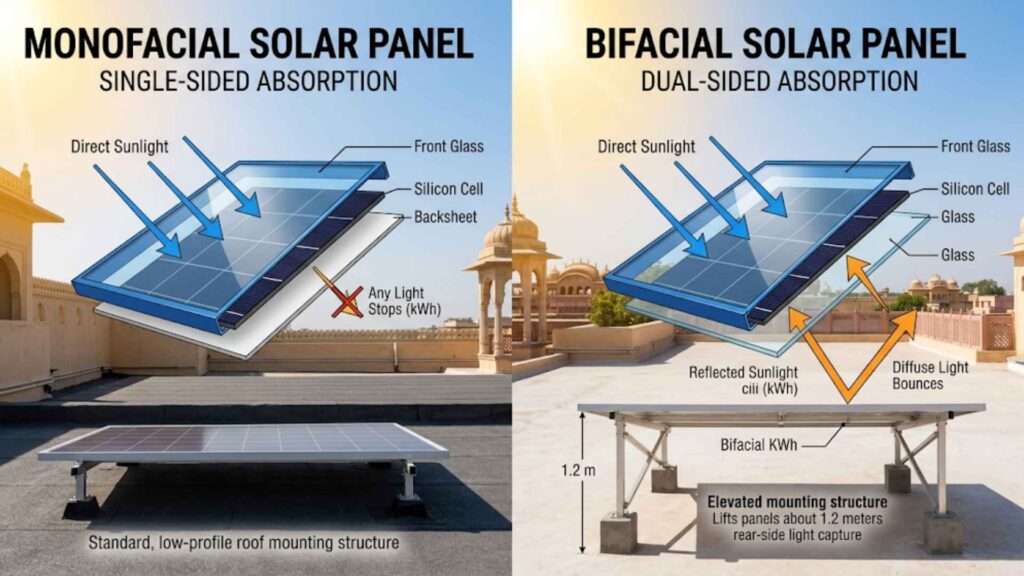
To appreciate the innovation, we must look at how these panels are constructed.
The Evolution of Monofacial Technology
Monofacial solar panels have been the backbone of the solar industry for decades. They consist of a single layer of silicon cells protected by a glass front and an opaque backsheet.
- Design: The backsheet is typically white or black.
- Function: They only absorb sunlight that hits the front surface. Any light that passes through the gaps between cells or reflects off the ground is essentially lost energy.
The Bifacial Revolution: Capturing Light from Both Sides
Bifacial panels are a leap forward in photovoltaic engineering. Instead of an opaque back, they feature a transparent backsheet or a second layer of glass.
- Design: They utilize “Dual-Glass” or “Glass-on-Glass” construction.
- Function: They capture direct sunlight from the front and reflected (albedo) light from the back. This is the primary difference between Monofacial and Bifacial solar panels. By utilizing the rear side, these panels can boost energy production by up to 30% without increasing the physical footprint of the array.
The Science of High Yields: Albedo and Irradiance
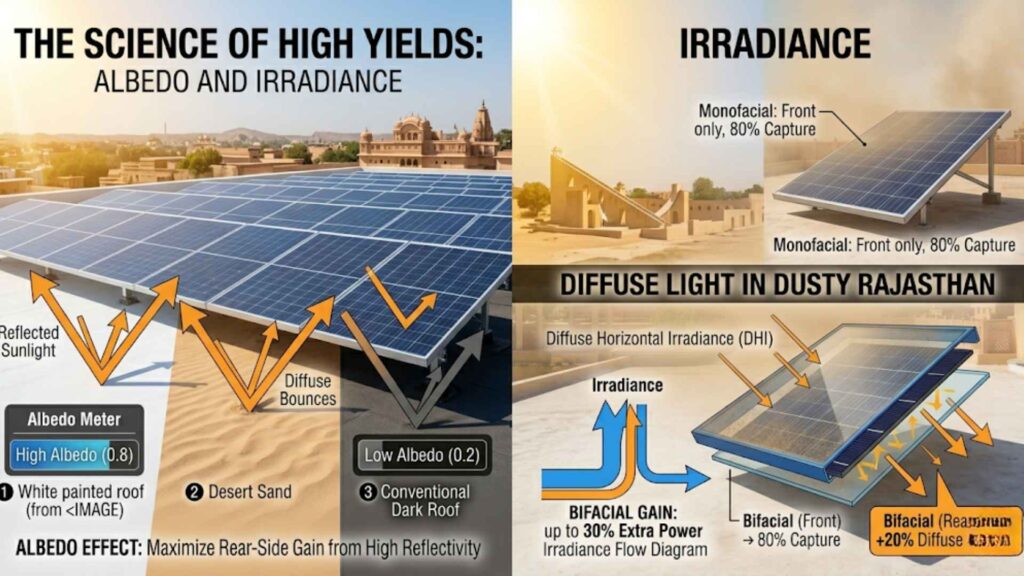
The efficiency of a solar power plant isn’t just about the panel; it’s about the environment. This is where the difference between Monofacial and Bifacial solar panels becomes highly visible in regions like Jaipur or the Thar Desert.
The Role of the Albedo Effect
“Albedo” refers to the reflectivity of a surface.
- High Albedo Surfaces: White-painted roofs, light-colored RCC terraces, and sandy terrain have high albedo. They reflect a lot of sunlight upward.
- Low Albedo Surfaces: Dark bitumen roofs or grass reflect very little light.
If you are installing solar in a desert climate, the high reflectivity of the ground makes Bifacial panels significantly more productive.
Bifacial Gain in Diffuse Light Conditions
During the dusty summer months in Rajasthan, “Direct Normal Irradiance” (DNI) can drop due to suspended dust particles. However, “Diffuse Horizontal Irradiance” (DHI) remains high because light is scattered in all directions.
- Monofacial panels struggle in these conditions because they only look “up.”
- Bifacial panels thrive because they can catch the scattered light bouncing off the surrounding environment.
Installation Guide: Structural Difference Between Monofacial and Bifacial Solar Panels
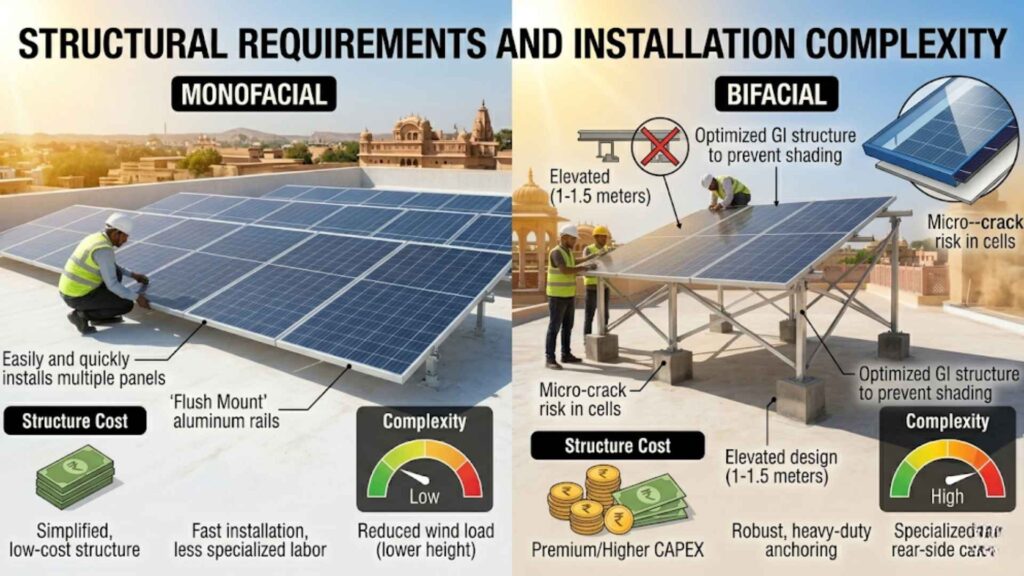
One major difference between Monofacial and Bifacial solar panels that many people overlook is the cost of the mounting structure.
Elevated Mounting for Bifacial Performance
For a Bifacial panel to work, it needs “breathing room.” If you mount it flat against a roof, the back side receives zero light.
- Height: Panels must be raised at least 1–1.5 meters.
- Tilt Angle: A steeper tilt often helps in capturing more reflected light from the ground.
- Shadowing: The mounting rails must be designed specifically so they don’t cast shadows on the back of the cells.
Monofacial Simplicity
Monofacial panels are far more flexible for residential rooftops. They can be installed on “Flush Mount” structures, which are cheaper and require less steel. If your roof cannot handle a tall, heavy structure due to high wind speeds, Monofacial is the safer, more practical choice.
Durability in Extreme Heat: A Critical Factor for Rajasthan
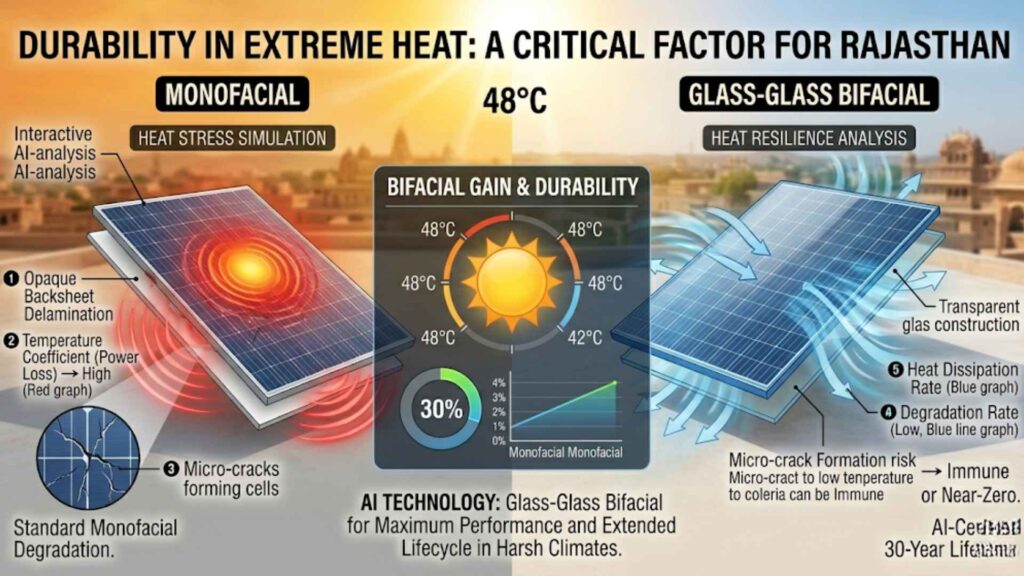
Rajasthan experiences some of the highest temperatures in India. How does the difference between Monofacial and Bifacial solar panels play out in 48°C heat?
The Benefit of Dual-Glass Construction
Most high-end Bifacial panels are “Glass-Glass” modules.
- Heat Dissipation: Glass is an excellent conductor of heat. Having glass on both sides allows the panel to cool down faster than a Monofacial panel with a plastic backsheet.
- Degradation Rates: Monofacial panels with plastic backsheets can suffer from “yellowing” or “delamination” over 20 years. Glass-Glass Bifacial panels are nearly immune to these issues, often coming with a 30-year performance warranty.
Mechanical Strength against Dust Storms
The “Andhi” (dust storms) in North India can put immense mechanical stress on panels. The dual-glass nature of Bifacial modules provides superior structural rigidity, reducing the risk of “micro-cracks” in the silicon cells.
Quick Summary Table: Analyzing the Difference Between Monofacial and Bifacial Solar Panels
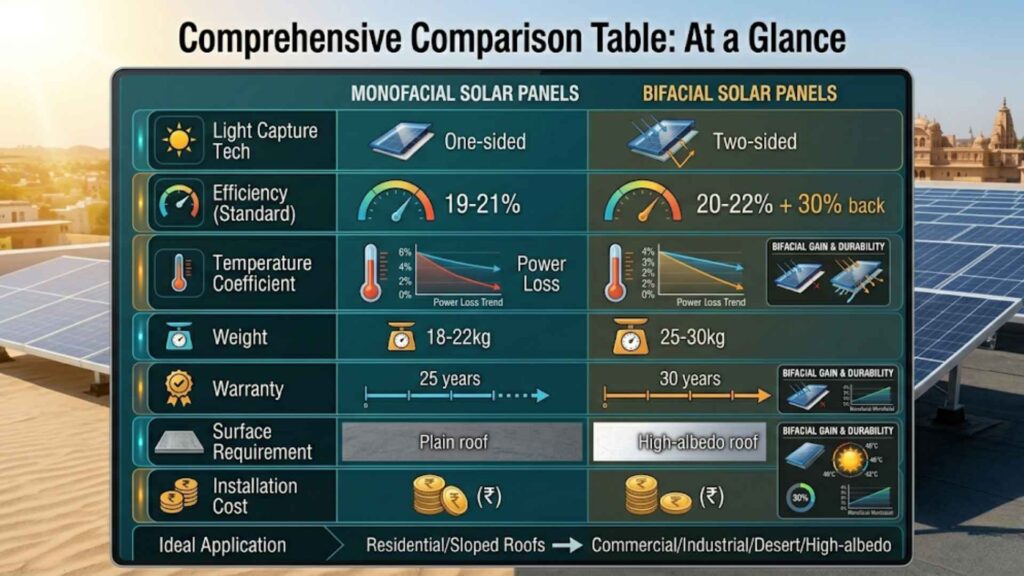
| Technical Parameter | Monofacial Solar Panels | Bifacial Solar Panels |
| Light Capture Technology | Front-side only | Dual-sided capture |
| Efficiency (Standard) | 19% – 21% | 20% – 22% (Front) + up to 30% (Back) |
| Temperature Coefficient | Higher (Loses more power in heat) | Lower (Better performance in hot climates) |
| Weight | 18kg – 22kg (Standard) | 25kg – 30kg (Heavier) |
| Warranty | 25 Years | 30 Years (usually) |
| Surface Requirement | Irrelevant | Needs high-reflectivity surfaces |
| Installation Cost | Economy | Premium (Structure costs are higher) |
Financial Breakdown: The “True” Cost of Solar
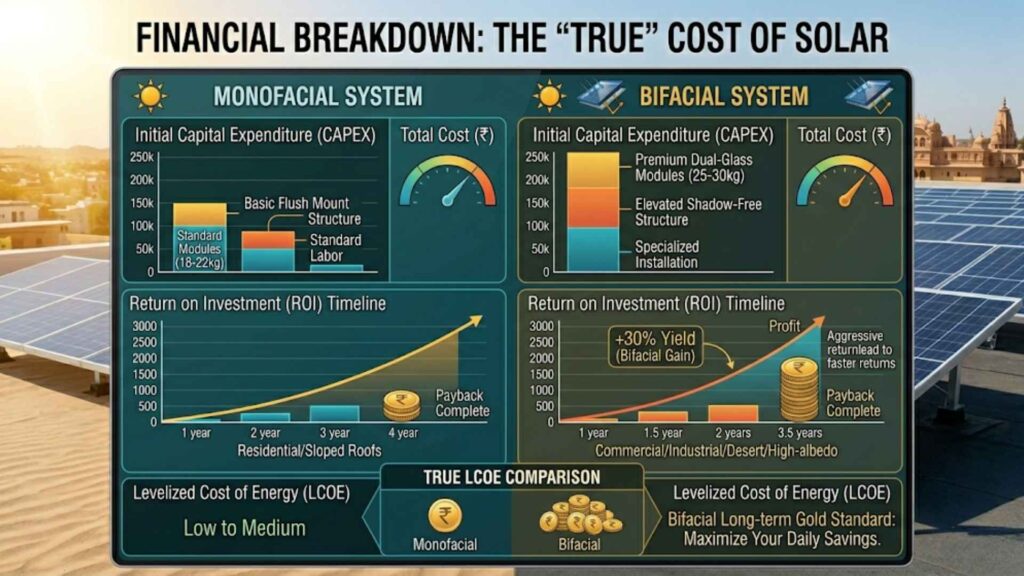
When analyzing the difference between Monofacial and Bifacial solar panels, we must look at the LCOE (Levelized Cost of Energy).
Initial Capital Expenditure (CAPEX)
A Bifacial system will always have a higher upfront cost. You are paying for:
- Higher quality glass-on-glass modules.
- Heavier galvanized iron (GI) structures to lift the panels.
- Potentially higher labor costs for specialized installation.
Return on Investment (ROI) and Payback Period
In a high-solar region like Kota or Jaipur, a 10kW Monofacial system might pay for itself in 4 years. A 10kW Bifacial system—producing 15-20% more units—might pay for itself in 3.5 years, despite the higher initial cost.
Pro Tip: If you are an industrial user paying high commercial electricity rates, the extra units generated by Bifacial panels translate directly into massive monthly savings.
Performance Maintenance and Cleaning Protocols
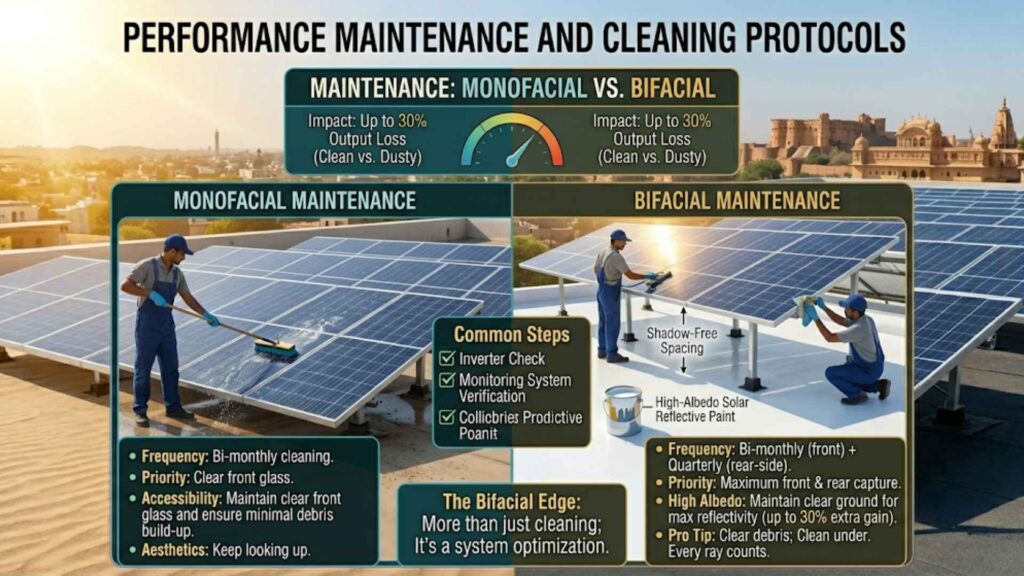
Dust is the enemy of solar. The difference between Monofacial and Bifacial solar panels also extends to how you maintain them.
Cleaning the Rear Side
While the front side is the priority, dust on the back side of a Bifacial panel can reduce the “Bifacial Gain.”
- Maintenance Tip: During your bi-monthly cleaning, ensure that the area under the panels is cleared of debris and that the back of the glass is wiped down at least once every quarter.
Roof Treatment
To maximize the difference between Monofacial and Bifacial solar panels, many smart homeowners in Rajasthan are painting their roofs with High-Albedo Solar Reflective Paint. This keeps the building cool and boosts solar production simultaneously.
Conclusion: Which One Should You Buy?
After analyzing every difference between Monofacial and Bifacial solar panels, the winner depends on your specific application.
- The Case for Monofacial: If you are a residential user with a limited budget, a sloped roof, or a small terrace where panels must be mounted low, Monofacial remains the most logical and cost-effective solution.
- The Case for Bifacial: If you are an industrial workshop, a large-scale farmer, or a homeowner with a large, flat, reflective terrace in Rajasthan, Bifacial is the superior choice. The 30-year lifespan and increased energy yield make it the “gold standard” for future-ready energy systems.
In the land of the sun, every ray counts. Whether you choose the reliable Monofacial or the high-output Bifacial, transitioning to solar is the best decision you can make for the environment and your bank account.
FAQs: Addressing Common Concerns
Q1. Is Bifacial better for small home roofs?
Usually, no. Unless you have a large flat terrace where you can raise the panels, the extra cost of Bifacial technology won’t provide enough extra energy to justify the expense on a small 2kW or 3kW system.
Q2. Can I mix Monofacial and Bifacial panels?
It is not recommended. The electrical characteristics (voltage and current) differ significantly. Mixing them on the same string in an inverter will lead to “mismatch losses,” reducing the efficiency of the entire system.
Q3. Does the glass-on-glass design make them break easier?
Actually, it’s the opposite. Dual-glass modules are often more resistant to hail and wind because the silicon cells are sandwiched between two rigid layers, preventing the cells from flexing.