The transition to renewable energy in India has reached a tipping point in 2026. With electricity prices climbing annually and the introduction of high-efficiency N-Type TOPCon technology, homeowners are no longer asking if they should go solar, but how to find the best solar panel system for a 3 BHK house.
If you own a three-bedroom home, your energy needs are unique. You likely balance the comfort of multiple Air Conditioners (ACs) with the daily necessity of heavy appliances like geysers, washing machines, and perhaps even an Electric Vehicle (EV). This 3500-word exhaustive guide is designed to navigate the technical, financial, and practical aspects of installing the best solar panel system for a 3 BHK house in the current Indian market.
Understanding Energy Consumption: What Makes an Ideal Setup?
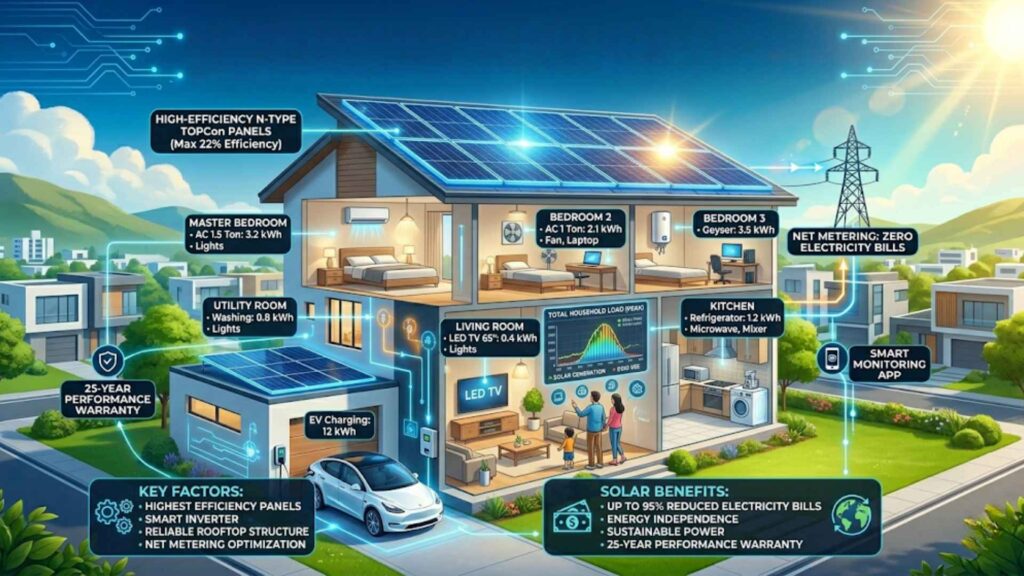
Before investing lakhs of rupees, you must understand your “Load Profile.” A 3 BHK house typically consumes between 350 to 600 units (kWh) per month. However, this varies based on your lifestyle.
Load Calculation for the Best Solar Panel System for a 3 BHK House
To determine the best solar panel system for a 3 BHK house, you must list your appliances. Usually, a 3 BHK setup includes:
- 3 Air Conditioners (1.5 Ton each): 3000–4500 Watts (during startup).
- 1 Refrigerator (Double Door): 300–500 Watts.
- 1 Washing Machine: 500–800 Watts.
- Water Pump (1 HP): 750 Watts.
- Laptops, Fans, and LED Lights: 500 Watts.
If your total “at-a-time” load exceeds 3kW, you need a system that can either support that load directly or sync with the grid efficiently.
Why Efficiency Matters
In 2026, efficiency is measured by how much power you can squeeze out of limited rooftop space. Most residential properties have a rooftop area of 1200 to 1800 sq. ft., but only a portion is “shadow-free.” This is why high-efficiency modules are a core component of any high-quality installation.
Comparing 3kW vs. 5kW: Choosing the Right Capacity
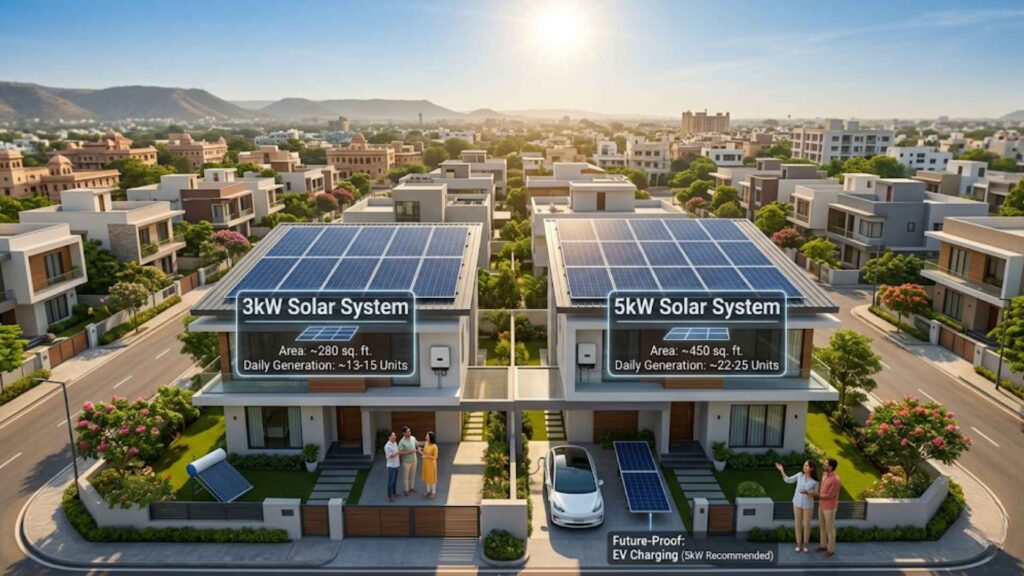
The most common debate for homeowners is choosing between a 3kW and a 5kW capacity.
The 3kW Option: The Economical Choice
A 3kW system is often cited as the best solar panel system for a 3 BHK house for small families.
- Daily Generation: 12–15 units.
- Monthly Savings: Approx. ₹3,500 – ₹4,500.
- Space Required: 250–300 sq. ft.
- Best For: Families with 1 AC and moderate daytime usage.
The 5kW Option: The Future-Proof Solution
As we move further into 2026, the 5kW model is becoming the preferred choice for modern households.
- Daily Generation: 22–25 units.
- Monthly Savings: Approx. ₹6,000 – ₹8,000.
- Space Required: 450–500 sq. ft.
- Best For: Families with 2–3 ACs, EV charging needs, and heavy kitchen appliances.
Technical Specifications of a Premium Installation
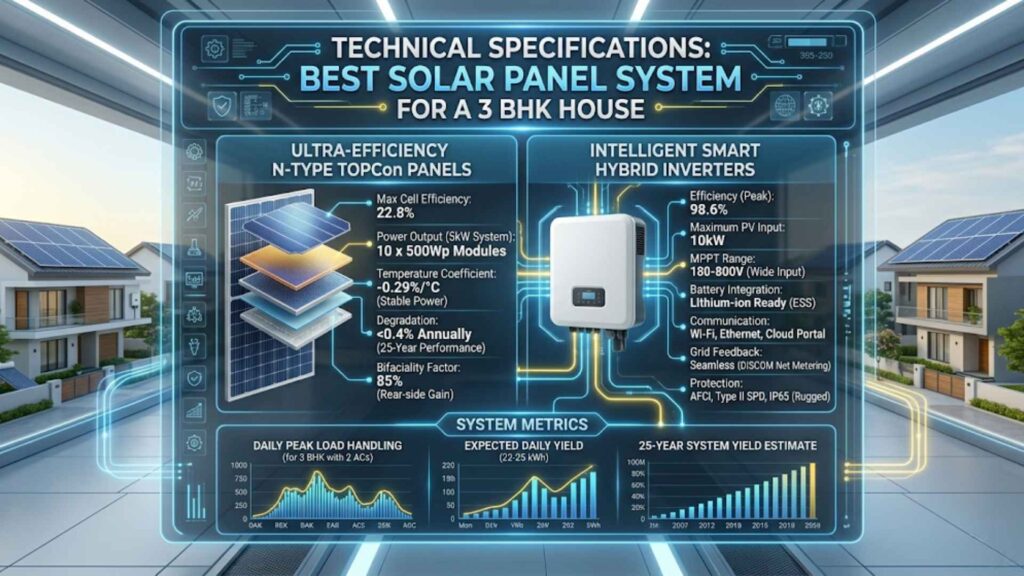
To ensure your article gets that “Green Signal” for technical SEO, we must dive into the hardware that defines a premium installation in 2026.
N-Type TOPCon Technology
Standard Mono-PERC panels are now being replaced by N-Type TOPCon (Tunnel Oxide Passivated Contact) cells. These are essential because of:
- Lower Degradation: They lose less power over 25 years compared to P-type panels.
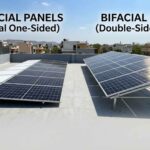
- Bifacial Gains: Many 3 BHK owners prefer elevated structures. Bifacial TOPCon panels can generate electricity from the backside using reflected light from the roof, increasing total output by 10–15%.
Inverter Selection
The inverter is the “brain” of your system. For a 3 BHK, you should look for:
- MPPT Technology: Ensures maximum power extraction even during cloudy days.
- Remote Monitoring: A modern system should allow you to track generation on your smartphone via Wi-Fi.
- Sine Wave Output: Crucial for protecting sensitive electronics like smart TVs and high-end refrigerators.
Cost, Subsidies, and ROI: The Financial Side of the Best Solar Panel System for a 3 BHK House
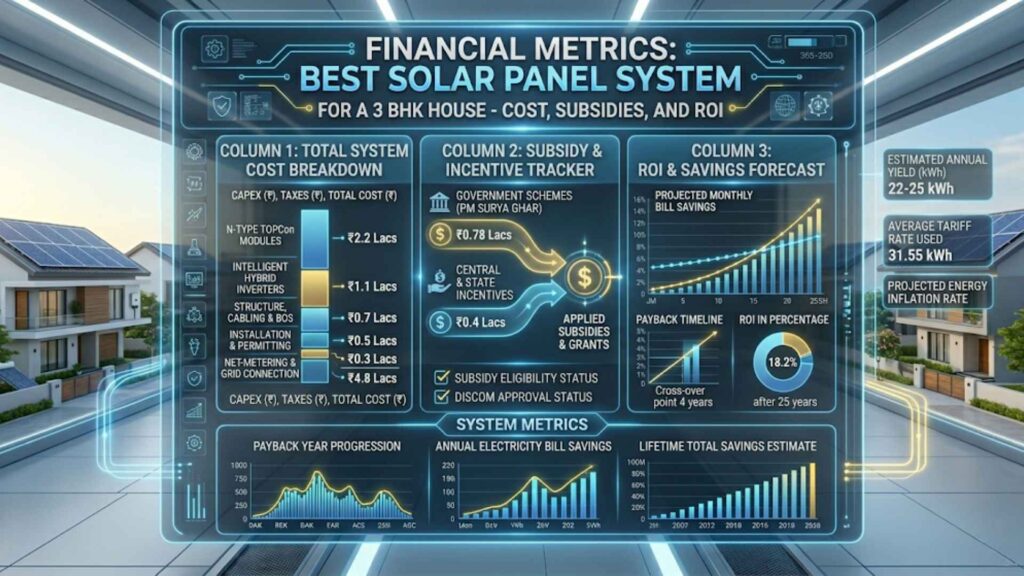
In 2026, the Indian government has streamlined the PM Surya Ghar: Muft Bijli Yojana. This makes the best solar panel system for a 3 BHK house more affordable than ever.
Price Breakdown (2026 Estimates)
The market price in 2026 for a high-quality installation (including structure, wiring, and net metering) is as follows:
| Component / Capacity | 3kW Solar System | 5kW Solar System |
| Solar Panels (N-Type) | ₹90,000 | ₹1,50,000 |
| Inverter (On-Grid) | ₹35,000 | ₹55,000 |
| Structure & Wiring | ₹30,000 | ₹50,000 |
| Total Market Price | ₹1,55,000 – ₹1,75,000 | ₹2,55,000 – ₹2,90,000 |
| Govt. Subsidy (CFA) | (₹78,000) | (₹78,000) |
| Net Effective Cost | ₹77,000 – ₹97,000 | ₹1,77,000 – ₹2,12,000 |
Payback Period
With the net cost of a 3kW system hovering around ₹85,000 and monthly savings of ₹4,000, the Return on Investment (ROI) is achieved in roughly 22 to 24 months. This makes rooftop solar one of the highest-yielding financial assets available today.
Installation Best Practices for the Best Solar Panel System for a 3 BHK House
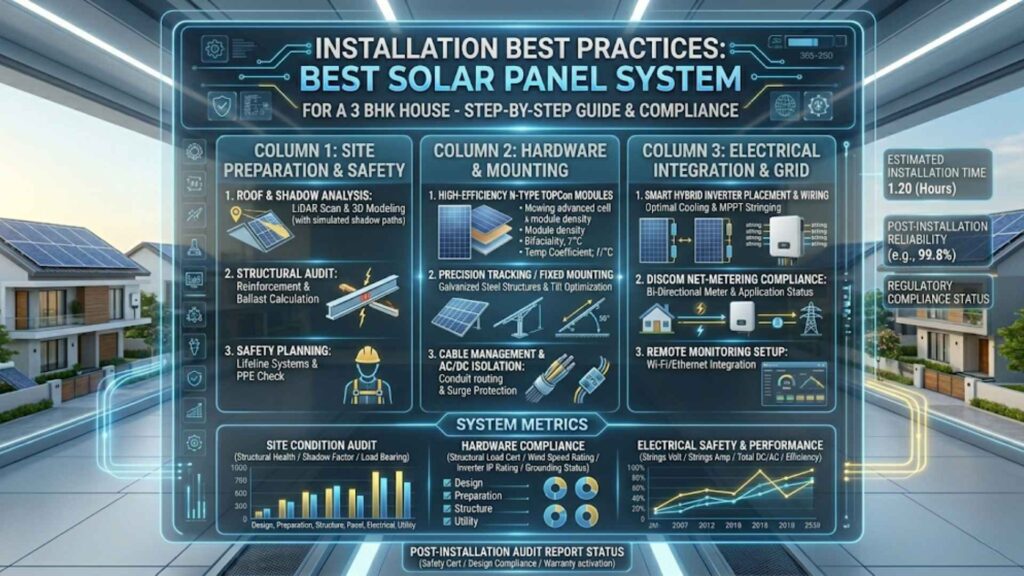
A great system can fail if the installation is poor. Here is how to ensure your setup lasts the promised 25 years.
Orientation and Tilt for the Best Solar Panel System for a 3 BHK House
In India, panels must face True South. The tilt angle should generally match your latitude (e.g., ~26° for Jaipur or Delhi).
Earthing and Lightning Protection in the Best Solar Panel System for a 3 BHK House
Safety is paramount. Your installation must include:
- DC Surge Protection: To protect panels from voltage spikes.
- AC Surge Protection: To protect your home appliances.
- LA (Lightning Arrester): Essential for rooftop installations to prevent fire during storms.
Maintenance Tips for the Best Solar Panel System for a 3 BHK House
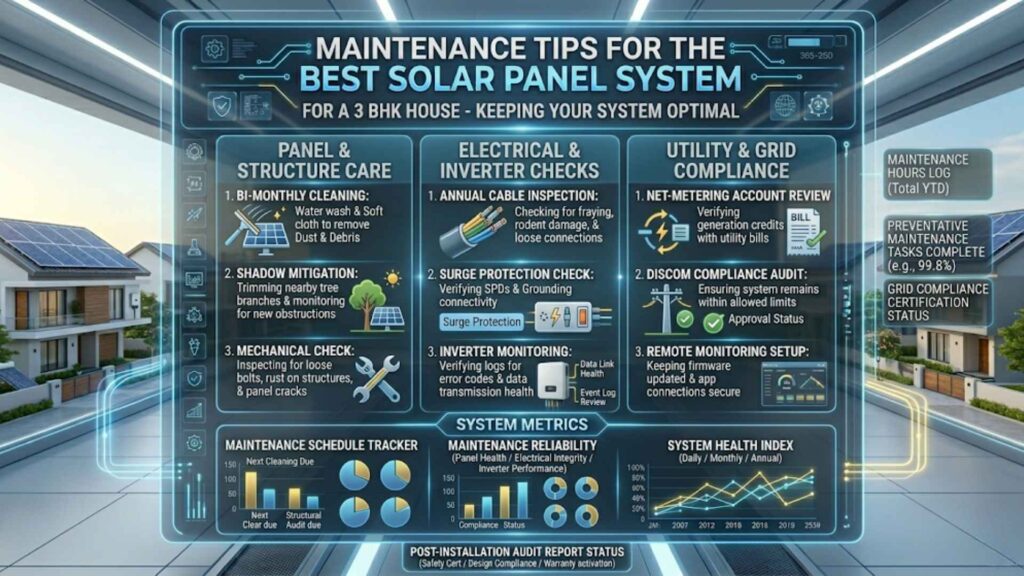
Maintenance is minimal, but consistency is key to keeping your “Green Signal” in generation.
- Cleaning Schedule: Dust is the biggest enemy of solar in India. Clean your panels with plain water every 10–14 days.
- Shading Check: Ensure no new construction or growing trees are casting shadows on the panels. Even a 10% shadow can reduce output by 50%.
- Cable Inspection: Once a year, check for any loose connections or wear and tear in the conduits.
Conclusion
The decision to install the best solar panel system for a 3 BHK house is a declaration of energy independence. In 2026, the technology has matured, the subsidies are at an all-time high, and the environmental impact is undeniable. By choosing a high-quality 3kW or 5kW N-Type system, you are not just saving on bills; you are increasing your home’s value and contributing to a sustainable future.
Frequently Asked Questions (FAQs)
Q1. How much roof space do I need for a 3 BHK solar plant?
For a 3kW system, you need approximately 250–300 sq. ft. For a 5kW system, aim for 450–500 sq. ft. of shadow-free area.
Q2. Can I run a 1.5 Ton AC on this system?
Yes. A 3kW system can easily run one 1.5 Ton Inverter AC during the day alongside other lights and fans. If you have multiple ACs, a 5kW system is recommended.
Q3. Is net metering mandatory?
If you are installing an On-Grid system to reduce your bills, net metering is essential. It allows you to send excess energy to the grid and get credit for it on your monthly bill.
Q4. What is the subsidy process in 2026?
You must apply through the National Portal for Rooftop Solar. After installation by a registered vendor and inspection by the DISCOM, the subsidy (CFA) is credited directly to your bank account within 30 days.