The global energy landscape is undergoing a radical shift. As we navigate through 2026, the question for most homeowners and industrial operators is no longer if they should switch to solar, but which technology will provide the highest return on investment over the next quarter-century. Among the various options, high-efficiency monocrystalline solar panels have emerged as the gold standard for those seeking performance, longevity, and aesthetic appeal.
In this exhaustive 2026 guide, we will explore why these panels are dominating the market, the technical innovations making them more powerful than ever, and a detailed financial analysis to help you decide if they are the right fit for your energy needs.
Understanding the Foundation of High-Efficiency Monocrystalline Solar Panels
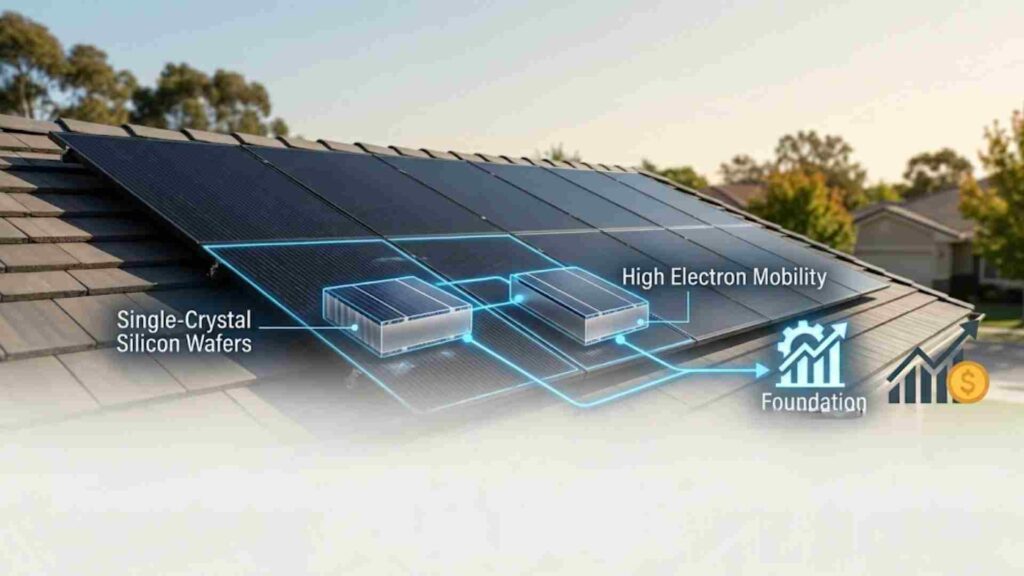
To appreciate the value of a premium product, one must understand its origin. Solar panels are not created equal, and the secret to the power of high-efficiency monocrystalline solar panels lies in the purity of their silicon.
The Czochralski Method: Crafting the Perfect Crystal
Unlike polycrystalline panels, which are made by melting multiple silicon fragments together, monocrystalline cells are “grown” from a single seed crystal of high-grade silicon. This process, known as the Czochralski method, results in a cylindrical ingot that is sliced into thin wafers. Because the entire cell is made of a single crystal, electrons have a clear, unobstructed path to flow.
In the world of physics, less resistance equals more power. This is the fundamental reason why high-efficiency monocrystalline solar panels consistently outperform their blue-colored, multi-crystalline counterparts.
The Visual and Structural Distinction
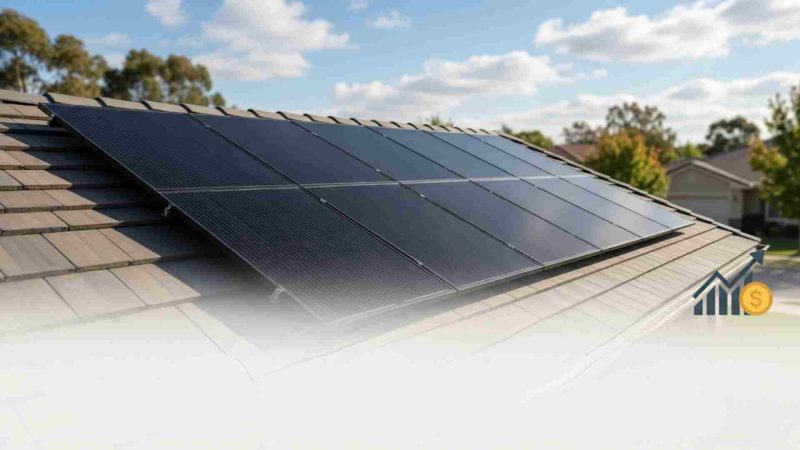
You can identify these panels by their sleek, dark (often black) appearance and rounded edges. In 2026, the trend has shifted toward “All-Black” modules, where even the backsheet and frame are black. This isn’t just for looks—the dark surface absorbs more sunlight across the spectrum, contributing to the “high-efficiency” tag.
The Technical Evolution of High-Efficiency Monocrystalline Solar Panels in 2026
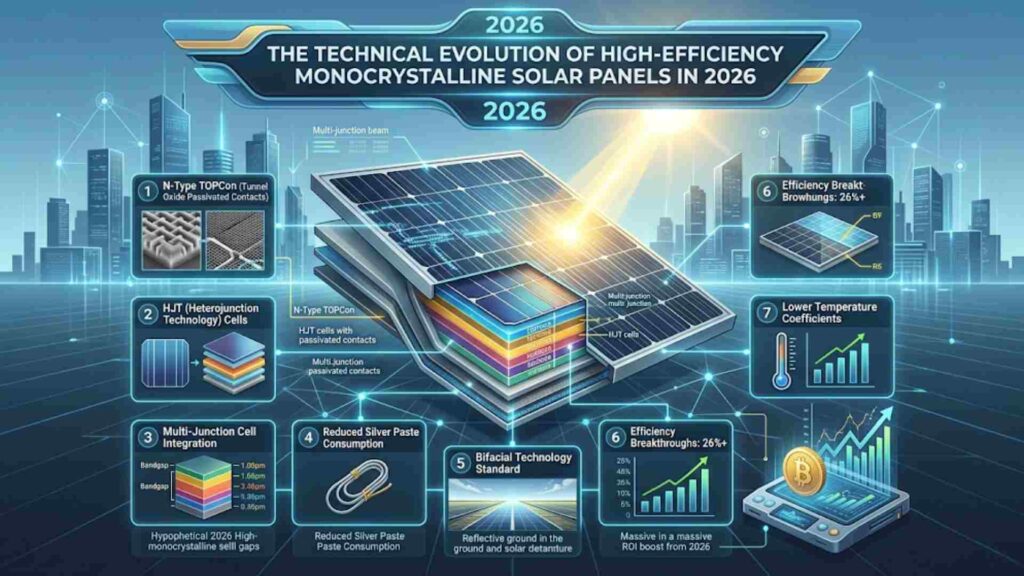
The solar industry does not sit still. The high-efficiency monocrystalline solar panels of today are significantly more advanced than those manufactured just three years ago. Several key technologies have pushed conversion rates from the old 18% average to a staggering 23%–25%.
N-Type TOPCon and HJT Technology
The industry has largely moved away from P-Type cells toward N-Type (Negative-type) silicon. Specifically, Tunnel Oxide Passivated Contact (TOPCon) technology has become the new benchmark.
- Lower Degradation: N-Type cells are immune to Light-Induced Degradation (LID).
- Higher Bifaciality: They can capture more light from the rear side.
- Better Conversion: They allow high-efficiency monocrystalline solar panels to reach theoretical efficiency limits that were previously thought impossible for commercial modules.
Half-Cut Cell Design and Multi-Busbars (MBB)
If you look closely at a modern panel, you’ll notice the cells are cut in half. This “Half-Cut” design reduces internal resistance and ensures that if one portion of the array is in the shade, the rest continues to produce energy at a high rate. Combined with 10 or 16 busbars (MBB), these advanced modules can transport electricity with minimal loss, even during peak afternoon heat when traditional systems often struggle with voltage drops.
Comparative Analysis: Efficiency, Cost, and Performance
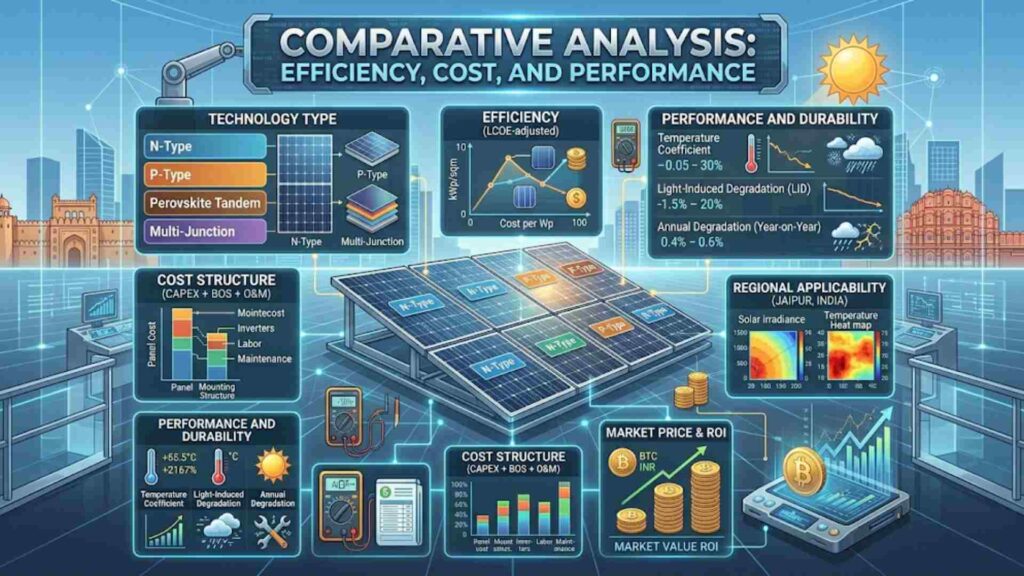
If you are still weighing your options, this table highlights why monocrystalline is the industry standard for 2026.
Performance Comparison Table
| Feature | Monocrystalline (High-Efficiency) | Polycrystalline | Thin-Film (Amorphous) |
| Current Efficiency (2026) | 22% – 25% | 15% – 18% | 10% – 13% |
| Temperature Coefficient | -0.29% to -0.35%/°C | -0.40% to -0.50%/°C | -0.20%/°C |
| Space Required (per kWp) | ~4.5 – 5 sq. meters | ~7 – 8 sq. meters | ~12 – 15 sq. meters |
| Performance in Shade | Excellent (Half-cut) | Poor | Fair |
| Degradation (Year 1) | <1.0% | 2.0% – 3.0% | 3.0%+ |
| Estimated Lifespan | 25 – 40 Years | 20 – 25 Years | 15 – 20 Years |
Economic Justification: Why High-Efficiency Monocrystalline Solar Panels Offer Better ROI
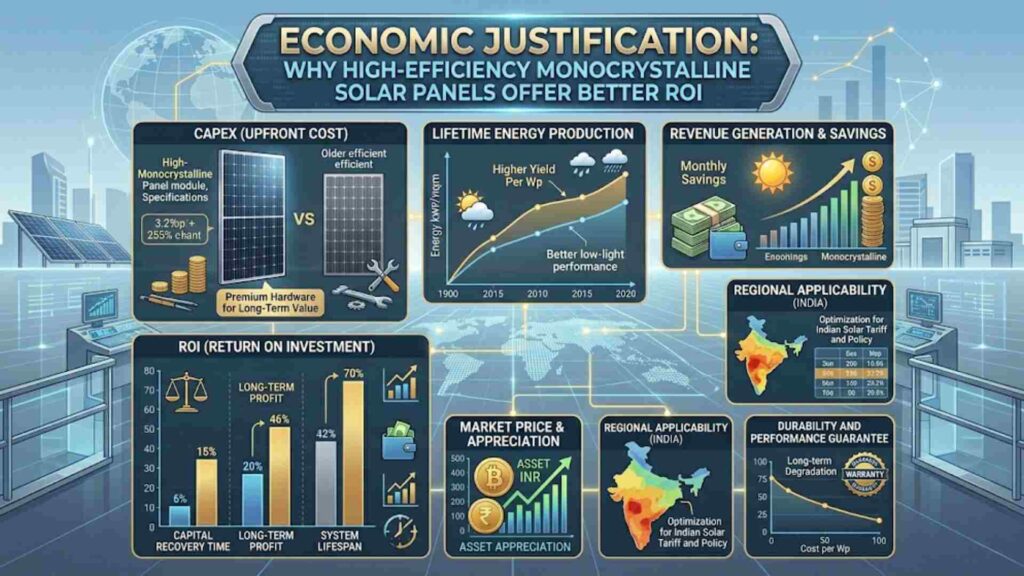
It is easy to be deterred by the higher upfront “sticker price” of premium panels. However, the true cost of solar is measured by the Levelized Cost of Energy (LCOE)—the total cost of the system divided by the total energy it will produce over its lifetime.
Reduced Balance of System (BOS) Costs
Because high-efficiency monocrystalline solar panels produce more power per square inch, you need fewer of them to reach your target capacity (e.g., a 5kW system).
- Fewer Rails and Clamps: Less mounting hardware is required.
- Lower Labor Costs: Installing 10 high-power panels is faster and cheaper than installing 16 low-power ones.
- Optimized Inverter Usage: High-efficiency strings allow inverters to start up earlier in the morning and shut down later at night.
Land and Roof Value Maximization
For a commercial factory or a residential villa, roof space is a finite asset. If you install low-efficiency panels, you “lock” your roof into a lower energy yield for 25 years. By choosing high-efficiency monocrystalline solar panels, you maximize the revenue-generating potential of every square meter of your property.
Environmental Impact and Sustainability
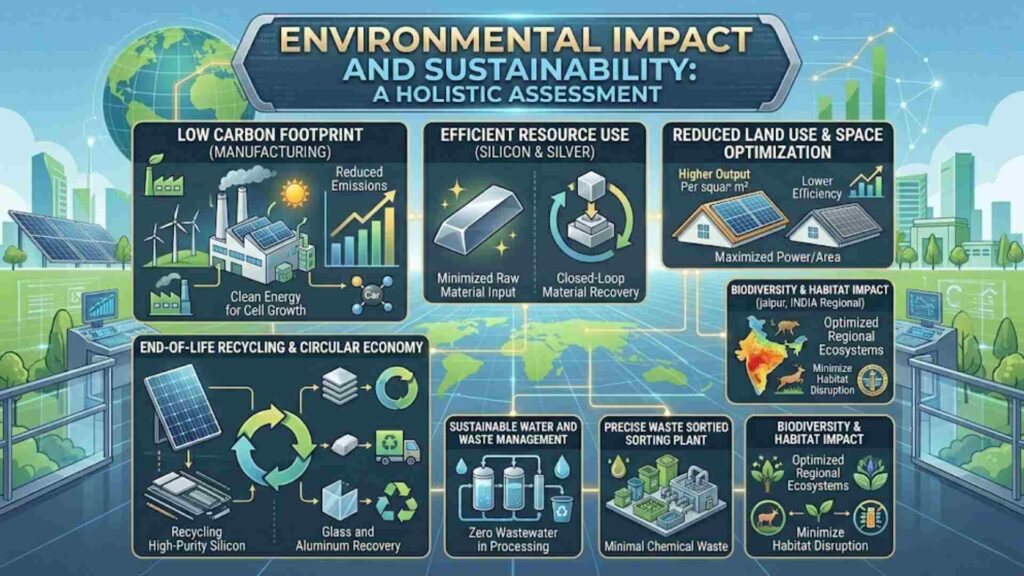
Choosing high-efficiency monocrystalline solar panels is also a greener choice in the long run.
- Lower Carbon Footprint per Watt: While the manufacturing process for pure monocrystalline silicon is energy-intensive, the fact that these panels produce significantly more energy over 30 years means their “energy payback time” is actually shorter than lower-quality alternatives.
- Resource Efficiency: Producing one 550W high-efficiency panel uses fewer raw materials (glass, aluminum, and silver) than producing two 275W panels.
Installation Best Practices for High-Efficiency Monocrystalline Solar Panels
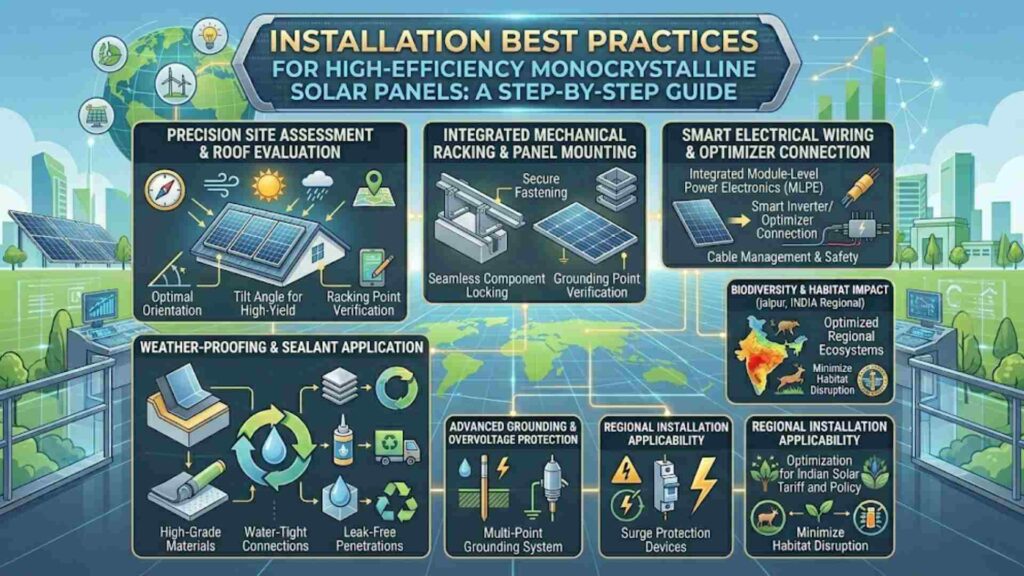
To truly see the benefits of your investment, the installation must match the quality of the hardware.
Optimization of Orientation for High-Efficiency Monocrystalline Solar Panels
In the Indian market, these modules should ideally face True South. Depending on your specific location, a tilt angle of 20 to 30 degrees ensures that the sun’s rays hit the surface perpendicularly for the longest possible duration. Proper alignment can increase your annual energy harvest by as much as 15%.
Smart Monitoring Solutions for High-Efficiency Monocrystalline Solar Panels
Modern high-efficiency systems are often paired with Smart Monitoring. By using micro-inverters or power optimizers with your high-efficiency monocrystalline solar panels, you can track the performance of every single cell. Since these panels are a premium asset, keeping them clean from dust (especially in desert regions) can increase yield by an additional 5-10%.
Conclusion: The Strategic Choice for a Sustainable Future
Investing in high-efficiency monocrystalline solar panels is an investment in certainty. While the energy market remains volatile, having a high-yield, durable, and technologically advanced power plant on your roof provides a level of financial independence that budget-grade solar simply cannot match.
For the homeowner, it means lower bills and higher property value. For the business owner, it means a faster path to “Green Energy” certification and significantly lower operational overheads. As we look at the data for 2026, the verdict is clear: the efficiency, durability, and superior technology make them the most logical and profitable investment in the renewable energy sector today.
Frequently Asked Questions (FAQ)
Q1: Are high-efficiency monocrystalline solar panels worth it for small homes?
Yes. In fact, they are most beneficial for small homes. When roof space is limited, high-efficiency panels are the only way to generate enough power to cover a modern household’s electricity bill.
Q2: How do these panels perform in extreme heat?
Monocrystalline panels have a superior Temperature Coefficient. This means that as the temperature rises above 25°C, they lose less voltage than polycrystalline panels, making them ideal for hot climates.
Q3: What is the typical warranty for high-efficiency monocrystalline solar panels in 2026?
Most Tier-1 manufacturers now offer a 25-year product warranty and a 25 to 30-year linear performance warranty, guaranteeing that the panels will still produce at least 85-89% of their original power after three decades.
Q4: Can I mix monocrystalline and polycrystalline panels?
It is not recommended. Different panels have different electrical characteristics (Voltage and Amperage). Mixing them can lead to “mismatch losses” and significantly reduce the efficiency of your entire string.