
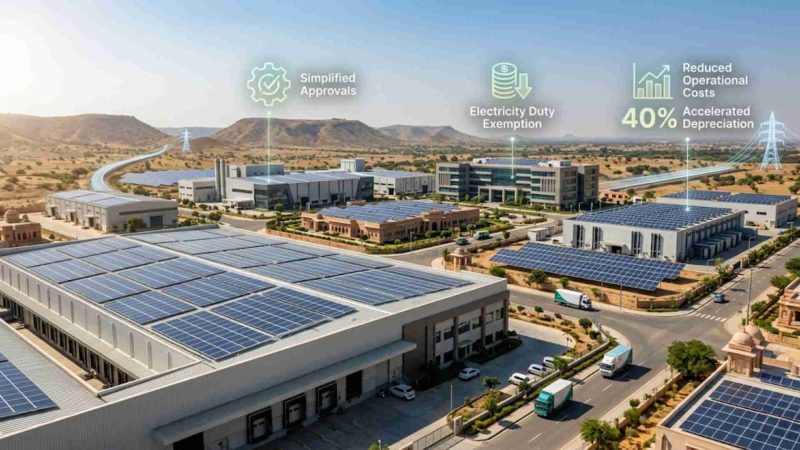
Rajasthan’s Integrated Clean Energy Policy 2024 has transformed the state into a hub for sustainable business growth. By switching to solar, companies can now leverage substantial tax benefits for commercial solar Rajasthan, including 40% accelerated depreciation and a 7-year electricity duty waiver. These incentives significantly lower the initial investment and shorten the payback period for industrial users.
Beyond direct savings, the policy simplifies the transition through streamlined “single-window” approvals and improved energy banking facilities. For businesses in 2026, adopting solar is a smart financial move that ensures long-term price stability against rising grid tariffs. This framework makes Rajasthan the ideal location for energy-intensive industries looking to optimize their margins.
Unlocking Federal Incentives: Federal Tax Benefits for Commercial Solar Rajasthan

The Integrated Clean Energy Policy 2024 was designed to simplify the “Ease of Doing Business” in the renewable sector. Unlike previous policies that were fragmented, the 2024 version integrated solar, wind, and hybrid systems into a single window clearance system.For commercial power users, this means faster commissioning of projects and guaranteed access to the state’s transmission network. If you are looking for tax benefits for commercial solar Rajasthan, the first place to look is the exemption list provided under this policy, which works in tandem with the Rajasthan Investment Promotion Scheme (RIPS).
Unlocking Federal Tax Benefits for Commercial Solar Rajasthan

While state policies provide the local push, federal tax laws provide the heavy lifting for ROI. Any commercial entity in Jaipur, Jodhpur, or Bhiwadi can leverage these central incentives.
Maximizing ROI with Accelerated Depreciation: A Key Tax Benefit for Commercial Solar Rajasthan
Under Section 32 of the Income Tax Act, businesses can claim Accelerated Depreciation on solar energy systems. As of 2026, the rate remains highly attractive at 40%.
- How it works: Instead of spreading the tax deduction over 15–20 years, a business can write off a massive portion of the solar plant’s cost in the very first year of operation.
- The Impact: This significantly reduces taxable income, effectively providing a “discount” on the project cost through tax savings.
Section 80-IA (The Tax Holiday Perspective)
While many older tax holidays have transitioned, certain structures under the 2024 policy allow for deductions on profits derived from “Generation of Power.” For large-scale industrial units setting up captive plants, this remains a vital pillar of tax benefits for commercial solar Rajasthan.
State-Level Advantages: Rajasthan State Incentives and Tax Benefits for Commercial Solar Rajasthan
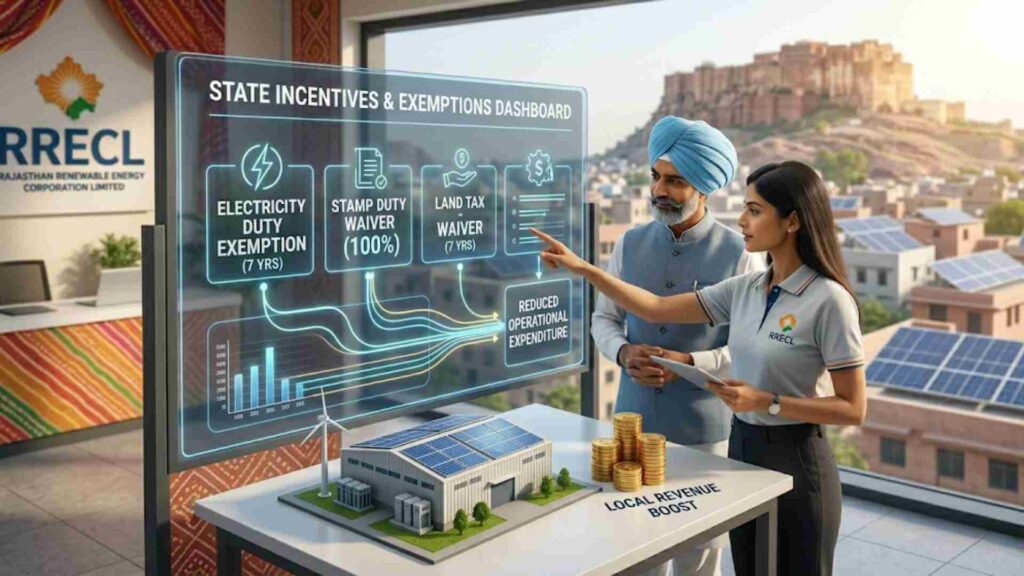
The Rajasthan government’s 2024 policy provides specific exemptions that directly lower the “Levelized Cost of Energy” (LCOE).
Electricity Duty (ED) Exemptions: Crucial Tax Benefits for Commercial Solar Rajasthan
One of the most significant tax benefits for commercial solar Rajasthan is the 100% exemption from Electricity Duty.
- The Rule: For commercial users setting up solar plants for captive consumption, the state offers a full waiver on ED for a period of 7 years from the date of commissioning.
- The Saving: Given that ED can range from ₹0.40 to ₹1.00 per unit depending on the industry, this waiver adds up to millions in savings for heavy power users like textile mills or cement plants.
Stamp Duty and Land Tax Waivers
Under the Integrated Clean Energy Policy 2024, commercial solar developers and captive users enjoy:
- 100% Exemption on Stamp Duty: For land purchased or leased for solar power projects.
- Land Tax Exemption: A 100% waiver on land tax for the first 7 years, making the “cost of space” significantly lower.
Operational Gains: Banking and Wheeling Charges
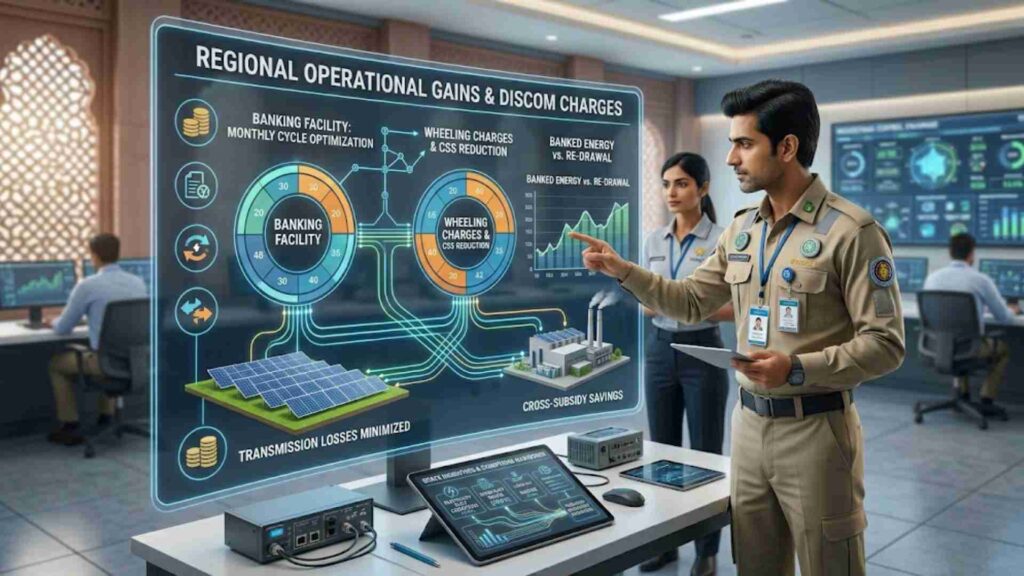
Tax benefits are great, but operational flexibility is where the 2024 policy truly shines for commercial power users.
Energy Banking Facilities
The 2024 policy improved “Banking” rules. Banking allows you to “store” the excess energy you generate during the day with the Discom (like JVVNL or JDVVNL) and draw it back during the night or during peak hours.
- The banking period is now calculated on a monthly cycle, providing better alignment with industrial production schedules.
Cross-Subsidy Surcharge (CSS) and Additional Surcharge
For businesses opting for Open Access Solar (buying solar from a third-party park), the 2024 policy provides a roadmap for reduced CSS. This is a critical component of the tax benefits for commercial solar Rajasthan, as it makes third-party solar purchase agreements (PPA) competitive with the Discom’s high commercial tariffs.
Financial Comparison: Solar vs. Grid Power in Rajasthan (2026)
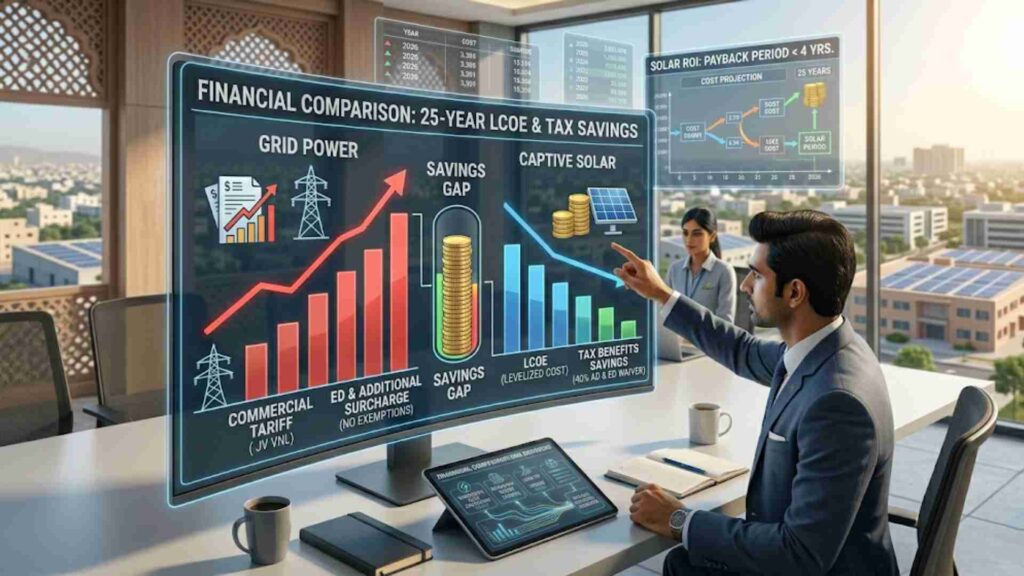
To understand why the tax benefits for commercial solar Rajasthan are so impactful, we must look at the numbers.
| Feature | Grid Power (Discom) | Commercial Solar (Captive) |
| Average Tariff | ₹8.50 – ₹11.00 per unit | ₹3.50 – ₹4.50 (Levelized) |
| Electricity Duty | Applicable (100%) | Exempt for 7 Years |
| Tax Savings | None | 40% Accelerated Depreciation |
| Price Stability | Variable (Increases annually) | Fixed for 25 years |
| Carbon Credits | None | High Market Value (BRSR Reporting) |
How to Claim Tax Benefits for Commercial Solar Rajasthan

Claiming these benefits requires a systematic approach and proper documentation.
Step 1: RRECL Registration
Your project must be registered with the Rajasthan Renewable Energy Corporation Limited (RRECL). This is the nodal agency that certifies your plant for state-level exemptions.
Step 2: Net-Metering/Gross-Metering Agreement
For rooftop commercial solar, you must sign an agreement with your local Discom. The 2024 policy allows for Net-Metering up to 500 kW or your sanctioned load, whichever is lower.
Step 3: Audited Financials for AD
To claim the tax benefits for commercial solar Rajasthan related to depreciation, ensure your Chartered Accountant has the commissioning certificate and the final invoices of the solar components (Modules, Inverters, and Structures).
Industry-Specific Impact in Rajasthan
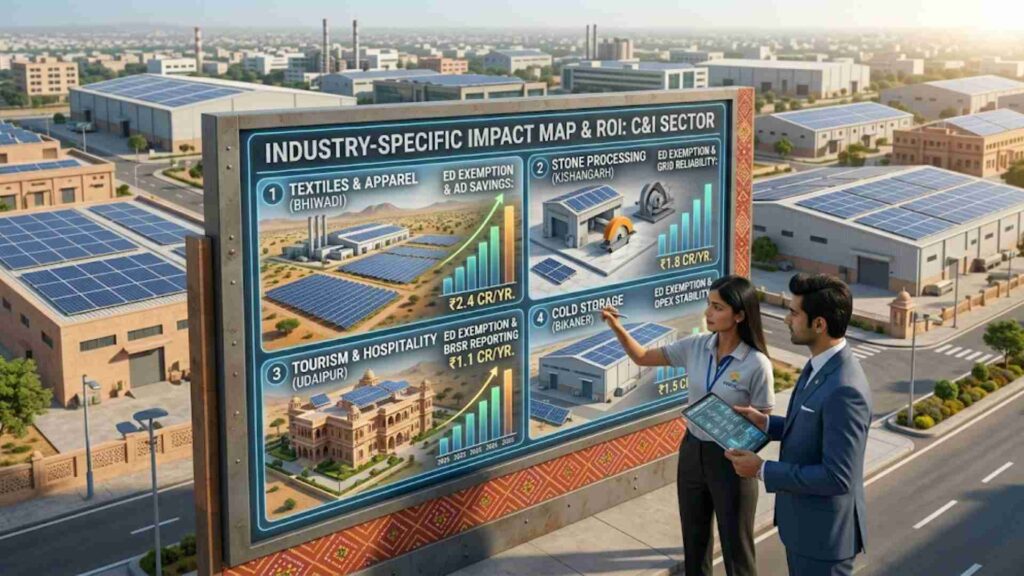
Different sectors in Rajasthan benefit in unique ways from the 2024 Clean Energy Policy:
- Hospitality & Resorts (Udaipur/Jaipur): By using solar, hotels can market themselves as “Green Stays” while using tax savings to upgrade guest amenities.
- Stone & Marble Units (Kishangarh/Rajsamand): High-energy cutting tools lead to massive bills. The 100% ED exemption provides an immediate boost to their bottom line.
- Warehousing & Logistics: Large roof spaces are being converted into “Revenue Generators” through rooftop solar, utilizing the 40% AD to offset corporate taxes.
Conclusion: The Future is Bright and Tax-Free
The Rajasthan Integrated Clean Energy Policy 2024 has removed the barriers that once made solar a “complex” investment. By combining state-level duty waivers with federal tax benefits for commercial solar Rajasthan, the payback period for a commercial system has dropped to an average of 3.2 to 4 years.
In 2026, staying on the grid is no longer just an expense—it is a missed opportunity. Transitioning to solar allows you to lock in your energy costs for the next two decades while significantly reducing your tax liability today.
Frequently Asked Questions (FAQs)
Q1: Can I claim both RIPS benefits and Accelerated Depreciation?
Yes. RIPS (State level) and Accelerated Depreciation (Federal/Income Tax level) are independent. You can enjoy the 100% Electricity Duty waiver from the state while simultaneously claiming 40% AD on your income tax returns.
Q2: What is the maximum capacity for commercial solar under the 2024 policy?
For Net-Metering, the limit is generally 500 kW. However, for Captive Power Plants (Behind-the-meter or Open Access), there is no upper limit, provided it matches your sanctioned load and technical feasibility.
Q3: Are there any tax benefits for commercial solar Rajasthan specifically for MSMEs?
Yes. MSMEs often get additional interest subvention (lower interest rates) on solar loans under the Rajasthan Investment Promotion Scheme (RIPS) 2024, alongside the standard tax deductions.
Q4: Does the policy cover Solar-Wind Hybrid systems?
Yes. The 2024 policy specifically encourages “Hybridization.” If your business has a 24/7 load, a hybrid system can offer better banking terms and higher tax savings on a larger capital investment.
Q5: Is GST applicable on commercial solar installations in 2026?
Solar components generally fall under a concessional GST bracket (typically an effective rate of around 12% for the total EPC contract), which is much lower than standard industrial equipment (18-28%).