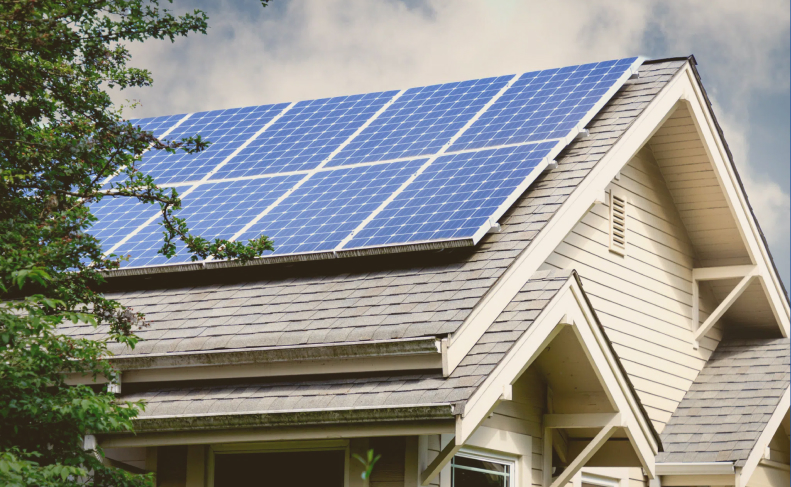

Are you tired of paying electricity bills that seem to get higher every summer? You are not alone. With the launch of the PM Surya Ghar Muft Bijli Yojana, millions of Indian homeowners are switching to solar. But the biggest question remains: How much do you actually have to pay from your own pocket? The headline figure is attractive: a flat ₹78,000 subsidy from the central government. But what is the final 3kW solar system price in India with subsidy? Is it really as affordable as the ads claim?
In this detailed guide, we will break down the exact costs, hidden charges, component prices, and the Return on Investment (ROI) to help you decide if a 3kW system is right for your home.
Understanding the 3kW Solar System Capacity
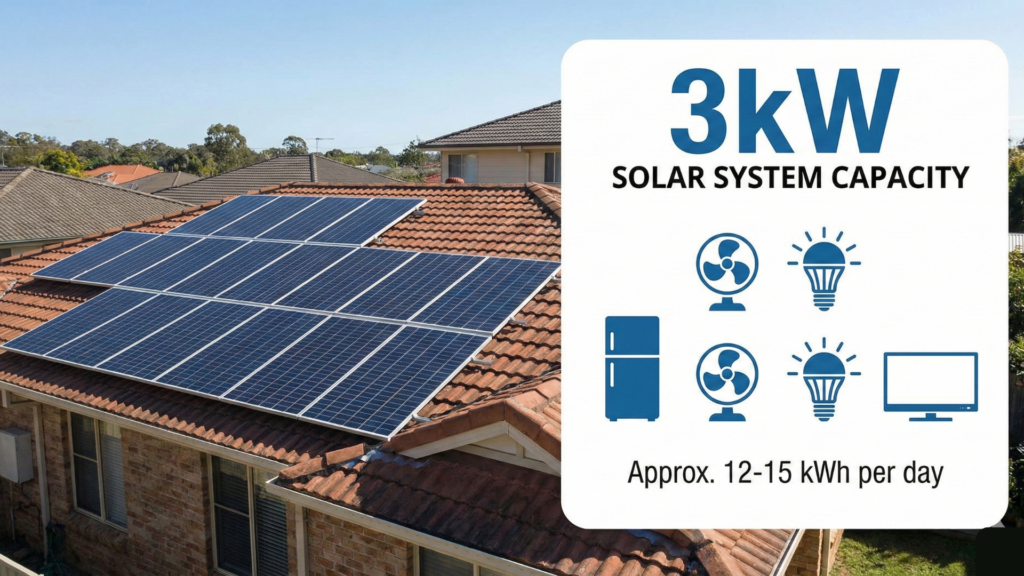
Before we talk about money, it is crucial to understand what a 3kW system actually delivers. For the average Indian middle-class household (2-3 BHK), a 3kW system is often the “Goldilocks” size—not too big, not too small.
- Daily Generation: ~12 to 15 Units (kWh) per day.
- Monthly Generation: ~360 to 450 Units per month.
- Space Required: Approx. 300 sq. ft. of shadow-free roof area.
If your monthly electricity bill is between ₹2,500 and ₹4,000, a 3kW system is likely the perfect fit to bring your bill down to nearly zero.
The PM Surya Ghar Subsidy Structure (2025)
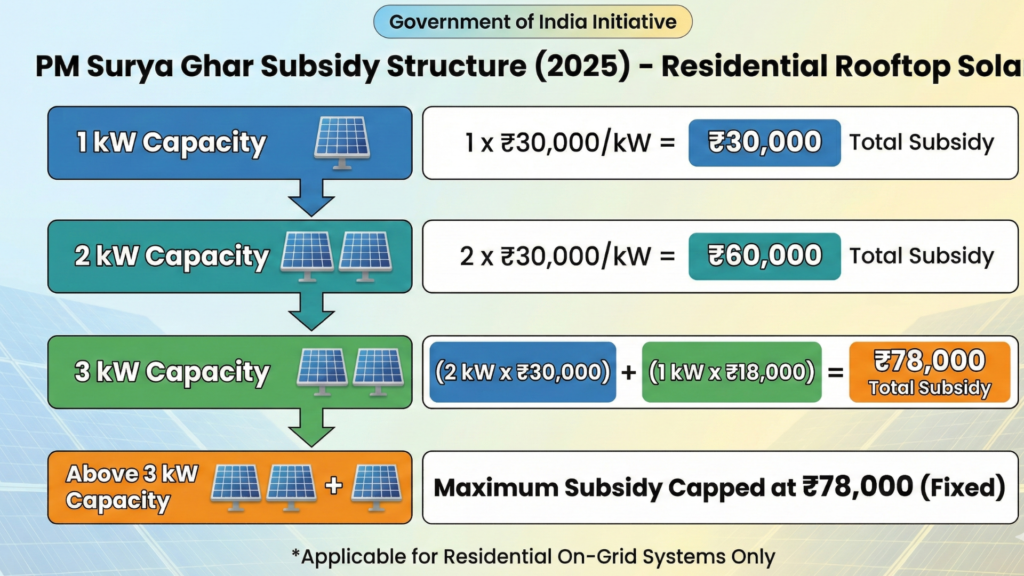
The government has simplified the subsidy (CFA – Central Financial Assistance) process significantly. Unlike previous years where percentages were confusing, we now have fixed caps.
The subsidy is applicable only to residential homes with an On-Grid connection (connected to the government electricity meter).
Table 1: Government Subsidy Structure for 3kW Solar System
| System Capacity | Subsidy Calculation Rule | Total Subsidy Amount |
| 1 kW System | ₹30,000 per kW | ₹30,000 |
| 2 kW System | ₹30,000 × 2 | ₹60,000 |
| 3 kW System | ₹30,000 (for first 2kW) + ₹18,000 (for next 1kW) | ₹78,000 |
| Above 3 kW | Fixed Cap (Maximum Subsidy) | ₹78,000 |
Key Takeaway: The sweet spot for maximum government benefit is exactly 3kW. If you install 4kW or 5kW, you still only get ₹78,000, reducing the percentage of government support.
3kW Solar System Price in India with Subsidy: The Real Cost Breakdown
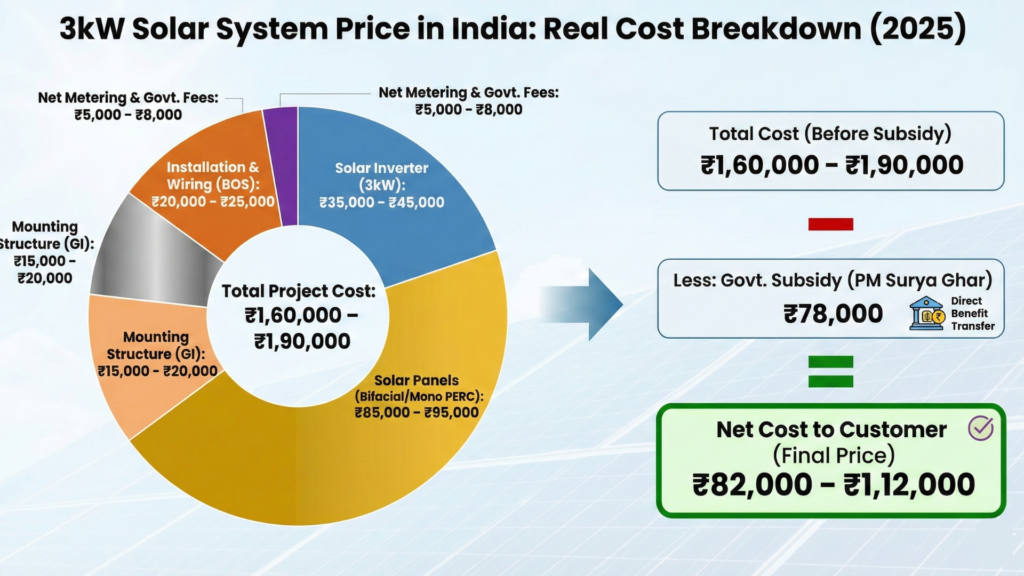
Now, let’s answer the main query. The market price of solar components has fluctuated, but as of 2025, prices have stabilized.
The “Market Price” (what you pay the vendor) depends heavily on the technology you choose. Polycrystalline panels are cheaper but older technology. Mono PERC and Bifacial panels are more expensive but generate more power in low light.
Below is a realistic price estimation for a high-quality On-Grid 3kW System using Mono PERC panels (the current standard).
Table 2: Component-Wise 3kW Solar System Cost in India
| Component | Estimated Cost (₹) | Notes |
| Solar Panels (Bifacial/Mono PERC) | ₹85,000 – ₹95,000 | 540W or 580W high-efficiency modules |
| Solar Inverter (3kW) | ₹35,000 – ₹45,000 | Good brands like Growatt, GoodWe, or Sofar |
| Mounting Structure (GI) | ₹15,000 – ₹20,000 | Galvanized Iron (Rust-proof) is essential |
| Installation & Wiring (BOS) | ₹20,000 – ₹25,000 | AC/DC cables, earthing kit, lightning arrestor |
| Net Metering & Govt. Fees | ₹5,000 – ₹8,000 | Official DISCOM charges |
| Total Project Cost (Before Subsidy) | ₹1,60,000 – ₹1,90,000 | Varies by state & vendor |
| Less: Govt. Subsidy | (-) ₹78,000 | Direct Benefit Transfer (DBT) |
| Net Cost to Customer | ₹82,000 – ₹1,12,000 | Final price you pay effectively |
The Verdict on Price
So, for a high-quality system, you are looking at an effective investment of approximately ₹1 Lakh. If you choose cheaper panels or a local inverter, this could drop to ₹75,000, but that often compromises long-term reliability.
On-Grid vs. Hybrid: Which 3kW Solar System is Right for You?
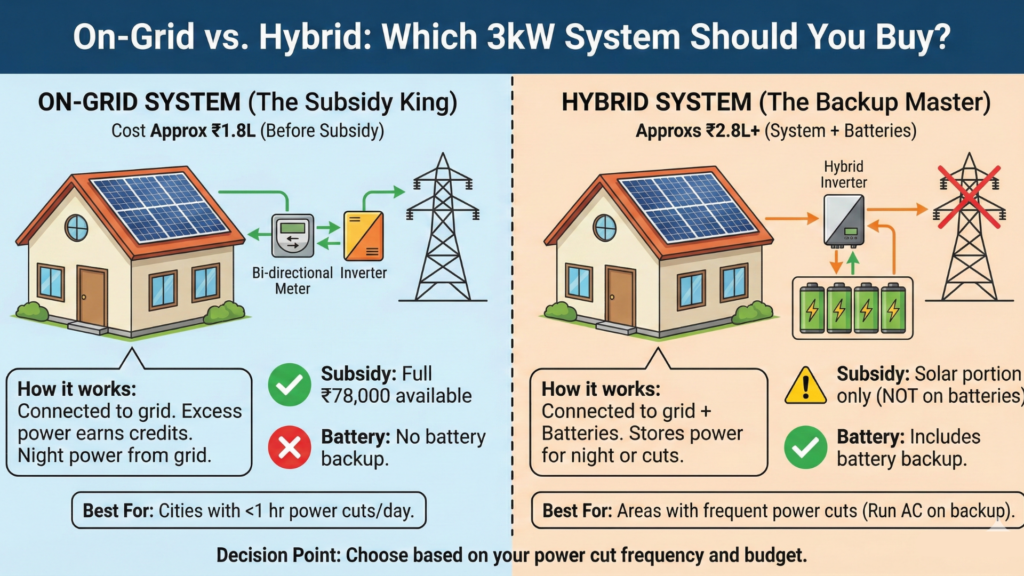
When searching for the “3kW solar system price in India with subsidy,” you will encounter different types of systems. The subsidy rules apply differently to them.
1. On-Grid 3kW Solar System Benefits and Limitations
- How it works: Connected to the electricity grid. When you produce excess power, it goes to the government, and they give you credits. At night, you pull from the grid.
- Subsidy: Full ₹78,000 available.
- Battery: No battery backup.
- Best For: Cities with less than 1 hour of power cuts per day.
- Cost: Lowest (approx ₹1.8L before subsidy).
2. Hybrid 3kW Solar System Price and Battery Cost
- How it works: Connected to the grid BUT also has batteries. It stores power for night use or power cuts.
- Subsidy: You get the subsidy on the solar plant components, but NOT on the batteries.
- Cost: Higher.
- System Cost: ₹1.8L
- Battery Cost (Lithium): +₹1L
- Total: ₹2.8L+
Best For: Areas with frequent power cuts where you want to run ACs on solar backup.
Can a 3kW Solar System Run an Air Conditioner (AC)?
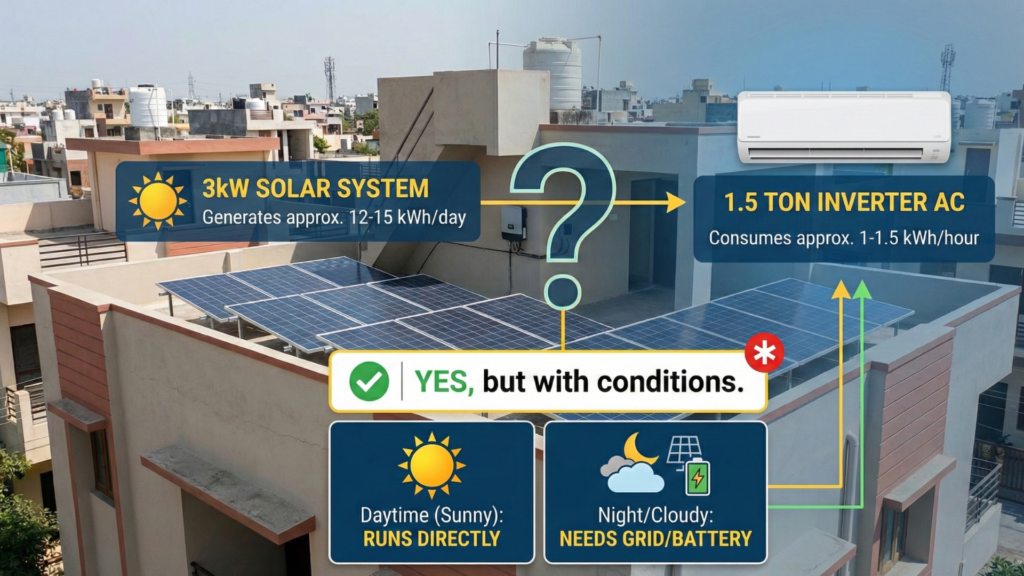
This is the most common question homeowners have. The answer is a Yes, but with conditions.
A 3kW system generates roughly 12 to 15 units a day.
- A 1.5 Ton Inverter AC consumes about 1 to 1.5 units per hour.
If you run your AC for 8 hours at night, it might consume 10-12 units. This means your 3kW system produces just enough to cover the AC usage, leaving little for other appliances like the fridge, lights, and fans.
Recommendation: If you want to run an AC stress-free, a 3kW system will offset the bill, but you might still pay a small amount to the electricity department during peak summer months. For a completely zero bill with heavy AC usage, a 4kW or 5kW system is often safer.
Return on Investment (ROI) for a 3kW Solar System in India
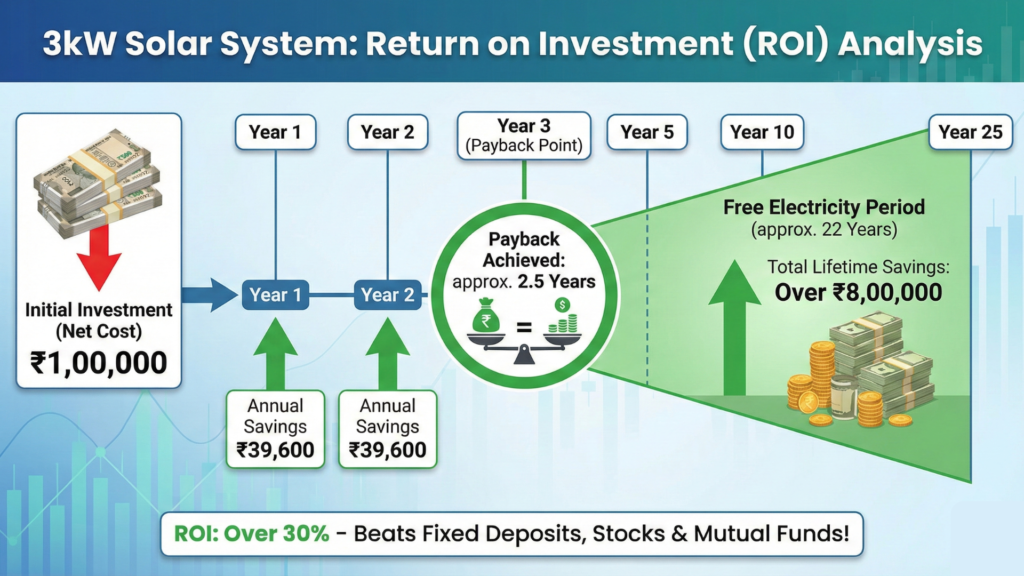
Let’s talk pure finance. Is spending ₹1,00,000 (after subsidy) worth it?
- Average Bill Without Solar: ₹3,500/month.
- Average Bill With 3kW Solar: ₹200/month (Fixed meter charges).
- Monthly Savings: ₹3,300.
- Annual Savings: ₹3,300 × 12 = ₹39,600.
Payback Period Calculation:
To calculate how fast you recover your money, simply divide your Net Cost by your Annual Savings.
If your Net Cost is ₹1,00,000 and you save ₹39,600 per year, your payback period is approximately 2.5 Years.
Conclusion: You recover your entire investment in 2.5 to 3 years. Since solar panels last for 25 years, you essentially get free electricity for the next 22 years. This is an ROI of over 30%, which beats any Fixed Deposit, Stock, or Mutual Fund returns.
Factors That Affect the 3kW Solar Price
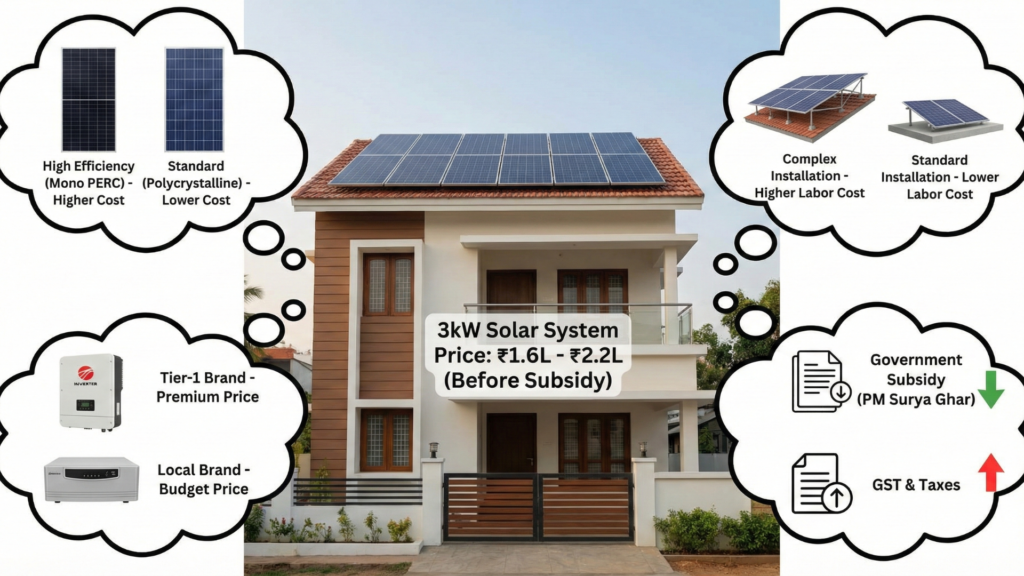
While we gave you an estimate, the final quote from your vendor might differ. Here is why:
1. Elevated Structure (High Rise)
If you want the solar panels raised 8-10 feet high so you can walk underneath them (to use your roof for parties or drying clothes), the structure cost increases. This can add ₹15,000 to ₹25,000 to the final bill.
2. Wire Length
The standard installation cost usually covers up to 30 meters of wiring. If your roof is on the 4th floor and your meter is on the ground floor, the extra DC cable (which is expensive, approx ₹60-₹80 per meter) will add to the cost.
3. Brand Selection
- Tier-1 Brands: Tata Power, Adani, Waaree, Mammuth (Usually 5-10% costlier).
- Local Assemblers: Cheaper by ₹10k-₹20k, but warranty service might be risky.
How to Apply for the 3kW Solar Subsidy
To ensure you actually get the 3kW solar system price in India with subsidy benefit, you must follow the official government route. Do not pay cash to a vendor and expect a subsidy later.
- Register: Go to the National Portal (pmsuryaghar.gov.in).
- Apply: Enter your electricity consumer number and state details.
- Vendor Selection: Once approved, choose a vendor registered on the portal. (Only registered vendors can process the subsidy).
- Installation: The vendor installs the system.
- Net Metering: The local electricity department (DISCOM) installs the net meter.
- Inspection: A government official approves the safety of the plant.
- Subsidy Release: You upload a cancelled cheque on the portal, and the ₹78,000 is credited directly to your bank account within 30 days.
Conclusion
The 3kW solar system price in India with subsidy is currently at its most attractive point in history. With the net cost hovering between ₹80,000 and ₹1.1 Lakhs, and a payback period of under 3 years, it is no longer a luxury—it is a smart financial decision.
By installing a 3kW system, you are not just saving ~₹40,000 a year; you are also protecting yourself from future electricity rate hikes. If you have the roof space and the budget, 2025 is the best year to make the switch.
Ready to switch? Start by checking your latest electricity bill to confirm your sanctioned load is at least 3kW!
FAQ: 3kW Solar System Price in India with Subsidy (2025)
Q1: What is the exact subsidy for a 3kW solar system in 2025?
A: Under the PM Surya Ghar Muft Bijli Yojana, the subsidy is capped at ₹78,000 for any residential system of 3kW or higher capacity.
Q2: Can I get the subsidy if I install it myself?
A: No. To avail of the subsidy, the installation must be done through a vendor registered on the National Solar Portal.
Q3: Does the 3kW solar system work during a power cut?
A: If it is an On-Grid system (which is the most common for subsidy), NO, it will not work during a power cut for safety reasons (anti-islanding). If you need power during cuts, you need a Hybrid system with batteries.
Q4: How much roof space do I need for 3kW?
A: You need approximately 300 sq. ft. (roughly 27-30 square meters) of shadow-free area.
Q5: Are there any monthly charges after installation?
A: Solar maintenance is very low. You only need to clean the panels with water every 2 weeks. There are no monthly fees, though you may pay a small “fixed charge” to the electricity department for the grid connection (usually ₹100-₹200).
Q6: What happens if I generate more electricity than I use?
A: The extra units are exported to the grid. Your electricity bill will show a “credit” balance, which is adjusted against your usage in future months (e.g., during monsoon/winter when generation is lower).