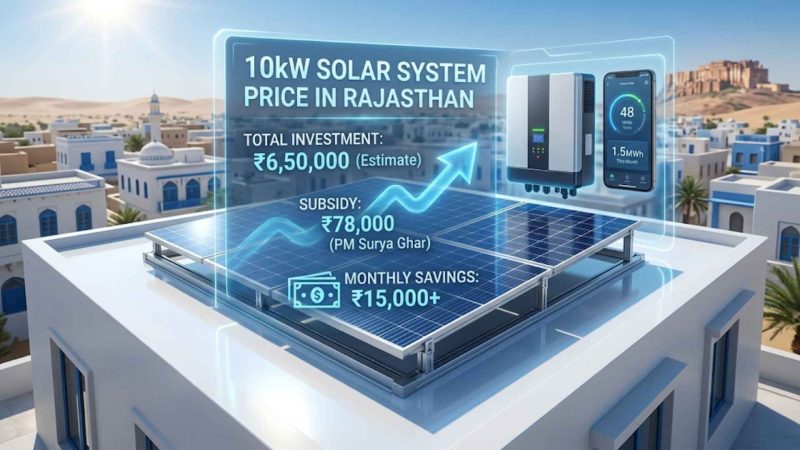
In 2026, the energy landscape in India is shifting rapidly toward sustainability. For residents of Rajasthan, a state blessed with the highest solar irradiance in the country, installing a solar plant is the most logical financial move. If your monthly electricity consumption is high, a 10kW system can practically eliminate your utility bills. Central to this transition is the technology you choose, specifically the price of 10kW bifacial solar panels in India, which has become a primary focus for smart investors.
Defining the 10kW Solar Capacity
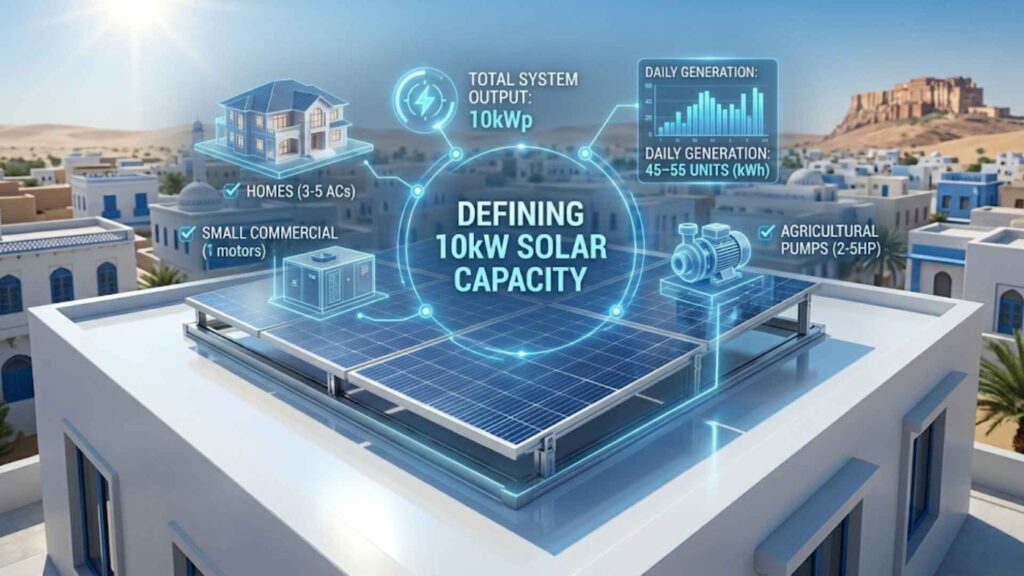
A 10kW solar system is categorized as a “small commercial” or “large residential” setup. It is designed to handle a heavy load, typically generating between 45 to 55 units (kWh) per day.
What Can You Power with 10kW?
- Residential: 4-5 Air Conditioners (1.5 Ton), a water pump (2HP), lighting for a 5-6 bedroom house, and EV charging.
- Commercial: Small workshops, cooling units for shops, or server rooms for small IT offices.
- Agricultural: Drip irrigation systems and small-scale cold storage.
Why the Price of 10kW Bifacial Solar Panels in India is the Key to High Efficiency
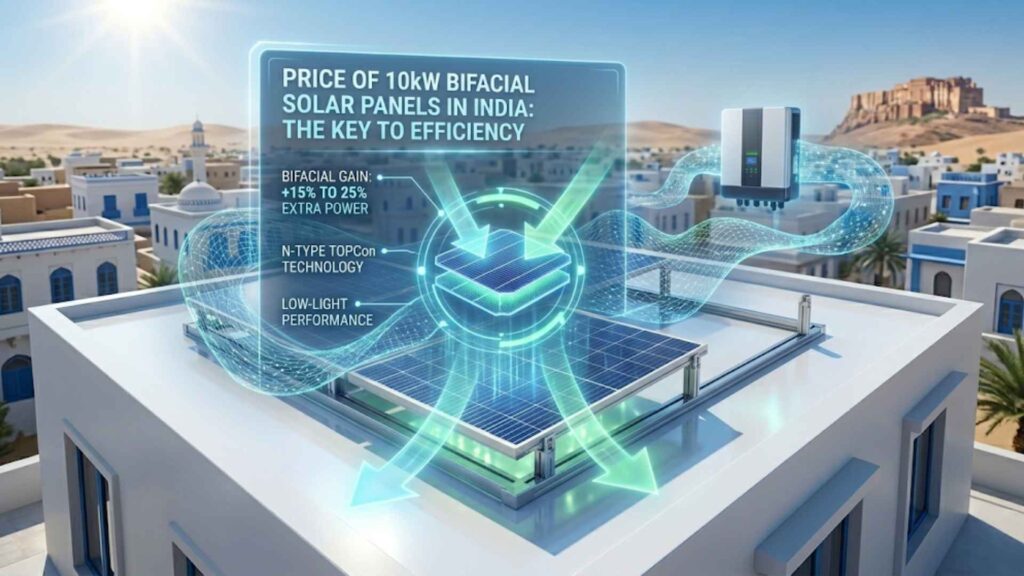
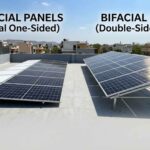
Bifacial panels are the future of green energy. Unlike standard panels, these have glass on both sides. They capture light from the front and reflected light from the back.
The Science of Bifacial Gain in Rajasthan
Rajasthan’s geography is unique. The presence of sandy terrain and light-colored rooftops provides high Albedo (reflectivity). Bifacial panels use this reflected light from the ground to generate up to 20% more power. Even if the price of 10kW bifacial solar panels in India is slightly higher than standard panels, the extra generation makes the payback period much faster.
Low Light and Diffuse Radiation Performance
Bifacial panels are exceptional during cloudy days or early mornings. Because they can absorb diffuse radiation from the atmosphere through the back side, the energy curve stays flatter and longer throughout the day compared to monofacial setups.
Detailed Market Breakdown: Price of 10kW Bifacial Solar Panels in India
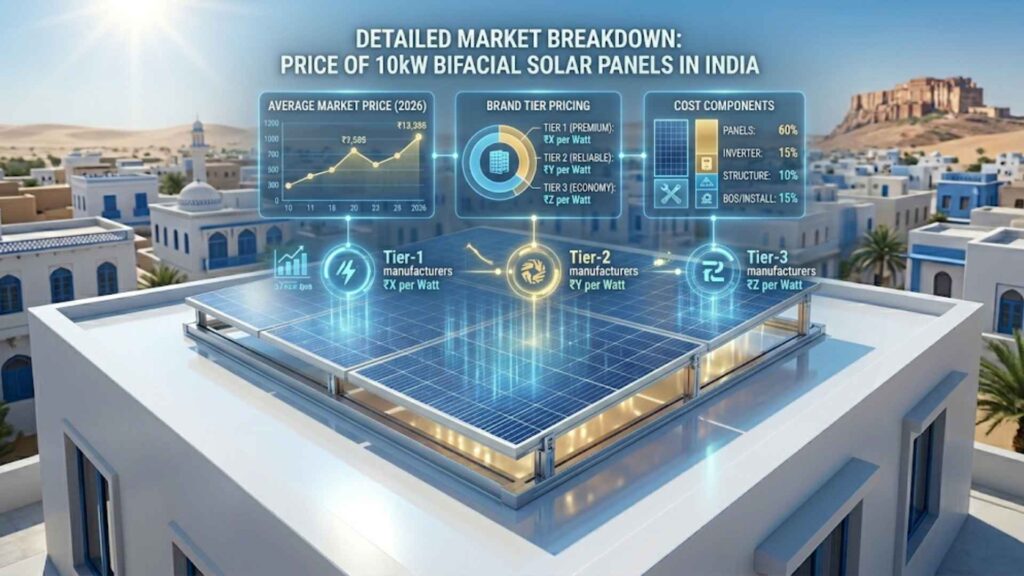
To understand the total investment, we must look at the current market trends for 2026. The market rate for 10kW bifacial solar systems has stabilized due to increased domestic manufacturing under the PLI scheme.
Brand Tiers and Their Impact on Cost
The market is divided into Tier-1, Tier-2, and Tier-3 manufacturers.
- Tier-1 Brands: These offer the highest efficiency (22%+) and long-term warranties (30 years).
- Tier-2 Brands: Reliable performance at a lower price of 10kW bifacial solar panels in India.
- Tier-3 Brands: Budget-friendly but may have higher annual degradation rates.
10kW System Component Cost Table
| Component | Specification | Estimated Cost (INR) |
| Solar Panels | 10kW Bifacial (N-Type TOPCon) | ₹3,85,000 – ₹4,15,000 |
| Inverter | 10kW On-Grid (High Efficiency) | ₹85,000 – ₹1,10,000 |
| Structure | High-Rise HDG (Hot-Dip Galv.) | ₹65,000 – ₹85,000 |
| BOS | DC/AC Cables, Earthings, DBs | ₹55,000 – ₹70,000 |
| Installation | Professional Commissioning | ₹40,000 – ₹55,000 |
| Total Cost | Before Subsidy | ₹6,30,000 – ₹7,35,000 |
Government Subsidies Reducing the Price of 10kW Bifacial Solar Panels in India
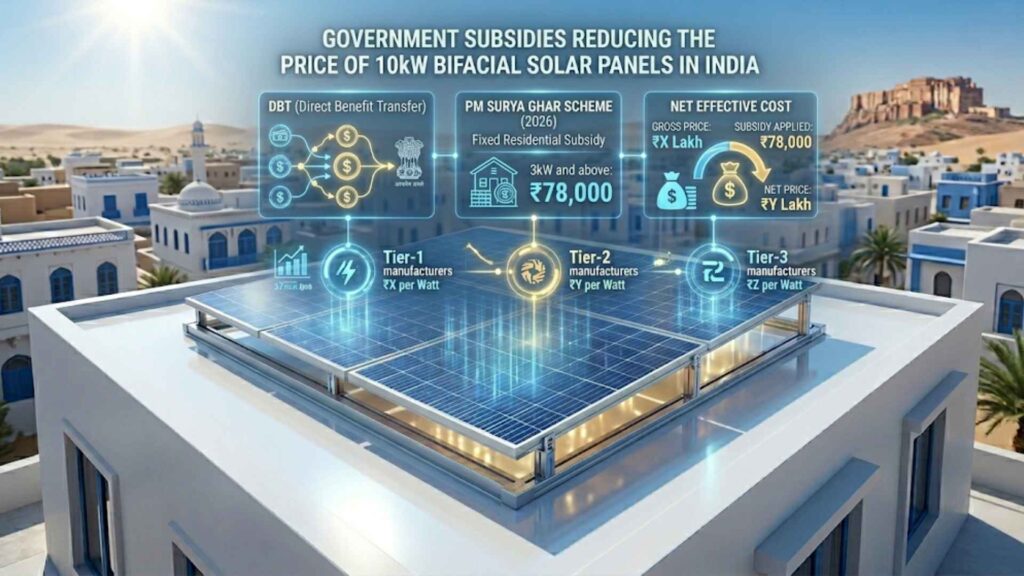
The Indian government’s PM Surya Ghar Muft Bijli Yojana has revolutionized residential solar adoption. While a 10kW system is large, the subsidy calculation follows a specific slab that helps lower the effective price of 10kW bifacial solar panels in India.
Residential Subsidy Slab (2026)
- Up to 2kW: ₹30,000 per kW (Max ₹60,000)
- For the 3rd kW: Additional ₹18,000
- Above 3kW: The subsidy is capped at a total of ₹78,000.
Even though the subsidy stops increasing after 3kW, the “cost per watt” for a 10kW system is much lower than a 3kW system because of bulk purchasing and shared installation costs.
Installation Standards for 10kW Bifacial Solar Panels
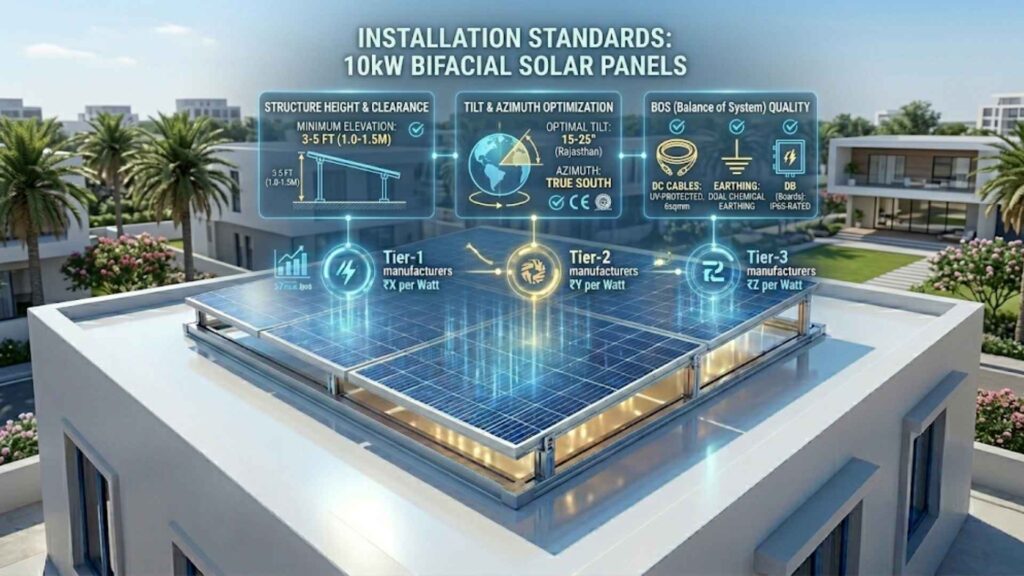
Proper setup is crucial. If the installation is poor, you will not get the extra “bifacial gain” from the back side of your panels.
Elevating the Structure for Back-Side Generation
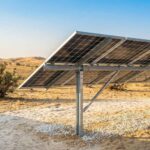
Bifacial panels require a “high-rise” structure. If the panels are mounted too close to the roof surface (less than 2 feet), the back side will not receive enough reflected light. For the best results, a height of 3 to 5 feet is recommended.
Managing Shadow and Pitch
A 10kW system requires roughly 750 to 850 square feet. The “Pitch” (the distance between rows) must be calculated to ensure that one row does not cast a shadow on the next, especially during the winter months when the sun is lower in the sky.
Financial Returns and Long-Term Value: Is the Price of 10kW Bifacial Solar Panels in India Worth It?
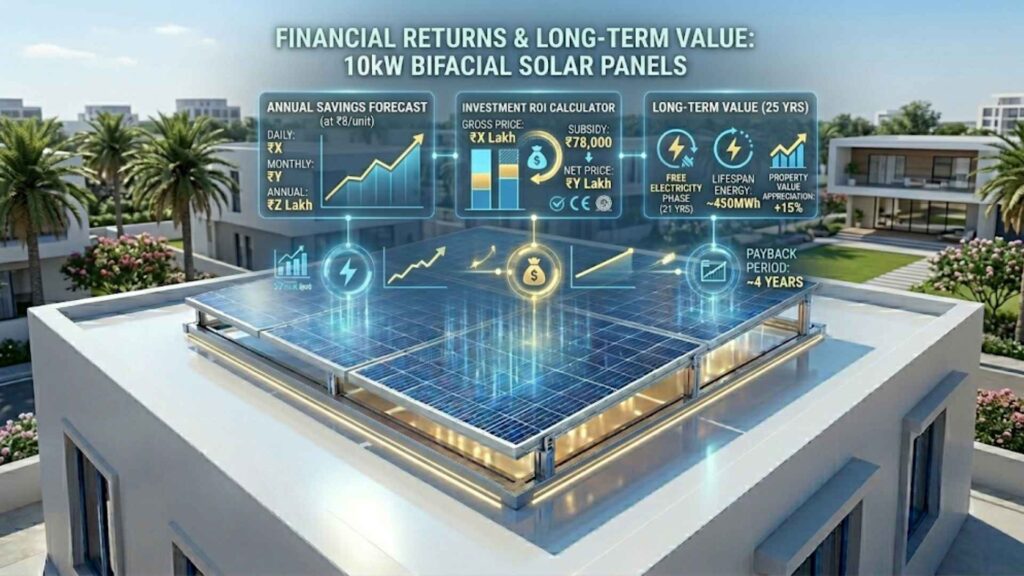
When discussing the price of 10kW bifacial solar panels in India, we must look beyond the initial invoice. Solar is not an expense; it is an asset that generates monthly revenue by saving on your utility bills. In a state like Rajasthan, the financial math is incredibly favorable.
Calculating the Monthly Savings and “Free Electricity” Phase
A 10kW system typically generates between 1,300 and 1,500 units per month in cities like Jaipur or Kota. At an average commercial or high-end residential rate of ₹8 to ₹10 per unit, you are looking at monthly savings of ₹12,000 to ₹15,000.
If the net price of 10kW bifacial solar panels in India (after subsidy) is approximately ₹5.7 Lakh, your system will pay for itself in 44 to 48 months. After this “break-even” point, every unit of electricity generated for the next 21 years is essentially ₹0 cost to you.
Appreciation of Property Value
Beyond direct savings, installing a high-tech bifacial system increases your property’s market value. Future buyers in Rajasthan are now looking for “Solar-Ready” homes. A well-installed 10kW system is a premium feature that makes your property more attractive and technologically advanced.
Common Installation Mistakes to Avoid to Protect the Price of 10kW Bifacial Solar Panels in India
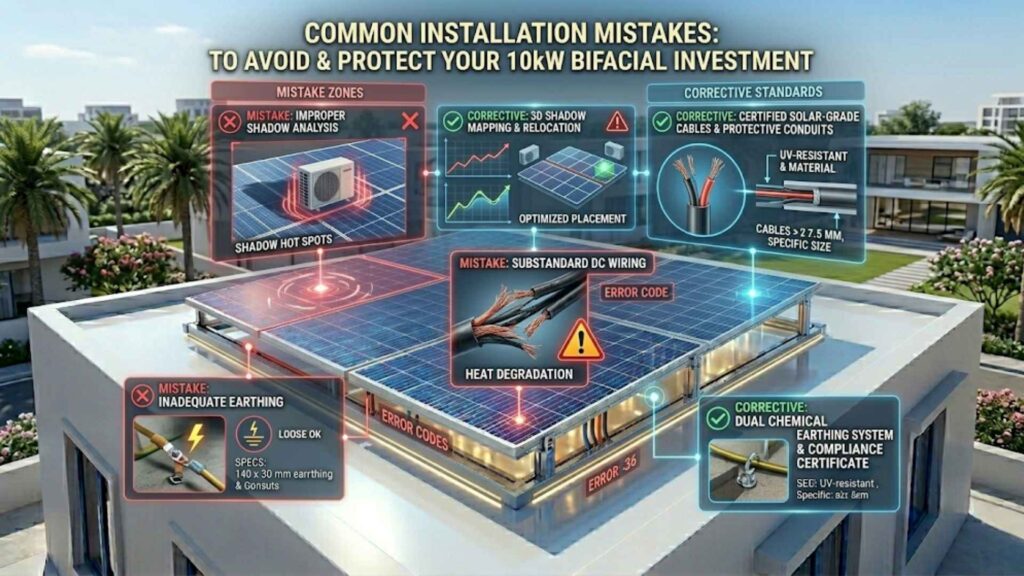
Many people focus so much on the price of 10kW bifacial solar panels in India that they ignore the quality of the installation. A bad installation can lead to a 30% drop in efficiency, meaning you lose more money over time than you saved on the initial cost.
Poor Shading Analysis and Orientation
Rajasthan has intense sunlight, but even a small shadow from a neighbor’s water tank or a nearby tree can create “Hot Spots” on your bifacial panels. A professional installer should use a 3D Shading Analysis tool before placing a single panel. In India, panels must face True South to capture the maximum path of the sun. Any deviation can significantly reduce your ROI.
Using Substandard Wires and Earthing
To keep the price of 10kW bifacial solar panels in India low, some local contractors use non-solar DC wires or poor-quality earthing strips. This is a massive safety risk. Solar panels produce high-voltage DC current. If the wires are not UV-protected and properly sized, they will crack under the Rajasthan heat, leading to short circuits or even fire hazards. Always insist on BIS-certified, 4sqmm or 6sqmm DC cables and proper chemical earthing.
Expert Maintenance Tips: Maximizing the Output of Your 10kW Bifacial Solar Panels
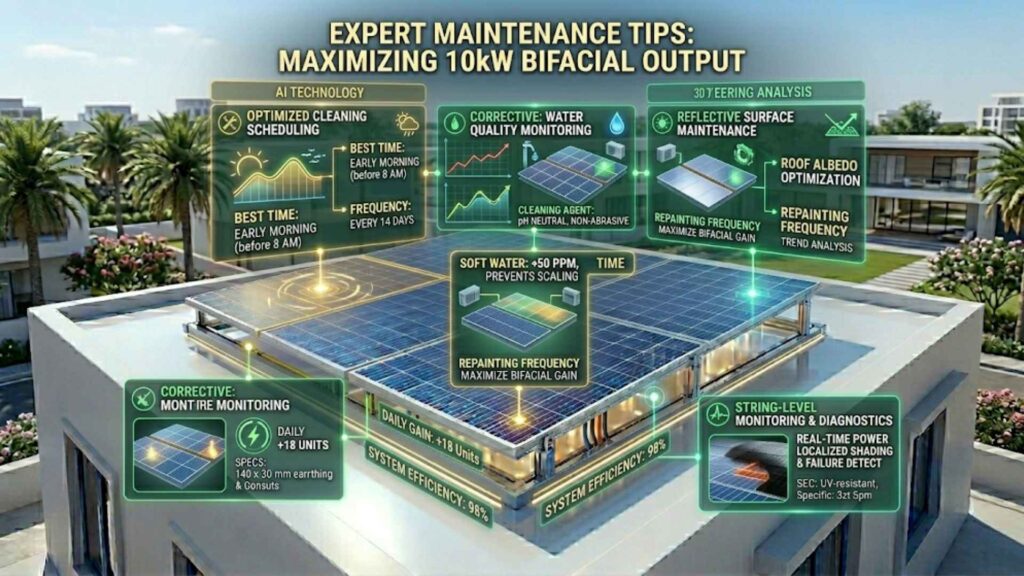
Once you have paid the price of 10kW bifacial solar panels in India, your job is to ensure they stay clean. Rajasthan is a “High-Dust” zone, and dust is the single biggest enemy of solar efficiency.
The “Golden Hour” Cleaning Strategy
Never clean your panels in the middle of a hot Rajasthan afternoon. The glass can reach temperatures of 60°C to 70°C. Splashing cold water on hot glass can cause thermal shock, leading to micro-cracks that ruin the panel.
- Best Time: Early morning (before 8 AM) or late evening (after 6 PM).
- Tool Kit: Use a soft-bristled nylon brush or a microfiber mop. Avoid hard wipers or metal tools that scratch the glass.
Monitoring the “Bifacial Gain”
Bifacial panels generate extra power from the back side by catching reflected light. Over time, the roof surface under the panels may get dirty.
- Pro-Tip: Every few months, give your roof a quick wash or a fresh coat of white reflective paint. This simple step increases the light bouncing into the back of the cells, ensuring you get the full value of the price of 10kW bifacial solar panels in India.
Conclusion: Your Journey to Energy Independence
Investing in a 10kW solar system is a transformational step for any large household or small business. While the price of 10kW bifacial solar panels in India might seem like a significant upfront cost, the combination of government subsidies, massive monthly savings, and the 25-year lifespan makes it a “no-brainer” investment.
By avoiding common installation pitfalls and following a simple maintenance routine, you can ensure that your 10kW plant remains a high-performing asset for decades to come.
Frequently Asked Questions (FAQs)
Q1: What is the average cost of a 10kW solar system in India without subsidy?
The total project cost usually ranges from ₹6.3 Lakh to ₹7.2 Lakh, depending on the brand of panels and the type of inverter used.
Q2: Can 10kW bifacial panels work during the monsoon?
Yes. While generation is lower on cloudy days, bifacial panels are actually better than monofacial panels in these conditions because they can capture diffuse light from all directions.
Q3: How many units will a 10kW bifacial system generate in Rajasthan?
In a sunny state like Rajasthan, you can expect 15,000 to 18,000 units per year, depending on how well the panels are cleaned and tilted.
Q4: Is it better to buy N-Type or P-Type bifacial panels?
N-Type (TOPCon) panels are currently the best choice. They have a lower degradation rate and perform better in high temperatures, making them worth the slightly higher price of 10kW bifacial solar panels in India.
Q5: Will the government subsidy be credited directly to my bank?
Yes, under the PM Surya Ghar scheme, the subsidy is credited to your linked bank account within 30 days of the system being commissioned and the net-meter being installed.