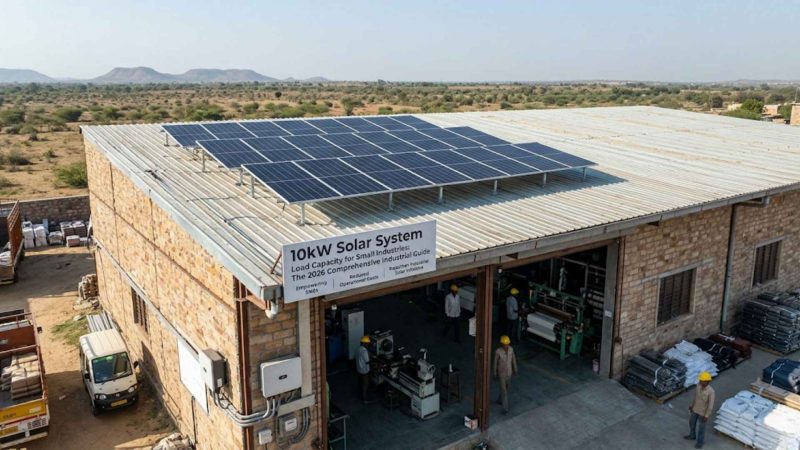
In the competitive landscape of 2026, electricity is no longer just a utility for small-scale industries (SMEs); it is a major operational “tax.” For a workshop, a small manufacturing unit, or a cold storage facility in regions like Rajasthan, where the sun is abundant but grid tariffs are rising, a 10kW solar system load capacity for small industries is the most strategic investment an entrepreneur can make.
This 3,000+ word guide is designed to be the ultimate resource for business owners. We will break down every watt, every rupee, and every technical hurdle involved in transitioning your factory to solar power.
What Exactly is a 10kW Solar System Load Capacity for Small Industries?
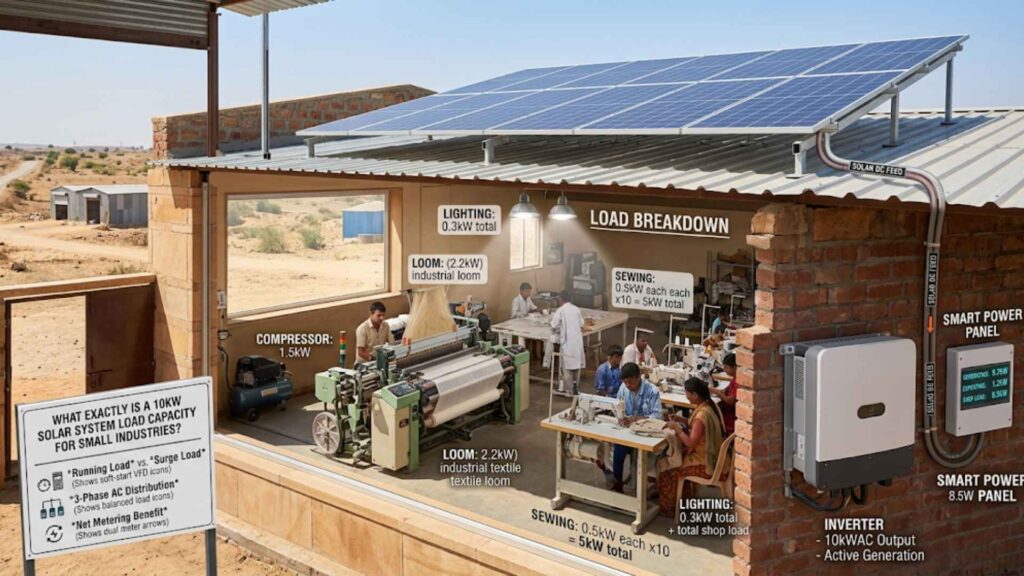
To understand the capacity, we must first define the components. A 10kW system (10 kilo-Watt peak or 10kWp) refers to the maximum power the solar panels can produce under standard testing conditions.
The Physics of Generation
In the high-irradiance zones of the Thar Desert and surrounding industrial hubs like Jaipur, Jodhpur, and Bhiwadi, a 10kW solar system load capacity for small industries performs at peak efficiency.
- Daily Energy Harvest: 45 to 55 Units (kWh).
- Monthly Energy Harvest: 1,350 to 1,650 Units (kWh).
- Annual Energy Harvest: 16,200 to 19,800 Units (kWh).
The “Net Metering” Advantage for Industries
For small industries, the 10kW system is usually an On-Grid setup. Through “Net Metering,” any excess power your factory doesn’t use (for example, on Sundays or during lunch breaks) is fed back into the government grid. This “exports” electricity, and your DISCOM (like JVVNL or JDVVNL) credits your bill accordingly.
Technical Load Breakdown: 10kW Solar System Load Capacity for Small Industries
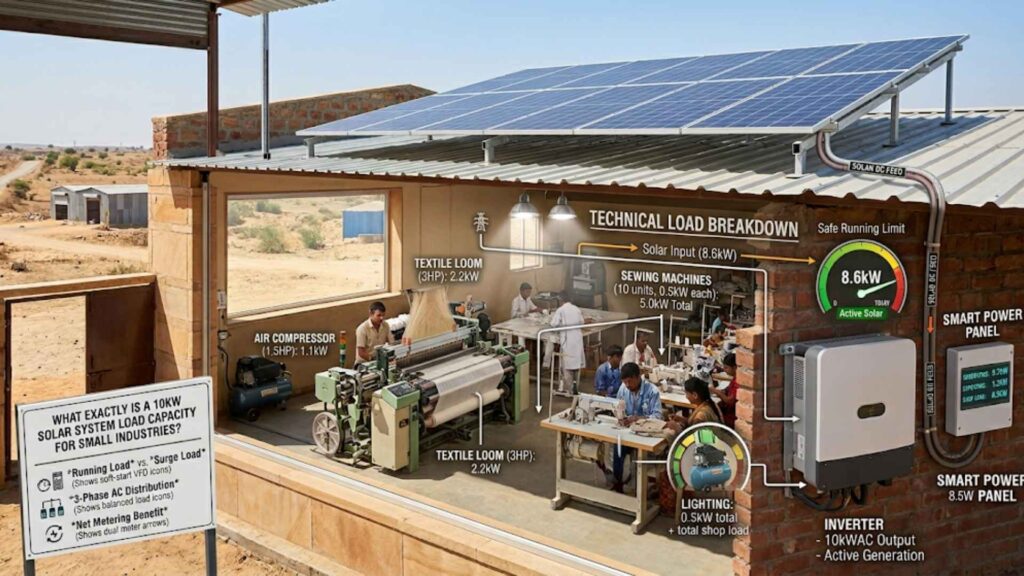
Industrial loads are significantly different from residential loads due to Inrush Current and Power Factor issues. If you plan to run heavy machinery, you must understand how a 10kW system handles “Start-up Spikes.”
Understanding Surge vs. Running Load
A 10kW inverter can handle a continuous load of roughly 9.5kW. However, industrial motors (like those in lathes or compressors) can pull 3x to 5x their rated current for a fraction of a second when they start.
- The 80% Rule: To ensure your inverter doesn’t trip, we recommend a consistent running load of 8kW. This allows for a “safety buffer” for sudden spikes in machinery demand.
3-Phase Power Distribution
Most small industries operate on a 3-phase connection. A 10kW solar system load capacity for small industries utilizes a 3-phase string inverter. This is critical because it balances the solar power across all three lines. If your CNC machine is on Phase A and your office AC is on Phase B, the solar system intelligently offsets the draw on both, ensuring your “Import Meter” stays as low as possible.
Machinery Analysis: 10kW Solar System Load Capacity for Small Industries
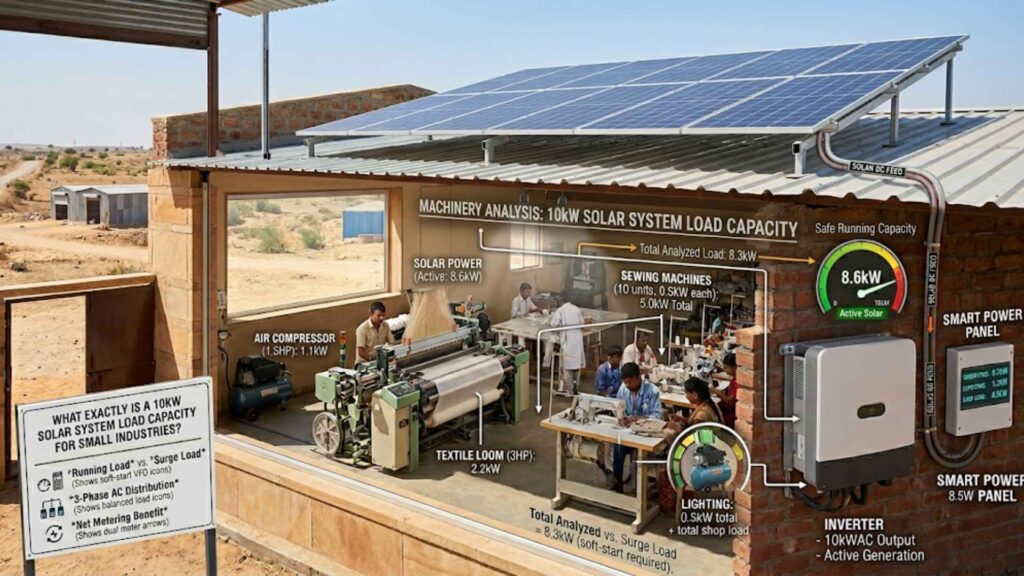
Let’s look at the specific industrial equipment you can run with a 10kW solar setup.
A. Metalworking and Fabrication (Workshops)
- Lathe Machines: A standard 3HP lathe draws about 2.2kW. You can run two lathes simultaneously and still have 4kW left for lighting and office computers.
- MIG/TIG Welding: Modern inverter-based welding units are highly efficient. A single heavy-duty welding station draws about 4kW during active arcs.
- Drill Presses & Grinders: These are low-draw units (0.5kW to 1kW) and can run all day on solar without denting the capacity.
B. Textile and Garment Manufacturing
- Industrial Sewing Machines: A typical 550W industrial sewing machine is very light. You can run up to 15 machines concurrently on a 10kW system.
- Fabric Cutting Machines: These typically draw 1kW to 1.5kW.
- Steam Irons: Electric steam generators are “heavy” (2kW each). A 10kW system can support 3 units easily.
C. Food Processing and Packaging
- Flour Mills (Small): A 5HP motor draws about 3.7kW. A 10kW system is perfect for running one 5HP mill alongside auxiliary packaging equipment.
- Pouch Packing Machines: These units draw roughly 2kW. You can run a full packaging line (3-4 machines) during peak sunlight hours.
Advanced Hardware: Optimizing 10kW Solar System Load Capacity for Small Industries
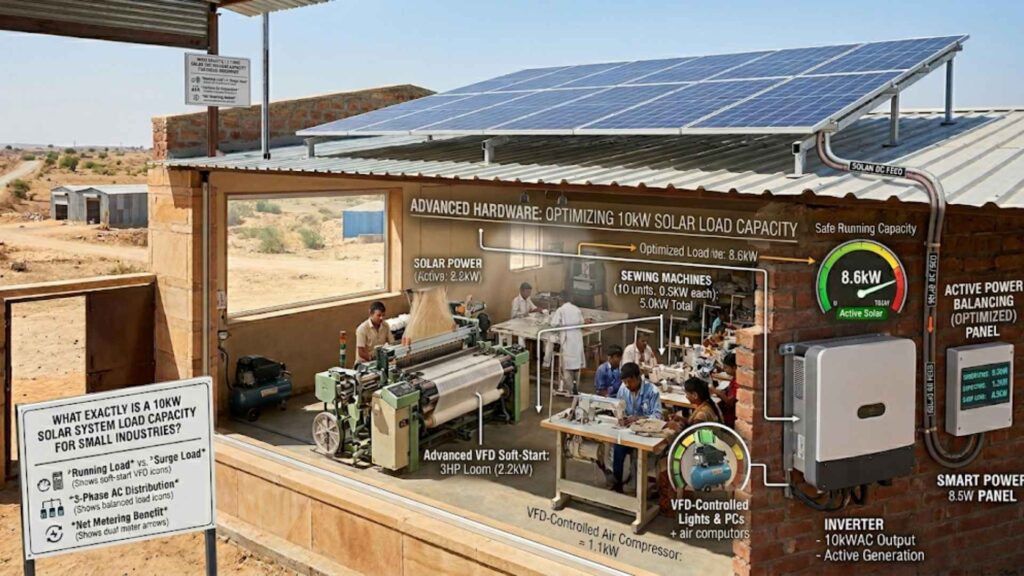
In 2026, simply “buying panels” isn’t enough. You need specific technology to handle industrial heat and dust.
N-Type TOPCon Technology
We strongly recommend N-Type TOPCon modules. Why?
- Lower Degradation: Industrial environments are harsh. N-Type panels degrade much slower than older P-Type panels.
- Higher Efficiency: You get more power from fewer panels, saving precious industrial roof space.
Bifacial Glass-to-Glass Modules
In Rajasthan, the “Albedo Effect” (reflected light from the ground or roof) is massive. Bifacial panels capture light from both sides. By installing them on a raised structure on your industrial shed, you can increase your 10kW solar system load capacity for small industries by an additional 15-22% simply by utilizing reflected light.
Load Distribution Table: Industrial Applications
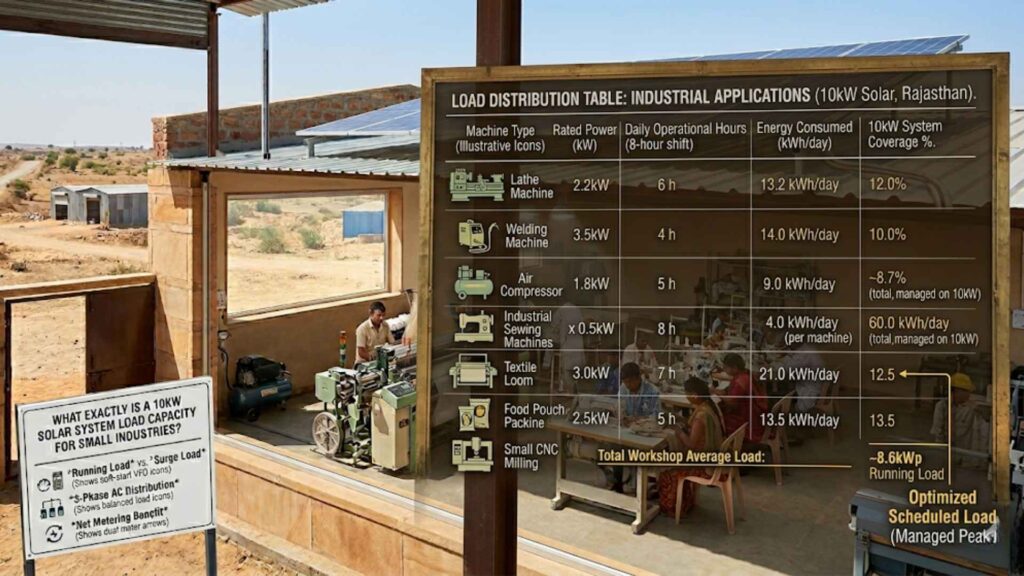
| Machine Type | Rated Power (kW) | Quantity | Can it run on 10kW? | Solar Coverage |
| CNC Milling Machine | 4.5 kW | 1 | Yes | 100% during day |
| Air Compressor (3HP) | 2.2 kW | 1 | Yes | 100% |
| Industrial Exhaust Fan | 0.7 kW | 4 | Yes | 100% |
| Heavy Welding Station | 4.0 kW | 1 | Yes | 100% |
| Office AC (2 Ton) | 2.4 kW | 1 | Yes | 100% |
| Total Combined Load | 11.9 kW | — | Selective | Requires Load Management |
Strategic Note: You cannot run all of the above simultaneously. Smart industrial owners schedule heavy machine use for peak sun hours (11:00 AM to 3:00 PM).
Financial Analysis: ROI of 10kW Solar System Load Capacity for Small Industries
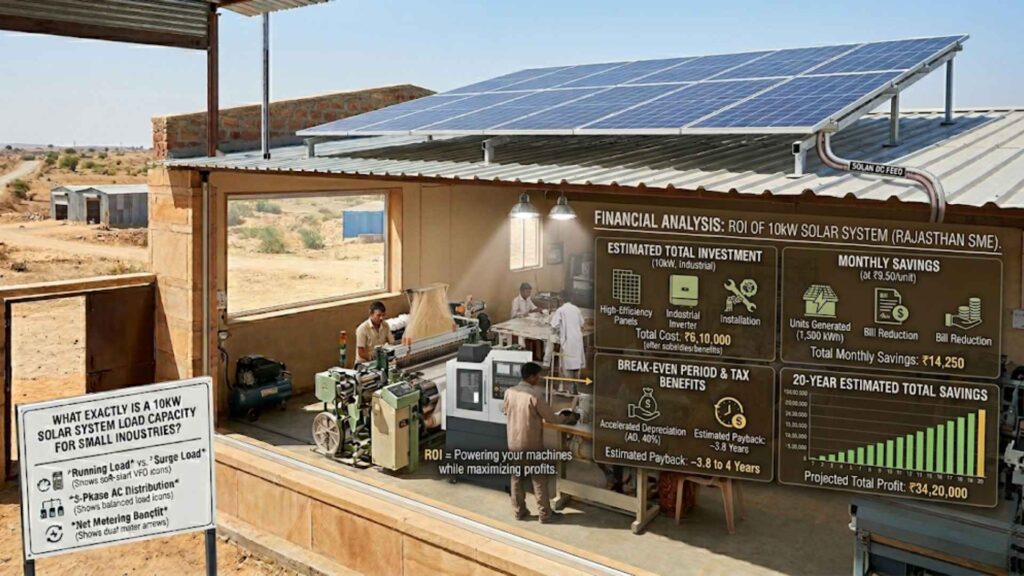
Investment Cost (2026 Estimates)
For an industrial-grade system (high-quality structure, bifacial panels, 3-phase inverter):
- Estimated Cost: ₹5,75,000 to ₹6,50,000.
Monthly Savings (The Rajasthan Context)
- Average Generation: 1,500 Units.
- Industrial Tariff: ₹9.50/unit (Avg).
- Monthly Savings: ₹14,250.
- Annual Savings: ₹1,71,000.
Payback Period & Accelerated Depreciation (AD)
The “Break-even” point is usually 3.5 to 4 years. However, for industries, the 40% Accelerated Depreciation benefit allows you to save significantly on Income Tax in the first year, effectively bringing your “Actual Cost” down by nearly 25-30% immediately.
The 2026 Maintenance Protocol for Industrial Solar
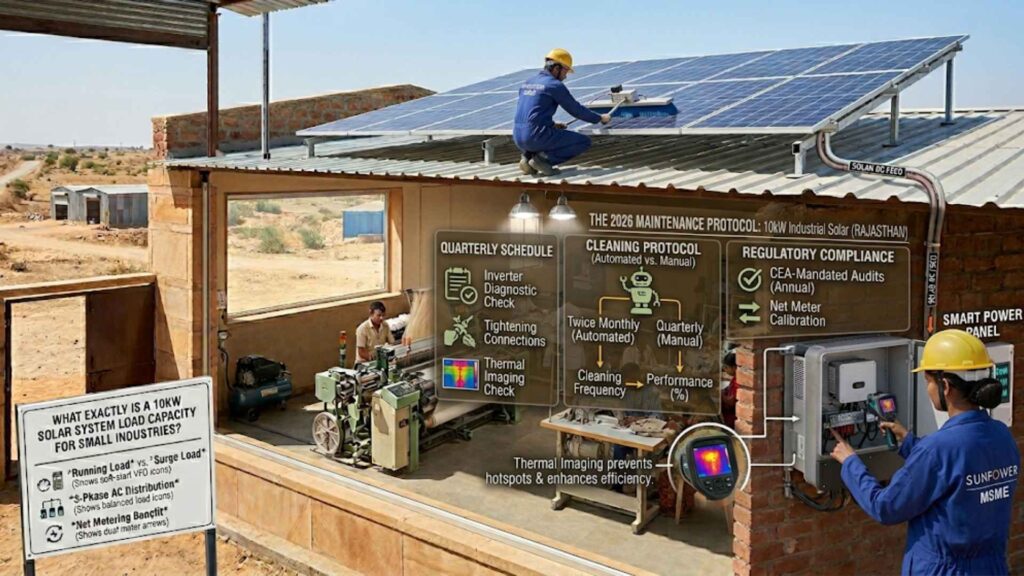
Industries are “dirty” environments. Smoke, chemical soot, and dust can reduce your 10kW solar system load capacity for small industries by 30% in just one month if not maintained.
Step 1: Automated Water Sprinklers
Install a basic PVC pipe sprinkler system. Cleaning panels manually on a high industrial shed is dangerous. A sprinkler system ensures daily cleaning with minimal effort.
Step 2: Thermal Imaging
Once a year, use a thermal camera to check for “Hotspots” caused by industrial dust or micro-cracks. This prevents long-term fire hazards on your roof.
Step 3: Inverter Cooling
Industrial sheds get incredibly hot. Ensure your inverter is installed in a shaded area with a dedicated cooling fan or ventilation to prevent “Thermal Throttling” (where the inverter reduces power output to protect itself from overheating).
Conclusion: Scaling Your Industry with Solar
A 10kW solar system load capacity for small industries is more than just a green upgrade—it is a hedge against inflation. While your competitors struggle with rising power costs, your factory will be running on “Free Fuel” for the next 25 years.
By choosing the right technology—N-Type TOPCon and Bifacial modules—and managing your machinery schedule, you can turn your roof into a profit-generating asset.
Frequently Asked Questions (FAQs)
Q1: Can a 10kW system run a 10HP motor?
A: A 10HP motor draws 7.5kW while running, but its starting current is too high for a 10kW inverter. You would need a Variable Frequency Drive (VFD) to soft-start the motor, or ideally, upgrade to a 15kW or 20kW system for a 10HP load.
Q2: What is the benefit of “Net Metering” for my small industry?
A: Net Metering allows you to “bank” your excess electricity with the grid. If your factory is closed on Sundays, the power generated that day is deducted from your monthly bill, ensuring zero wastage.
Q3: How much space is required for 10kW?
A: Modern high-efficiency panels require approximately 650 to 800 square feet of clear, shadow-free rooftop space.
Q4: Are there subsidies for industrial solar in 2026?
A: While direct cash subsidies are mostly for residential homes, industries benefit from MSME subsidized loans (low interest rates) and Accelerated Depreciation tax benefits.