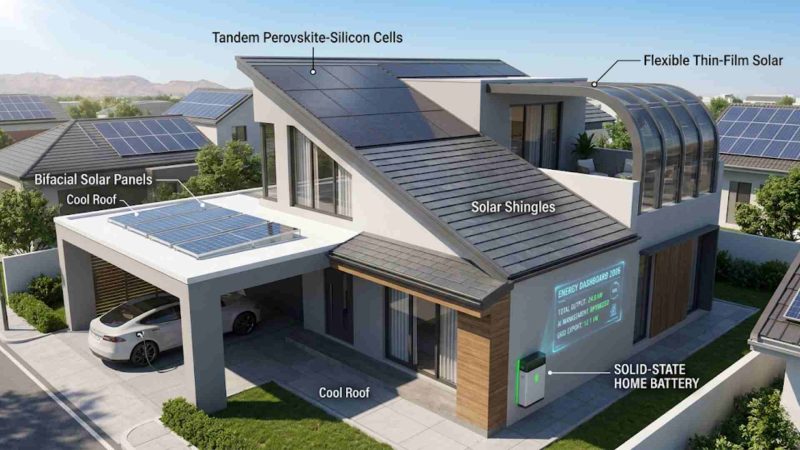
The latest solar technology for residential roofs is driving a radical transformation in the global energy landscape. As we move further into 2026, the shift toward decentralization and residential self-sufficiency has accelerated significantly. Homeowners are no longer just looking for “a few panels” to lower their utility bills; they are seeking high-tech, integrated ecosystems that effectively turn their homes into mini power plants.
If you are considering an upgrade or a new installation, understanding the current innovations in the industry is crucial. This year, the focus has shifted from mere energy generation to a sophisticated combination of ultra-high efficiency, aesthetic beauty, and artificial intelligence.
1. The Era of Perovskite-Silicon Tandem Cells
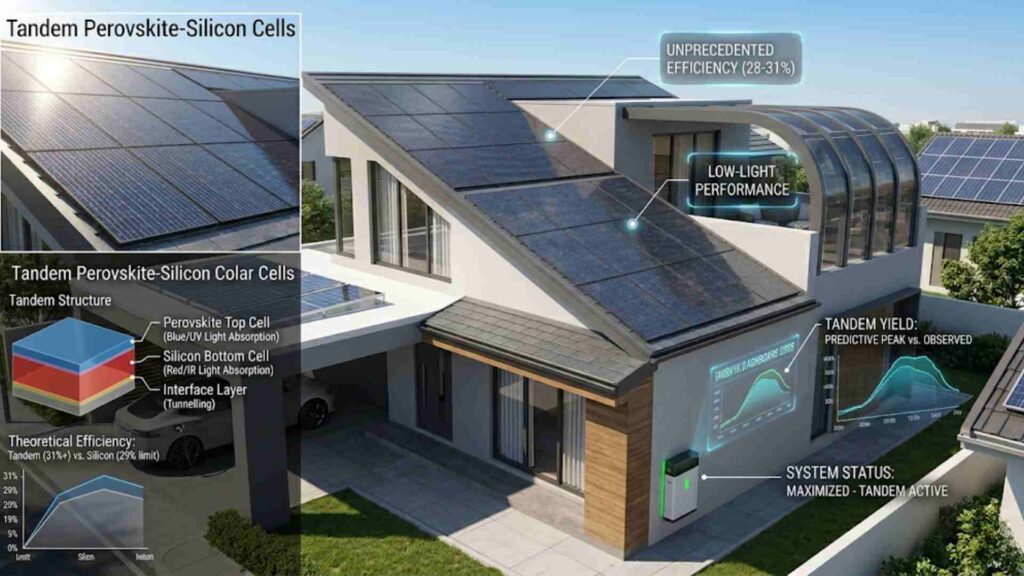
For over forty years, crystalline silicon has been the undisputed king of the solar industry. however, it has a physical limit—the Shockley-Queisser limit—which caps its efficiency at around 29%. In 2026, we have finally seen the commercial breakthrough of Perovskite-Silicon Tandem Cells.
Why This is the Latest Solar Technology for Residential Roofs You Need
Perovskite is a synthetic material with a unique crystal structure that is incredibly efficient at absorbing blue light. When you layer perovskite on top of traditional silicon (which is great at absorbing red and infrared light), you get a “tandem” effect.
- Unprecedented Efficiency: While standard residential panels in 2023 averaged 20%, tandem cells in 2026 are hitting 28% to 31% efficiency in residential formats.
- Performance in Low Light: Perovskite layers are highly sensitive. This means the latest solar technology for residential roofs can now generate significant power during the early morning and late evening hours when standard silicon panels would be dormant.
Challenges and 2026 Solutions
Previously, perovskite was criticized for its lack of durability. However, the 2026 generation uses advanced encapsulation techniques that protect the cells from moisture and heat, allowing manufacturers to offer the same 25-to-30-year warranties we expect from traditional silicon.
2. Bifacial Technology: Harvesting Light from Both Sides
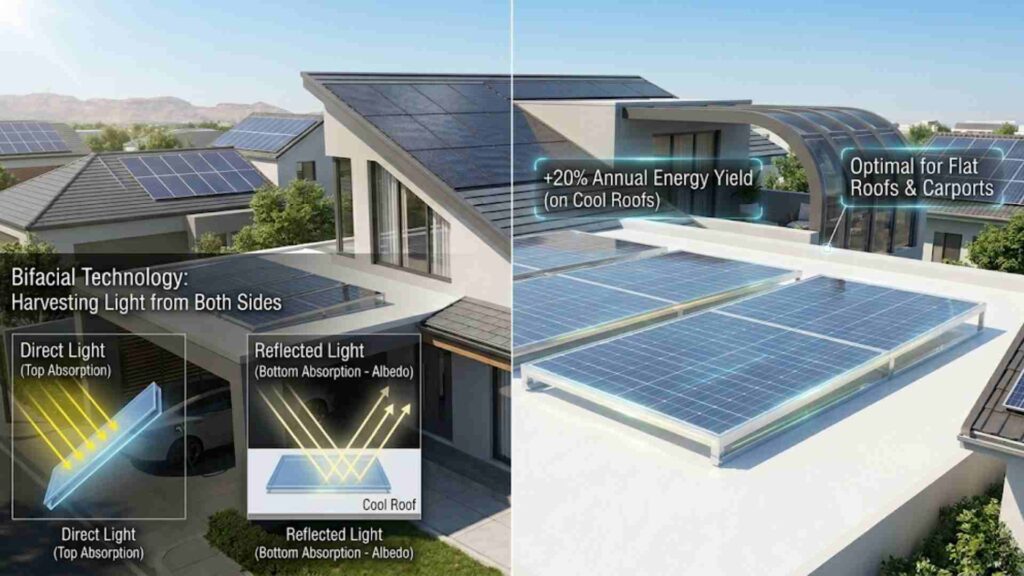
If your home has a flat roof, a carport, or a pergola, bifacial solar panels are the most logical choice in the current market.
Mastering the Albedo Effect with the Latest Solar Technology for Residential Roofs
A bifacial panel has a glass back instead of an opaque white sheet. This allows the panel to capture “albedo” light—sunlight that reflects off your roof surface and hits the back of the cell.
- Total Energy Yield: In optimized residential setups, bifacial modules can produce 15% to 25% more energy than a traditional panel of the same size.
- Modern Aesthetics: Because they are made of glass-on-glass, they have a sleek, transparent look that fits modern architectural designs perfectly.
Optimization for Residential Roofs
To make the most of this latest solar technology for residential roofs, installers are now using “cool roofs”—white or reflective roofing membranes. This increases the amount of light bouncing back into the panels, maximizing your ROI (Return on Investment).
3. Building-Integrated Photovoltaics (BIPV) and Solar Shingles
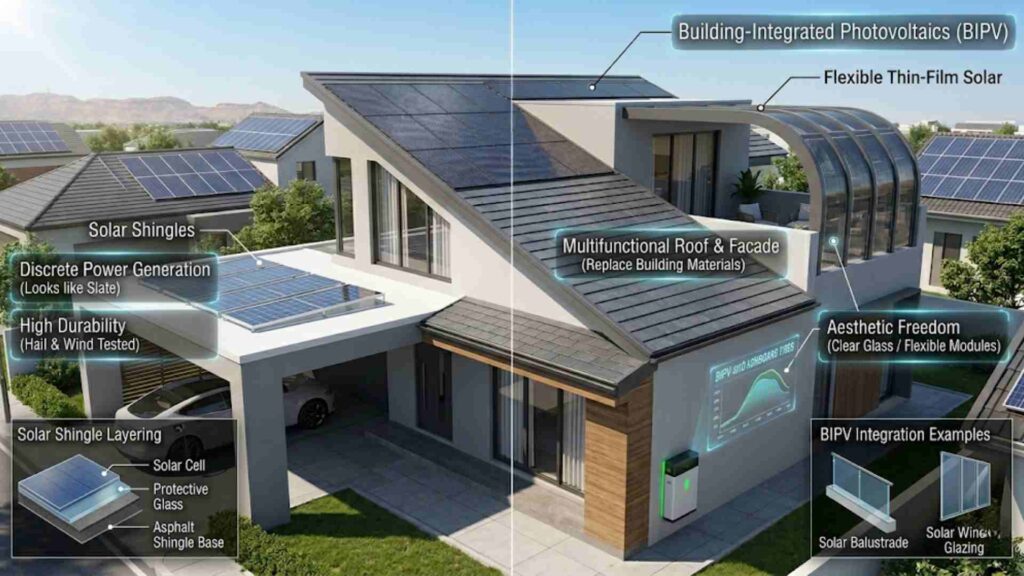
One of the biggest hurdles to solar adoption was always the “look.” Many homeowners in prestigious neighborhoods or those with historic homes resisted solar because of the bulky frames. In 2026, BIPV has solved this problem entirely.
Designing Homes with the Latest Solar Technology for Residential Roofs
BIPV refers to solar technology that replaces traditional building materials rather than being mounted on top of them.
- Solar Shingles: Companies like GAF Energy and Tesla have refined solar shingles to the point where they are indistinguishable from high-end asphalt or slate tiles.
- Solar Windows and Facades: For modern homes with large glass areas, transparent and semi-transparent solar glass can now generate electricity from windows and balconies while still letting light into the home.
Structural Integrity and Cost-Efficiency
While the upfront cost of BIPV is higher, you must factor in the “avoided cost” of traditional roofing materials. In 2026, if you are building a new home, installing the latest solar technology for residential roofs in the form of shingles is often cheaper than installing a premium roof plus separate solar panels.
4. TOPCon and HJT: The New Standard for Durability and Heat
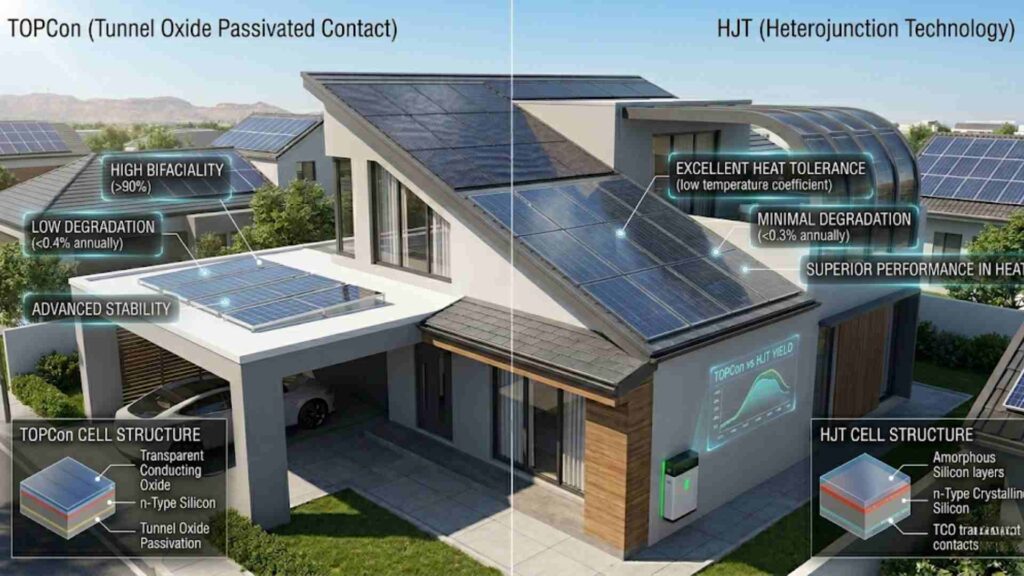
In 2026, the industry has largely moved away from older PERC technology. The new standard-bearers for high-performance residential installations are TOPCon (Tunnel Oxide Passivated Contact) and HJT (Heterojunction Technology).
Reliability and the Latest Solar Technology for Residential Roofs
These technologies deal with how the “internal wiring” of the cell is managed to prevent energy loss.
- HJT (Heterojunction): This combines crystalline silicon with “amorphous” thin-film silicon. It is currently the best technology for hot climates because it has a very low temperature coefficient.
- TOPCon: This is an evolution of standard N-type cells. It offers a higher “bifaciality” factor and better performance under shaded conditions.
Why Durability Matters
The latest solar technology for residential roofs isn’t just about power; it’s about degradation. Older panels lost nearly 1% of their power every year. 2026-grade HJT panels degrade at only 0.2% per year, meaning after 30 years, your roof will still be producing over 90% of its original rated power.
5. AI-Integrated Energy Management Systems (AI-EMS)
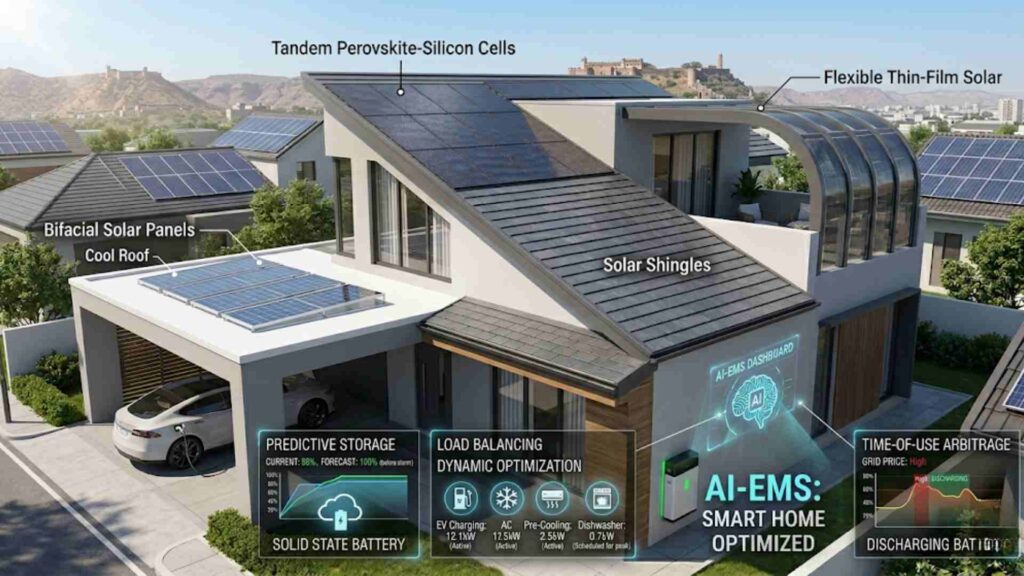
A solar panel is just a piece of hardware. In 2026, the “brain” of the system—the Smart Inverter—is what defines a high-tech home.
The Brain Behind the Latest Solar Technology for Residential Roofs
Modern systems now come integrated with proprietary AI algorithms that connect to your home’s IoT (Internet of Things) devices.
- Predictive Analytics: The system monitors real-time weather satellite data. If a storm is approaching Jaipur or your specific region, the AI will automatically charge your home batteries to 100% and pre-cool your home to save energy later.
- Time-of-Use (ToU) Optimization: The AI knows when grid electricity is most expensive. It will automatically switch your home to battery power during peak hours and sell excess solar energy back to the grid when the export rates are highest.
Seamless User Experience
Through intuitive mobile apps, homeowners can now see exactly how much energy each appliance is consuming. This level of transparency, powered by the latest solar technology for residential roofs, has led to an average 15% reduction in total household energy waste.
6. Flexible Thin-Film Solar: Lightweight and Versatile
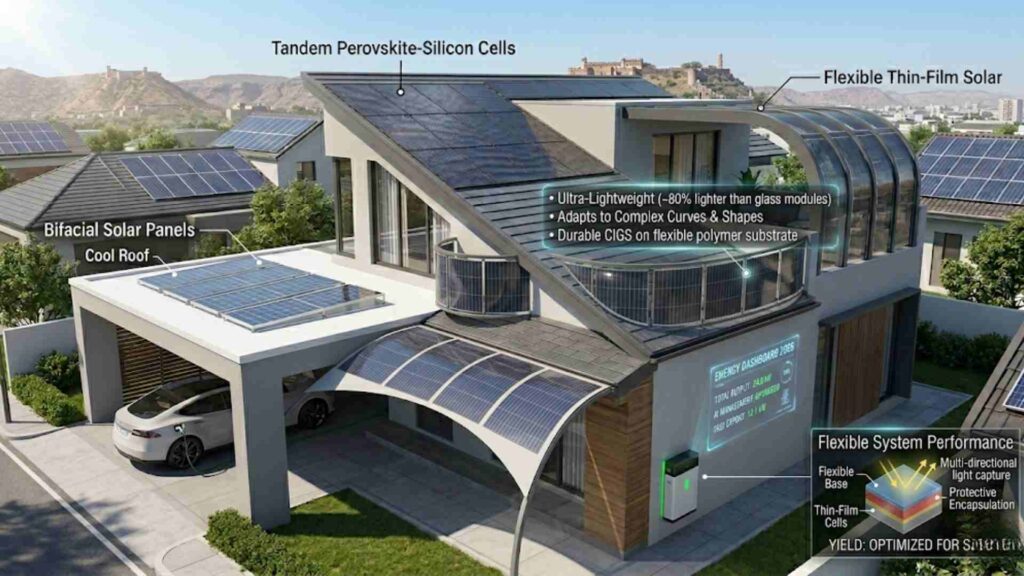
Not all roofs are built to hold the weight of heavy glass panels. For older homes or unique architectural shapes, Flexible Thin-Film technology has become a game-changer in 2026.
Applying the Latest Solar Technology for Residential Roofs to Any Surface
These modules are made using CIGS (Copper Indium Gallium Selenide) or organic photovoltaics.
- Ultra-Lightweight: They are roughly 80% lighter than traditional panels, requiring no roof reinforcement.
- Curvature Adaptation: They can be applied to curved roof sections, domes, or even the sides of a structure.
- Peel-and-Stick Installation: This reduces labor costs and eliminates the need for drilling holes into your roof membrane, reducing the risk of leaks.
7. Solid-State Home Battery Storage
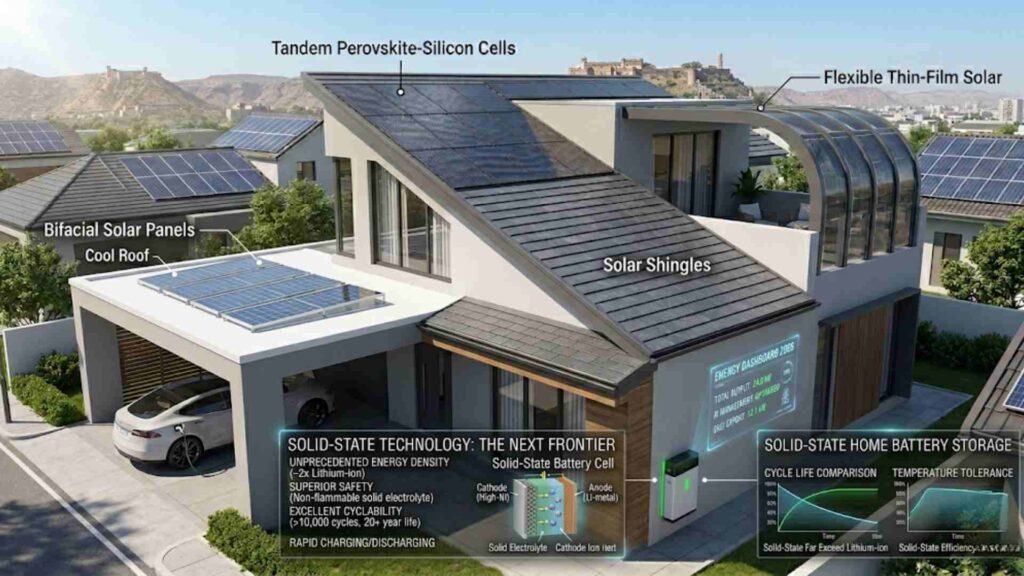
Storage is the final piece of the puzzle. While Lithium-Ion (LFP) was the standard for years, 2026 marks the beginning of the Solid-State Battery era for residential homes.
Safety and Density in the Latest Solar Technology for Residential Roofs
Solid-state batteries replace the liquid electrolyte with a solid ceramic or polymer material.
- Safety: They are non-flammable. This is a massive selling point for residential installations where the battery is located in a garage or basement.
- Energy Density: You can store twice as much energy in the same physical footprint. This is essential for urban homes with limited space.
- Lifespan: These batteries can handle over 10,000 charge cycles, easily lasting 20 years without needing replacement.
Technical Comparison Table: 2023 vs. 2026
| Metric | Older Technology (PERC/Mono) | Latest Tech (Tandem/HJT/TOPCon) |
| Panel Efficiency | 18% – 21% | 24% – 31% |
| Annual Degradation | 0.5% – 0.7% | 0.2% – 0.3% |
| Heat Tolerance | High power loss in summer | Minimal power loss (Excellent) |
| Visual Appeal | Raised racks, visible frames | Flush-mount, Shingles, Glass |
| Battery Tech | Lithium-Ion (LFP) | Solid-State / High-Density LFP |
| Intelligence | Passive monitoring | AI-Predictive Management |
Deep Dive: How to Choose the Latest Solar Technology for Residential Roofs
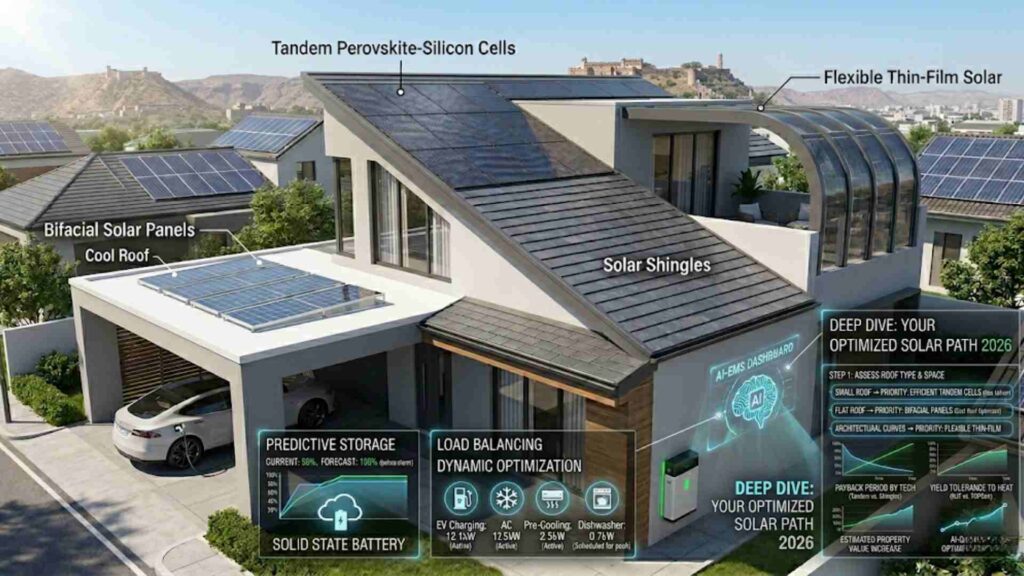
Choosing the right system requires balancing your budget with your specific roof type.
For Small Roofs
If you have limited square footage, Perovskite-Silicon Tandem panels are your best bet. Because they produce more power per square meter, you can meet 100% of your energy needs even on a small urban roof.
For Hot and Sunny Climates
If you live in a region with extreme heat (like Rajasthan or Gujarat), HJT panels are superior. Standard panels lose efficiency as they get hot; HJT panels stay cool and keep producing at high levels.
For Aesthetic Preservation
If you own a luxury villa or a heritage home, skip the panels and go for BIPV Solar Shingles. They protect the architectural integrity of your home while providing all the benefits of clean energy.
The Financial Impact: ROI in 2026
In the past, solar was seen as a 10-year investment. Thanks to the latest solar technology for residential roofs, the math has changed:
- Lower Installation Costs: Robotics and AI-driven site mapping have reduced soft costs.
- Higher Incentives: Many governments now offer “Smart Home” credits for AI-integrated systems.
- Shortened Payback: Most homeowners are seeing a full return on their investment within 5 to 6 years, while the panels continue to provide “free” energy for another 30 years.
Conclusion: Embracing the Solar Revolution
The latest solar technology for residential roofs is no longer just a “green” choice—it is the smartest financial choice a homeowner can make in 2026. From the extreme efficiency of tandem cells to the invisible beauty of solar shingles and the safety of solid-state batteries, the technology has reached a point of maturity that makes traditional energy sources look obsolete.
By investing in these advanced modules, you aren’t just saving money on your monthly bills; you are future-proofing your home, increasing its market value, and contributing to a cleaner, more resilient planet.
Frequently Asked Questions (FAQ)
1. What is the actual lifespan of the latest solar technology for residential roofs?
In 2026, most tier-1 manufacturers offer a 30-year performance warranty. However, due to the lower degradation rates of HJT and TOPCon cells, these panels are expected to remain functional for 40 years or more.
2. Can I install the latest solar technology for residential roofs on an old house?
Absolutely. For older structures that cannot handle the weight of heavy glass panels, flexible thin-film solar is the perfect solution. It is lightweight and requires no structural reinforcement.
3. How does AI improve my solar system’s performance?
The AI manages “loads.” For example, it will wait to charge your Electric Vehicle until the sun is at its peak, or it will discharge the battery during the evening when grid prices are highest. This “smart” usage can save you an additional 20% on your bills.
4. Are perovskite panels available for everyone right now?
As of 2026, Perovskite-Silicon tandem panels are available through specialized high-end installers. They carry a premium price but offer the highest energy density currently available on the market.
5. Does the latest solar technology for residential roofs require a lot of maintenance?
No. Modern panels often come with “anti-soiling” coatings that shed dust and bird droppings during rain. Furthermore, AI monitoring will alert you immediately if a single panel is underperforming, so you don’t have to guess if your system is working.
This guide is intended for homeowners, architects, and developers looking to stay at the forefront of the renewable energy sector in 2026.