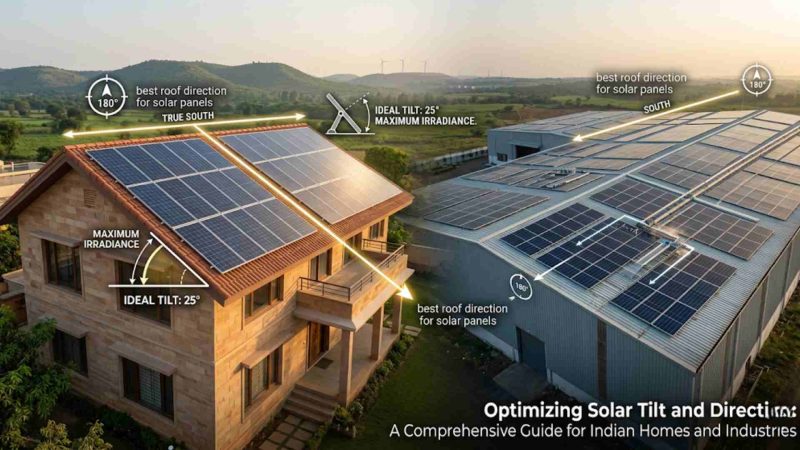
India is currently witnessing a massive green energy revolution. With the government’s push through schemes like the PM-Surya Ghar: Muft Bijli Yojana, thousands of homeowners and industrial giants are transitioning to solar power. However, simply installing panels isn’t enough to maximize your return on investment (ROI); you must first identify the best roof direction for solar panels to ensure they capture the maximum amount of sunlight available at your specific location.
To squeeze every drop of energy from the sun, you must understand the science of positioning beyond just the orientation. In this guide, we will dive deep into how to determine the optimal placement and the ideal tilt angle to ensure your system performs at peak efficiency throughout the year, turning your rooftop into a high-performance power plant.
Why Orientation and Tilt Matter for Solar Efficiency
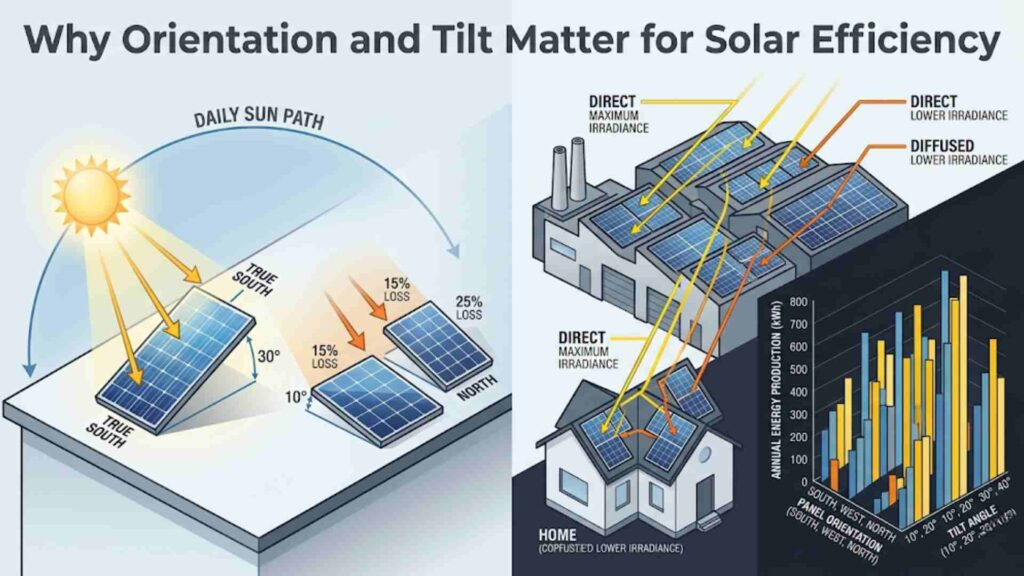
Before we get into the technicalities, it is essential to understand why “placement” is the most critical factor after the quality of the panels themselves. Solar panels generate electricity by converting photons from sunlight. The more directly the sunlight hits the surface of the panel (the angle of incidence), the more energy is produced.
If your panels are facing the wrong way or are lying too flat/steep, you could lose up to 15-25% of potential energy production. For a large-scale industry, this translates to lakhs of rupees in lost savings over the 25-year lifespan of the system.
What is the Best Roof Direction for Solar Panels in India?
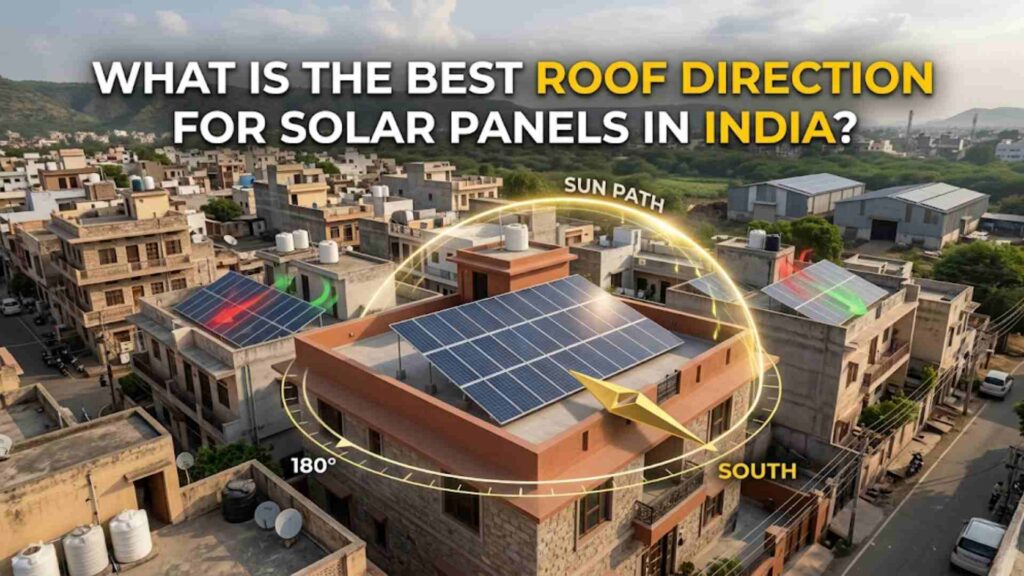
India is located in the Northern Hemisphere. This geographical fact is the single most important piece of information for any solar installer.
The Rule of South-Facing Panels
Because India is north of the equator, the sun is always in the southern part of the sky. Therefore, the best roof direction for solar panels in India is True South.
When panels face South, they are exposed to sunlight for the maximum duration of the day—from sunrise in the east to sunset in the west. This orientation ensures that during the “peak sun hours” (usually between 11:00 AM and 3:00 PM), the sunlight hits the panels at the most productive angle.
What if You Cannot Face South?
In many urban settings like Jaipur or Delhi, roof layouts or shadows from neighboring buildings might prevent a perfect South-facing installation. Here is how other directions stack up:
- East-Facing: These panels will produce maximum energy in the morning but will drop off significantly in the afternoon.
- West-Facing: These are great for “peak-shaving” if your highest electricity usage occurs in the late afternoon (common for homes with ACs running after work).
- North-Facing: In India, this is generally avoided. North-facing panels receive the least amount of direct sunlight and are often considered inefficient for ROI.
Calculating the Ideal Tilt Angle for Indian Cities
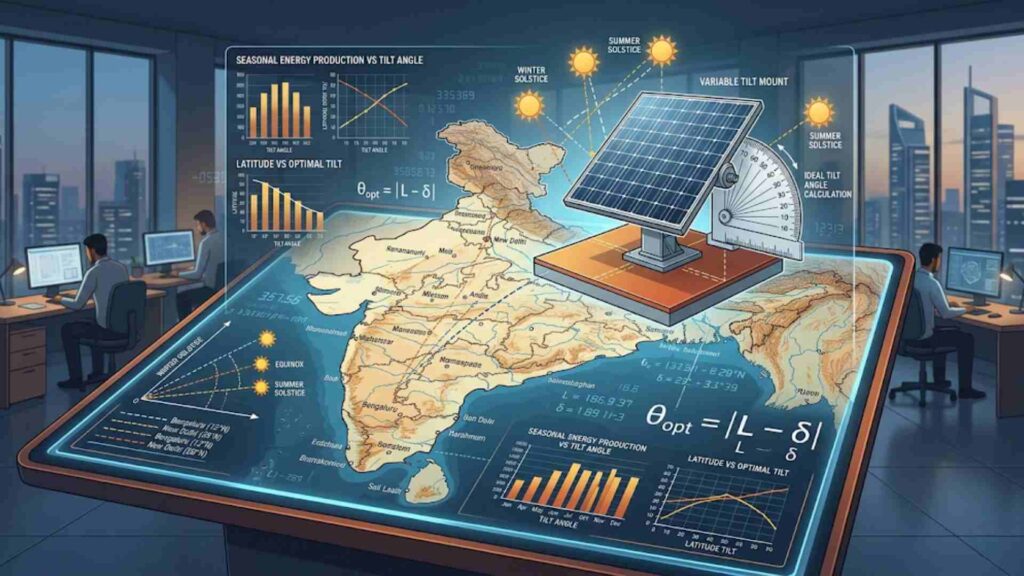
While finding the best roof direction for solar panels is the first step, the “Tilt” (the angle at which the panels are slanted) is the second piece of the puzzle.
The Latitude Rule
As a general rule of thumb for India, the tilt angle should be roughly equal to the latitude of your location.
- In South India (e.g., Bengaluru, Latitude ~12°N), panels should have a shallow tilt.
- In North India (e.g., Jaipur or Delhi, Latitude ~26-28°N), panels require a steeper tilt to catch the sun, which sits lower in the sky during winter.
Seasonal Adjustments
If you have an adjustable mounting structure, you can optimize production by changing the tilt twice a year:
- Summer: Decrease the tilt (make it flatter) by about 15 degrees from your latitude.
- Winter: Increase the tilt (make it steeper) by about 15 degrees to catch the low-hanging winter sun.
Finding the Best Roof Direction for Solar Panels: Residential vs. Industrial
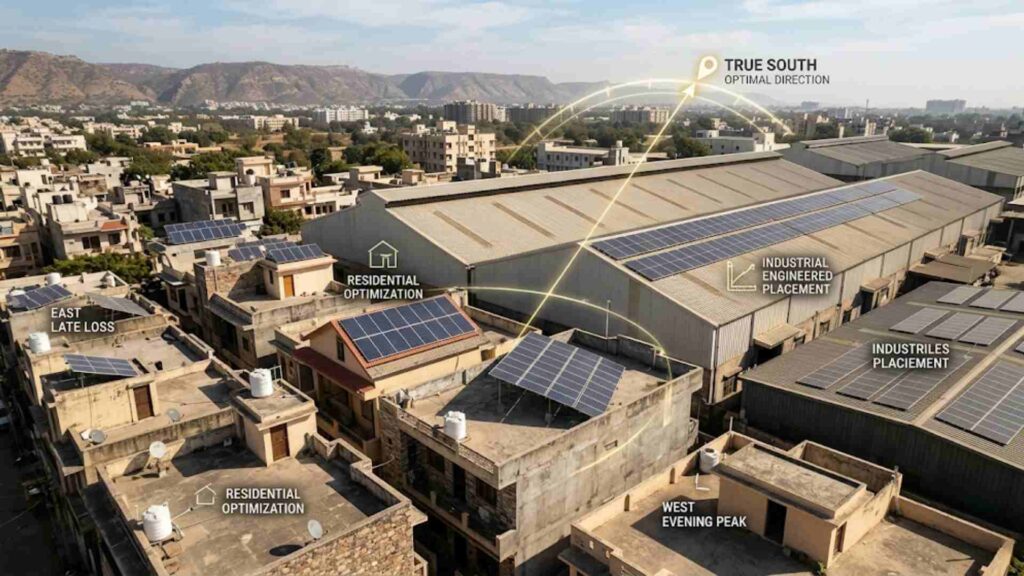
The approach to finding the best roof direction for solar panels differs slightly depending on the scale of the installation.
1. Residential Setup: Finding the Best Roof Direction for Solar Panels at Home
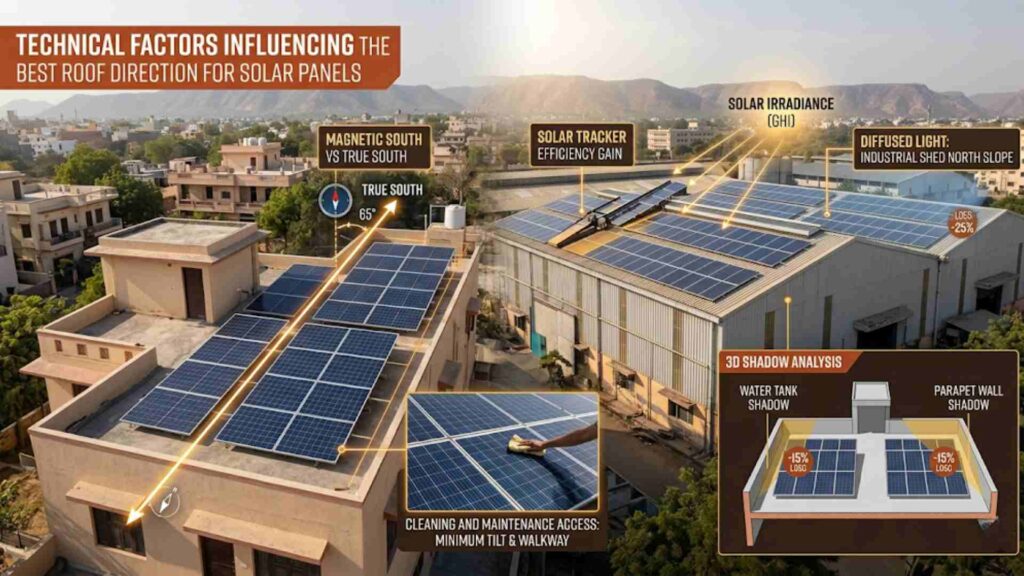
For Indian homes, space is often limited. Most roofs are “RCC flat roofs.” Here, installers use “Shadow Analysis” to ensure that water tanks or parapet walls don’t cast shadows on the panels. Even if you have the best roof direction for solar panels, a small shadow on one corner of a panel can reduce the output of the entire string.
2. Industrial Scale: Achieving the Best Roof Direction for Solar Panels on Large Sheds
Industries often have “Shed Roofs” (Tin or Metal sheets). These roofs are usually sloped. If the slope of the shed faces North, the installation becomes tricky. In such cases, specialized “Inclined Structures” are built on top of the shed to force the panels to face South, ensuring they still hit the target for the best roof direction for solar panels.
Comparison Table: Tilt and Direction Impact
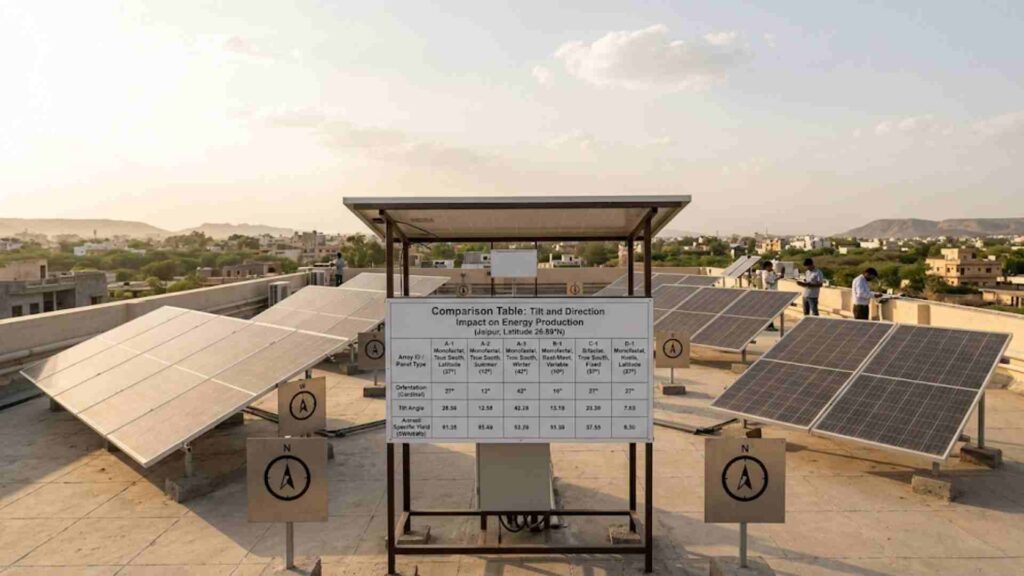
| Location (Example) | Latitude | Ideal Tilt (Fixed) | Best Roof Direction | Estimated Efficiency Loss (If North Facing) |
| Chennai | 13.08° N | 13° | True South | 20-30% |
| Mumbai | 19.07° N | 19° | True South | 25-35% |
| Jaipur / Delhi | 26.89° N | 27° | True South | 35%+ |
| Srinagar | 34.08° N | 34° | True South | 40%+ |
Technical Factors Influencing the Best Roof Direction for Solar Panels
1. Magnetic South vs. True South
Your compass points to Magnetic South, but solar panels need to face True South. In India, the difference (Magnetic Declination) is relatively small, but for large-scale industrial plants, correcting this by a few degrees can result in thousands of extra units (kWh) per year.
2. The Role of Solar Trackers
While fixed structures are common, some industries use Solar Trackers. These are motorized systems that move the panels to follow the sun. This removes the worry of finding a single best roof direction for solar panels because the panels are always facing the sun directly. However, these are expensive and require high maintenance.
3. Cleaning and Maintenance Access
Even if you have the perfect tilt, dust is the enemy of solar in India. Your “Optimized Tilt” must also allow for easy access for cleaning. If the panels are tilted at a very steep angle on a high structure to catch the best roof direction for solar panels, ensure your maintenance team has a safe walkway.
Common Myths About Solar Panel Placement
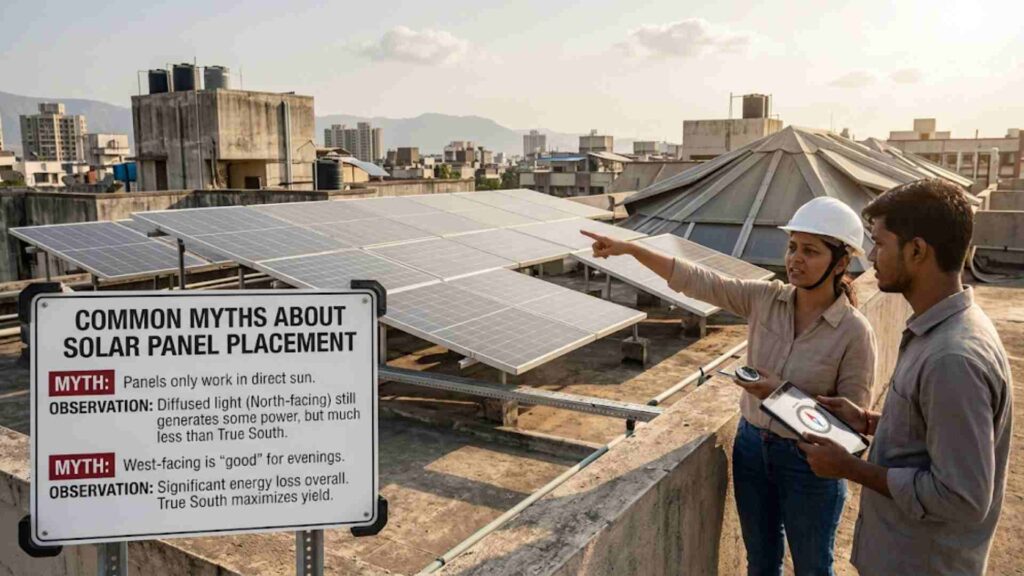
Myth 1: Panels only work in direct sunlight.
Fact: Panels can generate power from diffused light (cloudy days), but for maximum efficiency, the best roof direction for solar panels (South) is required to capture direct “Global Horizontal Irradiance.”
Myth 2: A flat (0 degree) tilt is best for all-day sun.
Fact: While a flat panel catches sun from all sides, it collects dust and rainwater, which creates “hotspots.” A minimum tilt of 10 degrees is recommended even in the southernmost parts of India for “self-cleaning.”
Conclusion
Choosing the best roof direction for solar panels is not just a recommendation; it is a financial necessity. In the Indian context, facing your panels True South and setting the tilt angle close to your city’s latitude ensures that your solar system pays for itself as quickly as possible.
Whether you are a homeowner in Jaipur looking to slash your electricity bill or an industrialist aiming for a greener footprint, optimizing your solar geometry is the first step toward energy independence. Always consult with a professional solar engineer who can perform a 3D shadow analysis to ensure that your “perfect” direction isn’t ruined by a hidden shadow.
By following this guide, you are well on your way to mastering the art of solar energy and securing a sustainable, cost-effective future for your property.
Frequently Asked Questions (FAQs)
1. What is the best roof direction for solar panels in the Southern Hemisphere?
Unlike India, if you were in Australia or South Africa, the best direction would be True North. Since India is in the Northern Hemisphere, we always aim for South.
2. Can I install solar panels on a West-facing roof?
Yes. While South is the best roof direction for solar panels for overall daily production, West-facing panels are excellent for businesses or homes that use most of their power in the evening. You might lose about 10-15% efficiency compared to South, but it is still viable.
3. How do I find True South without a professional?
You can use a smartphone compass app, but a more accurate way is the “Shadow Method.” At exactly Solar Noon (when the sun is at its highest point), the shadow of a vertical object will point exactly North-South.
4. Does the tilt angle change for Monofacial vs. Bifacial panels?
Bifacial panels (which catch light from both sides) often benefit from a slightly higher tilt and being raised further off the ground to allow reflected light to hit the back of the panel.