Finding the best Solar Panel Price Per Watt in India can be overwhelming when vendors quote vastly different rates. One vendor quotes ₹45 per watt, another offers ₹38, and a third claims their effective price is just ₹25 per watt.
Who is telling the truth?
The metric that matters most is Solar Panel Price Per Watt. However, looking at the sticker price of a panel alone is a financial trap. To make a smart investment, you must calculate the Real Price Per Watt—a figure that accounts for installation, hidden costs, and the massive impact of government subsidies like the PM Surya Ghar Yojana.
What is “Solar Panel Price Per Watt” and Why Does It Matter?
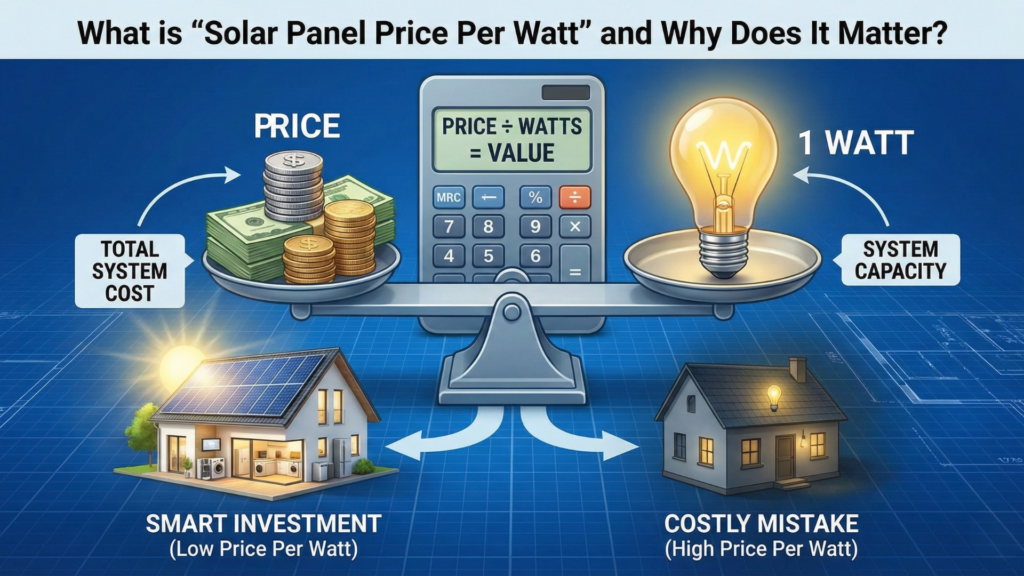
At its simplest, Solar Panel Price Per Watt is the standard unit of measurement for solar value, similar to buying vegetables by the kilogram or petrol by the litre.
To find this number, you simply take the Total Cost of the Solar System and divide it by the Total Capacity in Watts.
For example, if a 500-watt solar panel costs ₹15,000, you divide 15,000 by 500. The result is ₹30 per watt.
The “Sticker Price” vs. The “Real Price”
Most homeowners make the mistake of only asking, “What is the rate of the panel?”
- Sticker Price: This is just the cost of the solar module (e.g., ₹28/watt for a Polycrystalline panel). It ignores the inverter, wires, structure, and labour.
- Real System Price: This is the total cost of the fully functioning power plant on your roof, divided by its capacity.
- Effective Price: This is the Real Price minus the government subsidy benefits.
Market Trends: Average Solar Panel Price Per Watt in India
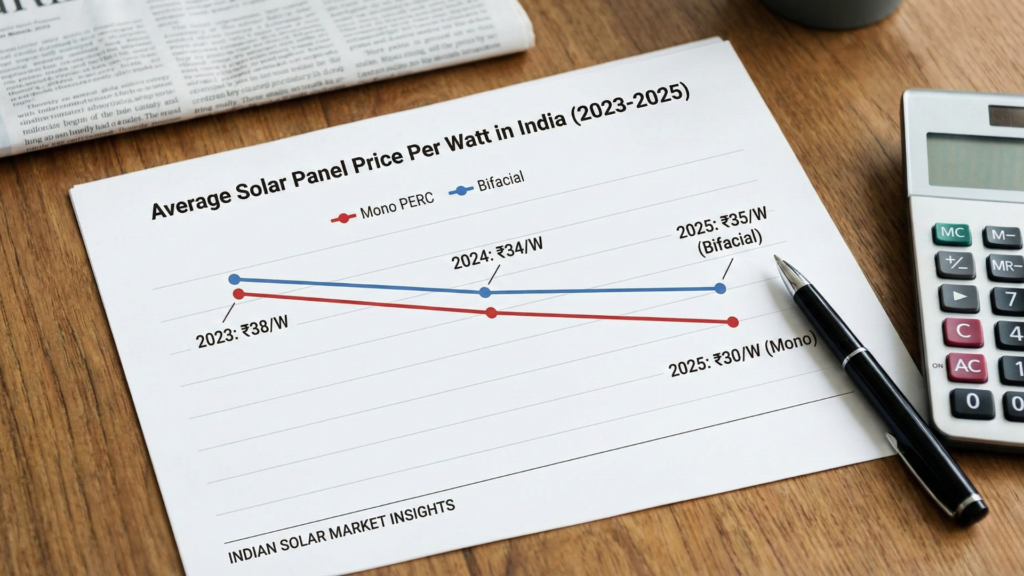
Before we calculate your specific price, let’s look at the current market benchmarks in India. Prices have stabilized due to lower raw material costs, but technology upgrades (like Bifacial and TOPCon) command a premium.
Table 1: Solar Panel Price Per Watt by Technology (Panel Only)
| Panel Technology | Efficiency | Price Per Watt (Approx.) | Ideal For |
| Polycrystalline | 16% – 17% | ₹22 – ₹28 / watt | Large factory roofs; budget constraint. |
| Mono PERC | 19% – 21% | ₹30 – ₹38 / watt | Standard homes in India; good low-light performance. |
| Bifacial (Mono) | 21% – 23% | ₹35 – ₹42 / watt | Reflective roofs (white paint/chips); generates power from both sides. |
| TOPCon (N-Type) | 22% – 24% | ₹40 – ₹48 / watt | Premium users wanting maximum power in limited space. |
Note: The prices above are for the panels only. A complete system (with inverter and structure) typically costs ₹50 – ₹65 per watt before subsidy.
Step-by-Step: How to Calculate the “Real” Price Per Watt
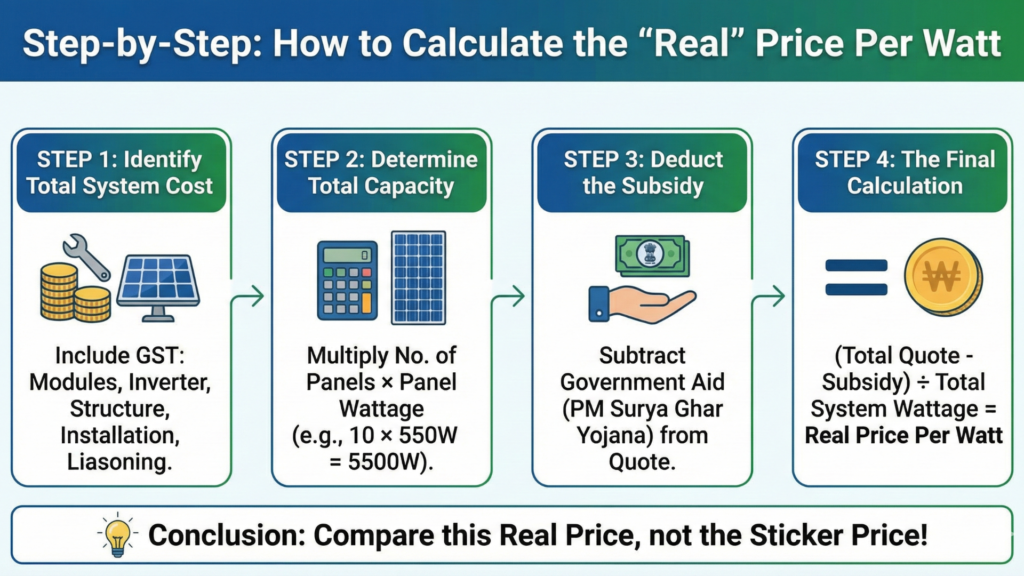
To find the true value of a quotation, follow this 4-step process. Do not rely on the verbal quote given by a sales agent; ask for the written “Bill of Materials.”
Step 1: Identify the Total System Cost
This must include GST. Ensure your quote covers:
- Solar Modules: (e.g., 10 panels of 550W each).
- Inverter: The heart of the system (e.g., a 5kW On-Grid Inverter).
- BOS (Balance of System): This includes the mounting structure (GI or Aluminium), AC/DC cables, earthing kit, and lightning arrestors.
- Installation & Liasoning: The labour charge and the fee for getting the “Net Meter” approved by your local DISCOM (like JVVNL, BESCOM, or Tata Power).
Step 2: Determine Total Capacity in Watts
Multiply the number of panels by the wattage of a single panel.
- Example: If you have 6 panels and each is 540 Watts, your total capacity is 3,240 Watts.
Step 3: Deduct the Subsidy (The Game Changer)
Under the PM Surya Ghar: Muft Bijli Yojana, the subsidy landscape in India is very attractive for residential users.
- 1 kW to 2 kW systems: Subsidy of ₹30,000 per kW.
- 3 kW systems: Flat subsidy of ₹78,000.
- Above 3 kW: The subsidy is capped at ₹78,000 fixed.
Step 4: The Final Calculation
To get your final number, take the Total Quote Value, subtract the Subsidy Amount, and then divide that result by the Total System Wattage.
Real-World Example: 3kW Home System in Jaipur
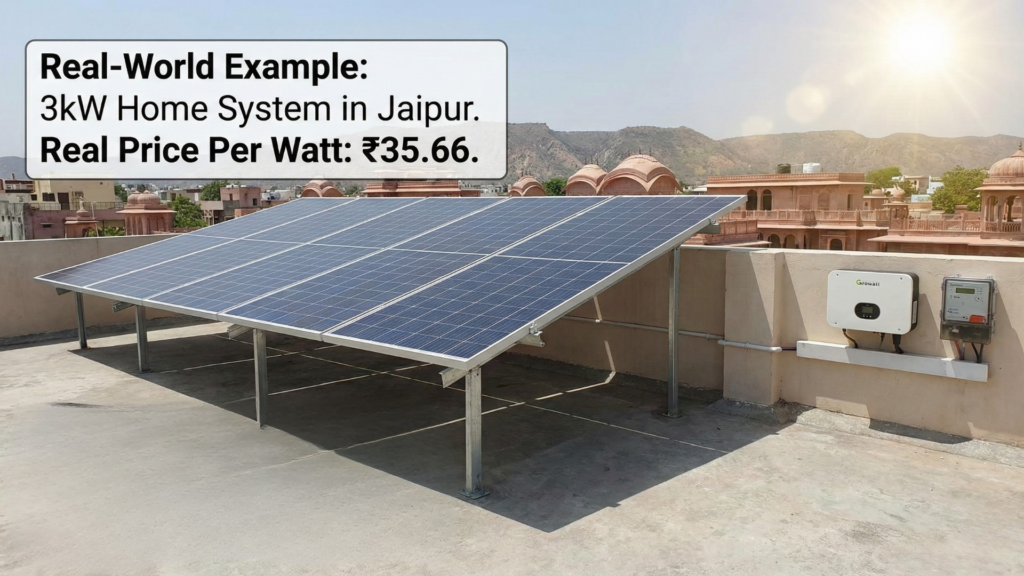
Let’s apply this method to a typical scenario for a middle-class Indian household installing a 3kW system. This example highlights how the “Effective” Solar Panel Price Per Watt drops significantly.
Table 2: The “Real” Price Calculation (3kW System)
| Cost Component | Standard Market Price (₹) | Notes |
| 1. Solar Panels (Mono PERC) | ₹1,05,000 | @ ₹35/watt for 3000W |
| 2. On-Grid Inverter | ₹35,000 | Reputable brand (Growatt/Solis/etc.) |
| 3. Structure & Wiring | ₹30,000 | Standard height structure |
| 4. Installation & Net Metering | ₹15,000 | Documentation & Labour |
| A. Total System Cost | ₹1,85,000 | Quote Price |
| B. PM Surya Ghar Subsidy | (-) ₹78,000 | Direct Benefit Transfer (DBT) |
| C. Net Cost to You | ₹1,07,000 | Final Investment |
| D. Total Capacity | 3,000 Watts | |
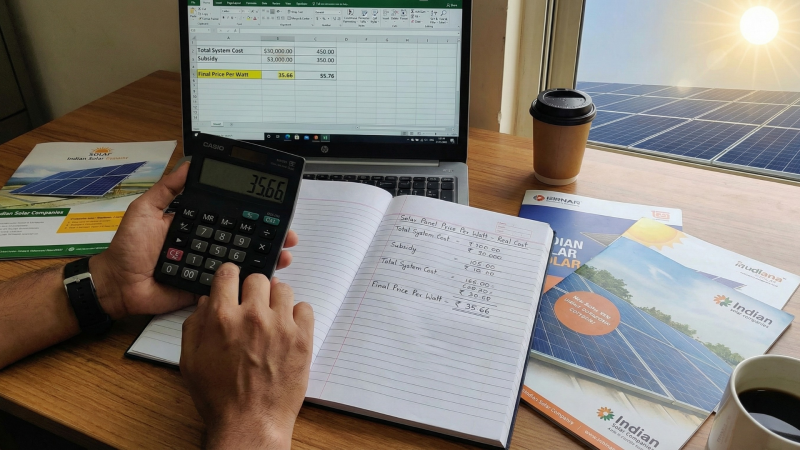
| E. REAL Price Per Watt | ₹35.66 / Watt | (₹1,07,000 divided by 3000) |
The Insight
While the market rate for the system was roughly ₹61 per watt, your Real Price Per Watt is only ₹35.66.Pro Tip: If a vendor quotes you a system price without mentioning the subsidy, they are inflating the Solar Panel Price Per Watt. Always calculate the post-subsidy rate yourself to see the true ROI.
5 Hidden Factors That Inflate Your Final Solar Price Per Watt
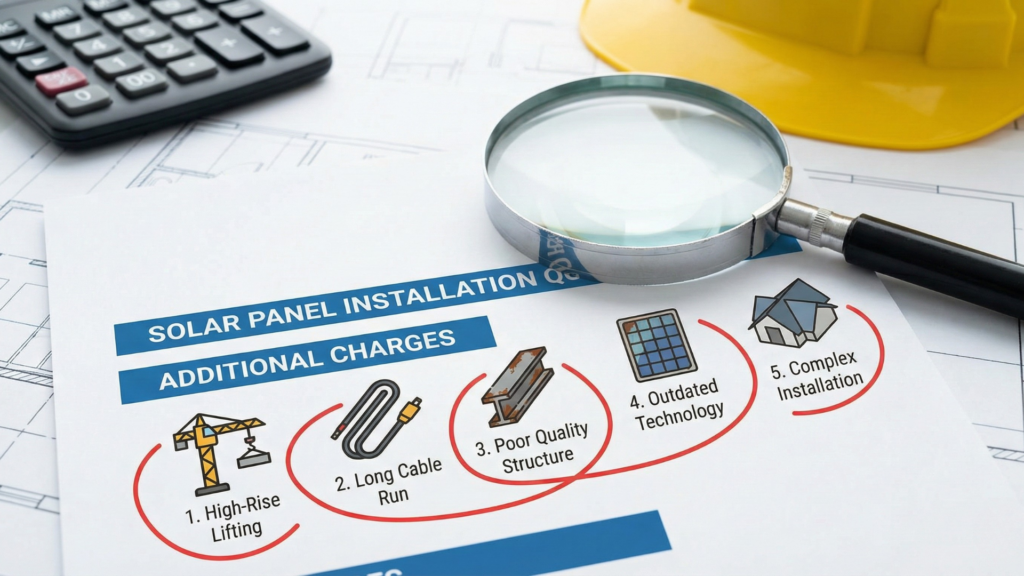
When you are comparing quotes from different vendors (e.g., Tata Power vs. Luminous vs. a local integrator), watch out for these hidden variables that increase the total cost.
1. Elevated Structures
The standard quote assumes your roof is flat and empty. If you need the panels raised to 8-10 feet (to use the roof space for walking or drying clothes), the steel requirement doubles. This can add ₹3 to ₹5 per watt to your cost.
2. High-Rise Lifting Charges
If you live on the 10th floor of an apartment complex, getting heavy panels up there requires cranes or specialized labour. This “lifting charge” is often excluded from the initial Solar Panel Price Per Watt advertised online.
3. AC/DC Cable Length
Standard installation covers roughly 30-50 meters of cabling. If your roof is far from your ground-floor meter (common in multi-story homes), the extra copper cable cost will increase your per-watt price.
4. Structure Quality (Galvanized vs. Aluminium)
A quote might look cheap (low price per watt) because the installer is using pre-galvanized iron (which may rust in 5-10 years) instead of Hot Dipped Galvanized (HDG) or Aluminium. Always ask for the micron thickness of the galvanization.
5. Mono PERC vs. Polycrystalline
A vendor offering ₹40/watt for a full system might be dumping old “Polycrystalline” stock on you. Always ensure the quote specifies “Mono PERC Half-Cut” or “Bifacial” technology.
Conclusion: Final Thoughts on Solar Panel Price Per Watt
Calculating the Solar Panel Price Per Watt is the only way to safeguard your investment. It cuts through marketing jargon and reveals the true financial efficiency of the system.
For a standard Indian home, a “Good” Real Price Per Watt (after subsidy) for a top-tier Mono PERC system should fall between ₹35 and ₹45.
If your calculation shows a price above ₹60/watt (after subsidy), you are likely overpaying or opting for unnecessary premium add-ons. If it is below ₹30/watt, be cautious—the installer might be compromising on the quality of the structure, earthing, or wires, which are critical for safety.
Your Action Plan:
- Get 3 distinct quotes (Local Vendor, National Brand, Online Platform).
- Use the 4-step calculation method for all three.
- Choose the one that offers the best balance of legitimate hardware brands and a competitive Real Price Per Watt.
Frequently Asked Questions (FAQs) About Solar Price Per Watt
Q1: Does “Price Per Watt” decrease as the system size increases?
A: Yes, absolutely. This is called “economy of scale.” A 10kW system will always have a lower Solar Panel Price Per Watt than a 3kW system because the fixed costs (inverter, installation crew, transport) are spread over more watts.
Q2: Which state in India has the lowest Solar Panel Price Per Watt?
A: Typically, states with high solar manufacturing hubs like Gujarat and Karnataka see slightly lower prices due to reduced logistics costs. However, Rajasthan also offers highly competitive rates due to the high volume of installations.
Q3: Should I choose Bifacial panels to improve my Price Per Watt value?
A: Only if you have a reflective floor (white tiles or white paint). Bifacial panels cost slightly more per watt upfront. If your roof is dark concrete, the extra generation won’t justify the higher Solar Panel Price Per Watt.
Q4: Is the GST included in the Price Per Watt?
A: When you see marketing ads, they often exclude GST. Solar components usually attract 13.8% GST (effective rate on the composite system). Always ask for the “All-Inclusive” price before doing your calculation.
Q5: Can I get a subsidy on Off-Grid systems?
A: No. The government subsidy (which drastically lowers your Real Price Per Watt) is only available for On-Grid systems (connected to the government meter). Off-grid systems with batteries are significantly more expensive.