The transition to renewable energy is no longer just a trend in Rajasthan; it is a financial necessity. With electricity tariffs rising, homeowners and businesses in Jaipur and Ajmer are looking toward the sun. However, installing solar panels is only half the battle. The real magic happens when you connect your system to the grid. This is where the Net Metering process for JVVNL/AVVNL consumers becomes the bridge between your solar investment and actual monthly savings.
In this guide, we will break down everything you need to know about the application, from documentation to final commissioning, specifically for the Jaipur Vidyut Vitran Nigam Ltd (JVVNL) and Ajmer Vidyut Vitran Nigam Ltd (AVVNL) regions.
What is the Net Metering Process for JVVNL/AVVNL Consumers?
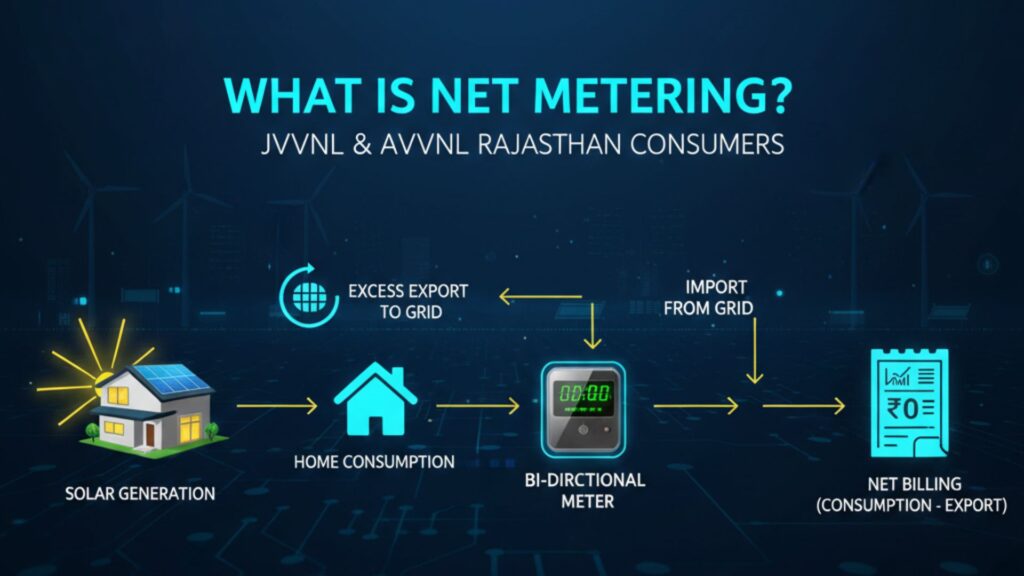
Before we jump into the application steps, it is vital to understand the mechanism. Net Metering is a billing arrangement that allows solar energy system owners to feed excess electricity back into the public utility grid.
In Rajasthan, under the jurisdiction of Jaipur Vidyut Vitran Nigam Ltd (JVVNL) and Ajmer Vidyut Vitran Nigam Ltd (AVVNL), this process is governed by the Rajasthan Electricity Regulatory Commission (RERC).
How the Net Metering Process for JVVNL/AVVNL Consumers Works
- Generation: Your solar panels produce DC electricity, which an inverter converts to AC for your home.
- Consumption: Your home appliances use the solar power first.
- Export: If your panels produce 10 units but you only use 4, the remaining 6 units are sent to the JVVNL/AVVNL grid.
- Import: At night, when the sun is down, you pull electricity from the grid.
- Net Billing: At the end of the month, the DISCOM subtracts the “Export” from the “Import.” You only pay for the difference.
Eligibility Criteria for Net Metering Process for JVVNL/AVVNL Consumers
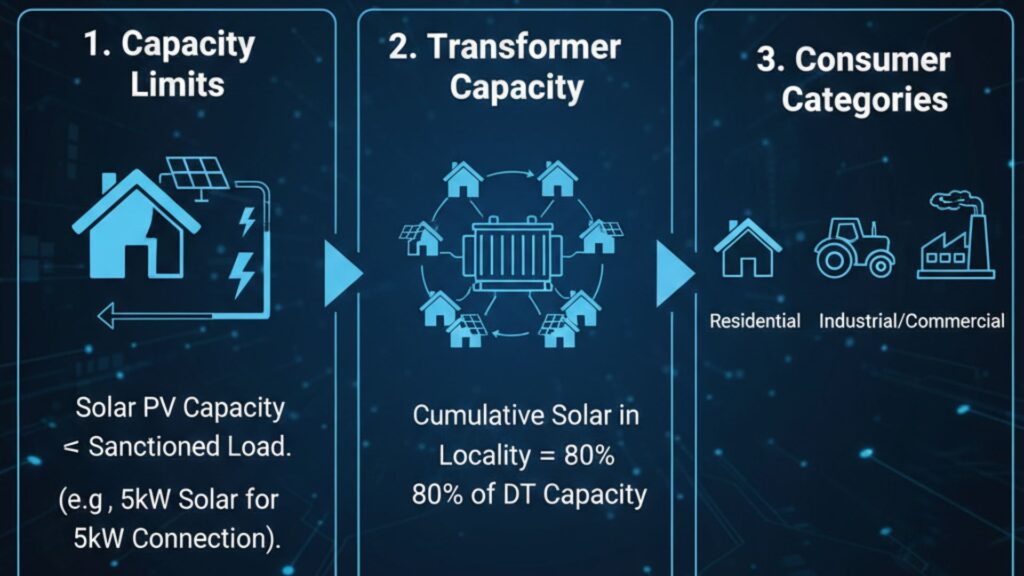
Not everyone can immediately jump into the Net Metering process for JVVNL/AVVNL consumers. There are strict regulatory boundaries set by the Rajasthan government.
1. Capacity Limits
The capacity of your solar Rooftop PV system must not exceed your Sanctioned Load. For example, if your domestic connection is 5kW, you cannot install a 7kW solar plant without first applying for a load enhancement with your respective DISCOM (JVVNL or AVVNL).
2. Transformer Capacity
This is a technical hurdle many consumers overlook. The total solar capacity connected to a specific distribution transformer (DT) cannot exceed 80% to 100% of its rated capacity. If your neighbors have already exhausted this limit, your application for the Net Metering process for JVVNL/AVVNL consumers might be rejected until the transformer is upgraded.
3. Consumer Categories
Net metering is available for:
- Residential (Domestic)
- Agriculture
- Industrial/Commercial (with specific RERC limits)
Table 1: Technical Specifications for JVVNL/AVVNL Solar Connections
| System Capacity | Connection Voltage | Meter Type Required | Phase Type |
| Up to 5 kW | 230V (Low Tension) | Single Phase Bi-directional | Single Phase |
| 5 kW to 18.65 kW | 440V (Low Tension) | Three Phase Bi-directional | Three Phase |
| 18.65 kW to 100 kW | 440V (Low Tension) | Whole Current/CT Operated | Three Phase |
| Above 100 kW | 11 kV / 33 kV | HT Metering | High Tension (HT) |
Documents Required for Net Metering Process for JVVNL/AVVNL Consumers
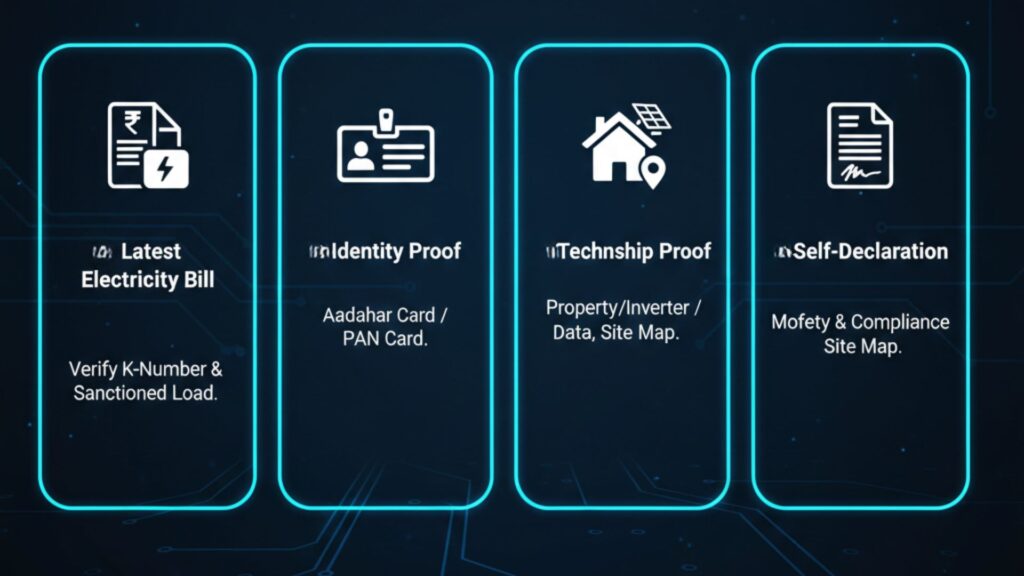
The most common reason for delays in the Net Metering process for JVVNL/AVVNL consumers is incomplete documentation. Keep these scanned copies ready:
- Latest Electricity Bill: To verify the K-Number, Name, and Address.
- Identity Proof: Aadhaar Card, Voter ID, or Passport.
- Ownership Proof: Registry of the house, Allotment letter, or latest House Tax receipt.
- Site Map: A basic layout of where the panels and inverter will be placed.
- Technical Data Sheets: Specifications of the Solar Modules (must be ALMM approved) and the Inverter.
- Self-Declaration: A form stating that the structure is safe and follows DISCOM guidelines.
Detailed Step-by-Step Net Metering Process for JVVNL/AVVNL Consumers
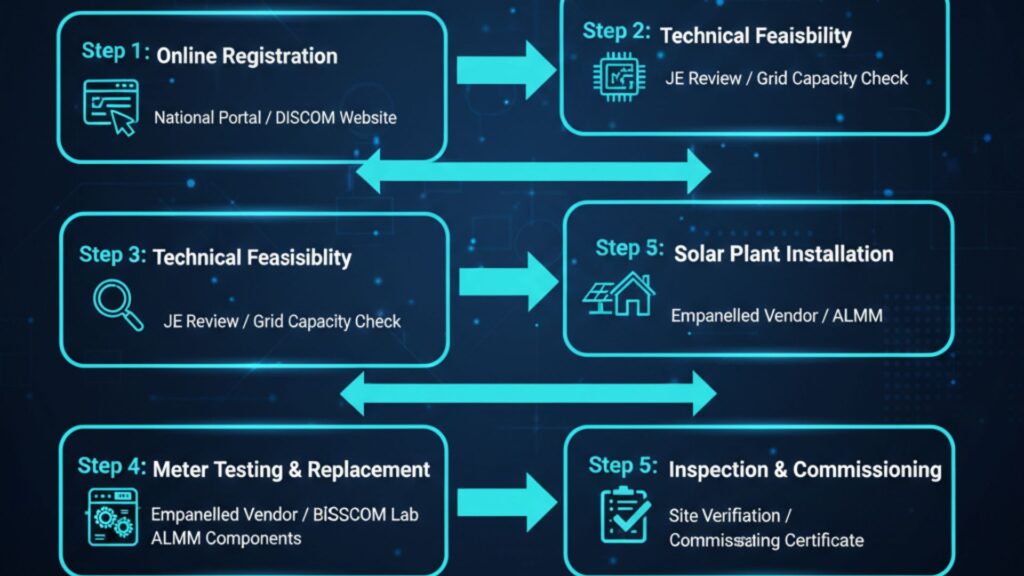
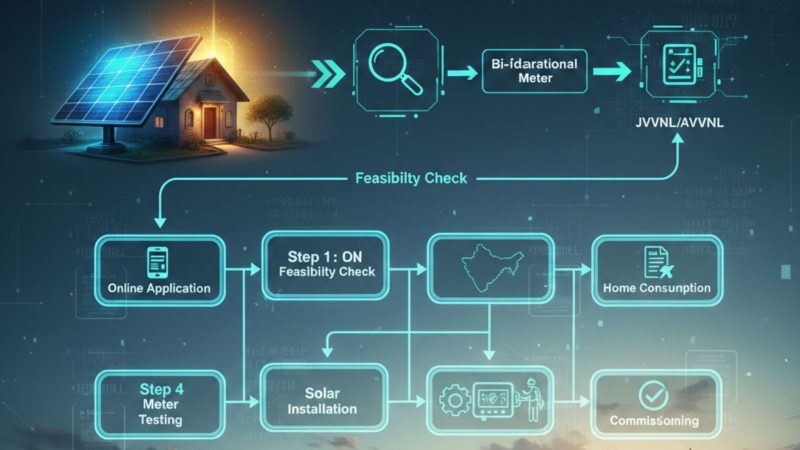
Step 1: Submission of Application (Online)
The first step is checking feasibility. You must apply through the National Portal for Rooftop Solar or the respective DISCOM portal.
- Register using your K-Number.
- Choose your DISCOM (JVVNL for Jaipur region, AVVNL for Ajmer/Udaipur region).
- Upload your documents and pay the application fee (Processing Fee).
Step 2: Technical Feasibility Approval
Once you apply, the local Junior Engineer (JE) of JVVNL or AVVNL will review your application. They check:
- If the sanctioned load matches.
- If the local transformer can handle the export.
This is a critical stage in the Net Metering process for JVVNL/AVVNL consumers. If approved, you receive a “Feasibility Certificate.”
Step 3: Installation by Empanelled Vendor
You must choose a vendor registered with the MNRE or the DISCOM.
- Note: To claim the PM Surya Ghar subsidy, the panels must be “Made in India” (DCR – Domestic Content Requirement).
- Once the installation is complete, the vendor will provide you with a Work Completion Report (WCR) and a Solar System Test Report.
Step 4: Applying for Meter Testing
After installation, you can’t just turn on the system. You need a Bi-directional meter.
- You can buy the meter yourself (it must be lab-tested by the DISCOM) or request the DISCOM to provide one for a fee.
- The meter recording ensures that both “Import” and “Export” units are tracked accurately.
Step 5: Inspection and Commissioning
The AEN/JEN will visit your site to verify the installation against the submitted WCR. They will check the earthing, lightening arrestor, and the “Manual Disconnect Switch.”
Once satisfied, they will install the Bi-directional meter and issue a Commissioning Certificate. Congratulations! You are now officially generating green energy.
Table 2: Estimated Timeline for Net Metering Process for JVVNL/AVVNL Consumers
| Stage | Activity | Estimated Time |
| Stage 1 | Application & Feasibility | 7 – 10 Days |
| Stage 2 | Solar Plant Installation | 5 – 7 Days |
| Stage 3 | WCR Submission & Meter Lab Testing | 10 – 15 Days |
| Stage 4 | Physical Inspection & Meter Replacement | 7 – 10 Days |
| Stage 5 | Subsidy Disbursement (After Commissioning) | 30 – 45 Days |
Financial Benefits: Subsidies and Savings
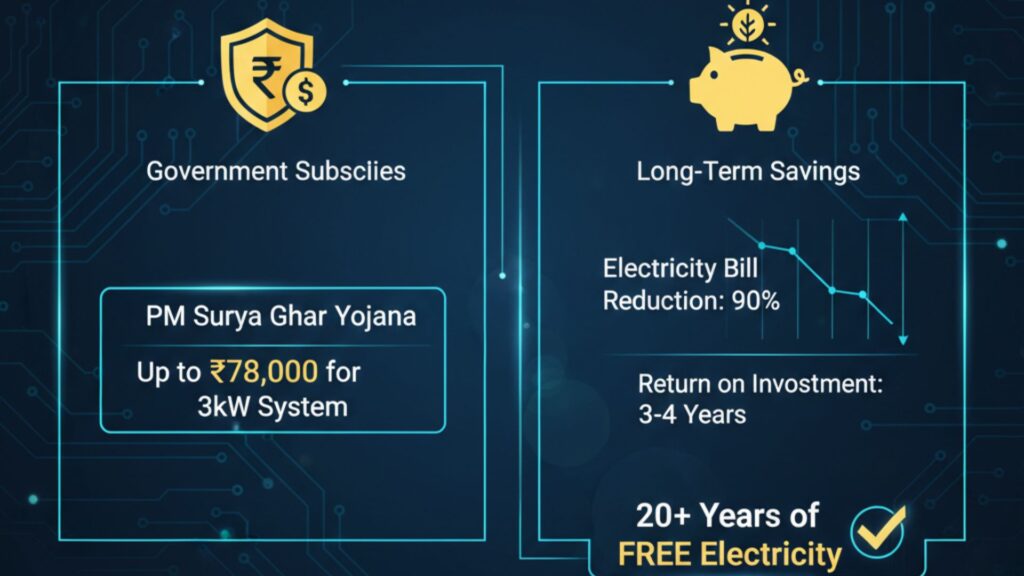
The Net Metering process for JVVNL/AVVNL consumers is the only way to claim the massive subsidies offered by the Central Government.
- Subsidy Structure: Under the 2024-2026 guidelines, residential consumers can get up to ₹78,000 for a 3kW system.
- Return on Investment (ROI): Most residential systems in Rajasthan pay for themselves within 3 to 4 years. Given that panels last for 25 years, you get over 20 years of essentially free electricity.
Challenges and Solutions in the Net Metering Process for JVVNL/AVVNL Consumers
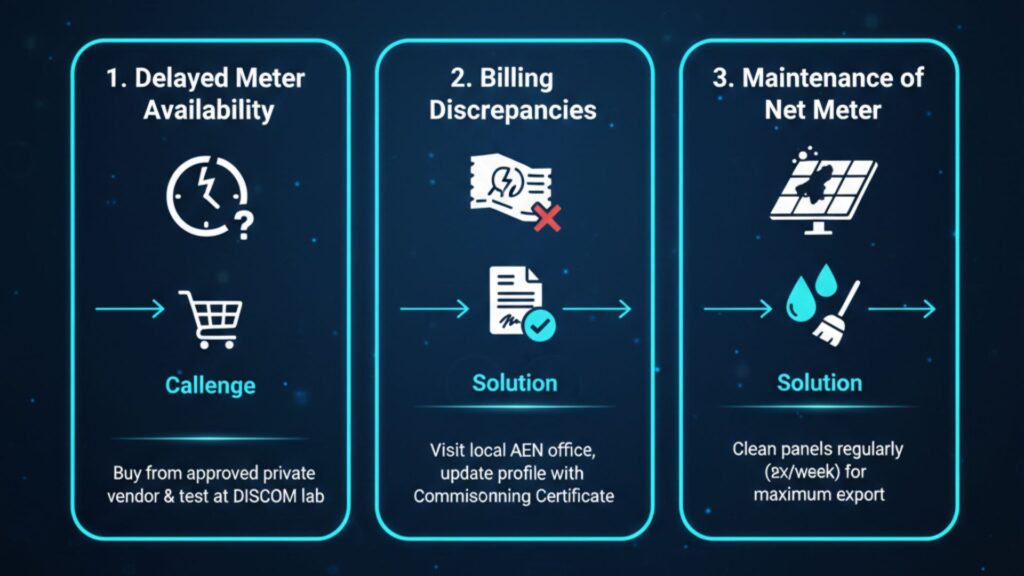
1. Delayed Meter Availability
Sometimes, JVVNL or AVVNL may run out of stock for Bi-directional meters.
- Solution: It is often faster to buy a meter from a private approved manufacturer (like Secure or HPL) and get it tested at the DISCOM lab yourself.
2. Billing Discrepancies
In the first few months after completing the Net Metering process for JVVNL/AVVNL consumers, your bill might not show the “Exported Units.”
- Solution: Keep your Commissioning Certificate safe. Visit the “Billing Section” of your sub-division office and ensure your consumer profile is updated from “General” to “Net Metered.”
3. Maintenance of Net Meter
Dust in Rajasthan is a major enemy. If your panels are dusty, production drops, and your “Net Meter” will show high consumption.
- Solution: Clean your panels twice a week to ensure maximum export to the grid.
Conclusion
The Net Metering process for JVVNL/AVVNL consumers is a transparent, digital-first procedure designed to empower the people of Rajasthan. While it requires following specific technical steps and coordinating with government officials, the reward is a lifetime of energy independence. By understanding the flow—from feasibility to commissioning—you can avoid common pitfalls and start saving from day one.
FAQs (Frequently Asked Questions)
1. Can I install solar without the Net Metering process for JVVNL/AVVNL consumers?
You can install an Off-grid system with batteries, but you won’t be able to export excess power to the grid, and you won’t receive any government subsidy.
2. What is the cost of the Bi-directional meter in Rajasthan?
Typically, it ranges from ₹2,500 to ₹8,000 depending on whether it is a single-phase or three-phase meter and whether you buy it privately or through the DISCOM.
3. Does the Net Metering process for JVVNL/AVVNL consumers apply to apartments?
Yes, but it requires a “Group Net Metering” or “Virtual Net Metering” setup, which has different RERC guidelines. Most apartments use solar for common area lighting.
4. What happens to my extra solar units?
Your DISCOM carries them forward each month. They pay out any remaining surplus at the end of the financial year.
5. Can I install a small 1kW solar system with this facility?
Yes, this billing facility is available for systems as small as 1kW. However, under current government schemes, you get the maximum subsidy (per kW) for installations up to 3kW.