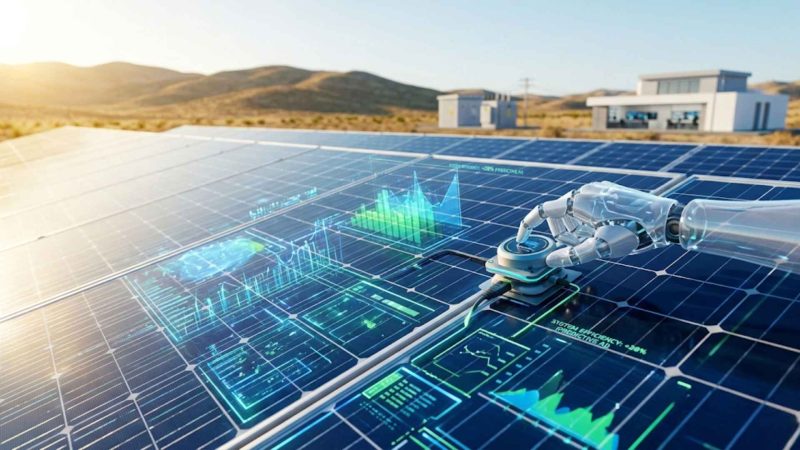
The global transition toward renewable energy has reached a fever pitch, but as solar installations multiply, a new challenge has emerged: Asset Management. For homeowners and large-scale developers, particularly in high-radiation zones like Rajasthan, the primary objective is to maximize the lifetime value of the hardware. This is where the AI-based solar monitoring system benefits come into play. By moving away from static data and embracing “Cognitive Energy Management,” AI-driven platforms ensure that your solar plant is not just a collection of glass and silicon, but a living, breathing, and self-optimizing ecosystem. In this definitive guide, we will explore why intelligence is the most critical component of the modern solar string.
The Anatomy of Intelligence: Understanding AI-Based Solar Monitoring System Benefits
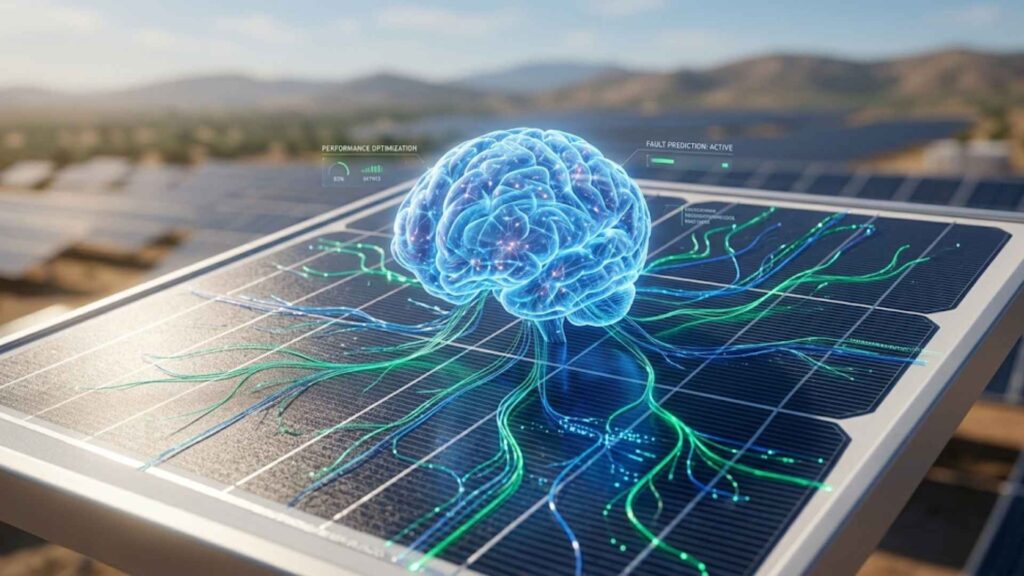
To understand how these systems work, we must first define what makes them “intelligent.” Traditional monitoring is a post-mortem tool—it tells you what happened yesterday. AI-based monitoring is a diagnostic tool—it tells you what is happening now and what will happen tomorrow.
The Power of Machine Learning in AI-Based Solar Monitoring System Benefits
One of the core AI-based solar monitoring system benefits is the application of Machine Learning (ML). ML algorithms are trained on billions of data points from solar farms across the globe. These algorithms can recognize patterns that the human eye (or a standard inverter) would miss. For example, if a specific string of panels is underperforming by only 2%, a standard system might ignore it as “natural variance.” An AI system, however, recognizes this as a specific signature of potential PID (Potential Induced Degradation) and alerts the owner before the loss climbs to 10%.
Beyond Simple Data: Actionable AI-Based Solar Monitoring System Benefits
Data is useless without context. A major AI-based solar monitoring system benefit is the conversion of raw voltage and current readings into “Actionable Intelligence.” Instead of a complex graph, the user receives a simple notification: “Your North-West string is shaded by a growing tree branch; prune it to recover 4 units of electricity per day.” This level of clarity is what makes AI indispensable for the non-technical homeowner.
Maintenance 2.0: Predictive AI-Based Solar Monitoring System Benefits
Maintenance is traditionally the highest “O&M” (Operations and Maintenance) cost for solar plants. In harsh environments like the Thar Desert or urban Jaipur, hardware is pushed to its limits.
Shifting from Reactive to Predictive AI-Based Solar Monitoring System Benefits
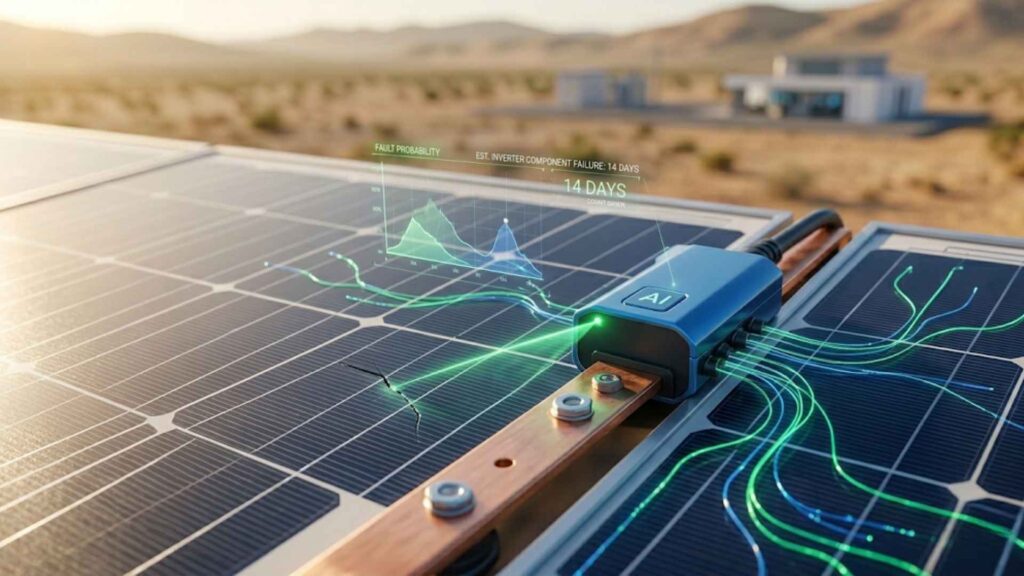
Most solar owners only call a technician when the system stops working. This “Reactive” approach results in “Down-Time Loss.” One of the most profitable AI-based solar monitoring system benefits is Predictive Maintenance. By analyzing the “Inverter Efficiency Curve,” the AI can sense when a capacitor is beginning to fail. By replacing a 500-rupee part today, you prevent a 50,000-rupee inverter blowout next month.
Thermal Imaging and Integrated AI-Based Solar Monitoring System Benefits
Advanced AI monitoring now integrates with drone-based thermal imaging. The AI scans the thermal maps for “Hotspots.” A hotspot is a cell that has become a resistor instead of a generator, creating dangerous heat. Identifying these via an AI-based solar monitoring system benefit prevents fire hazards and ensures the safety of the entire building or farm.
Environmental Adaptation: AI-Based Solar Monitoring System Benefits in Rajasthan
Rajasthan’s climate is perfect for solar, but brutal for equipment. High heat, heavy dust, and erratic monsoons require a system that can adapt.
Solving the “Soiling” Crisis with AI
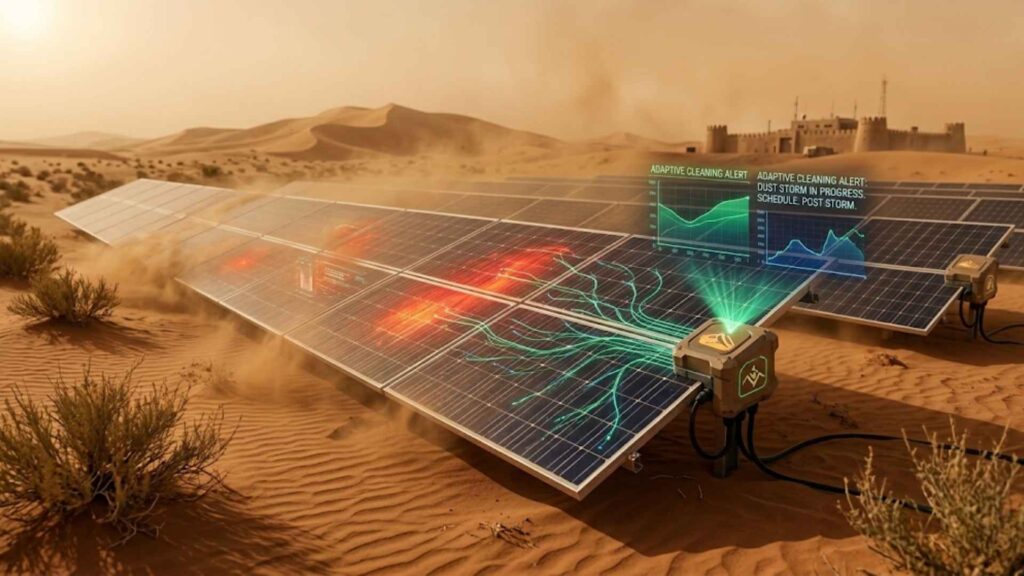
“Soiling” (dust accumulation) can kill up to 30% of your production in a single week after a dust storm. A key AI-based solar monitoring system benefit is the “Economic Cleaning Cycle.” The AI monitors the local weather API. If it knows a rainstorm is coming in 48 hours, it will tell you NOT to clean your panels today, saving you the labor cost. If no rain is predicted, it calculates the exact day when the dust-loss exceeds the cleaning cost, optimizing your maintenance budget.
Heat Stress Management and Efficiency
When temperatures in Rajasthan cross 45°C, solar panels actually lose efficiency. AI systems manage this by adjusting the “MPPT” (Maximum Power Point Tracking) parameters in real-time. This cooling-logic adaptation is a technical AI-based solar monitoring system benefit that protects the long-term health of the solar cells.
Technical Comparison: AI-Powered vs. Legacy Monitoring Systems
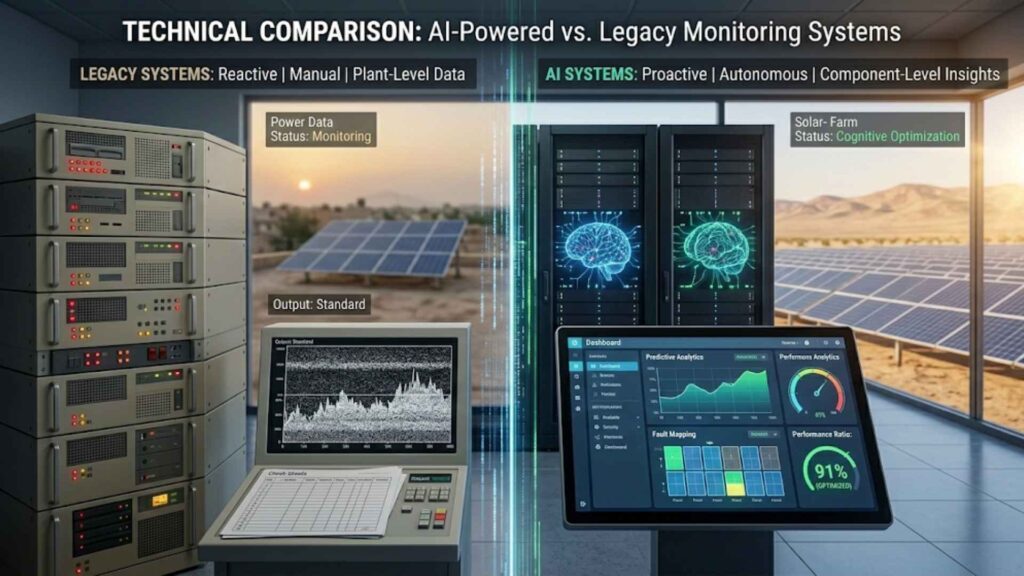
| Performance Metric | Traditional Data Logger | AI-Based Monitoring System |
| Fault Detection Speed | 24 – 48 Hours | Less than 60 Seconds |
| Weather Awareness | None | Integrated Satellite & Local API |
| Maintenance Strategy | Schedule-based (Inefficient) | Condition-based (Optimized) |
| Energy Forecasting | Simple Averages | Neural Network Prediction |
| ROI Enhancement | 0% (Observation Only) | 10% to 15% (Optimization) |
Financial Growth: How AI-Based Solar Monitoring System Benefits Your Wallet
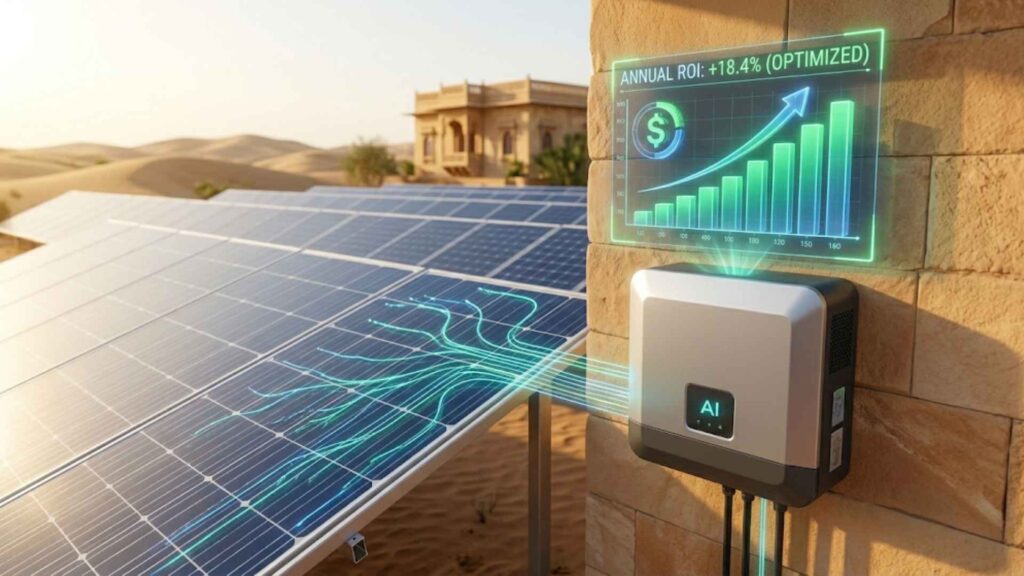
The “Levelized Cost of Energy” (LCOE) is the most important metric in solar. AI helps drive this number down.
Shortening the Payback Period
A standard 5kW system in India usually pays for itself in 4 years. By utilizing AI-based solar monitoring system benefits, you can increase the annual yield by 8-12%. This cumulative gain can reduce your payback period by 6 to 8 months. For a large-scale 1MW plant, this represents millions of rupees in additional revenue.
Maximizing Grid-Export and Net Metering
In states with active Net Metering, the timing of your energy export matters. AI can help manage “Load Shifting.” It suggests running heavy appliances (like ACs or Water Pumps) during peak sun hours and exporting power when the grid demand (and sometimes the credit rate) is optimal. This strategic consumption is a major AI-based solar monitoring system benefit.
The User Experience: Human-Centric AI-Based Solar Monitoring System Benefits
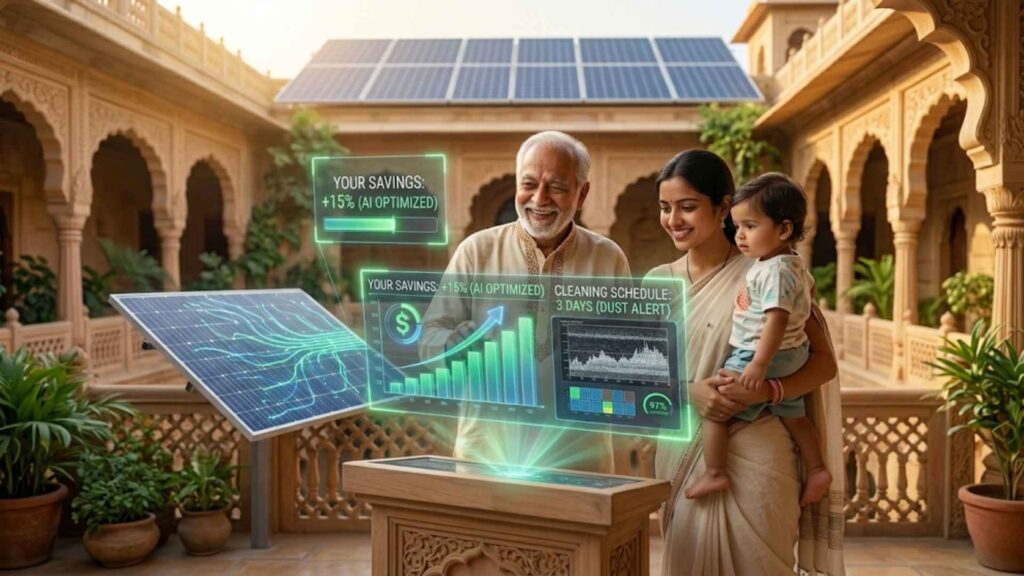
One of the biggest hurdles in solar adoption is the complexity of the tech. AI simplifies the “Human-Machine Interface.”
Simplified Dashboards for Residential Users
Gone are the days of reading green text on a small inverter screen. Modern AI-based solar monitoring system benefits include intuitive apps that use “Natural Language Processing.” You can ask the app, “How much did I save today?” and receive a clear answer in currency value, rather than kilowatt-hours.
Multi-Site Management for Businesses
For business owners with factories in Jaipur, Jodhpur, and Udaipur, AI provides a “Single Pane of Glass.” You can monitor the health of all three plants from one dashboard. The AI prioritizes which site needs attention first based on the severity of the alerts, another logistical AI-based solar monitoring system benefit.
Future-Proofing: AI-Based Solar Monitoring System Benefits and the Smart Grid

The grid of 2026 is not the grid of 1990. We are moving toward “Virtual Power Plants” (VPPs).
Preparing for Energy Storage (Batteries)
As battery prices drop, more users are adding storage. AI is the brain of the battery. It decides when to charge from the sun, when to hold power, and when to discharge. Managing the “State of Charge” (SoC) is a critical AI-based solar monitoring system benefit that ensures your expensive lithium batteries last 10 years instead of 5.
Integration with Smart Home Ecosystems
Imagine your solar system talking to your Electric Vehicle (EV). AI monitoring can trigger your EV charger only when there is surplus solar energy, ensuring you are “Driving on Sunshine.” this synergy is the ultimate AI-based solar monitoring system benefit for the modern eco-conscious citizen.
Conclusion: The Intelligence Imperative
Solar energy is the most abundant resource we have, especially in the vibrant state of Rajasthan. However, raw power is nothing without control. The AI-based solar monitoring system benefits we have discussed—from predictive maintenance to financial optimization—prove that “Smart Solar” is the only logical path forward. By investing in an AI-driven system, you aren’t just buying hardware; you are buying a 25-year guarantee of peak performance.
Frequently Asked Questions (FAQs)
1: What is the main benefit of an AI-based solar monitoring system?
The primary AI-based solar monitoring system benefit is Predictive Maintenance. Unlike traditional systems that only show data, AI predicts hardware failures before they happen. This reduces downtime and ensures your solar plant in Rajasthan consistently produces maximum energy without unexpected breakdowns.
2: Can AI monitoring really increase solar efficiency?
Yes, AI can boost efficiency by up to 20-25%. It achieves this by analyzing real-time weather patterns, optimizing inverter performance, and providing “Smart Cleaning” alerts. These AI-based solar monitoring system benefits ensure that your panels are always operating at their peak potential.
3: How does AI help with solar panel cleaning in dusty areas?
In dusty regions like Jaipur, AI monitors “Soiling Loss” by comparing actual output with theoretical satellite data. A key AI-based solar monitoring system benefit is that it tells you exactly when to clean your panels, preventing energy loss from dust while saving water and labor costs.
4: Is AI monitoring expensive for home solar systems?
While the upfront cost is slightly higher than basic data loggers, the AI-based solar monitoring system benefits lead to a faster ROI (Return on Investment). By increasing energy yield and preventing costly repairs, the system usually pays for itself within 12 to 18 months.
5: Does an AI solar system work during cloudy weather?
Absolutely. AI uses “Energy Forecasting” to predict generation during low-light conditions. One of the best AI-based solar monitoring system benefits is that it manages your battery storage or grid-export strategy in advance, ensuring you have power even when the sun isn’t shining.