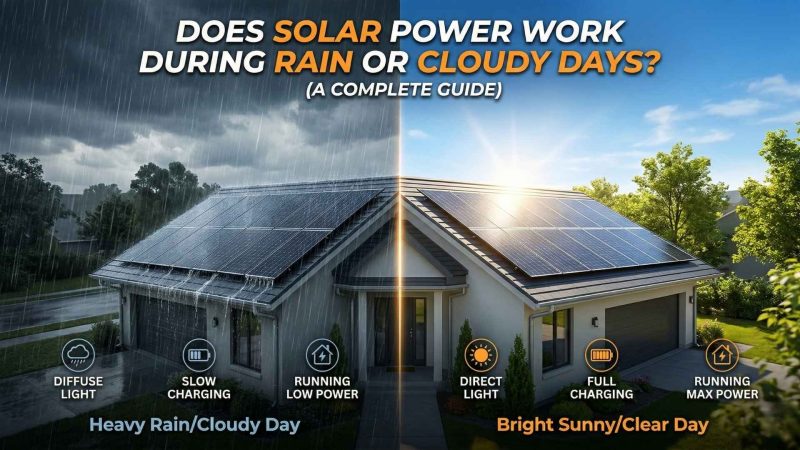
The transition to renewable energy is often met with a recurring question from skeptical homeowners and business owners alike: “Does solar power work during rain or cloudy days?” It is a fair concern. After all, the very name “solar” implies a total dependency on the sun. If you live in a region prone to monsoons, overcast winters, or frequent coastal fog, you might worry that your investment will sit idle for half the year.
The short answer is a resounding yes. Solar panels do not “turn off” just because the sky turns grey. However, the mechanics of how they generate electricity changes when direct sunlight is blocked. In this 2000-word guide, we will break down the science of photovoltaic (PV) technology in low-light conditions, analyze efficiency drops, and explain why rain might actually be a hidden blessing for your solar system.
The Science of Photons: How Does Solar Power Work During Rain or Cloudy Days?
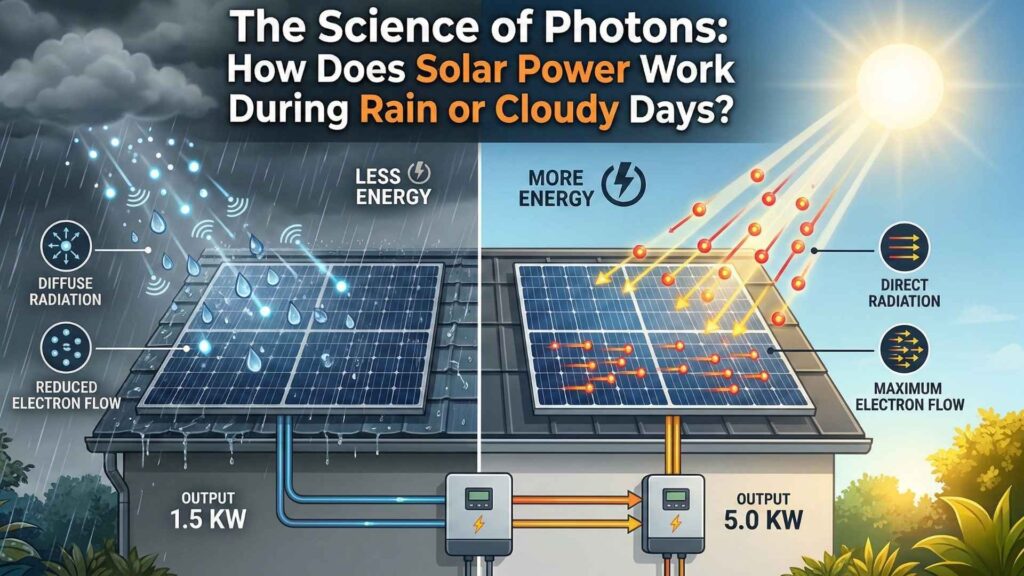
To understand how a solar panel functions in the rain, we must first dispel the myth that panels only react to “heat” or “visible yellow light.” Solar panels react to photons, which are particles of light that exist across a broad spectrum, including those we cannot see with the naked eye.
Direct vs. Diffuse Radiation
In the solar industry, we categorize sunlight into two types:
- Direct Beam Radiation: This is the light that travels in a straight line from the sun to your roof. This is the most “energy-dense” form of light and generates the maximum wattage.
- Diffuse Radiation: This is light that has been scattered by water molecules, clouds, dust, and the atmosphere.
When you ask, “Does solar power work during rain or cloudy days?”, you are really asking if panels can catch diffuse radiation. Modern Tier-1 Monocrystalline panels are incredibly sensitive. Even when a thick layer of clouds covers the sun, photons are still bouncing through the atmosphere and hitting your panels. This is why it is still light outside during a storm! If there is enough light for you to see your hand in front of your face, there is enough light for a solar panel to produce electricity.
Efficiency Metrics: Does Solar Power Work During Rain and How Much Power Is Lost?
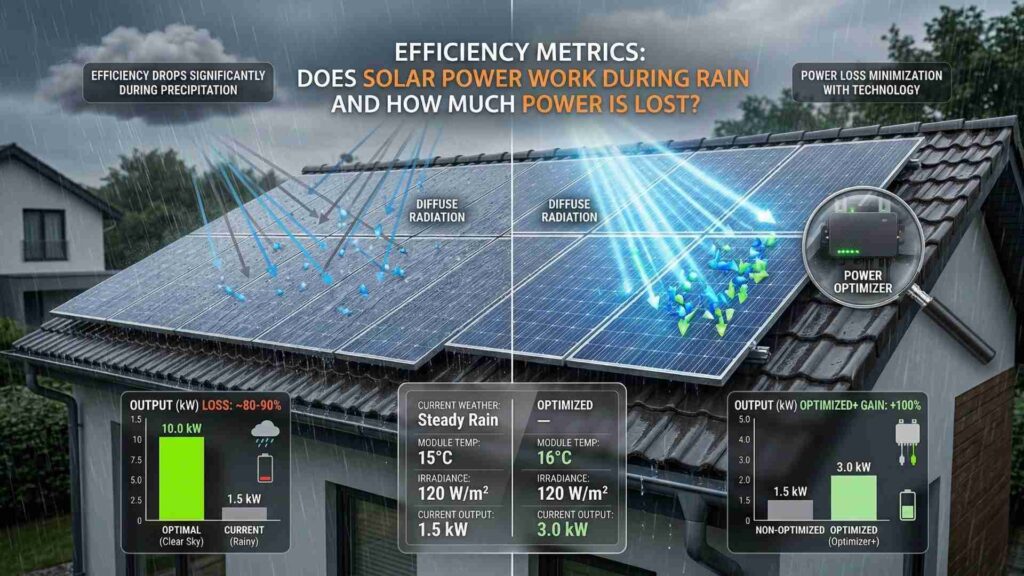
It would be dishonest to say that clouds have no impact. While the system works, its “yield” or “output” is lower. Typically, a solar array will produce between 10% and 25% of its rated capacity on a heavily overcast day.
Weather Impact Comparison Table
To help you visualize the performance, let’s look at how a standard 5-kilowatt (kW) residential system performs under different sky conditions.
| Weather Condition | Light Intensity | Estimated System Output (5kW System) | Impact on Battery Charging |
| Clear Blue Sky | 100% (Direct) | 4.5kW – 5.0kW | Rapid Charging |
| Light Clouds/Haze | 60% – 80% | 3.0kW – 4.0kW | Normal Charging |
| Heavy Overcast | 10% – 25% | 0.5kW – 1.25kW | Slow Trickle Charge |
| Heavy Rain/Storm | 5% – 15% | 0.25kW – 0.75kW | Minimal Charging |
The “Edge of Cloud” Effect: Does Solar Power Work During Rain Better Than Expected?
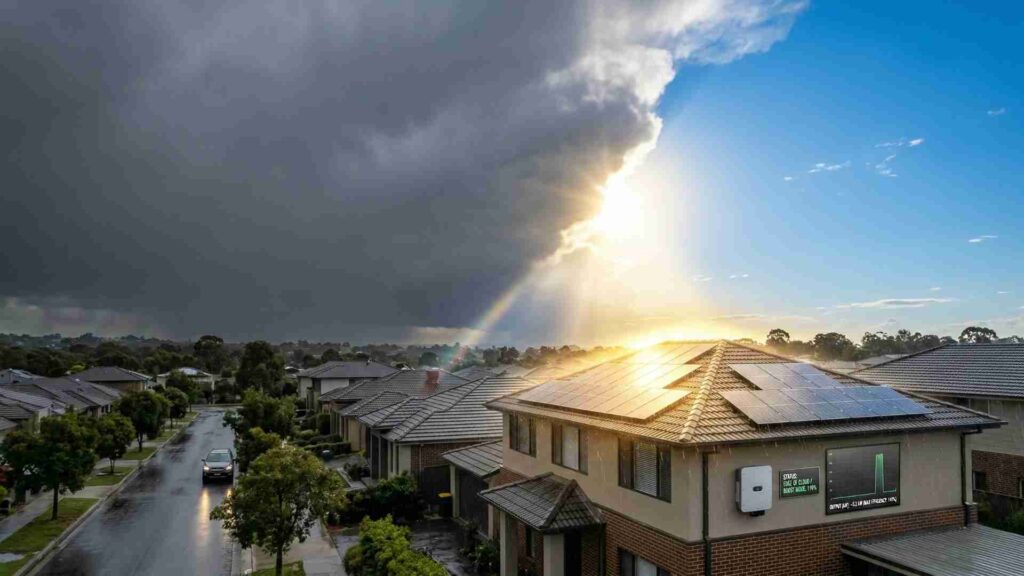
There is a fascinating meteorological phenomenon called the “Edge of Cloud” effect. Have you ever noticed that right before or after a rain shower, the light feels incredibly intense?
When a cloud passes by the sun, its edges act like a giant magnifying glass. The water droplets in the cloud refract and concentrate the sunlight. For brief windows of time, your solar panels can actually produce more than their rated capacity—sometimes hitting 110% or 120% efficiency. This “burst” of energy often helps offset the lower production seen during the darker parts of the day.
Rain as a Maintenance Tool: Why Your System Needs the Storm
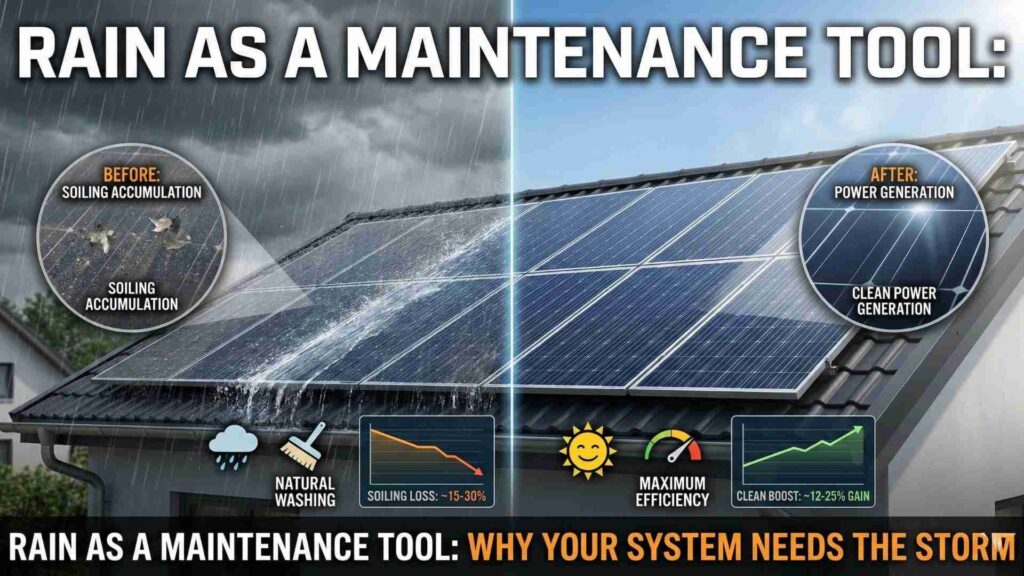
Most people view rain as an enemy of technology. However, in the world of Search Engine Optimization for solar content, we always highlight that rain is a natural cleaning service.
Does Solar Power Work During Rain to Improve Long-Term Yield?
Over weeks and months, solar panels accumulate “soiling.” This includes:
- Dust and Pollen: Especially in dry regions like Rajasthan or California.
- Bird Droppings: Which can create “hot spots” that damage cells.
- Industrial Pollution: A thin film of smog that blocks light.
A heavy downpour washes this debris away. Research shows that panels cleaned by rain can see a 5% to 12% boost in efficiency immediately after the weather clears compared to panels that remain dusty. So, while you lose some power during the rain, you gain more power after the rain.
Choosing Hardware: Best Panels for Rain and Cloudy Days
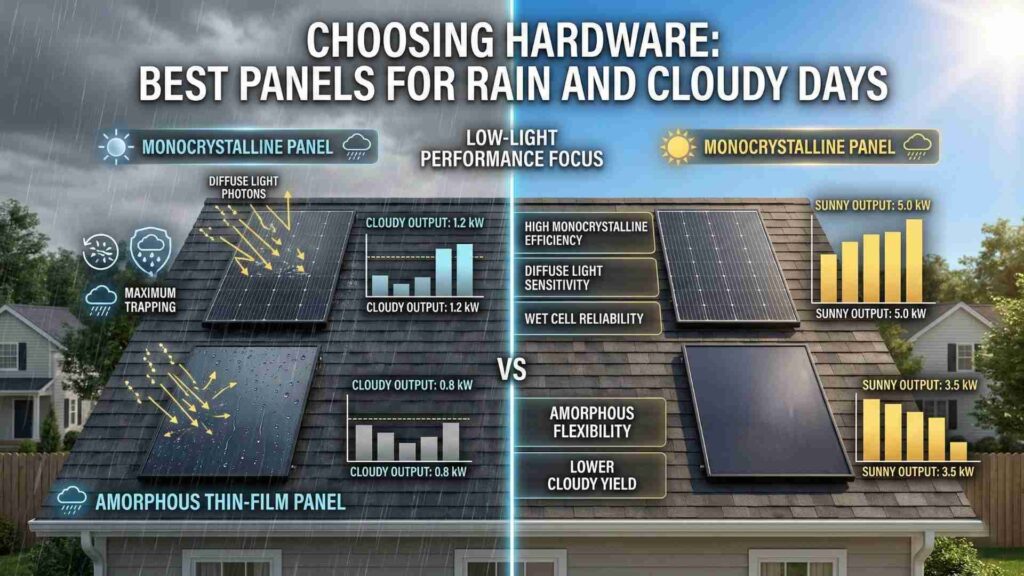
If you live in a high-rainfall area, not all solar panels are created equal. When considering “Does solar power work during rain or cloudy days?”, the hardware you choose is the most significant factor in performance.
Monocrystalline vs. Polycrystalline
- Monocrystalline (Recommended): These are made from a single, high-purity silicon crystal. They have the highest efficiency in low-light conditions because the electrons have a “clearer path” to flow, even when photon strikes are infrequent.
- Polycrystalline: These are cheaper but struggle significantly in the shade or under heavy clouds. They are better suited for desert environments with constant, direct sun.
Half-Cut Cell Technology
Modern panels often use “Half-Cut” cells. In a traditional panel, if a cloud shades the top half, the whole panel might stop producing. With Half-Cut technology, the top and bottom halves operate independently. If a cloud is partially covering your roof, the unshaded half keeps working at full capacity.
Battery Storage: The Solution for Cloudy Day Anxiety
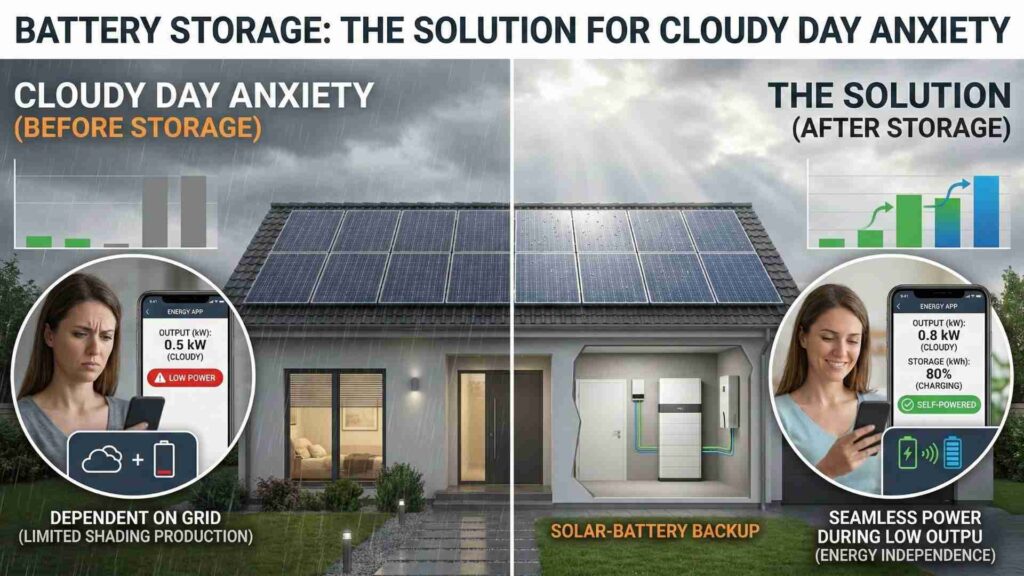
The ultimate answer to the question “Does solar power work during rain or cloudy days?” lies in storage. If your system is “Grid-Tied” without a battery, you rely on the grid when the clouds get too thick. But with a Solar Battery (like a Lithium-ion Powerwall), the weather becomes irrelevant.
Energy Management Strategies for Rainy Seasons
| Feature | Importance in Rainy Weather | How it Helps |
| Energy Arbitrage | High | Stores excess sun from Monday to use on a rainy Tuesday. |
| Backup Power | Critical | Keeps lights on during storm-related grid outages. |
| Trickle Charging | Medium | Ensures the battery stays topped up even with low cloud output. |
Common Myths About Solar and Weather
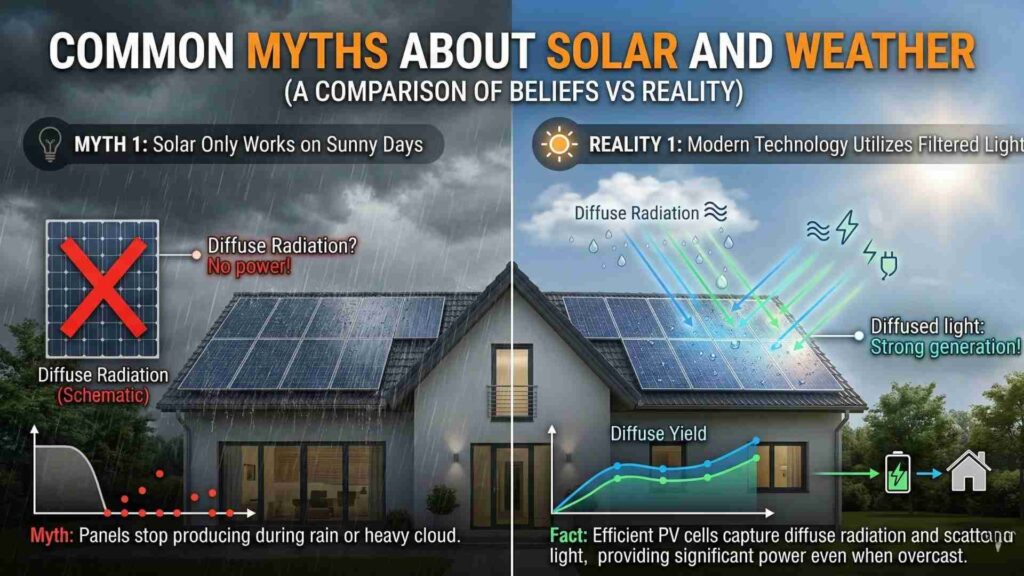
To provide a truly “Complete Guide,” we must debunk the misinformation circulating online.
Myth 1: Solar Panels Only Work in Hot Climates
Reality: This is actually the opposite of the truth. Solar panels are electronic devices. Like your laptop or phone, they perform better when they are cool. A cold, sunny day in December is often more productive than a sweltering, humid day in July.
Myth 2: Rain Will Short-Circuit the Panels
Reality: Solar panels are designed to withstand extreme weather. They are hermetically sealed with tempered glass and heavy-duty polymer backsheets. They undergo “Hail Tests” where ice balls are fired at them at high speeds. Your panels are safer in a storm than your roof shingles!
Conclusion: Why the Weather Shouldn’t Stop Your Solar Journey
When we ask “Does solar power work during rain or cloudy days?”, we are looking for reliability. The data is clear: solar technology has evolved beyond the need for “perfect” conditions. By utilizing diffuse radiation, benefiting from the cooling and cleaning effects of rain, and using battery storage to bridge the gaps, solar remains a robust and dependable energy source.
Whether it is a bright summer afternoon or a grey monsoon morning, your solar panels are hard at work, saving you money and reducing your carbon footprint. Don’t let a few clouds dim your enthusiasm for a greener future.
Frequently Asked Questions (FAQ)
Q1: Does solar power work during rain at night?
No. While panels can work with very little light, they cannot work with zero light. Moonlight and streetlights do not contain enough energy to trigger the photovoltaic effect. At night, you will use stored battery power or grid power.
Q2: Is it worth getting solar in a city that is mostly cloudy?
Yes. Germany is one of the world leaders in solar energy, yet it is one of the cloudiest countries in Europe. The key is to size your system slightly larger to account for the lower average daily sunlight.
Q3: Do solar panels get damaged by lightning?
Direct strikes are rare, but solar systems are equipped with grounding wires and surge protectors (SPD) to divert excess electricity safely into the earth.
Q4: How do I monitor my production during a storm?
Most modern inverters come with a mobile app (like SolarEdge or Enphase). You can watch your “Real-Time Yield” in watts and see exactly how much diffuse light your panels are catching.