For business owners in Rajasthan, the equation is simple but brutal: electricity tariffs are rising, and operational margins are tightening. Whether you run a textile unit in Bhilwara, a handicraft export house in Jaipur, or a cold storage facility in Alwar, finding effective commercial solar solutions for industries is no longer just an option—it is a necessity to control energy costs that likely represent one of your top three recurring expenses.
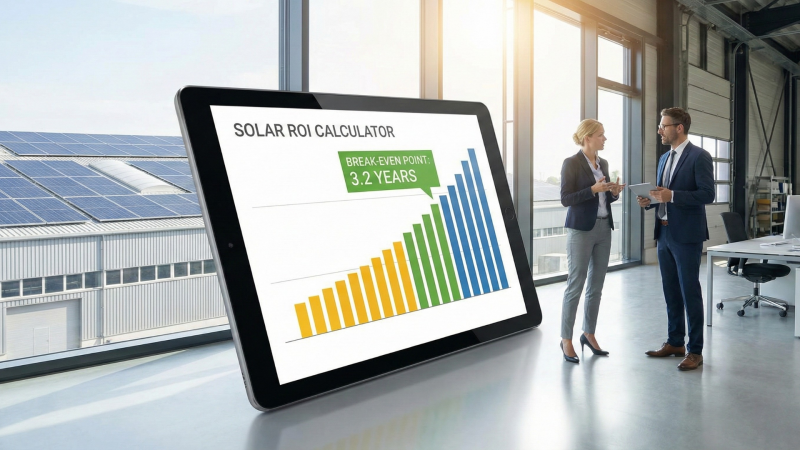
We know Rajasthan receives excellent sunlight. The shift to solar is a critical financial strategy. It is not just about “going green.” But is it worth it? This guide acts as your Commercial Solar ROI Calculator. It helps you understand your break-even point. We will also look at how much you save with commercial solar solutions for industries.
Why You Need Commercial Solar Solutions for Industries in Rajasthan
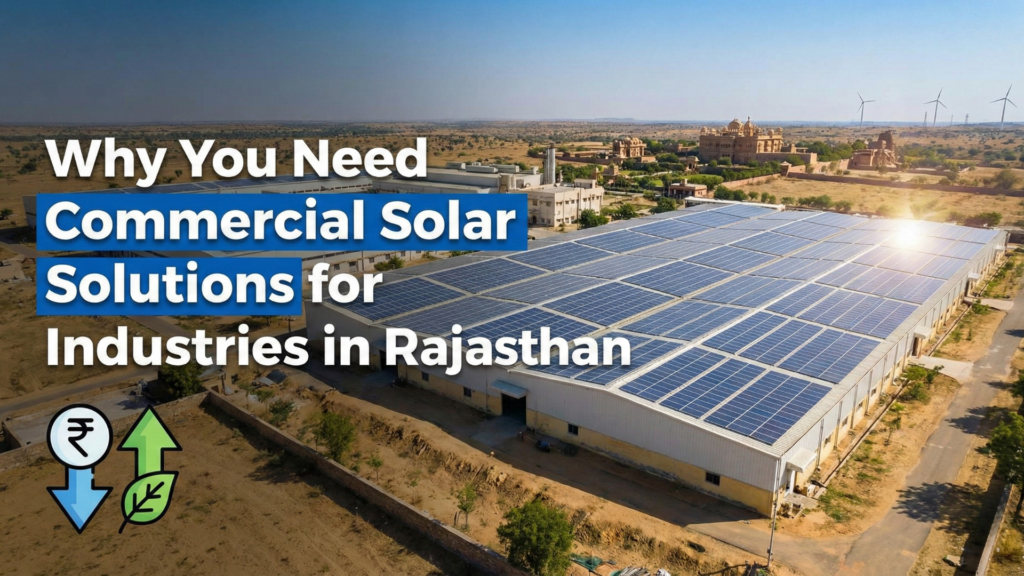
The industrial landscape in Rajasthan is unique. Unlike residential consumers who benefit from capped subsidies, industrial players face grid tariffs that can touch ₹8.5 to ₹10 per unit depending on the connection type (HT vs. LT) and fuel surcharges.
Implementing commercial solar solutions for industries is essentially locking in your electricity price at ₹3–₹4 per unit for the next two decades, while your competitors continue to pay rising grid rates.
The ROI “Calculator” Logic
To calculate your specific ROI (Return on Investment), you must look at three variables prevalent in the Rajasthan market for 2025-26:
- System Cost (CAPEX): Currently averaging ₹38,000–₹45,000 per kW for larger industrial projects.
- Grid Tariff Escalation: Rajasthan DISCOMs (JVVNL, AVVNL, JdVVNL) typically see effective tariff hikes of 3-5% annually.
- Generation Efficiency: A 100 kW plant in Rajasthan generates approximately 1.5 lakh units (kWh) annually due to excellent sunlight.
Below is a comparative look at the cost of inaction versus the cost of adoption.
Table 1: Grid Power vs. Solar Power Cost Analysis (10 Year Projection)
| Cost Component | Grid Power (Business as Usual) | Solar Power (CAPEX Model) |
| Initial Investment | ₹0 (Zero upfront, but perpetual monthly bills) | ₹40,00,000 (Approx for 100kW system) |
| Cost Per Unit (Year 1) | ₹9.00 / kWh | ₹0.00 / kWh (After Capex) |
| Cost Per Unit (Year 10) | ₹12.09 / kWh (Assumes 3% annual hike) | ₹0.00 / kWh (Fuel free) |
| Maintenance | None (DISCOM handles it) | Low (Approx 1% of project cost/year) |
| Asset Value | None (Expense only) | High (Depreciating Asset with Tax Benefits) |
| 10-Year Total Expense | ₹1.35 Crores (Approx cumulative bills) | ₹45 Lakhs (Initial + O&M) |
| Net Savings | – | ₹90 Lakhs+ |
Note: The “Grid Power” expense assumes a monthly consumption of 12,500 units for a mid-sized industry.
Sector-Wise Impact of Commercial Solar Solutions for Industries
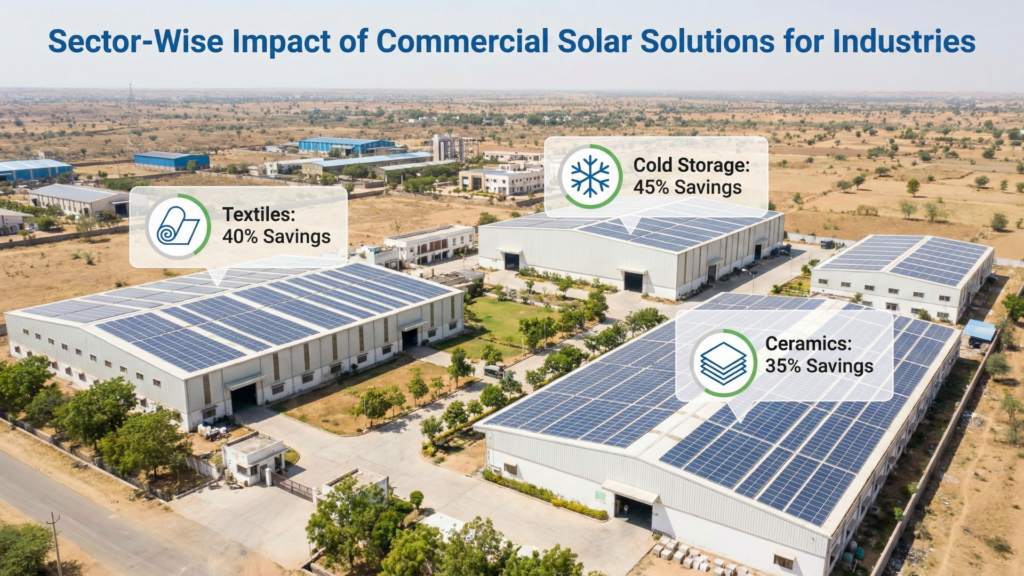
Not all industries consume power the same way. A hotel runs 24/7 with heavy AC loads, while a manufacturing factory might peak during the day—perfectly aligning with solar generation hours. This alignment affects how quickly you break even.
When customizing commercial solar solutions for industries, we look at the “load profile.” In Rajasthan, net billing regulations (as of late 2025 updates) allow you to bank surplus power, but the real ROI magic happens when you consume what you generate instantly (Captive Consumption).
The “Sanganer to Bhiwadi” Industrial Belt Analysis
Textile units in Sanganer and heavy industries in Bhiwadi have seen the fastest adoption rates. Why? Because their peak operations often coincide with peak sun hours (10 AM to 4 PM).
Table 2: Estimated Payback Period by Industry Sector (Rajasthan)
| Industry Sector | Typical Load Profile | Consumption Match with Solar | Est. Payback Period |
| Textile & Garment | High Day & Night (Spinning/Dyeing) | Moderate (60-70%) | 3.2 – 3.8 Years |
| Cold Storage | 24/7 Constant Load | High (Cooling needs peak in sun) | 3.0 – 3.5 Years |
| Hotels/Resorts | Evening Peak (Lighting/AC) | Low (Requires Net Metering) | 4.0 – 4.5 Years |
| Schools/Colleges | Day Time Only (9 AM – 4 PM) | Perfect (95% Match) | 2.8 – 3.2 Years |
| Hospitals | 24/7 Critical Load | Moderate | 3.5 – 4.0 Years |
Schools have the fastest ROI. They are closed when the sun is down.
Financial Incentives on Commercial Solar Solutions for Industries
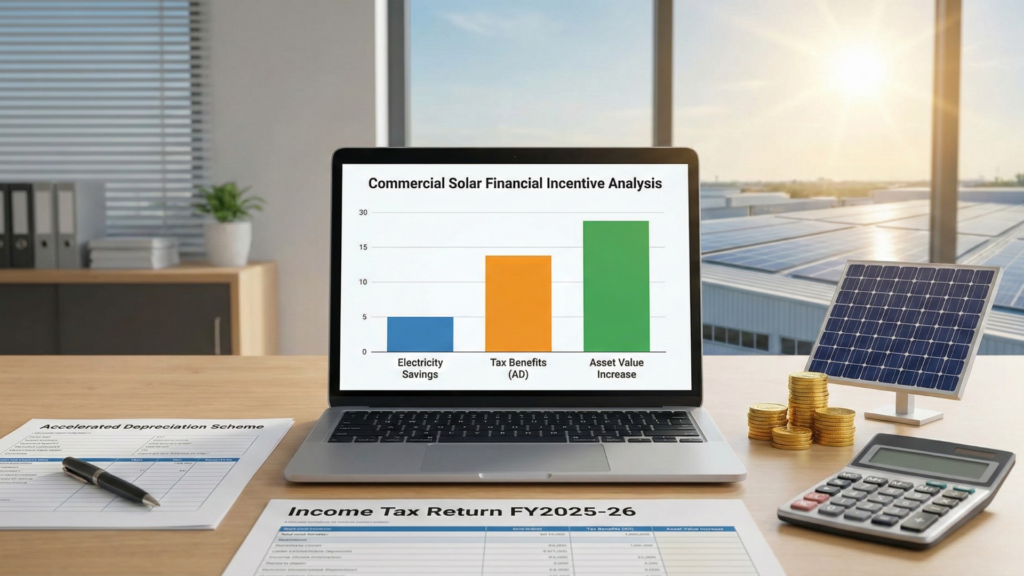
Many business owners in Jaipur and Jodhpur mistakenly look for “Subsidies.” For the commercial sector, the government does not typically offer direct cash subsidies (CFA) like they do for residential homes. Instead, they offer something far more valuable for a profitable business: Accelerated Depreciation (AD).
Under the Income Tax Act, you can claim 40% depreciation on the book value of your solar assets in the very first year. This significantly lowers your taxable profit, reducing the tax you pay to the government. This “tax saved” is essentially “cash earned,” which drastically shortens your ROI period.
Table 3: The “Hidden” Savings via Accelerated Depreciation (Example)
| Financial Metric | Without Solar | With Solar (100 kW Project) |
| Project Cost | N/A | ₹40,00,000 |
| Depreciation Rate | 15% (Standard Plant & Machinery) | 40% (Solar Specific Benefit) |
| Depreciation Amount | N/A | ₹16,00,000 (Year 1) |
| Tax Rate (Corporate) | 25% (Approx) | 25% |
| Tax Saved (Cash In) | ₹0 | ₹4,00,000 (Year 1 alone) |
| Effective Project Cost | N/A | ₹36,00,000 (Cost – Tax Saved) |
By leveraging AD, your effective cost drops immediately.
Conclusion
The numbers for Rajasthan are clear. Grid tariffs are near double digits. Solar costs are dropping. The “Commercial Solar ROI Calculator” shows a positive trend.
Waiting for battery prices to drop or panel efficiency to jump another 1% is a losing strategy when you are bleeding cash on monthly electricity bills today. The smartest move for industries in Rajasthan is to capitalize on the current Net Billing policies and Accelerated Depreciation benefits before the financial year closes.
Are you ready to stop renting your electricity and start owning it?
Frequently Asked Questions (FAQ)
Q1: Is there a direct subsidy for commercial solar industries in Rajasthan?
A: generally, no. Central Financial Assistance (subsidy) is usually reserved for residential and agricultural sectors. However, commercial industries benefit from Accelerated Depreciation (40%), which often outweighs the value of a small subsidy for profitable businesses. MSME units should check for specific collateral-free loan schemes which often have interest subvention.
Q2: What happens to the excess power I generate on Sundays or holidays?
A: Under Rajasthan’s RERC regulations, you can opt for Net Billing or Net Metering (depending on your load and transformer capacity). Excess power is exported to the grid, and you receive a credit on your bill. Recent updates in late 2025 have stabilized the export rates (approx ₹3.65/unit for net billing), ensuring you don’t lose value on generated power.
Q3: How much roof space do I need for a 100 kW commercial solar solution?
A: You typically need about 1,000 square feet per 10 kW. So, for a 100 kW system, you would need approximately 10,000 square feet of shadow-free area. If roof space is limited, ground-mounted options or high-efficiency Mono-PERC bifacial panels can be used to maximize output in less space.
Q4: Can I run my heavy machinery (motors, compressors) directly on solar?
A: Solar is a grid-tied system. Your machinery runs on the stable grid (or generator) reference. The solar system simply pumps energy into your internal circuit, reducing what you pull from the grid. It acts as a “savings generator,” not a direct battery for heavy motors, ensuring no fluctuation risks to your expensive equipment.
Q5: What is the lifespan of these commercial solar solutions?
A: Tier-1 solar panels come with a performance warranty of 25 to 30 years. In the dry, sunny climate of Rajasthan, these systems are incredibly durable, requiring only regular cleaning (due to dust) to maintain peak efficiency.