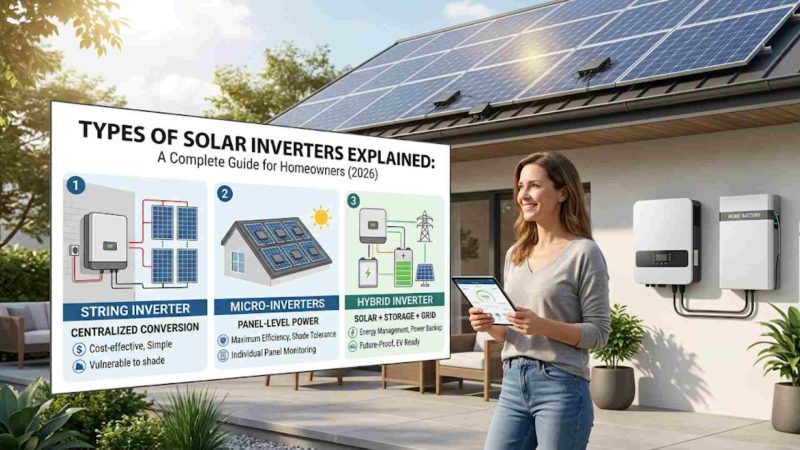
The global transition toward renewable energy has reached a pivotal moment in 2026, making it more important than ever to have the different types of solar inverters explained to ensure a high return on investment. As residential solar adoption hits record highs, homeowners are no longer just asking “should I get solar?” but rather “which components will maximize my system’s efficiency?” While solar panels are the most visible part of the installation, the solar inverter is undeniably the most critical—acting as the “brain” of the entire setup by managing energy flow, ensuring safety, and optimizing performance.
In this comprehensive guide, we provide the different types of solar inverters explained to help you make an informed decision for your home. Whether you are installing a 3kW system for a small household or a 10kW setup for a large bungalow, understanding these technologies is the first step toward energy independence.
What is a Solar Inverter and Why Does It Matter?
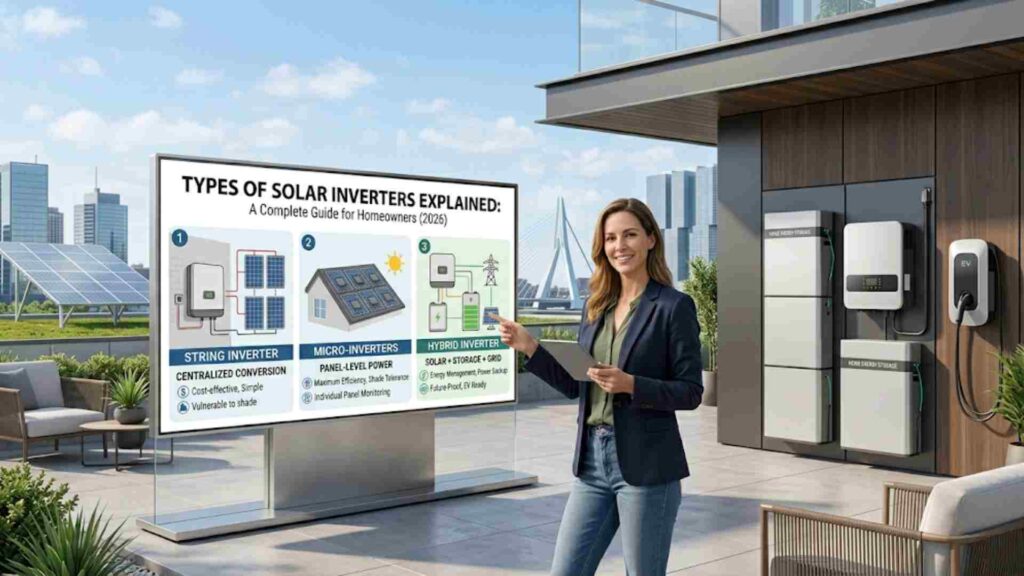
Before diving into the specific types of solar inverters explained, it is essential to understand their primary function. Solar panels generate electricity in the form of Direct Current (DC). However, almost all modern household appliances—from your air conditioner to your LED lights—run on Alternating Current (AC).
The solar inverter’s job is to “invert” that DC power into usable AC power. Beyond this conversion, modern inverters in 2026 now come equipped with smart monitoring, AI-driven efficiency tracking, and seamless integration with battery storage and electric vehicle (EV) chargers. Choosing the wrong inverter can lead to energy loss, even if you have the highest-efficiency panels on your roof.
Major Types of Solar Inverters Explained for 2026
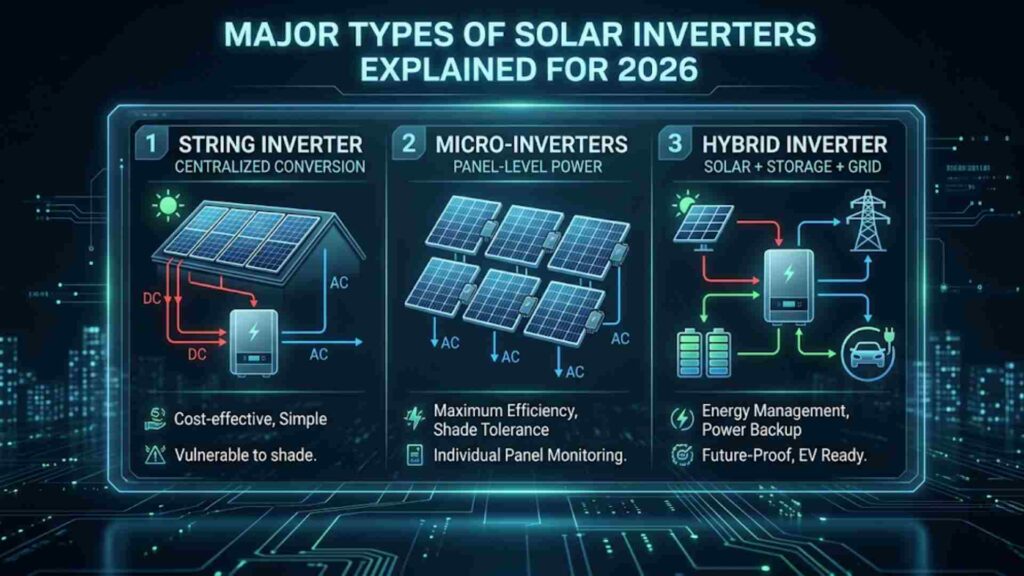
When evaluating solar technology today, the market is primarily divided into four categories. Each serves a different purpose based on your roof’s architecture, your budget, and whether you want to store energy for later use.
1. String Inverters: The Reliable Workhorse
Historically, string inverters have been the standard for residential installations. In this setup, several solar panels are connected in a “string,” and the DC power from all of them is sent to a single, central inverter usually mounted on a wall near your electrical meter.
- Best for: Homes with simple roof designs and no shading issues.
- Pros: Cost-effective, easy to maintain, and a proven track record of durability.
- Cons: If one panel in the string is shaded or underperforms, the output of the entire string drops.
2. Micro-Inverters: High Performance for Complex Roofs
When we look at types of solar inverters explained for maximum efficiency, micro-inverters stand at the top. Unlike string inverters, a micro-inverter is a small device installed under each individual solar panel. This means DC to AC conversion happens right at the panel level.
- Best for: Roofs with multiple angles (East-West facing) or significant shading from trees or nearby buildings.
- Pros: Individual panel monitoring, high efficiency in shade, and easy system expansion.
- Cons: Higher initial cost and more components installed on the roof.
3. Hybrid Inverters: The Future of Energy Independence
In 2026, the hybrid inverter has become the most sought-after technology. As the name suggests, it combines the functions of a traditional solar inverter and a battery inverter. It can manage power from your solar panels, your battery storage, and the utility grid simultaneously.
- Best for: Homeowners who want to include battery backup (like Lithium-ion storage) and want to be “future-proof.”
- Pros: Seamlessly switches between grid and battery, manages EV charging, and maximizes self-consumption.
- Cons: More expensive than standard string inverters.
4. Power Optimizers: The Hybrid Solution
Technically, power optimizers are “DC-to-DC” converters. They are used in conjunction with a string inverter. An optimizer is placed on each panel to “condition” the electricity before sending it to the central inverter. This provides many of the benefits of micro-inverters but at a slightly lower price point.
Choosing Based on Your Needs: Types of Solar Inverters Explained
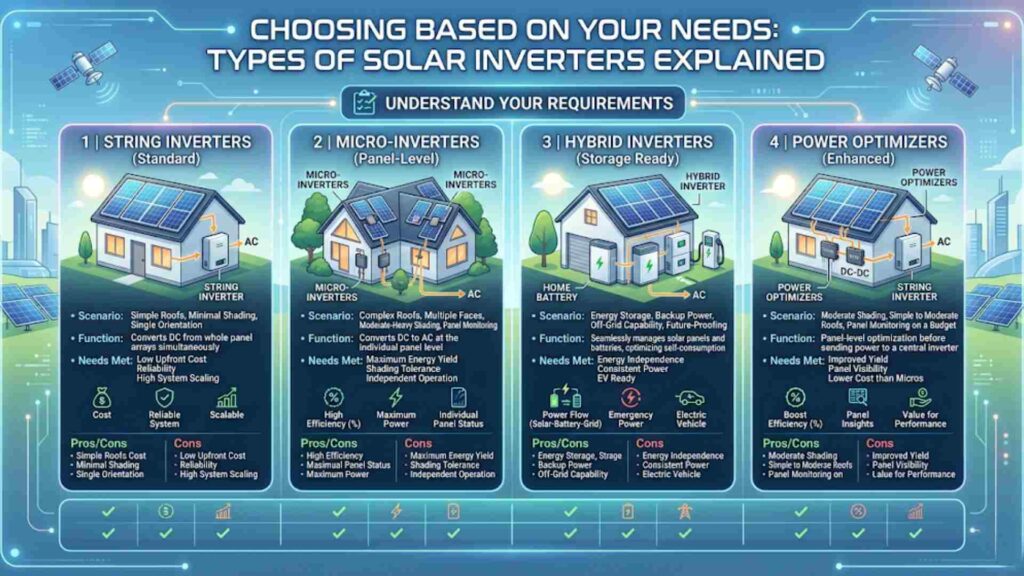
Selecting the right technology depends heavily on your specific requirements. In 2026, residential solar systems usually range from 3kW to 10kW. Let’s break down which inverter suits which scenario.
The Best Types of Solar Inverters Explained for 3kW to 5kW Systems
For a standard 3BHK house, a 3kW to 5kW system is usually sufficient to cover basic loads like lights, fans, and a refrigerator.
- If your roof is clear of shade, a High-Efficiency String Inverter with dual MPPT (Maximum Power Point Tracking) is the most logical financial choice.
- However, if you plan to add a battery in a year or two, starting with a Hybrid Inverter now will save you the cost of replacing the entire unit later.
Professional Considerations: Types of Solar Inverters Explained for 10kW+ Systems
Larger homes or small businesses with a 10kW load often deal with more complex power needs. Here, efficiency is paramount. Using Micro-Inverters or Power Optimizers ensures that even if a small section of a large array is blocked by a chimney or a water tank, the rest of the system produces at 100% capacity.
Furthermore, larger systems often benefit from Bifacial TOPCon modules, which generate power from both sides. Ensure your inverter is rated for the higher current (Amps) produced by these modern high-power modules.
Technical Comparison Table
To simplify your decision, here is a quick comparison of the primary inverter technologies available in the market today.
| Feature | String Inverter | Micro-Inverter | Hybrid Inverter | Power Optimizers |
| Typical Efficiency | 97% – 98% | 95% – 97% | 96% – 98% | 98% – 99% |
| Cost | Lowest | Highest | Mid-to-High | Mid-Range |
| Maintenance | Easy (Indoor/Eye-level) | Difficult (On-roof) | Easy (Indoor) | Moderate |
| Expansion | Limited | Very Easy | Easy | Moderate |
| Warranty | 5 to 12 Years | 15 to 25 Years | 10 to 15 Years | 20 to 25 Years |
| Battery Ready | No (Requires AC-coupling) | Possible | Yes (Native) | Depends on String Inverter |
Installation and Maintenance: Types of Solar Inverters Explained
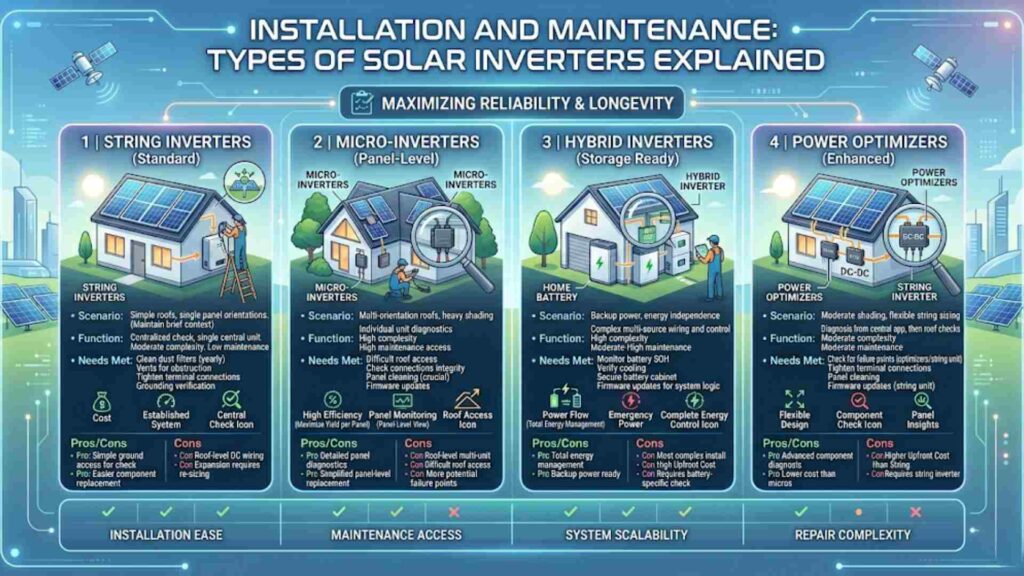
Correct installation is just as important as the hardware itself. In regions like Rajasthan and Gujarat, where temperatures can soar above 45°C, heat management is vital for inverter longevity.
Heat Dissipation and Placement
Even the best types of solar inverters explained in technical brochures will underperform if they overheat. Ensure your inverter is installed in a shaded, well-ventilated area. While most modern units are IP65 or IP66 rated (dust and water-resistant), keeping them out of direct sunlight prevents “thermal derating,” which is when the inverter limits its power output to protect its internal circuits from heat.
Monitoring and SEO-Ready Smart Features
Modern inverters now connect to your home Wi-Fi. You can track your daily generation, export to the grid, and even identify “green signals” of health for your system through mobile apps. In 2026, look for inverters that offer “OTA” (Over-The-Air) updates, allowing manufacturers to improve your inverter’s software without a technician visiting your home.
Financial Impact: Subsidies and ROI in 2026
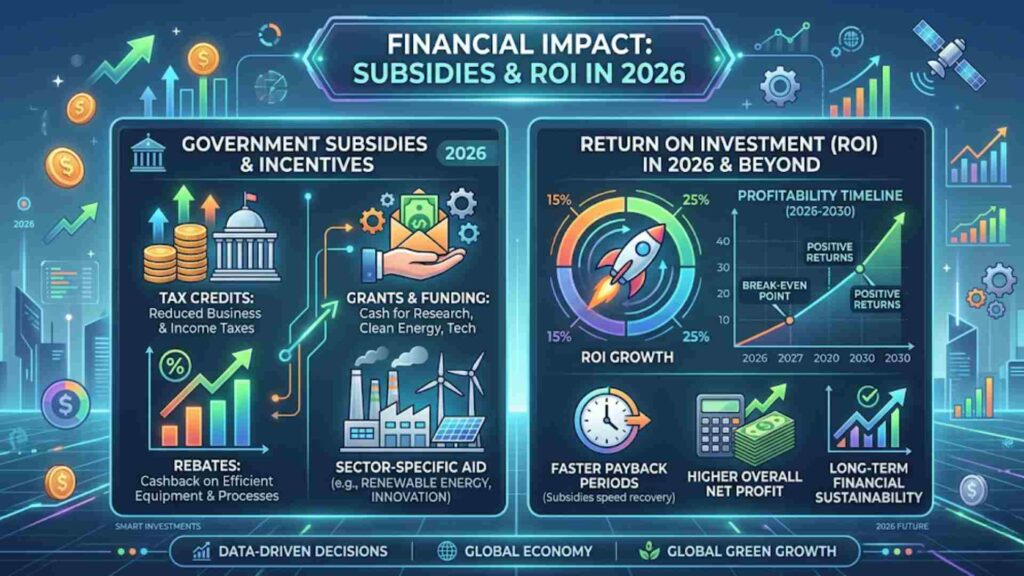
When discussing the types of solar inverters explained for Indian homeowners, we must mention the financial aspect. Government schemes like the PM Surya Ghar Muft Bijli Yojana have made solar incredibly affordable.
The choice of inverter directly affects your Return on Investment (ROI).
- String Inverters offer the fastest ROI (usually 3-4 years) because of their low initial cost.
- Hybrid Inverters might take 5-6 years for ROI, but they offer the added value of zero electricity bills even during night hours or power cuts.
Always ensure your inverter is on the ALMM (Approved List of Models and Manufacturers) to stay eligible for government subsidies and net-metering approvals.
Summary of Types of Solar Inverters Explained
Choosing an inverter is a balance between your current budget and your future energy goals. If you want the simplest, most affordable path to solar, the String Inverter is your best friend. If you have a complex roof or want the absolute best performance per square inch, Micro-inverters are the way to go. For those looking for total energy security and battery integration, the Hybrid Inverter is the gold standard of 2026.
Conclusion
In conclusion, having the various types of solar inverters explained allows you to look past the marketing jargon and focus on what matters: efficiency, reliability, and long-term savings. As solar technology continues to evolve in 2026, the inverter remains the heart of the system. By matching the right inverter type to your roof’s specific conditions and your family’s energy consumption patterns, you can ensure that your solar journey is both sustainable and highly profitable for decades to come.
FAQ: Frequently Asked Questions
Q1: What are the main types of solar inverters explained for residential use?
The four main types are String Inverters, Micro-Inverters, Hybrid Inverters, and Power Optimizers. String inverters are the most common, while Hybrids are best for battery storage.
Q2: How long does a solar inverter typically last?
String inverters usually last 10-15 years, while micro-inverters and power optimizers often come with warranties ranging from 20 to 25 years.
Q3: Can I upgrade my string inverter to a hybrid later?
Yes, but it is often more cost-effective to install a hybrid inverter from the start if you plan on adding batteries within 2-3 years. Alternatively, you can use “AC-coupling” to add batteries to an existing string system.
Q4: Which inverter is best for high-temperature areas like Rajasthan?
Inverters with robust heat sinks and high thermal derating thresholds are best. Look for brands that specialize in “tropicalized” designs for the Indian climate.